Tremella (Tremella fuciformis)
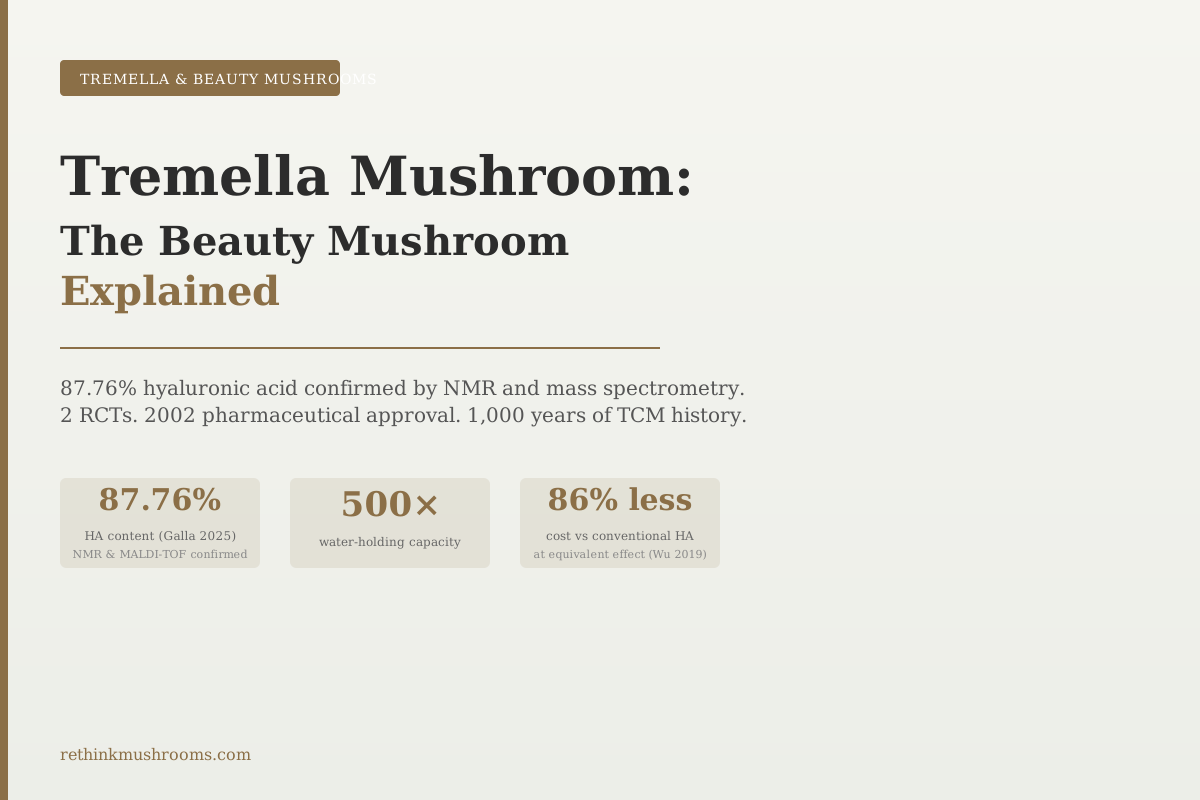
87.76% HA
A 2025 laboratory study confirmed Tremella extract contains 87.76% hyaluronic acid by mass, with molecular weight over 2,000 kDa, verified by NMR spectroscopy and MALDI-TOF mass spectrometry.
Galla et al., Foods, 2025
2 RCTs
published human trials on cognitive and blood sugar outcomes
500×
water-holding capacity of Tremella polysaccharides (Wu 2019)
2002
year China approved Tremella as a pharmaceutical drug (Yang 2019)
Galla et al., Foods, 2025
 View as image ↗
Tremella fuciformis, also called snow fungus or silver ear mushroom, is a gelatinous jelly fungus native to tropical and subtropical Asia. Its water-soluble polysaccharides behave as natural humectants with exceptional water-holding capacity, up to 500 times their weight in water, making it the world's best-studied mushroom for skin hydration applications.[1] What most people asking "what is tremella mushroom" do not expect is that a 2025 laboratory study confirmed Tremella extract contains 87.76% hyaluronic acid by mass, structurally verified by NMR spectroscopy, infrared analysis, and mass spectrometry.[5]
That is not a marketing claim. It is structural chemistry. The supplement industry's standard language that Tremella "acts like hyaluronic acid" turns out to be an understatement. The chemistry, the traditional history spanning over a millennium, and two published randomized controlled trials tell a more complete story than most Tremella coverage provides.
Key Takeaways
- Galla et al. (2025, Foods) confirmed Tremella extract contains 87.76% hyaluronic acid by mass with molecular weight over 2,000 kDa, verified by NMR spectroscopy and MALDI-TOF mass spectrometry.
- In UV-exposed human dermal fibroblasts, Tremella polysaccharides significantly increased collagen I, elastin, and hyaluronic acid production via the Nrf2/Keap1 antioxidant pathway (Fu et al., J Cosmet Dermatol, 2021).
- An 8-week double-blind RCT found that 600-1,200 mg/day of Tremella significantly improved subjective memory complaint scores compared to placebo in adults with mild cognitive concerns (Ban et al., J Med Food, 2018).
- A 12-week RCT in 56 overweight prediabetic adults found Tremella beverage improved HbA1c from 6.03% to 5.96% (p=0.047) and reduced waist circumference versus placebo (Gitsomboon et al., BMC Nutr, 2024).
- China's State Food and Drug Administration approved Tremella polysaccharide enteric-coated capsules as a pharmaceutical for chemotherapy-induced low white blood cell counts in 2002 (Yang et al., Prog Mol Biol Transl Sci, 2019).
- Dermatologists writing in Archives of Dermatological Research documented Tremella's roles in skin hydration, photoprotection, barrier support, and wound healing biology, while calling for more human clinical trials (Mineroff and Jagdeo, 2023).
Three Names for the Same Mushroom (And Why the Confusion Persists)
Tremella fuciformis goes by at least three common names in English-language commerce: Tremella mushroom, snow fungus, and silver ear mushroom. In China, it is called 银耳 (yín ěr, literally "silver ear"). In Japan, it is shiro kikurage. In Korean traditional medicine, it appears as baegmogyI. All refer to the same organism.
The confusion persists because TCM texts written across many centuries used regional Chinese names, Japanese supplement companies introduced their own trade names, and Western skincare brands coined "beauty mushroom" and "natural hyaluronic acid" marketing language independently. When researchers search for literature on this mushroom, they must check multiple name variants to capture the full body of evidence.
For taxonomic purposes, the correct scientific name is Tremella fuciformis Berk., assigned by the British botanist Miles Joseph Berkeley in 1856. The species belongs to the class Tremellomycetes, a group of jelly fungi whose fruiting bodies form translucent, frilly, ear-shaped clusters that expand and turn gelatinous when hydrated. The comparison to a white or silver ear is visually accurate.
The deeper history of Tremella in TCM, including the Tang Dynasty legend of imperial consort Yang Guifei crediting snow fungus for her complexion and the documented cultivation history beginning in Fujian province, is covered at Snow Fungus in Traditional Chinese Medicine: 1,000+ Years of Use.
The Chemistry That Sets Tremella Apart from Other Medicinal Mushrooms
Most medicinal mushrooms derive their primary bioactivity from beta-glucans: polysaccharides built from glucose units in specific branching patterns. Lion's Mane, Reishi, Maitake, and Chaga are all beta-glucan-dominant mushrooms.
Tremella is not. Its primary active compounds belong to a structurally distinct class called acidic glucuronoxylomannan polysaccharides. The difference is not just technical. These polysaccharides have a different backbone, a different electrical charge, and different behavior in water compared to beta-glucans. The backbone is built from alpha-mannose units linked in a specific pattern, with side branches of xylose and glucuronic acid attached at defined positions. The glucuronic acid groups carry a negative charge, which creates the anionic (negatively charged) properties of the whole molecule. That charge is what drives the exceptional capacity to attract and hold water.
Wu and colleagues' 2019 systematic review in the International Journal of Biological Macromolecules characterized the compositional range across multiple analyzed samples: mannose makes up 32-45% of the total sugar content, glucuronic acid 13-25%, fucose 13-20%, and xylose 15-18%.[1] The molecular weight range is wide across different preparations: from 8,000 Da at the lower end to 6,000,000 Da at the upper end, depending on extraction method and strain. Higher molecular weight fractions generally provide better surface film formation and more sustained water retention on skin.
The 86% cost reduction versus conventional hyaluronic acid that Wu 2019 calculated is a direct consequence of this structure: Tremella polysaccharides achieve equivalent moisturizing effect at a fraction of the material cost, which has attracted significant cosmetics industry interest beyond the traditional use context.[1]
For a detailed breakdown of the monosaccharide composition, acetylation properties, and why specific structural features determine biological activity, see Tremella Bioactive Compounds: Polysaccharides and Their Unique Properties.
Tremella's acidic glucuronoxylomannan structure also distinguishes it from Wood Ear mushroom (Auricularia auricula-judae), which uses a neutral heteropolysaccharide with a completely different branching architecture. For anyone comparing supplement options across related mushrooms, the structural comparison matters: see Wood Ear Bioactive Compounds: Polysaccharides, Melanin, and Minerals.
The 2025 Lab Study That Settled the Hyaluronic Acid Debate
Tremella has been marketed as "nature's hyaluronic acid" for years, and the claim was always approximately true but never precisely demonstrated. Tremella's acidic glucuronoxylomannan polysaccharides have similar water-binding properties to hyaluronic acid (HA), the compound produced naturally in human skin, joints, and connective tissue. The "similar to" framing was accurate but left the fundamental structural question unanswered.
In 2025, Galla and colleagues published a study in the journal Foods that subjected a Tremella fuciformis polysaccharide extract to the full battery of structural identification tools used to characterize pharmaceutical HA: attenuated total reflectance Fourier-transform infrared spectroscopy (ATR-FTIR), nuclear magnetic resonance spectroscopy (NMR), and matrix-assisted laser desorption ionization time-of-flight mass spectrometry (MALDI-TOF). In plain terms: they ran every standard structural test used to identify pharmaceutical-grade HA, and they ran them on Tremella extract.[5]
The conclusion was direct: the Tremella extract contained 87.76% hyaluronic acid by mass.
This is not a polysaccharide that behaves like HA. It is HA, confirmed by three independent structural techniques.
The molecular weight of the Tremella-derived HA exceeded 2,000 kDa. Molecular weight matters for skin applications because it determines where and how the compound functions. High-molecular-weight HA (above roughly 1,000 kDa) forms a film on the skin surface, providing cushioning and surface hydration. Low-molecular-weight HA (under 100 kDa) penetrates more deeply but can sometimes trigger different biological responses. Most conventional pharmaceutical HA comes from bacterial fermentation, and the resulting molecular weight varies by production method. Galla 2025 noted that the Tremella extraction method uniquely yields high-MW HA, which is a distinct advantage over some conventional sources.[5]
The cost calculation from Wu 2019 reinforces the industrial relevance: 86% lower cost than conventional HA for equivalent moisturizing effect, with a source that requires no animal material and scales through fungal cultivation rather than bacterial fermentation or animal processing.[1]
What Tremella Does to Skin Cells: Collagen, Elastin, and UV Protection
The HA structural story is one part of the skin science. The other part concerns collagen and elastin, the proteins that give skin its firmness and elasticity. UV radiation is one of the primary external drivers of collagen and elastin degradation. Unprotected UV exposure activates enzymes that break down these structural proteins and suppresses the cells that produce them.
Fu and colleagues published a 2021 study in the Journal of Cosmetic Dermatology testing Tremella polysaccharides on human dermal fibroblasts exposed to UVA radiation.[3] Fibroblasts are the cells in the deep layer of skin responsible for producing collagen, elastin, and HA. When exposed to UVA, they normally reduce their output of all three. Fu's group found that pre-treating fibroblasts with Tremella polysaccharide significantly reversed this suppression: collagen I production, elastin production, and HA content all increased significantly in Tremella-treated cells compared to UV-exposed controls.
The mechanism operated through the Nrf2/Keap1 pathway. This pathway is the cell's main response to oxidative stress. When Tremella polysaccharides activated it, the upregulation of protective antioxidant proteins preserved the fibroblasts' ability to synthesize structural proteins despite UVA exposure.[3]
This is in-vitro data, not clinical trial data. But it provides a specific molecular explanation for the skin effects attributed to Tremella, one that goes beyond surface hydration to protection of the underlying skin architecture.
Corroboration came from a 2024 comprehensive review of macrofungal cosmetics published in Nutrients, where Paterska and colleagues analyzed 52 publications on mushrooms in anti-aging cosmetics and identified Tremella fuciformis as a top-performing species across moisturizing effect, photoprotection, and collagen/elastin preservation criteria.[10]
The most credible third-party validation comes from the dermatology literature rather than from supplement sources. In 2023, Mineroff and Jagdeo published a review of Tremella's cutaneous benefits in Archives of Dermatological Research, a peer-reviewed journal read by practicing dermatologists. Their assessment after reviewing the published body of evidence: Tremella has documented roles in skin hydration, barrier support, photoprotection, and wound healing biology. They noted that the evidence is predominantly preclinical and called for human clinical trials to establish clinical protocols.[4]
Academic dermatologists writing in dermatology journals about a traditional mushroom is a signal worth noting. The compound has moved from supplement category into the range of topics that specialist physicians consider worth systematic review.
The full skin science, including the specific UV doses tested, the protein quantification data, and the beauty industry context, is covered at Tremella fuciformis: The Beauty Mushroom With Serious Science Behind It.
Two Randomized Controlled Trials: Cognition and Blood Sugar
The skin data dominates Tremella marketing. But two human clinical trials tested Tremella for effects that have nothing to do with topical skin application: one in adults with subjective memory concerns, one in people with prediabetes.
Ban 2018: The cognitive RCT
Ban and colleagues conducted an 8-week double-blind, placebo-controlled randomized trial published in the Journal of Medicinal Food.[6] Participants were adults who reported subjective cognitive complaints: the experience of noticing their memory is not as sharp as before, without a formal clinical diagnosis of cognitive impairment. Participants were randomized to 600 mg/day of Tremella extract, 1,200 mg/day, or placebo.
Both the 600 mg and 1,200 mg groups showed significantly greater improvement in subjective memory complaint scores than the placebo group at week 8. No serious adverse events occurred in either Tremella group. This was not a study of diagnosed dementia or mild cognitive impairment in a clinical sense. It targeted a self-reported experience of cognitive decline, which is a common and distinct population.
The laboratory science supporting this finding involves Tremella's ability to stimulate nerve cell growth. A 2013 study published in the Journal of Medicinal Food found that hot water extract of Tremella promoted neurite outgrowth in PC12h nerve cells at levels superior to other natural substances tested and significantly reduced beta-amyloid-induced cell death (p<0.01), with the effect pattern suggesting NGF-like (nerve growth factor-like) neurotrophic activity.[11] Neurites are the projections nerve cells extend to connect with other cells. Beta-amyloid is the protein fragment that accumulates in Alzheimer's disease and is toxic to neurons.
Gitsomboon 2024: The blood sugar RCT
Gitsomboon and colleagues published a 12-week double-blind, placebo-controlled RCT in BMC Nutrition testing a Tremella-based beverage in 56 overweight or obese adults with prediabetes, defined by HbA1c in the 5.7-6.4% range.[7] HbA1c is a measure of average blood sugar over the preceding 2-3 months. Improving it requires sustained metabolic change over the study period, not just short-term dietary adjustment.
At 12 weeks, the Tremella group showed a statistically significant reduction in HbA1c from 6.03% to 5.96% (p=0.047), while the placebo group showed no significant change. Waist circumference also decreased significantly in the Tremella group. No adverse events were reported.
A 0.07 percentage-point HbA1c change is modest relative to the 0.5-1.0+ percentage-point reductions typical in drug treatment of diabetes. But it represents a real metabolic signal in a prediabetic population from a food-derived product over 12 weeks, and in a condition where early intervention can prevent or delay progression to type 2 diabetes, directionally significant findings in at-risk populations are worth documenting.
One mechanism that may explain metabolic effects operates through gut bacteria. He and colleagues showed in a 2022 animal study that Tremella polysaccharides significantly reduced high-fat diet-induced weight gain and fat accumulation, decreased the ratio of unfavorable to beneficial gut bacteria (the Firmicutes/Bacteroidetes ratio), and produced downstream reductions in blood glucose and inflammatory markers through gut microbiota remodeling.[9] For broader context on how mushroom polysaccharides interact with gut bacteria, see Mushroom Polysaccharides and Microbiome Nourishment and Mushrooms as Prebiotics: How Fungal Polysaccharides Feed Beneficial Bacteria.
The Pharmaceutical Record Most Supplement Sites Never Mention
One of the more striking facts about Tremella is that its polysaccharides have been used as a regulated pharmaceutical drug, not just a dietary supplement, for over two decades.
In 2002, China's State Food and Drug Administration (now the National Medical Products Administration) approved Tremella fuciformis polysaccharide enteric-coated capsules as a pharmaceutical treatment for leukopenia, meaning abnormally low white blood cell counts caused by chemotherapy and radiation therapy.[2] Yang and colleagues' 2019 comprehensive review in Progress in Molecular Biology and Translational Science also noted its approved use as adjuvant therapy for hepatitis and mycoplasma pneumonia treatment in China.
The mechanism behind these immune applications involves the same polysaccharide structures that function as humectants in skin. At the immunological level, Tremella glucuronoxylomannan polysaccharides activate macrophages, T cells, B cells, and natural killer cells, stimulating the production of cytokines that support immune response. The anti-tumor and anti-infection effects documented in preclinical research operate through these pathways.[2]
The drug approval history does not mean that a Tremella supplement sold in Western markets is equivalent to the Chinese pharmaceutical preparation used in clinical settings. Pharmaceutical preparations are standardized to specific polysaccharide fractions, doses, and delivery forms. Commercial supplements are not. But the regulatory record does confirm that the biological activity of Tremella polysaccharides at the immune level is real enough that a national regulatory agency approved it for specific medical indications, something that most medicinal mushrooms cannot claim.
Brain Cells, NGF, and Beta-Amyloid: The Neuroprotective Laboratory Evidence
The Ban 2018 cognitive RCT showed a measurable effect in people with subjective memory concerns. The laboratory science behind that finding involves multiple pathways operating in nerve cells.
Park and colleagues' 2013 study in the Journal of Medicinal Food tested hot water extracts of Tremella on PC12h cells, a standard laboratory model for studying nerve cell behavior derived from rat adrenal tissue.[11] Two results from that study are relevant.
First, Tremella promoted neurite outgrowth at levels superior to other natural substances tested in parallel. Neurites are the projections nerve cells extend to connect with neighboring cells. They are the physical substrate of neural connectivity. Compounds that promote neurite growth are studied for potential roles in maintaining or recovering brain function.
Second, Tremella extract significantly reduced cell death caused by beta-amyloid peptide (p<0.01). Beta-amyloid is the protein fragment whose accumulation defines Alzheimer's disease at the pathological level. Its toxicity to neurons in culture is well established. Protection against beta-amyloid toxicity in a cell model is not evidence of Alzheimer's treatment effect in people. It does provide a biologically plausible mechanism that connects the mushroom's chemistry to a defined neurological threat.
Park's group described the pattern of effects as "NGF-like," meaning it resembles the action of nerve growth factor, a protein that supports neuron survival and growth during development and in response to injury. The label is a mechanistic description of observed effects, not a claim that Tremella contains NGF or works through identical signaling.
The complete pharmacological picture across all five mechanisms attributed to Tremella (skin, immune, brain, metabolic, antioxidant) is detailed at The Pharmacology of Tremella fuciformis: How It Works.
Why Strain and Quality Matter More Than the Label Suggests
Not all Tremella supplements contain the same thing. This gap between species name and actual bioactivity is a practical issue that affects how much published research applies to commercial products.
Han and colleagues published a 2015 study in the American Journal of Chinese Medicine comparing 12 different strains of Tremella fuciformis for immunomodulatory and anticancer activity.[8] The strains showed significantly varying potency. Some strains were highly active; others showed minimal biological activity. This variation occurred within the same species. A supplement label reading "Tremella fuciformis" does not specify which strain, and strain identity is not a standardized disclosure requirement in most markets.
Extraction conditions introduce a second variable. Research detailed in the bioactives article shows that specific structural features of Tremella polysaccharides, including the acetyl groups at particular positions on the sugar backbone, are essential for immune activity. Processing conditions that degrade these structural features can produce a material that retains moisturizing capacity but loses biological activity in immune assays. A Tremella supplement optimized for water retention in a cosmetic formulation may have different properties than one intended for systemic immune support.
No standardized commercial assay currently exists to test Tremella supplement polysaccharide profiles against the structural benchmarks established in published research. Consumers cannot currently verify that a given product's polysaccharide composition matches what was studied.
What Tremella Research Cannot Yet Prove: The Honest Assessment
The evidence for Tremella's skin effects is mechanistically credible and supported by a peer dermatology review, but it is predominantly in-vitro (cell culture) and animal research. There are no large-scale clinical trials testing Tremella topical formulations against placebo in human subjects measuring outcomes like skin hydration by probe, wrinkle depth by photography, or collagen density by biopsy. Mineroff and Jagdeo 2023, whose review represents the dermatology field's formal assessment, explicitly calls for such trials.[4]
The two human RCTs produce real findings, but both are single trials with limited sample sizes. The Gitsomboon 2024 prediabetes trial had 56 participants. The Ban 2018 cognitive trial did not report total sample size in the brief summary available. Single trials require replication before clinical conclusions are appropriate.
No head-to-head human clinical trial comparing Tremella to conventional hyaluronic acid for skin hydration has been conducted. The Galla 2025 structural study confirms chemical identity and molecular weight in a laboratory extract; it does not measure skin hydration outcomes in people.
The pharmaceutical approval in China is for systemic immune support in leukopenia. That indication does not transfer to the supplement category, to topical skin application, or to the cognitive and metabolic effects tested in the two RCTs.
Tremella's evidence profile is stronger relative to most medicinal mushrooms marketed for skin benefits. But strength is relative. The compound has plausible mechanisms, promising preclinical data, and two supporting clinical trials. It does not yet have the large, replicated Phase 2/3 trial record that evidence-based medicine uses to establish clinical recommendations.
The Bottom Line
Tremella fuciformis (snow fungus) is a gelatinous jelly mushroom with over a thousand years of TCM use and a growing body of modern laboratory and clinical research. Its primary compounds are acidic glucuronoxylomannan polysaccharides, confirmed in 2025 to contain 87.76% hyaluronic acid by mass at molecular weight over 2,000 kDa. Laboratory studies show protection of skin cells from UV damage, stimulation of collagen and elastin synthesis, and nerve cell-protective properties. Two human RCTs found significant effects on subjective memory complaints and HbA1c in prediabetic adults. China approved Tremella polysaccharides as a pharmaceutical for chemotherapy-induced leukopenia in 2002. Most skin and brain evidence remains preclinical; large-scale human clinical trials for dermatological or cognitive applications have not yet been conducted.
Frequently Asked Questions
Sources & References
- 1. Source details for this reference are not yet available.
- 2. Source details for this reference are not yet available.
- 3. Source details for this reference are not yet available.
- 4. Source details for this reference are not yet available.
- 5. Source details for this reference are not yet available.
- 6. Source details for this reference are not yet available.
- 7. Source details for this reference are not yet available.
- 8. Source details for this reference are not yet available.
- 9. Source details for this reference are not yet available.
- 10. Source details for this reference are not yet available.
- 11. Source details for this reference are not yet available.