Wood Ear Mushroom
~160 kDa acidic polysaccharide whose anticoagulant activity runs through antithrombin — the same clot-regulating protein that heparin activates
A 2003 study isolated an acidic polysaccharide from wood ear and showed its anticoagulant activity works by catalyzing thrombin inhibition through antithrombin — not by directly blocking clotting enzymes. The glucuronic acid residues were essential to the effect.
Yoon et al., Thrombosis Research, 2003
up to 788 mg/kg
iron in the highest Auricularia cornea strains — among the highest recorded for edible mushrooms
eumelanin
wood ear's dark pigment is chemically the same broad class as skin melanin, with hepatoprotective activity in mice
M2 → M1
crude polysaccharide repolarized macrophages toward an anti-tumor state in a 2024 breast-cancer cell study
Yoon et al., Thrombosis Research, 2003
 View as image ↗
Most people who cook with wood ear mushroom are thinking about texture and tradition, not biochemistry. But the compound profile of Auricularia auricula-judae is unusual enough that three independent lines of research — on polysaccharides, on the mushroom's melanin pigment, and on its mineral content — have each produced findings worth understanding on their own terms. For a broader introduction to wood ear, its history, and its traditional uses, see what is wood ear mushroom: the ancient blood health mushroom.
Wood ear mushroom bioactive compounds fall into three families. The polysaccharides are the dominant bioactive constituent, and a 2024 review established that their biological activity is tightly tied to their chemical structure — different extraction methods and source materials yield structurally different polysaccharides with different effects.[1] The melanin, contrary to a common assumption that fungal pigments are chemically exotic, is characterized in most studies as a eumelanin — the same broad pigment class found in human skin — and it shows hepatoprotective and antioxidant activity in animal models. And the mineral content, particularly iron, is unusually high, and part of it can be bound into a polysaccharide-iron complex that has been tested as an iron supplement.
Key Takeaways
- A 2024 review found that the biological activity of wood ear (Auricularia auricula) polysaccharides is determined by their chemical structure — spanning antitumor, hypoglycemic, antioxidant, and immune-regulating effects — with different sources and extraction methods producing different structures and activities (Tang et al., International Journal of Biological Macromolecules, 2024)
- The anticoagulant polysaccharide fraction works by catalyzing thrombin inhibition through antithrombin — the same regulatory protein activated by heparin — and not through heparin cofactor II; its glucuronic acid (uronic acid) residues are essential, and it contains no sulfate esters (Yoon et al., Thrombosis Research, 2003)
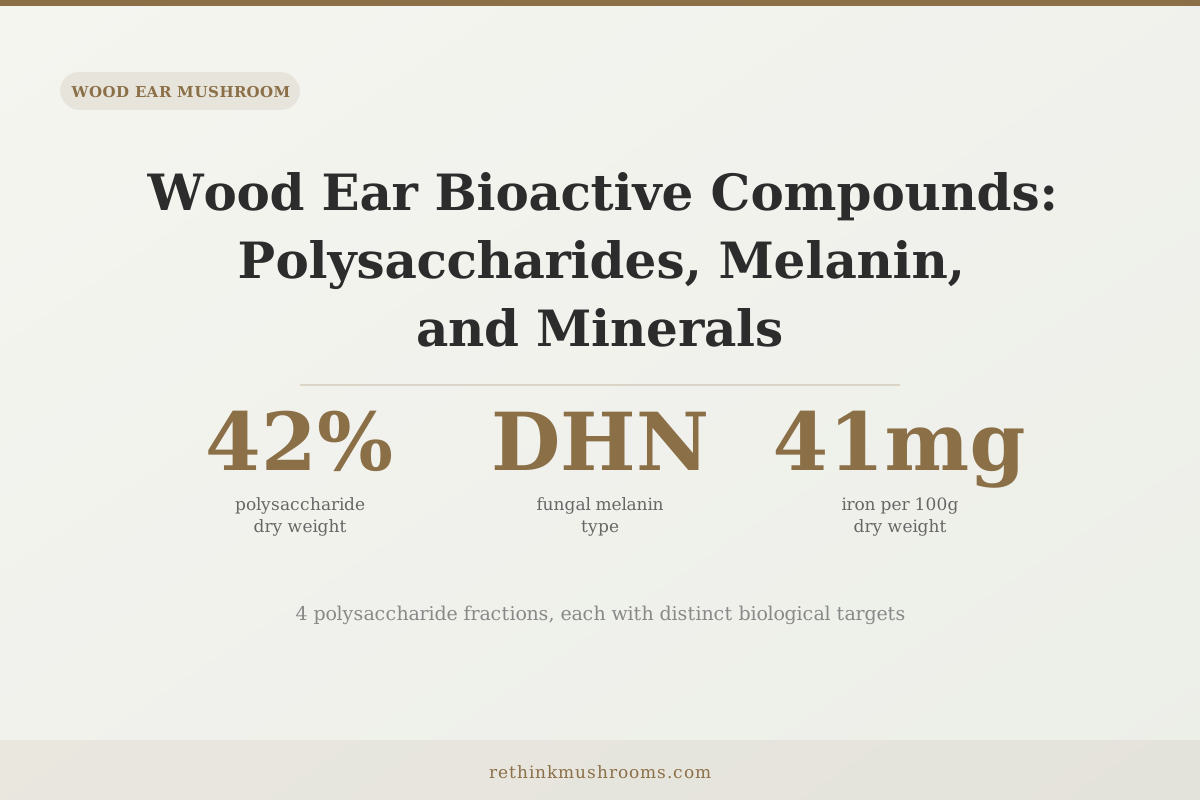
- Wood ear melanin is characterized in multiple studies as a eumelanin — a 5,6-dihydroxyindole polymer of the same broad class as human skin melanin, produced through a tyrosine-dependent pathway — though one 2022 study found the pigment is actually a mixture of eumelanin, pheomelanin, and 1,8-dihydroxynaphthalene (DHN) melanin (Sun et al., Food Chemistry, 2016; Ma et al., Journal of Basic Microbiology, 2022)
- Wood ear melanin protected mice against acute alcohol-induced liver injury, significantly lowering the liver-damage markers ALT, AST, and γ-GT while raising the antioxidant enzymes SOD and CAT, through activation of the Nrf2 pathway (Hou et al., Food & Function, 2019)
- Profiled Auricularia cornea strains reached iron levels up to 788 mg/kg dry weight — among the highest in edible mushrooms — and a separate study built a polysaccharide-iron(III) complex from wood ear that treated iron-deficiency anemia in a rat model (Khan et al., Frontiers in Nutrition, 2023; Liu et al., BioMed Research International, 2019)
- Wood ear polysaccharides improved glucose control in diabetic mice and reshaped their gut microbiota — decreasing Firmicutes and increasing Bacteroidetes, with more Faecalibaculum, Dubosiella, Alloprevotella, and Lachnospiraceae and fewer Desulfovibrio, Enterorhabdus, and Helicobacter (Liu et al., Molecules, 2022)
The Three Bioactive Families: An Overview
Before going deep on each, it helps to see the compound profile as a whole. The table below summarizes what the studies cited throughout this article actually measured.
| Compound Family | Measured content | Structure | Key Linked Activities |
|---|---|---|---|
| Polysaccharides | dominant bioactive fraction; up to ~216 mg/g total in profiled A. cornea fruiting bodies | acidic/uronic-acid-rich and other fractions; structure-dependent activity | Anticoagulation, immunomodulation, blood glucose, gut microbiota |
| Melanin | present in the dark outer layer; molecular weight ~49 kDa | eumelanin (5,6-dihydroxyindole polymer), with pheomelanin and DHN components reported | Antioxidant, hepatoprotection |
| Iron (mineral) | up to 788 mg/kg dry weight across A. cornea strains | free form, plus a polysaccharide-iron(III) complex | Iron supplementation (anemia model) |
| Zinc (mineral) | up to 486 mg/kg dry weight (A. cornea) | free ionic form | Trace mineral |
Two things stand out. First, polysaccharides are the workhorse: the same broad class of molecule underlies wood ear's anticoagulant, immune, blood-sugar, and gut effects, with the specific structure determining which effect dominates. Second, the mineral content — iron especially — is high, and at least a portion of it can be delivered in a polysaccharide-bound form that has been studied specifically as a supplement. Both are covered in detail below.
Polysaccharides: Structure Determines What They Do
Wood ear polysaccharides are not a single compound. They are a family of structurally different polymers, and the difference matters. Tang and colleagues published a 2024 review of the structure-activity relationships of Auricularia auricula polysaccharides.[1] The central point: because polysaccharides extracted by different methods and from different source material differ in their chemical structure, they differ in bioactivity — and the documented activities span antitumor, hypoglycemic, antioxidant, and immune-regulating effects.
That framework explains a puzzle that confused early researchers: how can a single mushroom show anticoagulant effects, immune effects, blood sugar effects, and gut effects at once? The answer is that structurally distinct polysaccharide fractions are doing different things, potentially in different parts of the body. The rest of this section walks through the specific fractions that individual studies have isolated and characterized.
The acidic, uronic-acid-rich fraction is the anticoagulant one. Its activity depends on glucuronic acid residues, and it works through antithrombin (detailed in the next section).
The immune-active fraction interacts with receptors on immune cells such as macrophages, shifting their behavior toward a more inflammatory, anti-tumor state.
The hypoglycemic, water-soluble fraction lowers blood glucose in diabetic animal models — an effect first documented in the late 1990s.
The gut-active fraction reaches the colon and reshapes the microbiota, which appears to be one mechanism behind the metabolic effects.
Each of these is grounded in a specific study, covered below.
The Anticoagulant Mechanism: Not What You'd Expect
The traditional use of wood ear mushroom for blood health in Chinese medicine has a specific biochemical explanation. It is not, as many people assume, a direct effect on blood vessel walls or clotting enzymes. The mechanism runs through a blood protein called antithrombin.
Yoon and colleagues isolated the anticoagulant polysaccharide fraction from wood ear and tested its mechanism directly.[2] The purified acidic polysaccharide — roughly 160 kDa, containing mannose, glucose, glucuronic acid, and xylose, but no sulfate esters — did not block thrombin on its own. What it did was catalyze thrombin inhibition by antithrombin, the body's natural clot-inhibiting protein, and specifically through antithrombin rather than the alternative regulator heparin cofactor II. By making antithrombin more effective, the polysaccharide amplified the body's existing anticoagulant system. This is the same regulatory protein that heparin — one of the most widely used medical anticoagulants — activates. Critically, the glucuronic acid residues were essential: chemically reducing their carboxyl groups abolished the activity. In ex vivo tests, rats fed the polysaccharide showed reduced platelet aggregation, comparable to the antiplatelet agent aspirin.
This matters for two reasons. First, it explains why the traditional food use makes pharmacological sense: potentiating your own antithrombin system is a fundamentally different mechanism from directly blocking coagulation enzymes. Second, it offers a plausible reason why culinary-dose use produced effects worth noting across generations.
Bian and colleagues later characterized an acidic polysaccharide fraction extracted by ultrasound-assisted methods and confirmed the anticoagulant activity using standard clinical coagulation tests.[3] The purified acidic fraction prolonged activated partial thromboplastin time (APTT), prothrombin time (PT), and thrombin time (TT) — indicating activity across both the intrinsic and extrinsic coagulation pathways. Like the earlier work, the fraction was rich in glucuronic acid, reinforcing that the uronic acid content is a structural determinant of the effect.
This article is educational and not medical advice. Because wood ear polysaccharides act on the same antithrombin pathway as anticoagulant medications, anyone taking blood thinners, awaiting surgery, or managing a bleeding disorder should consult a clinician before adding wood ear as a regular part of their diet or taking concentrated extracts. All of the findings below come from laboratory and animal studies, not human clinical trials.
For a full review of the blood health evidence, see wood ear and blood health: anti-coagulant research.
Immune Activity: Macrophage Polarization
A separate polysaccharide fraction of wood ear operates through the immune system rather than the coagulation pathway. Instead of affecting clotting, it interacts with immune cells.
Nilkhet and colleagues worked with Auricularia polytricha (the cloud ear variant of wood ear) and found that its crude polysaccharide fraction caused macrophages to switch from the M2 phenotype toward the M1 phenotype.[4] This distinction matters. In the tumor microenvironment, M2-like tumor-associated macrophages tend to promote cancer progression, while M1-like macrophages display anti-tumor activity. The M1-polarized macrophages in this 2024 study acted against human breast cancer cells in culture.
This is preclinical cell culture data, not clinical evidence. But it provides a specific mechanism linking the polysaccharide to the immune effects that earlier studies had observed without fully explaining.
For broader context on how polysaccharides across multiple mushroom species interact with the gut microbiome, see mushroom polysaccharides and microbiome nourishment.
Blood Sugar and the Gut: Two More Applications
Two additional polysaccharide activities — blood glucose regulation and effects on the gut microbiota — run largely separately from anticoagulation and immunity.
Yuan and colleagues demonstrated hypoglycemic activity in 1998 using genetically diabetic KK-Ay mice, a standard research model for type 2 diabetes.[5] A water-soluble polysaccharide fraction fed to the mice significantly reduced blood glucose. This was an early study — small and limited to animals — but it established the observation that has driven follow-up research since.
More recently, Liu and colleagues found a mechanism tied to the gut.[6] In diabetic mice, wood ear polysaccharides lowered fasting blood glucose and improved glucose tolerance while reshaping the gut microbiota: the abundance of Firmicutes fell and Bacteroidetes rose, beneficial genera including Faecalibaculum, Dubosiella, Alloprevotella, and members of the Lachnospiraceae family increased, and Desulfovibrio, Enterorhabdus, and Helicobacter decreased. The polysaccharides also boosted antioxidant enzymes (SOD, CAT, GSH-Px) and lowered the oxidative-stress marker MDA. The picture points to the gut microbiota as a plausible route for the metabolic benefits — rather than direct action on blood glucose.
Wood Ear Melanin: Closer to Skin Pigment Than You'd Think
A common assumption is that a fungal pigment must be chemically exotic — something unlike the melanin in human skin. For wood ear, the research points mostly the other way.
Sun and colleagues carried out a detailed characterization of Auricularia auricula melanin and identified it as a eumelanin — a macromolecular polymer of 5,6-dihydroxyindole and 5,6-dihydroxyindole-2-carboxylic acid.[7] That is the same broad pigment class as the eumelanin in human skin. Consistent with this, the study found that removing tyrosine from the growth medium sharply reduced melanin secretion — a signature of a tyrosine-dependent (Raper-Mason) pathway, the same starting material and route as animal eumelanin.
The picture is not entirely one-to-one, though. Ma and colleagues mapped the biosynthetic pathways in a 2022 study and found that wood ear melanin is actually a mixture: eumelanin, pheomelanin, and 1,8-dihydroxynaphthalene (DHN) melanin, produced via both the Raper-Mason pathway and the fungal DHN pathway.[8] So wood ear shares the eumelanin and pheomelanin chemistry of animal pigments, plus a fungal DHN component that animals do not make.
The practical implication cuts against overstated health claims in both directions: wood ear melanin is not a mysterious fungus-only molecule, but it is also not identical to skin melanin. It is best described as a predominantly eumelanin pigment with an added fungal component, and its health effects should be judged on the animal-model evidence rather than on analogies to skin pigment.
What Wood Ear Melanin Does: Liver Protection and Antioxidant Activity
The hepatoprotective finding is the strongest activity evidence for wood ear melanin.
Hou and colleagues administered wood ear melanin to mice with acute alcohol-induced liver injury — a standard model for liver-protective compounds — for three weeks before the injury.[9] They characterized the melanin as a eumelanin with an average molecular weight of about 49 kDa. Liver damage was quantified by measuring ALT, AST, and γ-GT (enzymes that leak from damaged liver cells) alongside liver MDA. The melanin significantly lowered all of these markers, and histology showed reduced liver injury. At the same time, the liver's own antioxidant enzymes — SOD, CAT — and alcohol dehydrogenase increased. The proposed mechanism runs through activation of the Nrf2 transcription factor and its downstream antioxidant genes (GCLC, GCLM, NQO-1), combining direct radical scavenging with upregulation of the body's antioxidant defenses.
On pure antioxidant measurements, Yin and colleagues studied melanin isolated from wild wood ear using an ultra-high-pressure extraction method.[10] The wild melanin was amorphous, stable to heat, light, and low concentrations of reducing and oxidizing agents, and — by its elemental profile — likely a 3,4-dihydroxyphenylalanine (DOPA-type) melanin, again pointing to the eumelanin family. It showed free-radical scavenging activity in cell-free assays; context matters, because those assays measure chemistry in a tube rather than absorption in a body.
Shi and colleagues developed a more efficient isolation method in 2023, using ultrasound-assisted alkaline cellulase and a deep eutectic solvent to break the tough cell wall, raising melanin yield substantially.[11] The resulting melanin showed concentration-dependent ABTS and hydroxyl-radical scavenging, and in a living model — the roundworm Caenorhabditis elegans — it prolonged survival under oxidative stress and raised in-vivo glutathione, SOD, and CAT activity. This moves the antioxidant evidence one step beyond the cell-free assays, into a whole organism.
For a complete treatment of the melanin antioxidant evidence, see wood ear and antioxidant activity: melanin research.
Iron, Zinc, and the Mineral Story
Wood ear's mineral content is where the gap between the mushroom's reputation and its documented data is widest. Most sources note simply that wood ear is "high in iron." The measured data is more specific.
Khan and colleagues profiled 50 strains of Auricularia cornea, a closely related Auricularia species, for nutritional composition and antioxidant activity.[12] Iron content varied widely by strain, reaching up to 788 mg/kg dry weight in the highest strain and around 350 mg/kg in another — among the higher values recorded for edible mushrooms. Zinc reached up to 486 mg/kg. Crude polysaccharide content ran as high as 15.6%, with total polysaccharide up to 216 mg/g of dry fruiting body, and the crude polysaccharides showed significant antioxidant (DPPH and ABTS) activity.
The iron figure warrants comparison. Spinach, often cited as a high-iron plant food, contains roughly 2.7 mg of iron per 100g fresh weight — about 30 mg per 100g once you correct for its high water content. The highest-iron wood ear strains, at up to ~79 mg per 100g dry weight, come in well above that on a dry-weight basis, though the exact figure depends heavily on strain and species.
Beyond the raw amount, Liu and colleagues showed that wood ear iron can be delivered in a bound form.[13] They prepared a polysaccharide-iron(III) complex from wood ear polysaccharides with an iron content around 28%, characterized as stable and water-soluble, with the iron released under simulated gastrointestinal conditions. The complex showed antioxidant activity in vitro — an advantage over typical non-antioxidant iron supplements — and, most importantly, treated iron-deficiency anemia effectively in a rat model. This connects two otherwise separate lines of research: the polysaccharide chemistry, which makes a good mineral-binding matrix, and the iron nutritional data. For a dedicated look at the iron data and its dietary context, see wood ear and iron: one of the best plant sources.
Calcium and Bone: The Protein Side of the Story
Wood ear's bone-related bioactivity comes from a part of the mushroom that gets less attention: the proteins.
Qu and colleagues prepared a peptide-calcium complex from wood ear — calcium bound to short protein fragments produced by enzymatic digestion — and tested it in a mouse model of disuse osteoporosis (bone loss from immobility, relevant to bedridden patients and astronauts).[14] Conventional calcium-carbonate supplements are poorly absorbed; the peptide-calcium complex was designed to address that. In the model, the complex suppressed disuse-induced bone loss and downregulated bone-resorption inflammatory genes — interleukin-1, TNF-α, and IL-6 fell by roughly 60%, 48%, and 40% respectively — positioning the complex as a candidate to reduce disuse osteoporosis risk.
More recently, Kim and colleagues found that a wood ear water extract exerts a biphasic effect on bone cells: it inhibited RANKL-induced osteoclast differentiation (the cells that break bone down) while enhancing BMP-2-stimulated osteoblast differentiation (the cells that build bone up).[15] Mechanistically, it suppressed osteoclast formation by inhibiting c-Fos/NFATc1 signaling downstream of ERK and JNK, and it strengthened bone formation through Runx2 and Smad activation. The RANKL pathway it targets is the same one addressed by pharmaceutical bone drugs such as denosumab. Together, the two studies suggest wood ear may support bone through both better mineral delivery and direct modulation of the bone-remodeling machinery.
Both bone studies are preclinical. Neither establishes the doses needed in humans, or whether the mouse and cell-culture effects translate to human bone health. They do provide mechanistic detail that contextualizes the traditional use of wood ear in bone-health preparations in parts of Asia.
For context on how wood ear's polysaccharide mechanism differs from the triterpene-based mechanism of reishi and other medicinal mushrooms, see triterpenes vs. polysaccharides: different anti-inflammatory pathways.
The Bottom Line
Wood ear mushroom's bioactive profile centers on three families. Its polysaccharides are the dominant bioactive fraction, and a 2024 review shows their effects — antitumor, hypoglycemic, antioxidant, and immune-regulating — are determined by chemical structure: an acidic, glucuronic-acid-rich fraction inhibits coagulation by potentiating antithrombin (the same protein heparin activates), a crude polysaccharide fraction repolarizes macrophages toward an anti-tumor M1 state, and other fractions lower blood glucose and reshape the gut microbiota. Its melanin, contrary to the assumption that fungal pigments are exotic, is characterized mostly as a eumelanin — the same broad class as human skin melanin, made through a tyrosine-dependent pathway — with one study finding it is actually a mixture of eumelanin, pheomelanin, and DHN melanin; it shows hepatoprotective and antioxidant activity in animal models. Its iron content is high (up to ~788 mg/kg dry weight in profiled Auricularia cornea strains), and a polysaccharide-iron(III) complex made from wood ear treated iron-deficiency anemia in rats. All of this evidence is preclinical; no human clinical trials have tested these specific fractions at food-relevant doses.
Frequently Asked Questions
Sources & References
- 1RTHM-00913·Tang, Jun et al. (2024). “Structural properties, bioactivities, structure-activity relationships and bio-applications of polysaccharides from Auricularia auricula: A review..” International journal of biological macromolecules.Study breakdown →PubMed →↩
- 2RTHM-00065·Yoon, Seon-Joo et al. (2003). “The nontoxic mushroom Auricularia auricula contains a polysaccharide with anticoagulant activity mediated by antithrombin..” Thrombosis research.Study breakdown →PubMed →↩
- 3RTHM-00609·Bian, Chun et al. (2020). “Extraction Optimization, Structural Characterization, and Anticoagulant Activity of Acidic Polysaccharides from Auricularia auricula-judae..” Molecules (Basel.Study breakdown →PubMed →↩
- 4RTHM-00897·Nilkhet, Sunita et al. (2024). “M1 macrophages polarized by crude polysaccharides isolated from Auricularia polytricha exhibit anti-tumor effect on human breast cancer cells..” Scientific reports.Study breakdown →PubMed →↩
- 5RTHM-00028·Yuan, Z et al. (1998). “Hypoglycemic effect of water-soluble polysaccharide from Auricularia auricula-judae Quel. on genetically diabetic KK-Ay mice..” Bioscience.Study breakdown →PubMed →↩
- 6RTHM-00780·Liu, Nannan et al. (2022). “Effects of Auricularia auricula Polysaccharides on Gut Microbiota Composition in Type 2 Diabetic Mice..” Molecules (Basel.Study breakdown →PubMed →↩
- 7RTHM-00449·Sun, Shujing et al. (2016). “Production of natural melanin by Auricularia auricula and study on its molecular structure..” Food chemistry.Study breakdown →PubMed →↩
- 8RTHM-00784·Ma, Zihui et al. (2022). “Studies on the biosynthetic pathways of melanin in Auricularia auricula..” Journal of basic microbiology.Study breakdown →PubMed →↩
- 9RTHM-00559·Hou, Ruolin et al. (2019). “Characterization of natural melanin from Auricularia auricula and its hepatoprotective effect on acute alcohol liver injury in mice..” Food & function.Study breakdown →PubMed →↩
- 10RTHM-00806·Yin, Chao-Min et al. (2022). “Physicochemical Properties and Antioxidant Activity of Natural Melanin Extracted from the Wild Wood Ear Mushroom, Auricularia auricula (Agaricomycetes)..” International journal of medicinal mushrooms.Study breakdown →PubMed →↩
- 11RTHM-00851·Shi, Qianwen et al. (2023). “Isolation, Characterization, and Antioxidant Activity of Melanin from Auricularia auricula (Agaricomycetes)..” International journal of medicinal mushrooms.Study breakdown →PubMed →↩
- 12RTHM-00835·Khan, Asif Ali et al. (2023). “Characterization, antioxidant activity, and mineral profiling of Auricularia cornea mushroom strains..” Frontiers in nutrition.Study breakdown →PubMed →↩
- 13RTHM-00574·Liu, Tong et al. (2019). “Preparation and Characterization of a Novel Polysaccharide-Iron(III) Complex in Auricularia auricula Potentially Used as an Iron Supplement..” BioMed research international.Study breakdown →PubMed →↩
- 14RTHM-00584·Qu, Hang et al. (2019). “Anti-Disuse Osteoporosis Activity of a Complex of Calcium-Binding Peptide from Auricularia auricula Protein Hydrolysates..” Journal of food science.Study breakdown →PubMed →↩
- 15RTHM-00885·Kim, Shin-Hye et al. (2024). “The Biphasic Activity of Auricularia Auricula-Judae Extract on Bone Homeostasis through Inhibition of Osteoclastogenesis and Modulation of Osteogenic Activity..” Journal of microbiology and biotechnology.Study breakdown →PubMed →↩