Wood Ear Mushroom
788 mg/kg peak iron, dry weight
Wood ear is unusually iron-dense, and its polysaccharides slow blood clotting through antithrombin — the same protein heparin recruits, though by a narrower route than heparin uses.
Khan et al., Frontiers in Nutrition, 2023
Beat aspirin
highest antiplatelet inhibition of eight edible species screened in vitro, exceeding 140 µmol/L ASA in the ADP test
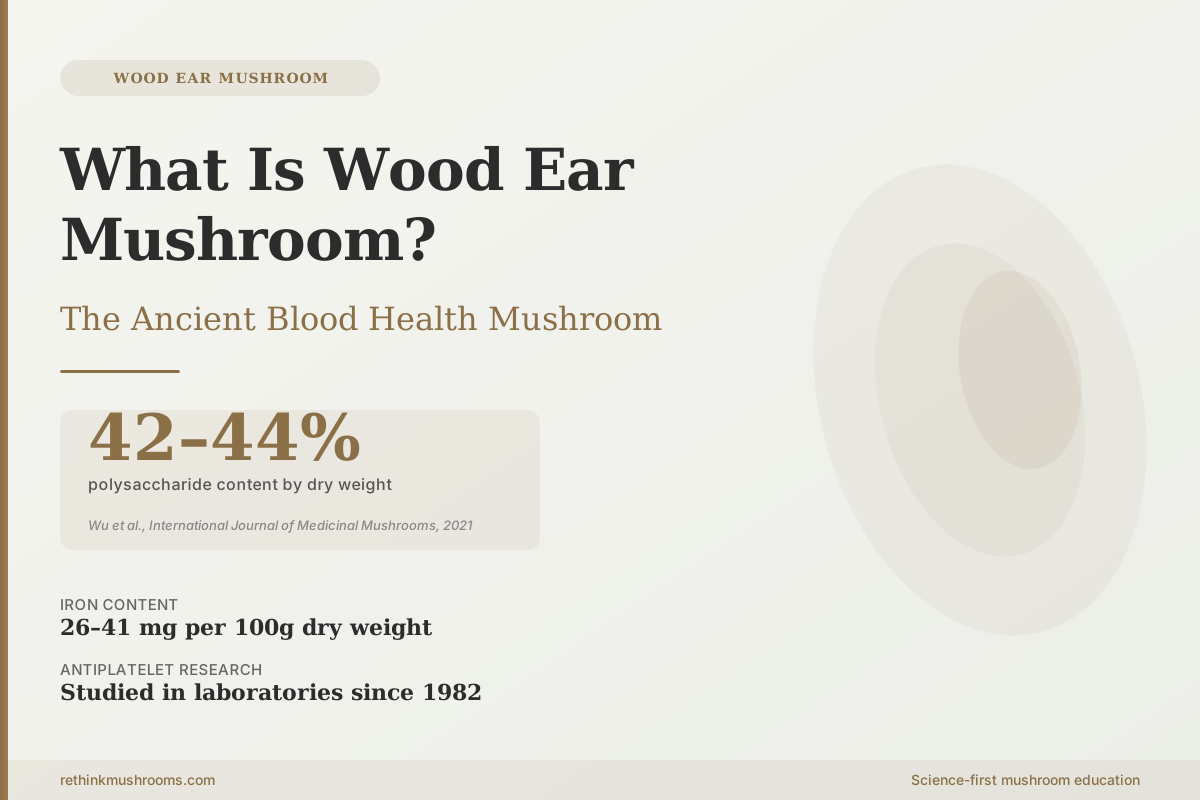
Since 1982
platelet aggregation inhibition documented in human and rat blood
0 trials
no human clinical trial has tested any of these effects
Khan et al., Frontiers in Nutrition, 2023
 View as image ↗
In 2003, a team publishing in Thrombosis Research isolated the polysaccharide in wood ear mushroom that slows blood clotting, and identified the protein it works through: antithrombin, the same blood component that heparin recruits.[4] Heparin is one of the oldest and most widely used anticoagulant drugs in clinical medicine. Wood ear (Auricularia auricula-judae) is a jelly fungus that has been eaten in Chinese soups, salads, and stir-fries for thousands of years.[19]
That overlap is the foundation of the mushroom's "blood health" reputation across East Asian medicine, and it is real. It is also narrower than it is usually reported to be. The same paper that found the antithrombin effect also found what the mushroom polysaccharide does not do: it does not help antithrombin shut down Factor Xa, it does not work through heparin cofactor II, and it contains no sulfate esters — the chemical feature heparin's entire activity depends on.[4] Same protein, different molecule, partly overlapping mechanism.
The research on wood ear is deeper than most sources acknowledge, and more frequently misquoted. Laboratory work going back to 1982 established the antiplatelet effect in human and rat blood.[1] Animal studies have since documented cholesterol-lowering, blood sugar-lowering, and gut microbiota-reshaping effects. A 2024 review pulled the structural chemistry together.[19] And a 2025 study on liver fibrosis used antibiotic ablation to show the liver benefit actually depends on gut bacteria.[20]
This article covers what wood ear is, how to distinguish it from cloud ear and black fungus, what its main compounds do, and what the evidence currently shows across blood health, metabolism, gut function, and immunity — including where the widely repeated numbers come from and which ones do not survive checking.
Key Takeaways
- Wood ear polysaccharides slow clotting by helping antithrombin inactivate thrombin — heparin's protein, but not heparin's full mechanism: Factor Xa inhibition is not accelerated and the molecule carries no sulfate esters — Yoon et al., Thrombosis Research, 2003
- Screened against seven other edible mushrooms and a reference dose of aspirin, wood ear showed the strongest antiplatelet effect, exceeding 140 µmol/L ASA in the ADP test — yet no extract shifted prothrombin time or INR — Poniedziałek et al., Nutrients, 2019
- Iron reached 788 mg/kg dry weight in the best of 50 Auricularia cornea strains, roughly 35–79 mg per 100 g dried across the top strains — Khan et al., Frontiers in Nutrition, 2023
- In mice on a cholesterol-enriched diet, wood ear polysaccharide lowered total and LDL cholesterol and raised lipoprotein lipase activity — but did not significantly move triglycerides or HDL — Chen et al., Journal of Food Science, 2008
- Three gut-liver studies from 2022 to 2025 all point the same direction, but share no common bacterial genus; the 2025 fibrosis study removed the microbiota with antibiotics and lost the protection — Zhang et al., Journal of Agricultural and Food Chemistry, 2025
- The often-quoted "42% polysaccharide" figure describes a purified laboratory extract, not the mushroom: whole fruiting bodies measure roughly 15–22% total polysaccharide — Chen et al., 2008; Khan et al., 2023
- Three Auricularia species are sold as wood ear or black fungus: auricula-judae, polytricha (cloud ear), and cornea — with meaningfully different mineral profiles
What Wood Ear Mushroom Actually Is: Species, Naming, and Long Use
Wood ear mushroom (Auricularia auricula-judae) is a jelly fungus found on fallen and living trees across Asia, Europe, and North America. It grows most commonly on elder, beech, and oak. The name describes two things at once: where it grows and what it looks like — a human ear seen from the side, ridges and folds included. Fresh, it is brown to dark brown, translucent, and gelatinous. It has almost no flavour of its own, which is why it absorbs surrounding flavours so effectively in cooking.
The mushroom has a long documented history in East Asia; the 2024 structural review describes it plainly as a medicinal and edible fungus used in China for thousands of years.[19] It became one of the most cultivated mushrooms in the world — by one 2022 assessment, the third most-eaten fungus globally.[13] Today it appears in hot-and-sour soup, glass noodle salads, and Buddhist vegetarian cuisine across China, Japan, Korea, and Vietnam.
When dried for export or storage, the mushroom shrinks dramatically. A few grams of dried wood ear rehydrates to many times its dried size when soaked. That ratio matters more than it sounds — nearly every nutritional figure quoted for wood ear is a dry-weight number, and nearly every portion eaten is mostly water.
Three Species, One Name — And Why the Difference Matters
Three Auricularia species are commonly sold under "wood ear," "black fungus," "cloud ear," or similar names. They are closely related but not identical:
Auricularia auricula-judae has the deepest research record and is the species most often referenced in the medicinal mushroom literature. Its scientific name contains "judae" (Judas), a reference to the legend that Judas Iscariot hanged himself from an elder tree. The naming history is tangled, culturally sensitive, and the subject of an active nomenclatural proposal: a 2023 paper in F1000Research traces the epithet back to Linnaeus, notes that Bulliard's 1789 change to auricula-judae would not normally be a valid alteration, and argues for returning to the original epithet auricula.[15] The full story lives in the dedicated article: Jew's Ear, Cloud Ear, Black Fungus: Understanding Wood Ear Names.
Auricularia polytricha is called "cloud ear" in Chinese cooking. It is smaller, thinner, and more delicate than auricula-judae, cultivated at enormous scale in China, and sold widely under the same "black fungus" label. A 2024 study found its crude polysaccharides drive resting macrophages toward an inflammatory, anti-tumour state in cell culture, confirming it shares some bioactivity with its better-studied relative.[18]
Auricularia cornea is a tropical species found across Southeast Asia, Africa, and the Americas. A 2023 study profiled 50 strains of it and produced one of the most complete mineral datasets for any Auricularia species.[16]
In Chinese: mù ěr (木耳). In Japanese: kikurage (木耳, same characters). In Korean: mogi (목이). In English markets: wood ear, black fungus, cloud ear, jelly ear, tree ear. The proliferation of names creates real confusion about package contents — auricula-judae and polytricha are often used interchangeably in commerce, and most health marketing does not distinguish them.
For this article, "wood ear" refers to Auricularia auricula-judae, the primary species in the medicinal research base.
How Wood Ear Affects Blood: The Antithrombin Mechanism, Precisely
The anticoagulant reputation of wood ear has a genuine molecular basis. The research trail starts in 1982 and arrives at a mechanism that is specific enough to state exactly — including the parts where it diverges from the drug it gets compared to.
In 1982, Agarwal and colleagues published the first laboratory confirmation that hot water extracts of "Mo-er" strongly inhibit ADP-induced platelet aggregation in both human and rat blood.[1] Platelet aggregation is the process by which platelets clump to form a plug at a vessel injury — protective when it stops bleeding, harmful when it produces clots inside arteries feeding the heart or brain.
The interesting part of that 1982 paper is the elimination work. The extracts contained adenosine, a known platelet inhibitor, at 133 µg per gram of dried A. auricula and 154 µg per gram of A. polytricha. But when the researchers destroyed the adenosine with adenosine deaminase, the extracts still inhibited aggregation. And in rat platelets, adenosine alone did nothing while the extract worked strongly. Their conclusion: wood ear contains an additional agent, beyond adenosine, that blocks platelet aggregation without going through the platelet cyclic AMP system.
The next question was which compound, and how.
Yoon and colleagues answered it in 2003.[4] They isolated an acidic polysaccharide — roughly 160 kDa, with a specific anticoagulant activity of 2 IU/mg — and tested its mechanism in plasma. It works by catalysing antithrombin's inhibition of thrombin. Antithrombin circulates naturally in human blood; its job is to shut down thrombin, the enzyme that converts dissolved fibrinogen into the solid fibrin mesh of a clot. Accelerate antithrombin, and fewer clots form.
That is the same node heparin acts on, and it is where the resemblance ends. Yoon's team tested the neighbouring steps and found the polysaccharide did not catalyse antithrombin's inhibition of Factor Xa — the activity low-molecular-weight heparins are specifically valued for — and did not work through heparin cofactor II, heparin's second route. The polysaccharide contained mannose, glucose, glucuronic acid, and xylose, and no sulfate esters at all. Heparin is among the most heavily sulfated molecules in biology. When Yoon's team chemically reduced the carboxyl groups on the polysaccharide's glucuronic acid residues, the anticoagulant activity disappeared entirely — so the mushroom achieves through carboxyls what heparin achieves through sulfates.
Mechanism Split
Where Wood Ear Matches Heparin — and Where It Stops
Both molecules recruit the same blood protein. That is where the similarity ends. Four of the six steps below separate them.
Both work through antithrombin rather than acting on thrombin directly. Yoon 2003 [ref 4]; Bian 2022 [ref 12].
This is the step the two genuinely share, and the reason the comparison gets made at all.
Yoon 2003 tested this directly: Factor Xa inhibition by antithrombin was not catalysed by the mushroom polysaccharide. Low-molecular-weight heparins are prized precisely for this activity.
A second heparin route the mushroom polysaccharide does not use [ref 4].
Heparin is one of the most heavily sulfated molecules in biology. Yoon’s purified fraction had no sulfate esters at all — its activity depended on glucuronic acid carboxyl groups, and disappeared when those were chemically reduced.
Across an eight-species screen, no mushroom extract — wood ear included — altered prothrombin time, prothrombin ratio, or INR [ref 8]. These are the tests used to monitor warfarin.
“Same protein” is accurate. “Same mechanism” is not. A compound that accelerates antithrombin against thrombin only, without sulfation and without touching Factor Xa, is a genuinely different molecule that happens to share one node with a drug.
Sources: Yoon et al. (2003) [ref 4]; Poniedziałek et al. (2019) [ref 8]; Bian et al. (2022) [ref 12].
The same paper ran an often-overlooked experiment: rats fed the polysaccharide orally showed inhibited platelet aggregation, comparable to the effect of aspirin. That is one of the few pieces of evidence in this entire literature that survives the digestive tract.
Bian and colleagues added structural detail in 2020, optimising extraction and characterising the acidic fraction.[9] Their purified fraction was dominated by mannose, with glucuronic acid, glucose, galactose, and xylose in a molar ratio of roughly 81:10:2:1:31. They measured three clotting markers — activated partial thromboplastin time (APTT), prothrombin time (PT), and thrombin time (TT) — and reported anticoagulant activity across them, acting synergistically through both the intrinsic and extrinsic coagulation pathways.
The most direct functional test came from the same group in 2022.[12] They purified a small polysaccharide (AAP-b2, 12.02 kDa) and tested it in mice with carrageenan-induced thrombosis. It inhibited platelet aggregation, shortened the black tail lesion characteristic of that model, and prolonged APTT, PT, and TT. Mechanistically, it affected both antithrombin III and protein C pathways, and modulated endothelial signalling molecules — nitric oxide synthase, endothelin-1, prostacyclin, and thromboxane B2. This is the second independent group to land on antithrombin, which matters: it is the closest thing to replication this mechanism has.
How It Compares to Aspirin — and What That Comparison Does Not Mean
The most useful single study for calibrating all of this is a 2019 screen that put wood ear on the same bench as seven other edible mushrooms and a reference dose of acetylsalicylic acid.[8]
Head-to-Head Screen
Eight Edible Species, Measured Against Aspirin
One 2019 study put wood ear on the same bench as seven other supermarket mushrooms and a reference dose of acetylsalicylic acid. It is the closest thing the literature has to a fair ranking — and it is all in vitro, on donated human blood.
Highest inhibition in both the ADP and AA tests. Exceeded 140 µmol/L ASA in the ADP test; comparable to it in the AA test.
Matched wood ear — the other top performer on both tests.
Showed the same dual effect, but was cytotoxic to platelets and leukocytes — the effect and the damage are not separable here.
Additive effect on AA-induced aggregation rather than inhibition.
Screened in the same panel without reaching the top antiplatelet tier.
The result that matters most for anyone on medication
None of the eight extracts moved prothrombin time, prothrombin ratio, or INR — the three parameters clinicians actually use to monitor warfarin. Strong antiplatelet activity and zero movement on the coagulation panel are two different findings, and this study reported both at once.
Beating aspirin in a test tube is a real result about platelets in a cuvette. It is not a result about a person who ate soup, and the same paper is careful to call for the experimental and clinical work that has not yet been done.
Source: Poniedziałek et al. (2019), Nutrients [ref 8].
Two findings from that paper deserve equal weight. Wood ear produced the strongest antiplatelet effect in the panel, exceeding 140 µmol/L aspirin in the ADP-induced test. And none of the eight extracts — wood ear included — altered prothrombin time, prothrombin ratio, or INR, the parameters clinicians use to monitor warfarin. The antiplatelet signal is strong; the clinical coagulation panel did not move.
None of this has been tested in a human clinical trial. All of the evidence above comes from laboratory assays, human blood in a cuvette, and rodents. Whether the polysaccharide concentrations achievable by eating wood ear produce meaningful effects in a living person remains unknown.
The dedicated deep-dive: Wood Ear and Blood Health: Anti-Coagulant Research.
What Wood Ear Is Made Of — And What the Percentages Actually Describe
Wood ear's biological profile comes from several compound families, and this is the part of the literature most damaged by loose quotation. Figures like "over 40% polysaccharide" circulate constantly. That number is real, but it does not describe the mushroom.
It is worth noting how the research base itself is shaped. A 2021 review of Auricularia auricula-judae as a functional food observed that work on the species has been unusually narrow — heavily concentrated on polysaccharides compared with other medicinal mushrooms, with the broader functional nutrition of the fungus comparatively under-researched.[11] Much of what follows reflects that emphasis.
Reading the Percentages
Three Different Objects, Three Different Denominators
Composition figures for wood ear get quoted without saying what they are a percentage of. These are the three layers, and they are not interchangeable.
Measured across 50 Auricularia cornea strains [ref 16] and by enzymatic melanin extraction [ref 10]. Strain matters: these are ranges, not constants.
Optimised ultrasound-assisted extraction [ref 9]. Almost everything a study calls "AAP" starts here — a small, selectively pulled fraction.
Composition of the AAP preparation used in the cholesterol study [ref 5]. This is where "42% carbohydrate" comes from — it is a fact about the powder in the vial, not about the mushroom in the bag.
Bar widths are drawn on a shared 0–100% scale within each layer, so the same width across layers does not mean the same quantity of mushroom. That is the point: layer 3 looks the most impressive and describes the smallest amount of actual food.
Sources: Chen et al. (2008) [ref 5]; Bian et al. (2020) [ref 9]; Chen et al. (2021) [ref 10]; Khan et al. (2023) [ref 16].
The 42.5% figure is the total carbohydrate content of a purified polysaccharide preparation — the powder in the vial after hot water extraction and ethanol precipitation.[5] That same preparation was also 20.3% ash, 19.6% uronic acids, and 15.8% sulfate groups. Meanwhile, optimised extraction recovers only about 14.74 mg of crude polysaccharide per gram of mushroom.[9] Measured in the fruiting body itself, total polysaccharide runs around 200–216 mg/g in the best strains, with crude polysaccharide at 15.2–15.6%.[16]
So: wood ear is a genuinely polysaccharide-rich food at roughly a fifth of its dry weight. It is not 42% polysaccharide, and the sources usually cited for that claim do not say so.
Polysaccharides: Not One Compound, But a Family
A 2024 review in the International Journal of Biological Macromolecules set out to systematise the structure-activity relationships for Auricularia polysaccharides, noting that despite the volume of research, this relationship had scarcely been reviewed until then.[19] Its central observation is that different original sources and extraction methods yield structurally distinct polysaccharides with correspondingly different bioactivities — which is why results across studies are harder to pool than they look.
The individual characterisations bear this out concretely. Yoon's anticoagulant fraction was ~160 kDa with no sulfate esters.[4] Bian's antithrombotic AAP-b2 was 12.02 kDa — more than ten times smaller — and also mannose-dominated with glucuronic acid.[12] Chen's cholesterol-active preparation carried 15.8% sulfate groups.[5] These are not the same molecule under three names. "Wood ear polysaccharide" is a category, and studies of it are not automatically comparable.
Melanin: The Pigment Behind the Colour
Wood ear's dark colour comes from melanin. A 2021 study optimised an enzymatic extraction that broke through the tough cell wall of the fruiting body, recovering melanin at a yield of 2.21% ± 0.03%.[10] The extracted pigment absorbed strongly at 192 nm and scavenged free radicals in a concentration-dependent way: at 1 mg/mL it cleared 85.7% of superoxide anion radicals, 91.3% of ABTS radicals, and 91.8% of hydroxyl radicals. In living C. elegans nematodes, it significantly extended lifespan and improved locomotion.
That is a nematode result and a set of chemical assays — meaningful for establishing that the pigment is biologically active, not evidence of an effect in people.
For the detailed biochemistry of wood ear melanin and its specific bioactivities: Wood Ear Bioactive Compounds: Polysaccharides, Melanin, and Minerals.
Iron: A Real Strength, Wrapped in an Unreliable Story
Iron is wood ear's most distinctive nutritional feature, and also the subject of its most garbled claim.
The mineral data are solid. Profiling 50 Auricularia cornea strains, researchers found iron reaching 788 mg/kg dry weight in the best hybrid strain and 350 mg/kg in a wild domesticated strain — roughly 35 to 79 mg per 100 g dried across the top performers.[16] Zinc reached 486 mg/kg. The strain-to-strain variation is more than twofold, which is itself worth knowing: there is no single iron number for wood ear.
The claim that gets attached to this is that wood ear contains a special polysaccharide-iron complex that absorbs better than iron supplements and irritates the stomach less. The underlying 2019 study says something different.[7] Researchers prepared the complex, reacting extracted Auricularia polysaccharide with ferric chloride at pH 8.0 and 50 °C for three hours to reach 28.40% iron content. The resulting compound was water-soluble, stable between 50 and 256 °C, released its iron under simulated gastrointestinal conditions, showed antioxidant activity, and treated iron-deficiency anaemia effectively in model rats.
Claim Audit
The Iron Story, Sorted
Five claims circulate about wood ear and iron. Two survive contact with the source papers intact, two do not, and one depends entirely on whether you are weighing the mushroom wet or dry.
“Wood ear naturally contains a special iron-polysaccharide complex”
Not supportedThe complex was synthesised: extracted Auricularia polysaccharide was reacted with ferric chloride at pH 8.0 and 50 °C for three hours to reach 28.40% iron [ref 7]. It is a candidate supplement built from the mushroom, not a compound found sitting in it.
“Its bioavailability beats inorganic iron salts”
Needs a caveatThe complex treated iron-deficiency anaemia effectively in model rats, and its iron was released under simulated gastrointestinal conditions [ref 7]. No head-to-head absorption comparison against ferrous sulfate — and no human data — is reported.
“It causes less gastrointestinal irritation than iron tablets”
Not supportedTolerability was not an endpoint. This claim does not trace to the study it is usually attributed to.
“Wood ear is genuinely iron-dense”
Holds upAcross 50 Auricularia cornea strains, iron reached 788 mg/kg dry weight in the best hybrid and 350 mg/kg in a wild domesticated strain — roughly 35–79 mg per 100 g dried [ref 16]. Zinc reached 486 mg/kg. Strain choice moves this more than twofold.
“That iron content is comparable to a serving of spinach”
Needs a caveatDried mushroom and fresh vegetable are different denominators. Wood ear rehydrates to many times its dried mass, so a portion on the plate carries a fraction of the per-100 g dry figure. The dry-weight number is real; the plate comparison needs the water put back.
The mushroom really is iron-rich. The frequently repeated part — that it delivers that iron better and more gently than a supplement — is a claim about a laboratory preparation that has never been tested in a person.
Sources: Liu et al. (2019) [ref 7]; Khan et al. (2023) [ref 16].
That is a promising supplement candidate synthesised from a mushroom. It is not a description of what happens when you eat the mushroom, and the study reports no head-to-head absorption comparison against conventional iron salts and no tolerability endpoint.
For a full breakdown of the iron content and bioavailability research: Wood Ear and Iron: One of the Best Plant Sources.
Blood Sugar and Cholesterol: What the Animal Models Show
Two of wood ear's most frequently cited traditional applications are cardiovascular support and blood sugar management. Both have animal support. Neither has been tested in a human clinical trial.
Cholesterol
Chen and colleagues fed ICR mice a cholesterol-enriched diet and gave one group wood ear polysaccharide by oral gavage at 120 mg/kg/day for eight weeks.[5] Compared with cholesterol-fed controls, the treated mice showed significantly lower total cholesterol and LDL cholesterol. Triglycerides and HDL were measured but not reported as significantly changed — a detail frequently lost when this study is summarised as improving "the full lipid panel."
The researchers also measured lipoprotein lipase, the enzyme that breaks down circulating triglycerides. Its activity increased, alongside improved total antioxidant capacity, reduced malondialdehyde, and a lower atherosclerotic index. That combination suggests the polysaccharide is doing more than blocking cholesterol absorption from food.
A separate 2011 study from the same research line tested an ethanol extract rather than a polysaccharide, and found a different pattern: total cholesterol fell and HDL rose, with increased faecal excretion of bile acids, but no significant effect on triglycerides, LDL, or faecal neutral cholesterol.[6] The active fraction there was polyphenolic — the extract was over 16% polyphenols by weight, deliberately excluding polysaccharides and fibre. Two different extracts from the same mushroom, two different lipid effects, two different mechanisms.
These are mouse data at defined doses of purified preparations. Translating them to dietary intake is not straightforward, and the human clinical picture is entirely absent.
Blood Sugar
In 1998, Yuan and colleagues tested a water-soluble polysaccharide from Auricularia auricula-judae in KK-Ay mice, a strain that develops type 2 diabetes spontaneously.[3] Mice ate a diet containing 30 g of the polysaccharide per kilogram of feed from 10 to 14 weeks of age. Compared with controls, they showed significantly lower plasma glucose, insulin, and urinary glucose, better tolerance to a glucose challenge, and higher hepatic glycogen.
The design detail that makes this study worth citing is its third arm. The polysaccharide also reduced food intake, which could by itself lower blood sugar. So the researchers added a food-restricted control group eating the same reduced amount of ordinary diet. That group's glucose fell slightly — but its hyperinsulinaemia and glucose tolerance did not improve. The polysaccharide was doing something beyond appetite suppression.
That is a well-controlled rodent experiment. It does not establish that eating wood ear affects blood sugar in humans, which has not been tested.
Gut, Liver, and the 2022–2025 Research Burst
The most active recent research area for wood ear is the connection between its polysaccharides, the gut microbiome, and the liver. Three studies from 2022 to 2025 are usually presented as a single converging story. They do converge on a conclusion — and they share no common organism.
Finding Ledger
Same Direction, Different Findings
Three rodent studies are often compressed into one claim. Read side by side, they share a conclusion but not a single named organism or pathway.
MeasuredFasting blood glucose and oral glucose tolerance after 5 weeks; antioxidant enzymes; 16S rRNA sequencing.
Increased
Faecalibaculum, Dubosiella, Alloprevotella, Lachnospiraceae; Bacteroidetes
Decreased
Desulfovibrio, Enterorhabdus, Helicobacter; Firmicutes
MechanismFramed as glucose and lipid metabolism improving through microbiota structure. Best dose 200 mg/kg/d.
MeasuredLiver injury, inflammation and fibrosis; intestinal barrier function; bile acid profile.
Increased
Odoribacter, Lactobacillus, Dorea, Bifidobacterium
Decreased
Not the reported axis of this study
MechanismBile acids, not short-chain fatty acids: deoxycholic acid rose and activated farnesoid X receptor, easing cholestasis. Stripping the polysaccharide’s O-acetyl groups reduced the benefit.
MeasuredExtracellular matrix deposition; NLRP3 inflammasome activation; antibiotic ablation and faecal microbiota transfer.
Increased
Lactobacillales, Rikenellaceae, Bacteroidaceae
Decreased
Not the reported axis of this study
MechanismTLR4/NF-κB signalling, with short-chain fatty acid metabolism enhanced. The antibiotic arm is the strongest design here — remove the microbiota and the protection goes with it.
Zero taxa appear in all three lists. Convergence on a conclusion across different models is genuine evidence, and it is weaker evidence than three studies finding the same organism do the same thing. Both statements are true at once.
Sources: Liu et al. (2022) [ref 14]; Shu et al. (2023) [ref 17]; Zhang et al. (2025) [ref 20].
The 2022 study induced type 2 diabetes in mice and gave wood ear polysaccharides for five weeks.[14] Fasting blood glucose and glucose tolerance both improved, antioxidant enzymes rose, and 16S rRNA sequencing showed Firmicutes falling and Bacteroidetes rising. Beneficial genera including Faecalibaculum, Dubosiella, and Alloprevotella increased; Desulfovibrio, Enterorhabdus, and Helicobacter decreased. The middle dose, 200 mg/kg/day, worked best — a reminder that these dose-response curves are not always monotonic.
The 2023 study tested polysaccharides in mice with non-alcoholic fatty liver disease.[17] Liver injury, inflammation, and fibrosis all eased, and intestinal barrier function held. The mechanism ran through bile acids rather than short-chain fatty acids: enrichment of Lactobacillus and Bifidobacterium raised deoxycholic acid, which activated the farnesoid X receptor and relieved cholestasis. This study also ran a clever comparison — it tested the polysaccharides with their O-acetyl groups chemically stripped, and found the deacetylated version less anti-inflammatory. The acetyl groups are part of the activity, not decoration.
The 2025 study extended the work to hepatic fibrosis, where liver tissue is progressively replaced by scar.[20] After eight weeks, extracellular matrix deposition fell substantially, linked to reduced NLRP3 inflammasome activation and TLR4/NF-κB signalling, with short-chain fatty acid metabolism enhanced. The strongest element of the design is the causal test: when the researchers used antibiotics to strip the gut microbiota, the protection went with it, and faecal microbiota intervention restored it. Lactobacillales, Rikenellaceae, and Bacteroidaceae were implicated.
Across the three, the gut microbiota does appear to be the route by which wood ear polysaccharides reach the liver, and the 2025 antibiotic experiment is real causal evidence for that in mice. But no single bacterial genus appears in all three results. Convergence on a mechanism is not the same as replication of a finding, and what any of it means for humans eating dietary amounts is not established.
For broader context on how polysaccharides from multiple mushroom species affect the gut microbiome: Mushroom Polysaccharides and Microbiome Nourishment.
The Immune Connection: From 1983 Antitumor Data to 2024 Macrophage Research
Wood ear's immune-modulating potential has been studied since the early days of medicinal mushroom research, and the mechanism is now partially understood.
In 1983, Ukai and colleagues published a comparative study of antitumour polysaccharides isolated from several fungi — Dictyophora indusiata, Ganoderma japonicum, Cordyceps cicadae, Auricularia auricula-judae, and a further Auricularia species.[2] That work placed Auricularia alongside Ganoderma and Cordyceps in the earliest generation of polysaccharide research. It established that something happened; it did not explain why.
The mechanistic account came four decades later. Nilkhet and colleagues, publishing in Scientific Reports in 2024, screened Auricularia polytricha extracts on differentiated THP-1 macrophages.[18] The water extract and its crude polysaccharide fraction both pushed resting macrophages toward the M1 phenotype — upregulating M1-related genes, raising IL-6, IL-1β, and TNF-α, and increasing expression of the M1 surface marker CD86.
Macrophages exist in different activation states. The M2 state is anti-inflammatory and supports tissue repair, but M2-like tumour-associated macrophages also tend to suppress immune activity in ways that help tumours progress. The M1 state is inflammatory in a targeted way, attacking abnormal cells. The 2024 work showed the polysaccharides drive activation via the NF-κB pathway in a dose-dependent manner that tracked with β-glucan content — implicating β-glucan as the likely active inducer. Macrophages polarised this way then inhibited the invasion of MCF-7 and MDA-MB-231 human breast cancer cells and induced apoptosis in them.
One clarification worth making, because it is commonly stated the other way: the study polarised resting (M0) macrophages toward M1. It did not demonstrate reprogramming of established M2 tumour-associated macrophages, which is a harder and clinically more relevant problem.
This is laboratory work in cell culture. Macrophage polarisation is a well-established concept and the M1/M2 framework is clinically meaningful, but a result in a dish is not a result in a human immune system.
What This Research Can and Cannot Tell You About Eating Wood Ear
Wood ear has one of the richer research profiles among edible fungi. The documented bioactivities — antiplatelet, anticoagulant, cholesterol-lowering, hypoglycaemic, prebiotic, hepatoprotective, immunomodulating — span a wide range of systems. That breadth is real and it does set wood ear apart from most functional foods.
What the research has not established is what happens in humans who eat it. There are no clinical trials. The overwhelming majority of studies use cell culture or rodents. Both are legitimate for identifying mechanisms; neither reliably predicts what a compound does at dietary concentrations in a human body.
Four specific gaps matter most.
Bioavailability. Whether the polysaccharide fractions responsible for the anticoagulant, cholesterol, or immune effects survive digestion and reach the tissues where they act is largely uncharacterised. The gut microbiota effects are the exception — those fractions act locally in the colon before any absorption question arises, which is why that evidence is the most internally coherent in the set. The 2003 finding that orally fed rats showed reduced platelet aggregation is one of the few data points suggesting anything survives the gut intact.
Dose. Animal studies use purified preparations at defined doses — 120 mg/kg/day of polysaccharide, 30 g/kg of feed, 200 mg/kg/day — not whole mushroom. Translating those to grams of rehydrated dried wood ear is not straightforward, and polysaccharide content varies by species, strain, cultivation conditions, and cooking method.
Preparation heterogeneity. "Wood ear polysaccharide" describes molecules ranging from 12 kDa to 160 kDa, with and without sulfate groups, with and without O-acetyl groups that demonstrably change activity. Findings do not automatically transfer between them.
Anticoagulant interactions. The antithrombin mechanism is the reason people taking anticoagulant medication should understand the overlap — and also the reason not to overstate it. The mechanism is real but partial: no Factor Xa effect, no heparin cofactor II route, no sulfation. In the one screen that checked, no mushroom extract moved prothrombin time or INR. The research does not establish that eating soup containing wood ear meaningfully affects clotting in someone on warfarin, and it does not establish that it is irrelevant either. Anyone on blood-thinning medication, or approaching surgery, should raise it with their prescriber rather than reason from mechanism.
None of this is medical advice, and nothing here is a basis for starting, stopping, or adjusting any medication. The evidence points consistently in directions that match the traditional uses. The distance between laboratory consistency and clinical evidence remains the whole story.
The Bottom Line
Wood ear mushroom (Auricularia auricula-judae) has a research profile deeper than most edible fungi, and a popular literature that consistently overstates it. Its polysaccharides slow clotting by helping antithrombin inactivate thrombin — heparin's protein, but reached without sulfation and without heparin's effect on Factor Xa. In an eight-species screen it produced the strongest antiplatelet effect, exceeding a reference dose of aspirin, while shifting no clinical coagulation parameter. Animal studies show lowered cholesterol and blood glucose, and three rodent studies from 2022 to 2025 link its polysaccharides to liver protection through the gut microbiome — convergent in direction, though sharing no common bacterial genus. Iron content is genuinely high at up to 788 mg/kg dry weight, though the widely repeated claim about a naturally occurring, better-absorbed iron complex describes a compound synthesised in a lab and tested in rats. The evidence base is entirely preclinical: no human clinical trial has tested any of it.
Frequently Asked Questions
Sources & References
- 1RTHM-00002·Agarwal, K C et al. (1982). “Inhibition of human and rat platelet aggregation by extracts of Mo-er (Auricularia auricula)..” Thrombosis and haemostasis.Study breakdown →PubMed →↩
- 2RTHM-00004·Ukai, S et al. (1983). “Polysaccharides in fungi. XIII. Antitumor activity of various polysaccharides isolated from Dictyophora indusiata, Ganoderma japonicum, Cordyceps cicadae, Auricularia auricula-judae, and Auricularia species..” Chemical & pharmaceutical bulletin.Study breakdown →PubMed →↩
- 3RTHM-00028·Yuan, Z et al. (1998). “Hypoglycemic effect of water-soluble polysaccharide from Auricularia auricula-judae Quel. on genetically diabetic KK-Ay mice..” Bioscience.Study breakdown →PubMed →↩
- 4RTHM-00065·Yoon, Seon-Joo et al. (2003). “The nontoxic mushroom Auricularia auricula contains a polysaccharide with anticoagulant activity mediated by antithrombin..” Thrombosis research.Study breakdown →PubMed →↩
- 5RTHM-00128·Chen, G et al. (2008). “Effect of polysaccharide from Auricularia auricula on blood lipid metabolism and lipoprotein lipase activity of ICR mice fed a cholesterol-enriched diet..” Journal of food science.Study breakdown →PubMed →↩
- 6RTHM-00208·Chen, Gang et al. (2011). “Hypocholesterolemic effects of Auricularia auricula ethanol extract in ICR mice fed a cholesterol-enriched diet..” Journal of food science and technology.Study breakdown →PubMed →↩
- 7RTHM-00574·Liu, Tong et al. (2019). “Preparation and Characterization of a Novel Polysaccharide-Iron(III) Complex in Auricularia auricula Potentially Used as an Iron Supplement..” BioMed research international.Study breakdown →PubMed →↩
- 8RTHM-01114·Poniedziałek, Barbara et al. (2019). “The Effect of Mushroom Extracts on Human Platelet and Blood Coagulation: In vitro Screening of Eight Edible Species..” Nutrients.Study breakdown →PubMed →↩
- 9RTHM-00609·Bian, Chun et al. (2020). “Extraction Optimization, Structural Characterization, and Anticoagulant Activity of Acidic Polysaccharides from Auricularia auricula-judae..” Molecules (Basel.Study breakdown →PubMed →↩
- 10RTHM-00679·Chen, Ya et al. (2021). “Preparation of Wood Ear Medicinal Mushroom, Auricularia auricula-judae (Agaricomycetes), Melanin and Its Antioxidant Properties: Evaluation In Vitro and In Vivo..” International journal of medicinal mushrooms.Study breakdown →PubMed →↩
- 11RTHM-00702·Liu, Enchao et al. (2021). “Review on Auricularia auricula-judae as a Functional Food: Growth, Chemical Composition, and Biological Activities..” Journal of agricultural and food chemistry.Study breakdown →PubMed →↩
- 12RTHM-00744·Bian, Chun et al. (2022). “A Novel Polysaccharide from AuriculariaAuricula Alleviates Thrombosis Induced by Carrageenan in Mice..” Molecules (Basel.Study breakdown →PubMed →↩
- 13RTHM-00763·Hao, Zhenkun et al. (2022). “Enhancing the Nutritional and Functional Properties of Auricularia auricula through the Exploitation of Walnut Branch Waste..” Foods (Basel.Study breakdown →PubMed →↩
- 14RTHM-00780·Liu, Nannan et al. (2022). “Effects of Auricularia auricula Polysaccharides on Gut Microbiota Composition in Type 2 Diabetic Mice..” Molecules (Basel.Study breakdown →PubMed →↩
- 15RTHM-01658·Autumn, Kendra C et al. (2023). “Whose Ear?: Proposal to conserve the name Auricularia auricula (L.) Underw. for Auricularia auricula-judae (Bull.) Quél..” F1000Research.Study breakdown →PubMed →↩
- 16RTHM-00835·Khan, Asif Ali et al. (2023). “Characterization, antioxidant activity, and mineral profiling of Auricularia cornea mushroom strains..” Frontiers in nutrition.Study breakdown →PubMed →↩
- 17RTHM-00852·Shu, Yifan et al. (2023). “The polysaccharides from Auricularia auricula alleviate non-alcoholic fatty liver disease via modulating gut microbiota and bile acids metabolism..” International journal of biological macromolecules.Study breakdown →PubMed →↩
- 18RTHM-00897·Nilkhet, Sunita et al. (2024). “M1 macrophages polarized by crude polysaccharides isolated from Auricularia polytricha exhibit anti-tumor effect on human breast cancer cells..” Scientific reports.Study breakdown →PubMed →↩
- 19RTHM-00913·Tang, Jun et al. (2024). “Structural properties, bioactivities, structure-activity relationships and bio-applications of polysaccharides from Auricularia auricula: A review..” International journal of biological macromolecules.Study breakdown →PubMed →↩
- 20RTHM-00956·Zhang, Lu et al. (2025). “Auricularia auriculaPolysaccharides Exert Anti-inflammatory Effects in Hepatic Fibrosis by the Gut-Liver Axis and Enhancing SCFA Metabolism..” Journal of agricultural and food chemistry.Study breakdown →PubMed →↩