Tremella (Tremella fuciformis)
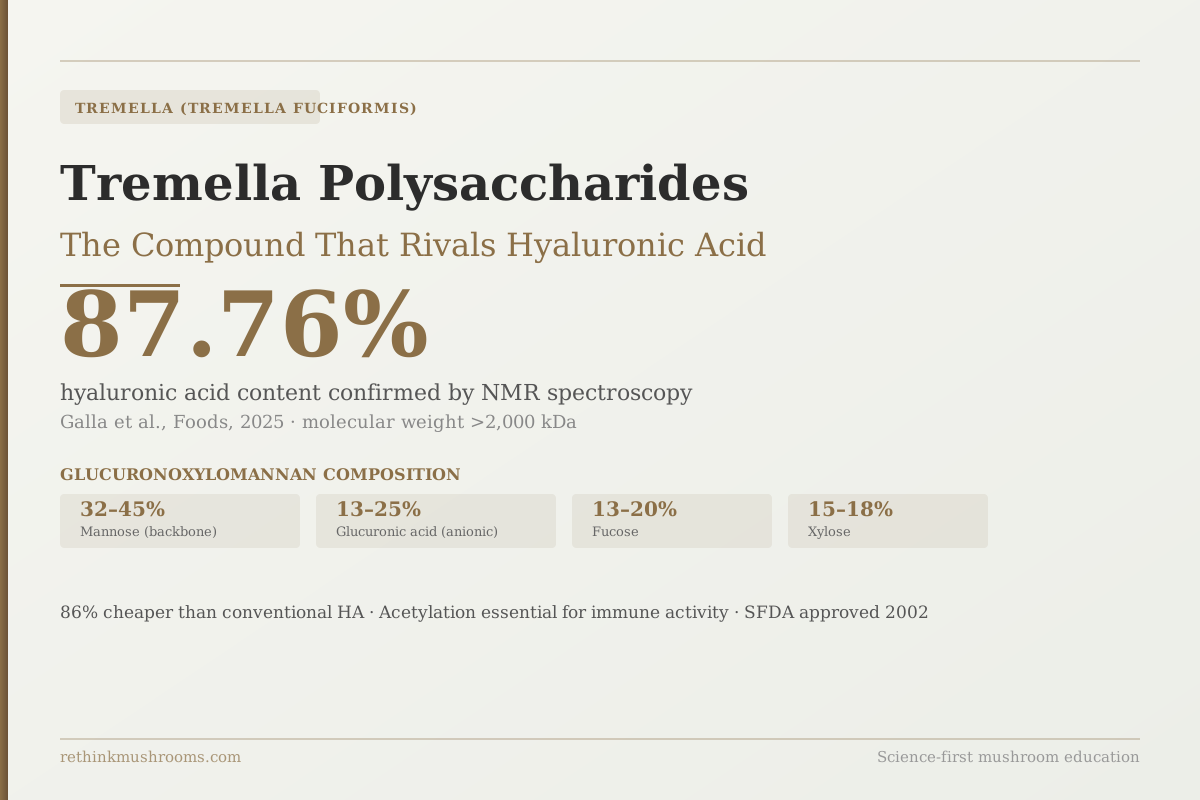
87.76% hyaluronic acid
Tremella extract confirmed at 87.76% hyaluronic acid content by NMR spectroscopy, with molecular weight above 2,000 kDa, structurally equivalent to pharmaceutical HA from animal sources, at 86% lower cost.
Galla et al., Foods, 2025
32–45%
mannose content in the glucuronoxylomannan backbone
>2,000 kDa
molecular weight of Tremella's hyaluronic acid fraction
86% cheaper
than conventional HA at equivalent moisturizing effect
Galla et al., Foods, 2025
 View as image ↗
The main bioactive compound in Tremella fuciformis is a glucuronoxylomannan, an acidic heteropolysaccharide with a chemical structure unlike the beta-glucans found in most other medicinal mushrooms. Where reishi, turkey tail, and shiitake derive their biological activity primarily from neutral beta-1,3-glucan chains, Tremella's active compounds are anionic (negatively charged) polysaccharides with a distinctive composition: roughly 32-45% mannose, 13-25% glucuronic acid, 13-20% fucose, and 15-18% xylose.[1]
That negative charge is what drives Tremella's water-binding properties. The charged uronic acid groups attract and hold water molecules with unusual efficiency. And in 2025, a structural study by Galla and colleagues confirmed that Tremella extract contains 87.76% hyaluronic acid by mass, with a molecular weight above 2,000 kDa, verified by NMR spectroscopy and ATR/FTIR analysis.[4]
That finding reframes the standard comparison to hyaluronic acid. Tremella is not simply a compound that "behaves like" HA. Structurally, it is HA, derived from a non-animal fungal source, at higher molecular weight than most pharmaceutical preparations.
For the broader overview of Tremella's evidence, see What Is Tremella Mushroom? The Beauty Mushroom Explained.
Key Takeaways
- Tremella polysaccharides are acidic glucuronoxylomannan compounds composed of mannose (32-45%), glucuronic acid (13-25%), fucose (13-20%), and xylose (15-18%). This structure is distinct from the neutral beta-glucans in most medicinal mushrooms (Wu et al., 2019)
- A 2025 NMR and ATR/FTIR structural study confirmed Tremella extract is 87.76% hyaluronic acid by mass, with molecular weight above 2,000 kDa, equivalent to pharmaceutical HA from animal sources (Galla et al., 2025)
- Acetyl groups at the C6-OH position of mannose residues are essential for immunomodulatory activity: complete deacetylation eliminates TLR4 activation entirely. This finding has direct implications for extraction and processing methods (Huang et al., 2022)
- Molecular weight spans from 8×10³ to 6×10⁶ Da depending on strain and extraction method; higher-weight fractions produce better water retention and skin texture; biological activity varies with structural features (Wu et al., 2019; Ge et al., 2020)
- Tremella polysaccharides provide equivalent moisturizing performance at 86% lower cost than hyaluronic acid, established across comparative studies (Wu et al., 2019; Ma et al., 2021)
- A 2024 iTRAQ proteomics study found Tremella heteromannan altered 43 differentially expressed proteins in aging mouse skin, spanning cellular metabolism, immune response, and structural protein synthesis (Xu et al., 2024)
What Glucuronoxylomannan Is and Why It Differs From Beta-Glucan
Most mushrooms famous for health benefits owe their biological activity to beta-glucans: long chains of glucose units linked in a specific beta-1,3 arrangement. These neutral polysaccharides bind immune receptors like Dectin-1 and activate macrophages. They are well-studied, and they are the primary active compound in shiitake, reishi, turkey tail, and maitake.
Tremella's main polysaccharide is fundamentally different. It is a glucuronoxylomannan, built around a mannose backbone (not glucose) with glucuronic acid, fucose, and xylose attached as side chains or branch points. The presence of glucuronic acid is what makes it an acidic polysaccharide: glucuronic acid carries a negatively charged carboxyl group, giving the entire molecule an anionic character.
The comprehensive structural review by Wu and colleagues in 2019 established the monosaccharide composition with precision: mannose at 32-45%, glucuronic acid at 13-25%, fucose at 13-20%, xylose at 15-18%.[1] These proportions vary by strain, cultivation conditions, and extraction method, but the overall framework is consistent across studies.
The practical consequence of the anionic structure: water molecules are electrostatically attracted to the negatively charged groups along the polysaccharide chain. This is the same physics that gives hyaluronic acid its water-binding properties. Hyaluronic acid also carries glucuronic acid in its backbone and is also anionic. The structural resemblance between Tremella glucuronoxylomannan and HA was suspected for years before it was confirmed analytically.
Structural Contrast
Glucuronoxylomannan vs. Beta-Glucan: Two Different Molecules
Tremella
Other mushrooms
Backbone sugar
Mannose (alpha-1,3-linked)
Glucose (beta-1,3-linked)
Charge
Anionic (negatively charged)
Neutral
Composition
Mannose 32–45%, glucuronic acid 13–25%, fucose 13–20%, xylose 15–18%
Glucose (single sugar), highly uniform chains
Water binding
High — uronic-acid groups hold water electrostatically
Low — neutral chains do not attract water
Primary receptor
TLR4 (acetylation-dependent)
Dectin-1
Structural analog
Hyaluronic acid — 87.76% HA by mass, >2,000 kDa
None — no cosmetic HA equivalence
Found in
Tremella fuciformis (snow fungus)
Reishi, shiitake, turkey tail, maitake
The two compound classes share almost nothing structurally. Beta-glucan research on immune activation does not transfer to Tremella, and Tremella’s hyaluronic-acid-like water binding has no counterpart in the beta-glucan mushrooms.
Sources: Wu et al. (2019) [ref 1]; Galla et al. (2025) [ref 4].
For context on how this compares to Wood Ear's polysaccharide profile (a neutral heteropolysaccharide with a distinct melanin compound), see Wood Ear Bioactive Compounds: Polysaccharides, Melanin, and Minerals.
The Architecture: Backbone, Branching, and Why Molecular Weight Matters
The detailed three-dimensional structure of Tremella polysaccharide was characterized by Ge and colleagues in a 2020 study isolating a specific strain (TFP-XY).[2] Their analysis identified an alpha-1,3-linked D-mannan backbone with beta-1,2-linked D-xylose units at the C-2 positions of some mannose residues. Glucuronic acid attaches as branches that project outward from the main chain.
The degree of branching and the positions of side chains correlate with biological activity. More branched fractions tend to show stronger immunomodulatory and antioxidant effects. The backbone conformation determines how the molecule interacts with receptors and water.
Molecular weight in Tremella polysaccharides spans an unusually wide range: from 8,000 Da on the low end to 6,000,000 Da (6×10⁶) on the high end, depending on strain, growth conditions, and extraction protocol.[1] This range matters for practical applications. In cosmetic formulations, higher molecular weight polysaccharides form a film on the skin surface and retain water effectively. Lower molecular weight fractions penetrate more readily but hold less water. The 2025 Galla structural study specifically noted molecular weights above 2,000 kDa in their HA-confirmed extract, which represents a high-MW fraction with superior surface hydration properties compared to most pharmaceutical HA preparations, which are typically processed to lower molecular weights to improve bioavailability in injectable or topical applications.
Molecular Weight
A 750-Fold Molecular Weight Range
Tremella polysaccharides span from about 8,000 to 6,000,000 daltons depending on strain and extraction. Where a fraction lands on this log scale predicts what it does: low-MW fractions penetrate but hold less water; high-MW fractions form a moisture-retaining film.
8 kDa — Low-MW fraction — penetrates, holds less water
>2,000 kDa — Galla 2025 HA-confirmed extract — surface film, high hydration
3.6x10⁶ Da — Xu 2024 heteromannan (NTP) used in skin-aging proteomics
6x10⁶ Da — Highest-MW fraction reported
Most pharmaceutical hyaluronic acid is deliberately fragmented to lower MW for dermal or injectable use. Tremella’s naturally high-MW HA fraction is better suited to surface hydration than penetration.
Sources: Wu et al. (2019) [ref 1]; Galla et al. (2025) [ref 4]; Xu et al. (2024) [ref 6].
The 2025 Structural Confirmation: Tremella Extract Is Hyaluronic Acid
The most important recent development in Tremella chemistry is a 2025 paper by Galla and colleagues in the journal Foods.[4] Using a combination of NMR spectroscopy, ATR/FTIR analysis, and MALDI-TOF mass spectrometry, they characterized a Tremella extract and found it was 87.76% hyaluronic acid by mass, with molecular weight consistently above 2,000 kDa.
Hyaluronic acid is a specific polysaccharide defined by its chemical structure: alternating units of D-glucuronic acid and N-acetyl-D-glucosamine linked in a specific pattern. The fact that Tremella extract confirmed to 87.76% HA by multiple independent analytical methods means it is not just a compound that mimics HA behavior. It meets the structural definition of HA.
Galla et al. (2025) · Foods
- Population
- Tremella fuciformis extract (in vitro structural analysis)
- Intervention
- Characterization by NMR spectroscopy, ATR/FTIR, and MALDI-TOF mass spectrometry
- Finding
- The extract was 87.76% hyaluronic acid by mass, with molecular weight consistently above 2,000 kDa — meeting the structural definition of HA, not merely mimicking it.
preliminary A rigorous multi-method structural study, but of a single extract. Independent replication across strains and commercial products is still needed before the 'Tremella is HA' claim generalizes to every Tremella ingredient on the market.
Galla et al., Foods, 2025
This matters for several reasons. First, conventional HA is derived from animal sources (rooster combs) or microbial fermentation (Streptococcus bacteria). Both production routes have limitations: animal sourcing raises ethical concerns for some consumers; bacterial fermentation produces lower molecular weight products. A fungal source that yields high-MW HA directly addresses both limitations.
Second, the 86% cost reduction figure from Wu 2019 gains new context: it is not that Tremella polysaccharide provides cheaper HA-like activity. It provides actual HA, at higher MW than most alternatives, from a fungal fermentation that scales readily.[1]
Third, the high MW is a genuine advantage for topical applications. High-MW HA forms a moisture-retaining film on the skin surface that does not penetrate the dermis. This is appropriate for surface hydration. Most pharmaceutical HA is deliberately fragmented to lower MW to allow dermal penetration for injectable applications, a different use case.
- Cell & Lab Studiescompleted
Structural characterization (NMR/FTIR/MALDI confirming 87.76% HA), TLR4 immune mechanism, and NF-kB / SIRT1 antioxidant pathways (Galla 2025; Huang 2022; Wu 2019; Rui 2025)
- Animal Studiescompleted
iTRAQ proteomics in aged mouse skin (43 differentially expressed proteins) and gut-microbiota shifts in rodents (Xu 2024; reviewed in Rui 2025)
- Clinical Use & Regulatorycompleted
Tremella polysaccharide enteric-coated capsules approved by China's SFDA in 2002 as an adjuvant for chemotherapy-induced leukopenia (Ma 2021)
- Small Human Trialscurrent
One double-blind RCT: Gitsomboon 2024 (n=56) found a small but significant HbA1c and waist-circumference improvement in prediabetic adults
- Large Randomized Trialsmissing
No large multi-center trials; no dose-optimization or head-to-head topical HA-vs-Tremella human trials
- Meta-Analyses & Systematic Reviewsmissing
No human meta-analysis of Tremella polysaccharide clinical endpoints
The chemistry and mechanism are exceptionally well-characterized, and there is a two-decade regulatory track record in China. But controlled human outcome data stops at a single small exploratory RCT — so structural claims are strong while clinical benefit claims remain early-stage.
Aggregate of Galla 2025, Huang 2022, Wu 2019, Rui 2025, Xu 2024, Ma 2021, and Gitsomboon 2024
For the full analysis of Tremella's skin science evidence, see Tremella fuciformis: The Beauty Mushroom With Serious Science Behind It.
The Acetylation Rule: Why Processing Determines Whether Tremella Immunomodulates
The most pharmacologically specific finding about Tremella polysaccharides comes from Huang and colleagues in 2022.[3]
They isolated a specific Tremella polysaccharide fraction (TFP-F1) and systematically removed the acetyl groups attached at the C6-OH positions of mannose residues. Then they tested whether the deacetylated product still activated immune cells. The result: complete deacetylation eliminated TLR4-mediated immunomodulatory activity entirely. At 1 microgram per milliliter, the intact TFP-F1 fraction stimulated TNF-alpha and IL-6 secretion in macrophages. The deacetylated version did not.
TLR4 is a receptor on macrophages and immune cells that recognizes specific molecular patterns and triggers immune activation. For Tremella's immunomodulatory activity to work, TLR4 must be activated. For TLR4 to be activated, the acetyl groups at C6-OH must be present.
This has a direct practical implication for supplement processing. Harsh heat treatments, extreme pH conditions, or oxidizing agents used during extraction can strip acetyl groups from the polysaccharide backbone. A Tremella extract that has lost its acetyl groups retains its water-binding properties (the anionic HA-like properties are independent of acetylation) but loses its immunomodulatory activity. The compound can be structurally present but biologically inert for immune purposes.
Processing Switch
Acetyl Groups Turn Immune Activity On and Off
Acetyl groups at the C6-OH position of mannose residues are required for TLR4-mediated immune activity. Strip them and the compound goes inert for immune purposes — but its water-binding, hyaluronic-acid-like behavior survives, because that comes from charge, not acetylation.
Immune activity ON
Immune activity OFF
Practical consequence: harsh heat, extreme pH, or oxidizing extraction can strip acetyl groups, leaving an extract that still moisturizes but no longer engages the immune system.
Source: Huang et al. (2022) [ref 3].
Safety
LowImmune benefits depend on how the extract is made
Concern
Because immune activity requires intact acetyl groups, a Tremella product can test high for polysaccharide content yet be immunologically inert if harsh extraction stripped those groups. Standard supplement labels do not report acetylation status.
What the research says
If immune support is the goal, look for products characterized for bioactivity or acetylation rather than total polysaccharide alone. If skin hydration is the goal, acetylation is not required and this concern does not apply.
Particularly relevant for: Anyone choosing a Tremella supplement for immune rather than cosmetic purposes
What to do
This article is educational and not medical advice. Consult a qualified healthcare provider before using Tremella for any therapeutic purpose, particularly alongside prescription medication.
Huang et al., 2022 [ref 3]
The 2025 review by Rui and colleagues confirms the mechanisms downstream of immune activation: NF-kB pathway inhibition, SIRT1 enhancement for antioxidant effects, glucose metabolic enzyme modulation for hypoglycemic effects, and short-chain fatty acid production from intestinal flora regulation.[5] These are the downstream effects that require intact acetylation upstream. For the full pathway mapping, see The Pharmacology of Tremella fuciformis: How It Works.
Beyond Skin: Antioxidant, Metabolic, and Gut Activity
Tremella polysaccharides affect multiple biological systems, not just skin hydration. The 2025 comprehensive review by Rui and colleagues maps three documented multi-system mechanisms with primary research support.[5]
Antioxidant activity operates through NF-kB pathway inhibition (reducing pro-inflammatory gene transcription) and SIRT1 enhancement. SIRT1 is a protein that activates antioxidant defenses and has been associated with cellular longevity in multiple model systems. Both pathways reduce the accumulation of reactive oxygen species that drive cellular aging.
Hypoglycemic activity involves modulation of glucose metabolic enzymes. The 2024 double-blind clinical RCT by Gitsomboon and colleagues, while using a whole Tremella beverage rather than isolated polysaccharide, found a statistically significant HbA1c improvement in 56 overweight or obese prediabetic adults over 12 weeks (HbA1c 6.03 to 5.96%, p=0.047).[8] The effect was small (Cohen's d = 0.39) and the authors described the trial as exploratory, calling for larger studies. It provides the first human outcome data that complements the mechanism research.
Gitsomboon et al. (2024) · Thai Clinical Trials Registry RCT
- Population
- 56 overweight or obese adults with prediabetes
- Intervention
- Once-daily beverage containing Tremella fuciformis for 12 weeks
- Comparator
- Placebo (double-blind)
- Finding
- HbA1c fell from 6.03% to 5.96% (p=0.047) and waist circumference decreased (p=0.022); no adverse events. Effect sizes were small (Cohen's d 0.39-0.45).
preliminary The only controlled human trial to date. It used a whole-mushroom beverage rather than isolated polysaccharide, the effect was small, and the authors call it exploratory pending larger RCTs.
Gitsomboon et al., 2024 [ref 8]
Gut microbiota activity: Tremella polysaccharides are not absorbed intact in the small intestine and reach the colon where they act as prebiotics. They promote short-chain fatty acid production, selectively feed beneficial bacterial populations, and have been shown in animal studies to reduce the Firmicutes-to-Bacteroidetes ratio that is associated with obesity and metabolic dysfunction.
The convergence of these properties in one compound class reflects the shared structural basis: the anionic, branched heteropolysaccharide that holds water at the skin surface, activates TLR4 immune receptors, and resists small intestinal digestion to reach the colon, is doing different things in different tissues through the same core molecular architecture.
For the connection between Tremella polysaccharides and microbiome health, see Mushroom Polysaccharides and Microbiome Nourishment.
From Structure to Skin Function: What the Proteomics Research Shows
A 2024 study by Xu and colleagues applied iTRAQ-based proteomics to ask a more complete question about Tremella's effects on aging skin.[6] Rather than measuring single outcomes like collagen content or oxidative stress markers, they mapped the entire protein expression profile of aged mouse skin before and after treatment with Tremella heteromannan (NTP, MW 3.6×10⁶ Da).
The result: 43 differentially expressed proteins across categories including cellular metabolism, immune response, and structural protein synthesis. The most relevant changes were reductions in hydroxyproline and hyaluronic acid loss, decreased oxidative stress markers, and protein expression changes consistent with restored cellular function in aging skin.
A single study of this depth in a mouse model does not establish human benefit. But it does show that Tremella polysaccharides affect skin at a systems level, not just through one mechanism. The 43-protein footprint suggests that the compound integrates into multiple cellular pathways simultaneously rather than acting through a single target.
The 2024 review by Paterska and colleagues, covering 52 publications on macrofungal cosmetic ingredients, identified Tremella fuciformis as a top-performing species for moisturizing effects across multiple comparison frameworks.[7] The review documented inhibition of collagen and elastin degradation, antioxidant activity, and photoprotective properties as Tremella's documented cosmetic mechanisms, placing it ahead of most other mushroom species for skin applications.
The Ma 2021 comprehensive review, drawing on decades of Chinese pharmaceutical research, provides the regulatory context: Tremella polysaccharide enteric-coated capsules received SFDA (China's FDA) approval in 2002 as an adjuvant treatment for chemotherapy-induced leukopenia.[9] A compound that has been a licensed pharmaceutical for over two decades has a safety and manufacturing record that most supplement ingredients do not. The same compound is now being characterized as structurally equivalent to HA in a skin context, which shows how much the research focus has expanded since the drug approval.
For the TCM history that preceded all of this pharmaceutical research, see Snow Fungus in Traditional Chinese Medicine: 1,000+ Years of Use.
Fact Check
What Tremella marketing claims vs. what the chemistry shows
The claim
“Tremella holds up to 500 times its weight in water and is 'nature's hyaluronic acid'”
Skincare and supplement marketing
What research shows
Partly TrueThe 'nature's hyaluronic acid' half is now literally accurate: a 2025 structural study confirmed Tremella extract is 87.76% hyaluronic acid by mass at above 2,000 kDa. The '500x' water figure, however, has no traceable primary source and should be treated as marketing shorthand, not a measured value.
Tremella's water binding is genuinely high and rests on the same anionic uronic-acid chemistry as HA. But a specific multiplier like 500x depends entirely on molecular weight, concentration, and test conditions, none of which the round number specifies.
Galla et al. (2025) [ref 4]; Wu et al. (2019) [ref 1]
The Bottom Line
Tremella polysaccharides are acidic glucuronoxylomannan compounds structurally confirmed as 87.76% hyaluronic acid at molecular weights above 2,000 kDa. They require intact acetyl groups at the C6-OH position of mannose residues for immunomodulatory activity via TLR4. Their biological activity spans skin hydration, immune activation, antioxidant pathways, glucose metabolism, and gut microbiota regulation. A pharmaceutical-grade extract has been approved in China since 2002 for chemotherapy support. The compound's structural equivalence to high-molecular-weight HA from a non-animal source at 86% lower cost represents the most commercially and scientifically significant property identified in recent years.
Frequently Asked Questions
Sources & References
- 1RTHM-01140·Wu, Yu-Ji et al. (2019). “Structure, bioactivities and applications of the polysaccharides from Tremella fuciformis mushroom: A review..” International journal of biological macromolecules.Study breakdown →PubMed →↩
- 2RTHM-01191·Ge, Xinyan et al. (2020). “Production, structure, and bioactivity of polysaccharide isolated from Tremella fuciformis XY..” International journal of biological macromolecules.Study breakdown →PubMed →↩
- 3RTHM-01541·Huang, Tzu-Yin et al. (2022). “An Immunological Polysaccharide from Tremella fuciformis: Essential Role of Acetylation in Immunomodulation..” International journal of molecular sciences.Study breakdown →PubMed →↩
- 4RTHM-02086·Galla, Rebecca et al. (2025). “Non-Animal Hyaluronic Acid from Tremella fuciformis: A New Source with a Structure and Chemical Profile Comparable to Hyaluronic Acid..” Foods (Basel.Study breakdown →PubMed →↩
- 5RTHM-02173·Rui, Yanlin et al. (2025). “Structure, Function and Application of Tremella Fuciformis Polysaccharide: A Review..” Journal of food science.Study breakdown →PubMed →↩
- 6RTHM-02026·Xu, Yuanyuan et al. (2024). “iTRAQ-Based Proteomic Profiling of Skin Aging Protective Effects of Tremella fuciformis-Derived Polysaccharides on D-Galactose-Induced Aging Mice..” Molecules (Basel.Study breakdown →PubMed →↩
- 7RTHM-01965·Paterska, Maja et al. (2024). “Macrofungal Extracts as a Source of Bioactive Compounds for Cosmetical Anti-Aging Therapy: A Comprehensive Review..” Nutrients.Study breakdown →PubMed →↩
- 8RTHM-01892·Gitsomboon, Sawika et al. (2024). “Tremella fuciformis beverage improves glycated hemoglobin A1c and waist circumference in overweight/obese prediabetic subjects: a randomized controlled trial..” BMC nutrition.Study breakdown →PubMed →↩
- 9RTHM-01399·Ma, Xia et al. (2021). “A review on the production, structure, bioactivities and applications of Tremella polysaccharides..” International journal of immunopathology and pharmacology.Study breakdown →PubMed →↩