Tremella (Tremella fuciformis)
5 distinct pharmacological pathways
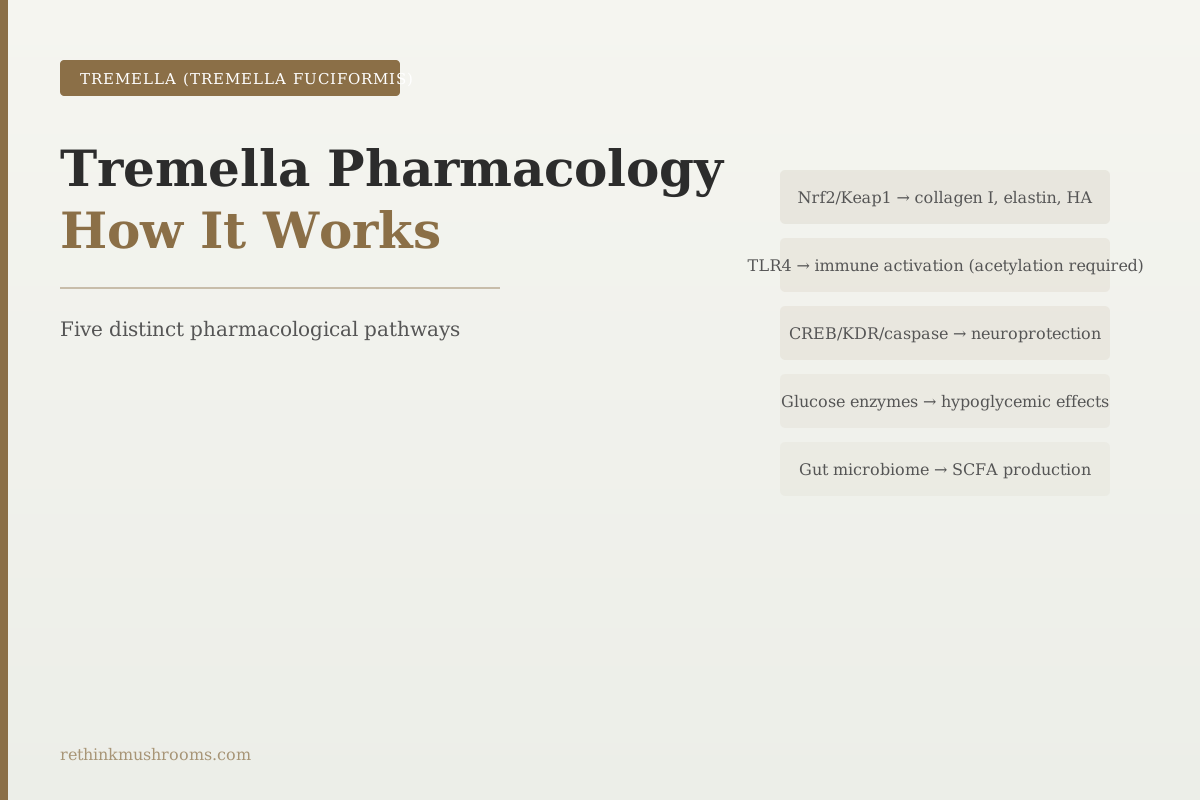
Tremella fuciformis polysaccharides activate five independently characterized mechanisms: Nrf2/Keap1 skin protection, TLR4 immune activation requiring intact acetyl groups, multiple brain neuroprotective pathways, glucose metabolic enzyme modulation, and gut microbiome remodeling.
Yang et al., Progress in Molecular Biology, 2019; Huang et al., IJMS, 2022
2002
China SFDA approval: Tremella fuciformis as a drug for chemotherapy-induced leukopenia
n=56
Gitsomboon 2024 prediabetes RCT: HbA1c improved 6.03% to 5.96% over 12 weeks
100%
loss of TLR4 immune activity after complete deacetylation of Tremella polysaccharides (Huang 2022)
Yang et al., Progress in Molecular Biology, 2019; Huang et al., IJMS, 2022
 View as image ↗
Tremella fuciformis has been used in traditional Chinese medicine for over a thousand years, primarily for skin and lung health. But "traditional use" and "confirmed pharmacological mechanism" are different claims, and the research on this mushroom has become precise enough to distinguish them. A 2022 study showed that removing a single chemical group from the polysaccharide (acetyl groups at C6-OH positions) completely eliminated its immune-activating property. A 2025 study identified the three-protein brain injury pathway Tremella polysaccharides inhibit. A 2024 randomized controlled trial in prediabetic adults showed HbA1c improvement over 12 weeks. This is not vague "adaptogen" territory. For the broader overview of Tremella mushroom, see What Is Tremella Mushroom? The Beauty Mushroom Explained. This article explains the Tremella fuciformis pharmacology: what it does, at the cellular level, through which pathways.
Key Takeaways
- Tremella polysaccharides activate Nrf2/Keap1 signaling in human dermal fibroblasts, increasing production of collagen I, elastin, and hyaluronic acid after UVA stress
- The immune-activating property requires intact acetyl groups on the polysaccharide; complete deacetylation eliminates TLR4 activity entirely, making extraction method a critical quality factor
- Three independent brain mechanisms are documented: NGF-like neurotrophic activity with beta-amyloid protection (Park 2013), CREB/cholinergic pathway activation improving memory in rats (Kim 2007), and KDR-mediated MAPK/NF-κB inhibition reducing brain injury (Wan 2025)
- A 12-week double-blind RCT (Gitsomboon 2024, n=56) showed Tremella beverage significantly improved HbA1c and waist circumference in prediabetic adults
- He et al. (2022) showed Tremella polysaccharides remodel gut microbiome composition in obese mice, reducing Firmicutes/Bacteroidetes ratio and improving blood glucose and lipids
- Tremella fuciformis polysaccharides received SFDA drug approval in China in 2002 for treating chemotherapy-induced leukopenia, providing regulatory validation beyond supplement classification
The Pharmacology of Tremella fuciformis: A Five-Pathway Framework
The active compound class in Tremella fuciformis is polysaccharides, specifically a glucuronoxylomannan. This is an acidic polymer with a mannose backbone and negatively charged side groups including glucuronic acid and xylose. Its acidity is what gives Tremella polysaccharides their unusual water-binding capacity and distinguishes them structurally from the neutral beta-glucan polysaccharides that dominate most other medicinal mushrooms.
Yang et al.'s 2019 review in Progress in Molecular Biology and Translational Science maps five distinct targets for these polysaccharides: skin, immunity, brain, metabolic regulation, and tumor suppression.[1] The review also documents the 2002 Chinese SFDA approval of Tremella polysaccharide enteric-coated capsules as a drug for chemotherapy-induced leukopenia (abnormally low white blood cell counts). This approval required clinical trial data submitted to the Chinese regulatory authority, making Tremella one of a small number of mushroom-derived compounds to have achieved drug status anywhere in the world.
The 2025 review by Rui et al. in the Journal of Food Science is the most current mechanistic synthesis.[2]
Pathway 1: Skin Protection Through Nrf2/Keap1 Activation
The skin pathway is the best-characterized Tremella mechanism and the one that explains the "beauty mushroom" classification from a cellular biology standpoint.
Nrf2 is a protein that, when activated, enters the cell nucleus and switches on genes for antioxidant enzymes and structural skin proteins. Keap1 is the protein that keeps Nrf2 inactive in unstressed conditions. Under oxidative stress (such as UV radiation from the sun), Keap1 releases Nrf2, which triggers the protective response. The Nrf2/Keap1 pathway is effectively a master switch for cellular defense.
Fu et al. (2021) exposed human dermal fibroblasts to UVA radiation and tested whether Tremella polysaccharide pretreatment changed the outcome.[3] Cells pretreated with Tremella polysaccharides showed significantly higher levels of collagen I (the structural scaffold), elastin (the elastic fiber protein), and hyaluronic acid (the tissue moisture molecule). The protection operated specifically through Nrf2/Keap1 pathway upregulation, confirmed by pathway inhibition experiments.
This is a specific mechanistic finding, not a general "skin benefits" claim. The named proteins (collagen I, elastin, HA) at named pathway targets (Nrf2/Keap1) under named stress conditions (UVA) in named cell types (human dermal fibroblasts) is the kind of specificity that distinguishes pharmacological research from marketing copy. Whether this translates to visible human skin outcomes at dietary or topical doses requires controlled human trials that have not yet been completed.
Pathway 2: Immune Activation and the Acetylation Requirement
The immune mechanism is the pathway with the most important practical implication for supplement quality.
Tremella polysaccharides activate TLR4, a surface receptor on macrophages, triggering production of TNF-α and IL-6. These cytokines coordinate innate immune responses. This TLR4/cytokine mechanism is consistent with other medicinal mushroom polysaccharides, including beta-glucans from reishi and lion's mane.
What makes the Tremella case unusual is the Huang et al. (2022) finding about acetylation.[4] Huang's group purified Tremella polysaccharides, then chemically removed the acetyl groups (CH3CO-) attached to the C6-OH positions on the mannose residues. They tested immune activity before and after deacetylation. At 1 μg/mL, the intact polysaccharide (TFP-F1) stimulated significant TNF-α and IL-6 secretion in macrophages. The fully deacetylated version did not. The acetyl groups are not incidental to the structure. They are required for TLR4 recognition.
The supplement quality implication: any extraction method that degrades or removes acetyl groups during processing may produce a Tremella polysaccharide that passes beta-glucan content testing but lacks immune-activating activity. Acetylation state is not routinely disclosed on supplement labels, and no consumer-accessible test standard currently measures it for Tremella products specifically.
Han et al. (2015) documents a second quality dimension: different Tremella strains show significantly different immune-activating and anticancer potency in cell culture.[5] Species identity alone does not determine compound activity.
The 2021 comprehensive review by Ma et al. confirms the SFDA drug approval history and documents the clinical adjuvant use for chemotherapy and hepatitis infection treatment.[6]
Pathway 3: Brain Neuroprotection Through Four Distinct Mechanisms
The brain pharmacology section has the most mechanistic complexity and also the most recently published data.
NGF-like neurotrophic activity. Park et al. (2013) tested Tremella hot water extract in PC12h cells, a model for studying neuron growth and survival.[7] Tremella extract promoted neurite outgrowth (the extension of neuron branches that form synaptic connections) and significantly reduced cell death from β-amyloid exposure. Beta-amyloid is the aggregated protein implicated in Alzheimer's disease. The researchers described the activity as "NGF-like" because it mimics the effects of nerve growth factor, the endogenous protein that supports neuron survival and development.
CREB/cholinergic pathway. Kim et al. (2007) identified a distinct brain mechanism in rats with trimethyltin-induced memory impairment.[8] Tremella supplementation improved performance on memory tests and increased activity in the CREB transcription factor pathway. CREB regulates genes for memory consolidation and synaptic plasticity. The cholinergic system (which uses acetylcholine and deteriorates severely in Alzheimer's disease) also showed improved function. This is a different target from the NGF/β-amyloid mechanism Park identified.
Caspase/mitochondrial pathway. Jin et al. (2016) found a third mechanism in a cell-culture model of glutamate-induced neuron death.[9] A purified Tremella polysaccharide fraction (TL04) protected neurons through inhibition of the caspase-dependent mitochondrial cell death cascade. Caspase activation is a key step in programmed cell death triggered by glutamate excitotoxicity.
KDR/MAPK/NF-κB pathway (2025). Wan et al. (2025) identified a fourth neuroprotective mechanism in a subarachnoid hemorrhage model.[10] Tremella polysaccharides reduced early brain injury through inhibition of the KDR-mediated P38 MAPK/NF-κB signaling pathway, decreasing neuronal apoptosis, neuroinflammation, and blood-brain barrier disruption. This is a pathway involved in acute brain injury response, distinct from the chronic neurodegeneration targets in the earlier studies.
For a deeper look at the brain health evidence, see Tremella and Brain Health: Neuroprotective Research.
Pathway 4: Metabolic Effects and Gut Microbiome
Rui et al.'s 2025 review documents glucose metabolic enzyme modulation as a fourth area: Tremella polysaccharides affect the enzymes that regulate how cells process glucose, producing hypoglycemic effects in animal and cell-culture models.[2]
He et al. (2022) tested a gut-mediated metabolic mechanism in high-fat-diet mice.[11] Tremella polysaccharide supplementation significantly reduced weight gain, blood glucose, blood lipids, and inflammatory markers. Gut microbiome composition shifted: the Firmicutes/Bacteroidetes ratio decreased, a pattern associated with metabolic health, and microbial diversity improved. Some of the metabolic improvements correlated specifically with the microbiome changes, suggesting a gut-mediated pathway distinct from direct enzyme effects.
The Rui 2025 review adds that Tremella polysaccharides stimulate production of short-chain fatty acids (SCFAs) in the colon. SCFAs, particularly butyrate, acetate, and propionate, are the end-products of bacterial fermentation of polysaccharides. They cross the gut lining into the bloodstream, where they serve as energy sources for colonocytes, modulate inflammation, and signal to metabolic receptors throughout the body. This SCFA production mechanism is how the gut-mediated effects of Tremella polysaccharides translate from microbiome changes to systemic outcomes. It positions Tremella polysaccharides among the mushrooms with documented prebiotic activity alongside turkey tail and reishi.
For the broader evidence on mushroom polysaccharides as prebiotics, see Mushrooms as Prebiotics: How Fungal Polysaccharides Feed Beneficial Bacteria.
For the evidence specifically on blood sugar and prediabetes, see Tremella and Blood Sugar: Hypoglycemic Research.
The Human Clinical Trials: Two Randomized Controlled Studies
The four pathways above are established in cell and animal models. Two randomized controlled trials in humans provide clinical translation evidence.
Ban et al. (2018) conducted an 8-week double-blind RCT in adults with subjective cognitive impairment, comparing Tremella fuciformis extract at 600 mg or 1200 mg daily against placebo.[12] The Tremella group showed significantly greater improvement in subjective memory complaint scores compared to placebo, with no serious adverse events at either dose. This is a small trial with a subjective outcome; it is consistent with the brain mechanism data, but a small sample with a self-reported endpoint is a limited basis for clinical claims. The biological plausibility is established; the clinical magnitude is not.
Gitsomboon et al. (2024) published a 12-week double-blind RCT in 56 overweight or obese adults with prediabetes.[13] The Tremella beverage group showed significant improvement in HbA1c (from 6.03% to 5.96%, p=0.047) and waist circumference reduction compared to placebo. No adverse events were reported. HbA1c is a 3-month blood sugar average, making it a more objective and clinically meaningful endpoint than subjective scores. A reduction of 0.07% in HbA1c is small in absolute terms but statistically significant and directionally consistent with the preclinical glucose mechanism data.
These are the only completed RCTs for Tremella fuciformis in humans published in peer-reviewed journals. Neither provides sufficient evidence to support strong clinical recommendations, but both confirm that the preclinical mechanisms produce measurable human responses in the expected directions.
The Bottom Line
Tremella fuciformis works through five pharmacological pathways: Nrf2/Keap1 activation increasing collagen I, elastin, and hyaluronic acid in skin cells (Fu 2021); TLR4 immune activation requiring intact acetyl groups on the polysaccharide (Huang 2022: deacetylation eliminates activity); four distinct brain neuroprotective mechanisms including NGF-like activity, CREB/cholinergic, caspase/mitochondrial, and KDR/MAPK pathways; glucose enzyme modulation with gut microbiome prebiotic effects (He 2022, Rui 2025); and SFDA-approved chemotherapy immune support (2002). Clinical RCTs show promising but modest effects in cognitive function (Ban 2018) and prediabetic HbA1c (Gitsomboon 2024). Most evidence remains preclinical.
Frequently Asked Questions
Sources & References
- 1. Source details for this reference are not yet available.
- 2. Source details for this reference are not yet available.
- 3. Source details for this reference are not yet available.
- 4. Source details for this reference are not yet available.
- 5. Source details for this reference are not yet available.
- 6. Source details for this reference are not yet available.
- 7. Source details for this reference are not yet available.
- 8. Source details for this reference are not yet available.
- 9. Source details for this reference are not yet available.
- 10. Source details for this reference are not yet available.
- 11. Source details for this reference are not yet available.
- 12. Source details for this reference are not yet available.
- 13. Source details for this reference are not yet available.