Tremella (Tremella fuciformis)
1,200+ years of documented use
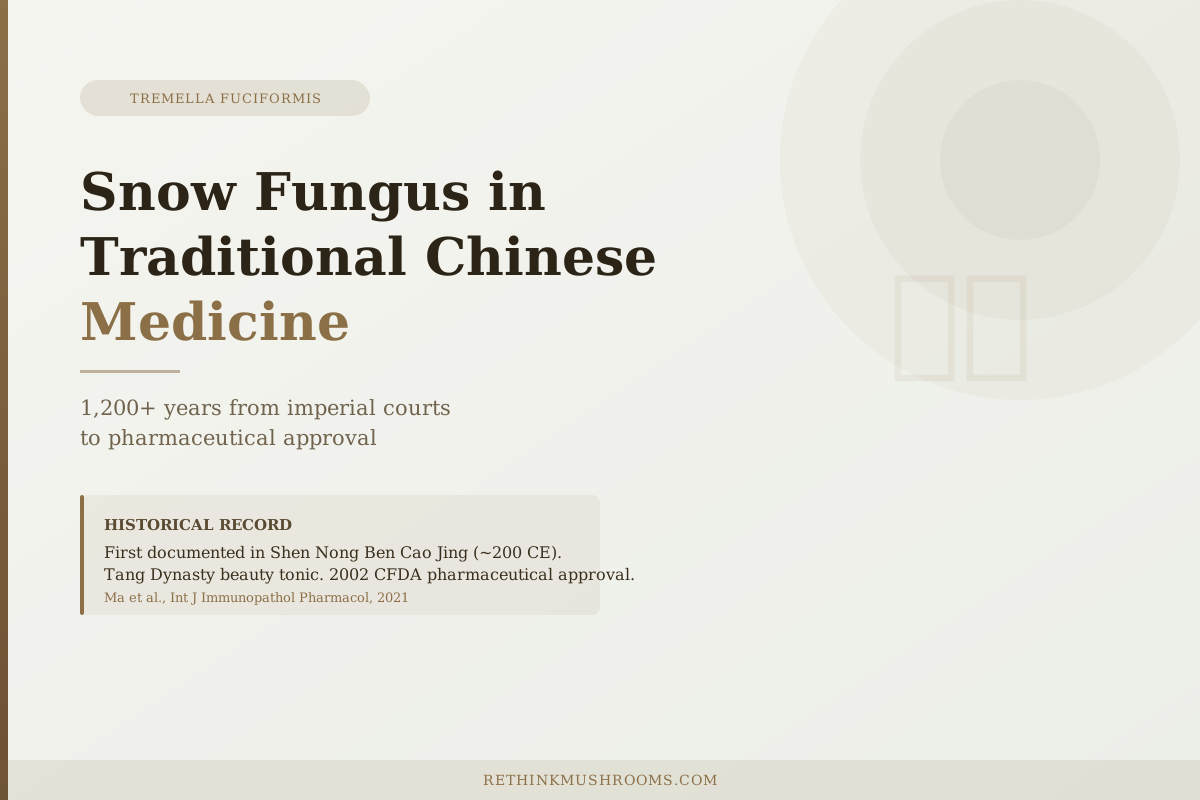
Snow fungus appears in Chinese medical texts dating to approximately 200 CE, making it one of the most historically attested mushrooms in traditional pharmacopoeias, with a record stretching from ancient lung tonics to a 2002 pharmaceutical drug approval.
Ma et al., Int J Immunopathol Pharmacol, 2021
618–907 CE
Tang Dynasty era when Yang Guifei popularized snow fungus as a beauty tonic in imperial courts
2002
year China's drug regulator approved Tremella enteric-coated capsules for leukopenia
8 weeks
duration of the double-blind cognitive RCT showing memory and executive-function improvement (Ban et al., 2018)
Ma et al., Int J Immunopathol Pharmacol, 2021
 View as image ↗
Sometime in the eighth century CE, a woman at the Tang Dynasty imperial court began eating snow fungus regularly and credited it for her skin. Her name was Yang Guifei, and she would become one of the Four Beauties of ancient China, one of the four women considered to embody feminine ideal in classical Chinese culture. Whether the snow fungus actually deserved credit for her complexion is a question ancient court records cannot answer. What those records do confirm is that Tremella fuciformis was already, by the Tang Dynasty, a well-established medicinal and beauty substance in Chinese medicine.
This article covers the history that competitors skip: the written record from ancient pharmacopoeias, the theoretical framework of traditional Chinese medicine that explains how snow fungus was classified, the cultural story that made it famous, and the modern pharmacological validation that gives 1,200 years of traditional use a contemporary scientific basis. For the full modern research overview, see What Is Tremella Mushroom? The Beauty Mushroom Explained.
Key Takeaways
- Snow fungus (銀耳, yín ěr, meaning "silver ear") appears in Chinese pharmacopoeias dating to approximately 200 CE, when the Shen Nong Ben Cao Jing first documented it as a lung tonic (Ma et al., 2021)
- In traditional Chinese medicine, Tremella is classified as a Yin-nourishing substance acting on the Lung, Kidney, Heart, and Stomach meridians; the primary indication is Yin deficiency syndrome, which manifests as dry cough, dry skin, fatigue, and poor memory
- The Tang Dynasty imperial consort Yang Guifei (c. 719–756 CE) reportedly credited snow fungus for her complexion; this is historical cultural lore that anchors TCM's beauty classification, though it is not a documented clinical record
- Commercial cultivation of snow fungus began in Gutian County, Fujian Province in the 19th century, transforming it from a rare forest luxury (comparable in price to bird's nest) to a widely available food and medicine
- In 2002, China's State Food and Drug Administration approved Tremella enteric-coated capsules for chemotherapy-induced leukopenia, officially bridging the botanical's TCM history with modern pharmaceutical regulation (Yang et al., 2019)
- An 8-week double-blind RCT (n=75) found that 600–1,200 mg/day of Tremella improved subjective memory complaint scores versus placebo, with significantly greater gains in short-term memory and executive function, providing modern validation for TCM's centuries-old classification of Tremella as a brain tonic (Ban et al., 2018)
Snow Fungus by Many Names: Silver Ear, White Wood Ear, and More
The first thing to understand about snow fungus is that it has accumulated many names over 1,200 years, and each name is descriptive.
In Chinese, the most common name is 銀耳 (yín ěr), meaning "silver ear." This name comes from the mushroom's appearance: gelatinous, translucent white to pale yellow fronds that branch out in an irregular, ear-like shape. When fresh, they have the texture of soft jelly; when dried, they shrink dramatically but rehydrate completely when soaked.
A second Chinese name is 白木耳 (bái mù ěr), meaning "white wood ear," distinguishing it from the related black wood ear (木耳, mù ěr), which is Auricularia auricula-judae. Both grow on dead or dying wood, and both have been used in Chinese cooking and medicine for centuries. The relationship between these two species (one gelatinous white, one firm black) is a useful frame for understanding why their polysaccharide structures, and therefore their bioactivities, differ substantially.
English names include snow fungus (for its white color and the snowflake-like appearance of dried specimens), white fungus, silver ear fungus, and white jelly fungus. The scientific name is Tremella fuciformis, from the Latin fuciformis meaning "shaped like seaweed," which accurately describes the frilled, translucent frond structure.
Tremella fuciformis grows natively on dead broadleaf trees, primarily in tropical and subtropical Asia: China, Japan, Korea, Taiwan, and extending into Southeast Asia and parts of India. It is not a cold-climate mushroom despite the "snow" in its common name. The name reflects appearance, not habitat.
1,200 Years in the Written Record: From Ancient Pharmacopoeia to Tang Dynasty Courts
Snow fungus (銀耳, yín ěr) appears in the Shen Nong Ben Cao Jing, the foundational Chinese pharmacopoeial text attributed to the mythological emperor Shen Nong, compiled approximately 200 CE. This text documented it as a lung tonic. It gained increased prominence during the Tang Dynasty (618–907 CE), when imperial consort Yang Guifei credited it for her complexion. Commercial cultivation began in 19th-century Fujian province, in Gutian County.[1]
The snippet above is a compressed version of a 1,200-year timeline. Each element in it represents a significant phase in how snow fungus moved through Chinese society.
One Mushroom, Twelve Centuries
Snow Fungus: From Ancient Lung Tonic to Modern Evidence
The documented path of Tremella fuciformis — from a c. 200 CE pharmacopoeial classification, through Tang-court prestige and 19th-century cultivation, to a 2002 pharmaceutical approval and modern clinical and structural research.
- c. 200 CETraditional Record
Documented as a lung tonic
Snow fungus (銀耳, yín ěr) appears in the Shen Nong Ben Cao Jing, the foundational Chinese pharmacopoeia, classified as a Yin-nourishing lung tonic — the record that established its medicinal legitimacy.
- 618–907 CETraditional Record
Tang Dynasty court prestige
Imperial consort Yang Guifei reportedly credits snow fungus for her complexion. Cultural lore, not a clinical record — but it crystallizes a beauty-tonic reputation that already predated her, rooted in TCM Lung/Skin Yin theory.
- 19th C.Cultivation
Commercial cultivation begins
Cultivation develops in Gutian County, Fujian — still the center of Chinese Tremella production today — transforming snow fungus from a forest luxury priced like bird’s nest into a widely available food and medicine.
- 2002Modern Science
Approved as a pharmaceutical
China’s State Food and Drug Administration approves Tremella enteric-coated capsules for chemotherapy-induced leukopenia, bridging the botanical’s TCM history with modern drug regulation.
- 2018Modern Science
Cognitive RCT
An 8-week double-blind trial (n=75) finds 600–1,200 mg/day Tremella improves subjective memory complaints, with significant gains in short-term memory and executive function — controlled evidence for the millennium-old "brain tonic" classification.
- 2025Modern Science
It really is hyaluronic acid
A structural analysis finds the most abundant polysaccharide in a Tremella extract is hyaluronic acid itself (~87.76%, >2,000 kDa), confirming the mushroom as a genuine non-animal source of the molecule behind its Lung/Skin "moistening" reputation.
Pharmacopoeial and cultivation history per Ma et al., Int. J. Immunopathol. Pharmacol., 2021. 2002 leukopenia approval per Yang et al., Prog. Mol. Biol. Transl. Sci., 2019. Cognitive RCT per Ban et al., J. Medicinal Food, 2018. Hyaluronic-acid structural analysis per Galla et al., 2025. The Tang-Dynasty entry is documented cultural lore, not a clinical record. The 2002 approval applies to a standardized pharmaceutical preparation, not to culinary snow fungus or consumer supplements.
The Shen Nong Ben Cao Jing phase established its medicinal legitimacy. In Chinese medical tradition, inclusion in a formal pharmacopoeia is the benchmark for official medicine. The classification as a lung tonic was specific and consequential: it meant practitioners across China would prescribe it for lung-related complaints for the next millennium.
The Tang Dynasty phase established its cultural prestige. By the time of the imperial courts, snow fungus was not merely medicinal; it was expensive, associated with luxury and beauty, and consumed by the elite. Wild-collected specimens from old-growth forests were rare and costly, comparable in market price to bird's nest, the other famous Chinese beauty food derived from the nests of swiftlets.
The 19th-century cultivation phase democratized it. The development of commercial cultivation in Gutian County, Fujian Province, which remains the center of Chinese Tremella cultivation today, transformed snow fungus from a luxury item into a common food ingredient. Current Chinese production is measured in hundreds of thousands of tons annually.
The 20th century brought pharmaceutical legitimacy. In 2002, China's State Food and Drug Administration (now the National Medical Products Administration) approved Tremella enteric-coated capsules as a pharmaceutical drug for the treatment of chemotherapy-induced leukopenia, the dangerous reduction in white blood cell counts that can interrupt cancer treatment.[2] Ma and colleagues also documented its use as adjuvant therapy for hepatitis and mycoplasma pneumonia.[1]
Yang Guifei and the Beauty Legend: What TCM Actually Claimed
Yang Guifei (Yang Yuhuan, c. 719–756 CE) was the imperial consort of Emperor Xuanzong of the Tang Dynasty. She is remembered as one of ancient China's Four Beauties, a classical list of women whose appearance was considered exceptional by the cultural standards of their era.
The tradition holds that she consumed snow fungus regularly as part of her beauty regimen and that she credited it for her complexion. This story has been retold in Chinese beauty literature for over a thousand years, and it remains a standard reference in contemporary Tremella marketing.
The honest statement about the Yang Guifei story is this: it is cultural lore, not a documented clinical record. No contemporaneous text provides clinical detail, dosage records, or controlled comparison. The story should be understood for what it actually is: a culturally transmitted claim that TCM practitioners at the Tang imperial court already classified Tremella as a Yin-nourishing substance with benefits for skin, and that someone famous was associated with that use.
That context matters for understanding the story's significance. The Yang Guifei association is not the origin of snow fungus's reputation as a beauty tonic. It is a notable example of a reputation that already existed. The Shen Nong Ben Cao Jing had classified it as a lung and skin tonic centuries earlier. Yang Guifei represents the cultural crystallization of a much older medical tradition.
The broader skin connection in TCM is rooted in the Lung meridian theory: in the TCM framework, the Lung meridian governs not just the respiratory system but also the skin. A substance classified as a lung tonic that also nourishes Yin is, in TCM logic, also a skin tonic. This theoretical framework is why dermatologists reviewing Tremella in 2023 found the skin connection pharmacologically plausible, not because they were validating the Yang Guifei story, but because the polysaccharide structure underlying the traditional use turned out to have relevant skin biology.
The TCM Framework: What "Yin-Nourishing Lung Tonic" Actually Means
Traditional Chinese medicine classifies substances according to a theoretical framework that does not map directly onto Western pharmacology. Understanding that framework is the only way to understand what practitioners were actually prescribing Tremella for, and why those prescriptions turned out to correspond reasonably well to what the pharmacology later found.
In TCM, Tremella fuciformis is classified as:[1]
Meridians: Lung, Kidney, Heart, Stomach Property: Cool, neutral Flavor: Sweet, bland Primary action: Nourishes Yin, moistens the Lung, tonifies Qi and blood, calms the Spirit
The primary diagnostic indication is Yin deficiency syndrome: a TCM diagnosis that presents as dry cough, dry skin, thirst without strong desire to drink, fatigue, afternoon fever or flushing, poor memory, and disturbed sleep. The syndrome describes what happens when the body's moistening, cooling, and nourishing principle (Yin) is depleted.
Each meridian affected gives a different clinical application:
Lung meridian: The most classical use. Dry cough without phlegm, chronic hoarseness, hemoptysis (coughing blood), recovery from respiratory illness. The "moistening the Lung" action was prescribed for conditions we would now call dry bronchitis, chronic cough, or tuberculosis recovery.
Kidney meridian: Tonifying essence and longevity. This connects to the anti-aging and general restorative use, as the Kidney in TCM is considered the root of all Yin.
Heart meridian: Calming the Spirit: disturbed sleep, palpitations, anxiety. This connects loosely to the cognitive and neuroprotective research found in modern studies.
Stomach meridian: Moistening dryness in the digestive tract, generating fluids, treating thirst and poor appetite. This connects to modern findings about Tremella polysaccharides affecting gut microbiota and metabolic parameters.
The pattern: every organ system TCM practitioners associated with Tremella turns out to be a system where modern research has found pharmacologically relevant activity. The lung/skin connection corresponds to the polysaccharide's moisturizing and photoprotective mechanisms. The heart/brain connection corresponds to the neuroprotective research. The stomach connection corresponds to the gut microbiota and blood sugar research. TCM's theoretical framework and modern pharmacology used different languages to describe overlapping observations.
For the full overview of modern Tremella research and the complete pharmacological picture, see Tremella Bioactive Compounds: Polysaccharides and Their Unique Properties.
Where Modern Science Validates the TCM Record
The honest summary of modern research on traditional snow fungus uses is this: most of what TCM claimed Tremella would do, modern science has found mechanistic or clinical support for, but in almost all cases the evidence base is preclinical, and controlled human trials are limited.
The lung and skin tonic claim: Wu and colleagues' 2019 comprehensive review in the International Journal of Biological Macromolecules documented that Tremella polysaccharides, with their extreme water-holding capacity and moisturizing properties, function as skin humectants comparable to hyaluronic acid.[3] Ma and colleagues' review reported that a Tremella polysaccharide can match the moisturizing effect of hyaluronic acid at roughly 86% lower cost.[1] The mechanism that underlies this is the acidic glucuronoxylomannan backbone's water-binding capacity, which corresponds to what TCM described as the Lung/Skin moistening action. A 2025 structural analysis went further: the most abundant polysaccharide in a Tremella fuciformis extract was hyaluronic acid itself, accounting for approximately 87.76% of the fraction at a molecular weight above 2,000 kDa, positioning the mushroom as a genuine non-animal source of the same molecule used in commercial skincare.[6]
The brain tonic claim: Ban and colleagues published an 8-week double-blind randomized controlled trial in the Journal of Medicinal Food in 2018.[4] Seventy-five adults with subjective cognitive impairment were randomized to 600 mg/day Tremella, 1,200 mg/day Tremella, or placebo. The Tremella group showed greater improvement in subjective memory complaint scores than placebo (the trial's primary outcome), and significantly greater gains on standardized tests of short-term memory and executive function. Adverse-event frequency did not differ meaningfully across groups (high-dose 40.4%, low-dose 35.1%, placebo 41.4%). TCM classified Tremella as a brain tonic for over a millennium; an RCT in the Journal of Medicinal Food now provides controlled trial evidence for the cognitive effects.
The immune and pharmaceutical application: The 2002 CFDA drug approval for chemotherapy-induced leukopenia is the most direct translation of TCM's immune-strengthening classification into regulatory medicine. Yang and colleagues' 2019 review in Progress in Molecular Biology and Translational Science documented the approval and described the polysaccharide's immunomodulatory mechanisms: macrophage and T-cell activation, B-cell stimulation, and NK cell enhancement.[2]
Comparative bioactive profile: Lo and colleagues published a comparative study in 2012 in the International Journal of Medicinal Mushrooms documenting polysaccharide, ergosterol, and triterpene content across multiple culinary-medicinal mushrooms including Tremella fuciformis fruiting bodies and mycelia.[5] The data confirm that Tremella's primary bioactive contribution is its polysaccharide fraction, not triterpenes or beta-glucans (as in reishi and chaga respectively), a profile consistent with the TCM classification of Tremella as a moistening, Yin-nourishing substance rather than a warming, stimulating one.
What science has not yet validated: No controlled human trial has directly tested Tremella for the lung/respiratory applications that represent TCM's oldest and most prominent use. The skin hydration evidence is predominantly in vitro or animal-model based; no human clinical trial has compared Tremella topical application against placebo or hyaluronic acid. The Stomach meridian/digestive claims, while supported by animal gut microbiota research, lack human clinical trial confirmation.
This article is for education only and is not medical advice. The 2002 Chinese drug approval applies to a standardized pharmaceutical Tremella preparation for chemotherapy-induced leukopenia, not to culinary snow fungus or consumer supplements; leukopenia and cancer are serious conditions requiring proven medical care. Talk to your doctor before using snow fungus or any mushroom extract, particularly if you are undergoing treatment or taking medication.
For the deeper coverage of how modern science explains Tremella's mechanisms, the Tremella fuciformis beauty science article and the detailed research on mushroom polysaccharides and gut microbiome nourishment cover those angles in full.
The Bottom Line
Snow fungus (Tremella fuciformis) has been documented in traditional Chinese medicine for over 1,200 years, classified as a Yin-nourishing Lung tonic for conditions including dry cough, dry skin, poor memory, and fatigue. The Tang Dynasty connection through Yang Guifei established its cultural prestige as a beauty food, though this is historical lore rather than a clinical record. Commercial cultivation beginning in 19th-century Fujian made it widely available; a 2002 Chinese drug approval for chemotherapy-induced leukopenia brought it into regulatory medicine. Modern research has found pharmacological support for the lung/skin, cognitive, and immune claims, most prominently in an 8-week cognitive RCT showing memory improvement and a 2025 structural study confirming 87.76% hyaluronic acid content. Most TCM applications remain supported by preclinical rather than human trial data.
Frequently Asked Questions
Sources & References
- 1RTHM-01399·Ma, Xia et al. (2021). “A review on the production, structure, bioactivities and applications of Tremella polysaccharides..” International journal of immunopathology and pharmacology.Study breakdown →PubMed →↩
- 2RTHM-01145·Yang, Dandan et al. (2019). “Tremella polysaccharide: The molecular mechanisms of its drug action..” Progress in molecular biology and translational science.Study breakdown →PubMed →↩
- 3RTHM-01140·Wu, Yu-Ji et al. (2019). “Structure, bioactivities and applications of the polysaccharides from Tremella fuciformis mushroom: A review..” International journal of biological macromolecules.Study breakdown →PubMed →↩
- 4RTHM-00941·Ban, Soonhyun et al. (2018). “Efficacy and Safety of Tremella fuciformis in Individuals with Subjective Cognitive Impairment: A Randomized Controlled Trial..” Journal of medicinal food.Study breakdown →PubMed →↩
- 5RTHM-00256·Lo, Yu-Chang et al. (2012). “Comparative study of contents of several bioactive components in fruiting bodies and mycelia of culinary-medicinal mushrooms..” International journal of medicinal mushrooms.Study breakdown →PubMed →↩
- 6RTHM-02086·Galla, Rebecca et al. (2025). “Non-Animal Hyaluronic Acid from Tremella fuciformis: A New Source with a Structure and Chemical Profile Comparable to Hyaluronic Acid..” Foods (Basel.Study breakdown →PubMed →↩