Mushroom Industry and Market Trends
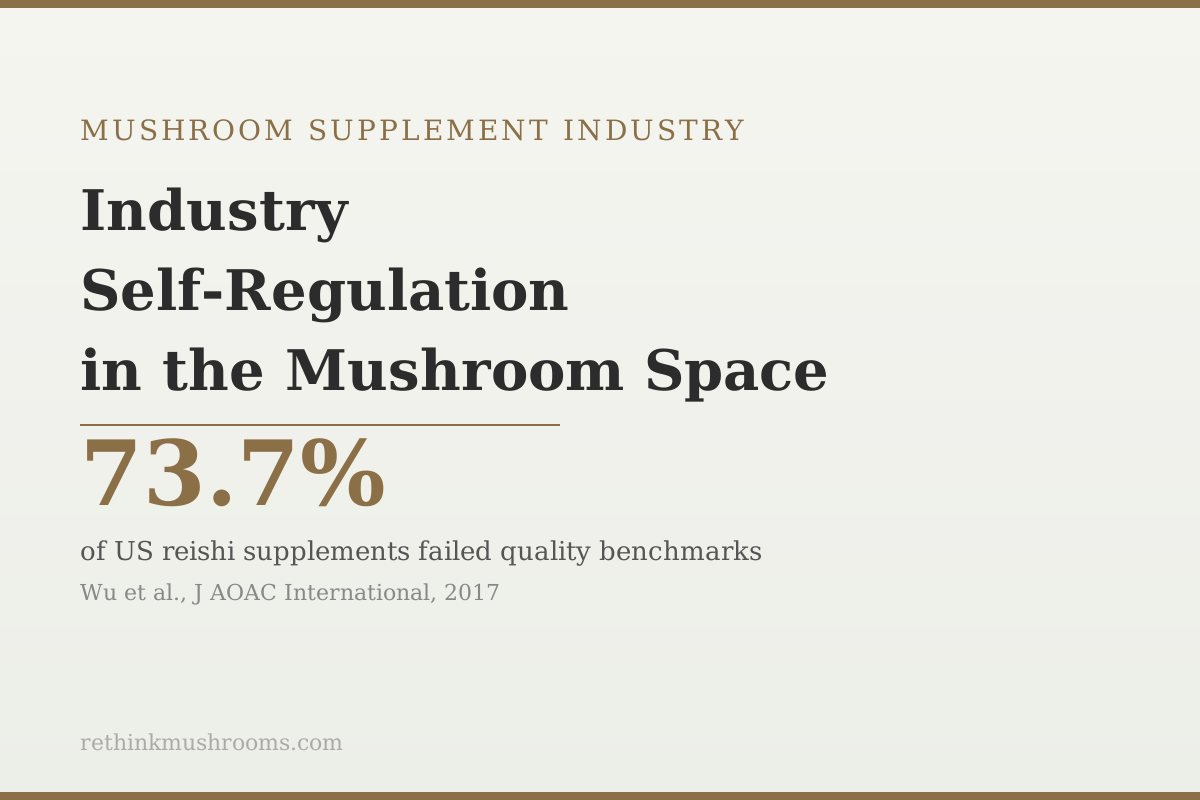
73.7% of US reishi supplements failed quality benchmarks
Despite a USP monograph for Ganoderma lucidum supplements existing as a reference standard, 73.7% of reishi supplements collected from US retail failed quality consistency benchmarks when independently tested. The standard existing and the standard being enforced are different things under current US dietary supplement law.
Wu et al., Journal of AOAC International, 2017
DSHEA 1994
the law that governs mushroom supplements as food products, requiring no proof of safety or efficacy before sale
28%
of dietary supplement manufacturers do not register with the FDA (the basic registration requirement) per Starr et al. (2015)
$60B+
US dietary supplement market size by 2025, the scale at which DSHEA's 30-year-old framework now operates (Wallace et al., 2025)
Wu et al., Journal of AOAC International, 2017
 View as image ↗
The question "does the FDA regulate mushroom supplements?" has a technically correct answer that most people find unsatisfying when they learn what it actually means. The FDA does regulate mushroom supplements, under the Dietary Supplement Health and Education Act of 1994 (DSHEA). What DSHEA requires is Good Manufacturing Practices, accurate labeling, and adverse event reporting. What it does not require is proof that the product works, proof that the product contains what it claims, or pre-market testing of any kind. The FDA operates reactively: it can take enforcement action after problems are documented, but it does not verify products before they reach consumers.
This framework governs a market now valued at over $60 billion. The consequences for mushroom supplement quality are significant and documented in peer-reviewed research. For the market context this regulation governs, see the functional mushroom market: size, growth, and projections.
Key Takeaways
- DSHEA (1994) classifies dietary supplements as food, not drugs, requiring no pre-market safety or efficacy proof; the FDA can only act after problems are reported, not before products are sold
- 73.7% of reishi supplements collected from US retail sources failed quality consistency benchmarks when tested, despite a USP reference monograph for Ganoderma existing as a quality guide (Wu et al., 2017)
- 28% of dietary supplement manufacturers did not register with the FDA even at the most basic level required by regulation, according to a 2015 analysis by Starr et al.
- USP pharmacopeial standards for botanical dietary supplements are voluntary but globally applicable to supply chains, providing a quality mechanism that reaches beyond US regulatory jurisdiction (Sarma et al., 2023)
- Mushroom-based supplements in Italian markets showed significant quality variation in testing, with multiple products failing to meet labeled claims, demonstrating that DSHEA-equivalent regulatory gaps are not unique to the United States (Risoli et al., 2023)
- The regulatory timeline for mushroom supplement labeling includes a June 2023 citizen petition (FDA-2023-P-2340) requesting clarity on mushroom vs. mycelium labeling, an FDA interim response in late 2023 that deferred a decision (citing competing agency priorities) rather than resolving the question, and the Functional Mushroom Council's formation in November 2025 as the industry's own answer
How DSHEA Created the Regulatory Framework
The Dietary Supplement Health and Education Act of 1994 is the law that has governed mushroom supplements, protein powders, vitamins, and all other dietary supplements for 30 years. Its fundamental architecture was a political compromise that determined the current regulatory reality.
DSHEA classified dietary supplements as a category of food, not as drugs. This classification meant supplements would not undergo the FDA pre-market approval process required for pharmaceuticals. Manufacturers could sell supplements without proving efficacy; they could not make specific drug claims (claiming to cure or treat a disease), but they could make structure/function claims (claiming to support immune health, for example) with relatively low evidentiary requirements.
Wallace and colleagues reviewed 30 years of DSHEA in 2025, noting that the law was designed for a much smaller, simpler market than now exists.[2] The US dietary supplement product catalog has grown from roughly 4,000 products in 1994 to more than 80,000 today, and the market now represents approximately $60 billion domestically. The 30-year-old framework was built for a category of vitamins and minerals, not a complex market of botanical extracts with varied chemistry and contested quality standards. Wallace's review documented the growing call in the public health and regulatory community for modernized oversight appropriate to the market's current scale.
The Structural Problem: Reactive Regulation and Quality Gaps
The DSHEA framework's reliance on reactive enforcement has documented consequences for product quality.
Starr and colleagues published a structural critique of US dietary supplement regulation in 2015 that remains relevant because the underlying regulatory architecture it describes has not changed.[1] Among the findings: 28% of dietary supplement manufacturers did not comply with the basic FDA registration requirement that all manufacturers are legally obligated to meet. If more than one in four manufacturers is not even registered, the population of manufacturers the FDA can monitor or inspect is structurally incomplete.
The reactive system means the FDA can investigate problems after they are reported but cannot systematically verify product quality before sale. For mushroom supplements specifically, this creates conditions where products making identical claims on their labels can have very different actual contents. The Ganoderma evaluation discussed below is a direct measure of that drift: when 19 US retail reishi products were independently tested, only about a quarter matched their label ingredients, a gap that a regulatory environment requiring no verification does nothing to close.
Reishi as the Case Study: Standards Exist, Enforcement Does Not
Wu and colleagues conducted a specific quality consistency evaluation of Ganoderma lucidum dietary supplements collected from US retail in 2017.[4] The finding is striking in its specificity: a USP reference monograph for Ganoderma existed as a quality standard when the study was conducted. The monograph defines what constitutes an acceptable Ganoderma product. Despite this standard existing and being available, 73.7% of retail products failed to meet the quality consistency benchmarks when tested.
This is the precise gap that critics of DSHEA point to: standards can exist (both voluntary and semi-official) without those standards being enforced or even commonly adopted. The USP monograph is not legally required. No manufacturer is obligated to comply with it. Products can fail its benchmarks and continue selling legally.
What the 73.7% failure rate means practically: if you purchased a reishi supplement from a US retailer without specific quality verification, the probability that it met established quality benchmarks was, in 2017, under 30%. The current situation may be better (the functional mushroom market's growth has attracted quality-conscious producers) or worse (more products means more variation). The structural regulatory situation that allowed 73.7% failures has not changed.
Wu, Deng, Chen, Zhao, Bzhelyansky & Li (2017) · Journal of AOAC International
- Population
- 19 batches of Ganoderma lucidum (Red Reishi) dietary supplements purchased from US retail
- Intervention
- Independent chemical profiling of triterpene and polysaccharide content against label claims, using chromatography and saccharide mapping
- Comparator
- The products' own label ingredient declarations and the USP Ganoderma reference monograph
- Finding
- Only 5 of the 19 products (26.3%) had measured ingredients in accordance with their labels — a 73.7% failure rate against quality-consistency benchmarks, even though a USP reference monograph for Ganoderma existed as a quality standard.
narrow-scope A rigorous but bounded snapshot: 19 batches from a single 2017 sampling of US retail. It documents that the quality gap is real and measurable, not that this exact failure rate holds today.
Wu et al., Journal of AOAC International (2017), PMID 28798349
What Happened with the Nammex Petition
The most specific regulatory action on mushroom labeling in recent years was a citizen petition filed by Nammex, a mushroom extract supplier, in June 2023 (FDA-2023-P-2340). The petition requested that the FDA clarify its labeling requirements to distinguish products made from actual mushroom fruiting bodies from products made from mycelium grown on grain (which may contain substantial grain starch and relatively little fungal material).
The petition addressed a genuine consumer confusion issue: products labeled as "mushroom" supplements that contain primarily mycelium-on-grain substrate rather than mushroom fruiting body, with the grain content not disclosed on the label, have generated significant debate within the industry and consumer advocacy community.
The FDA's interim response did not resolve the petition. In a letter dated November 30, 2023, the FDA's Office of Dietary Supplement Programs stated that it had not reached a decision within the first 180 days "due to competing agency priorities" and that the petition remained under evaluation. This was a deferral rather than a substantive ruling: the FDA neither granted the requested labeling clarification nor issued new guidance on the fruiting body versus mycelium question, leaving the issue unresolved.
This regulatory vacuum is the backdrop for the formation of the Functional Mushroom Council (FMC), launched in November 2025. The Council grew out of broader industry momentum rather than the petition alone, but its founding agenda directly targets the question the FDA declined to resolve: it is establishing common nomenclature (defining fruiting body, mycelium, and substrate) and voluntary testing and quality standards that allow quality-committed brands to differentiate from those that are not. The FMC represents the industry's own answer when regulatory action is not forthcoming.
Thirty Years of a Reactive Framework
From DSHEA to the Functional Mushroom Council
The mushroom-supplement quality gap is not an accident — it is what a reactive, food-not-drug framework produces. The arc below tracks how documented failures met regulatory deferral, and how the industry moved to self-regulate in the space the FDA declined to fill.
- 1994Law & regulator
DSHEA sets the framework
The Dietary Supplement Health and Education Act classifies supplements as a category of food, not drugs. No pre-market proof of safety, efficacy, or content is required; the FDA can act only reactively, after problems are reported.
- 2015Published evidence
The enforcement gap, quantified
Starr documents that the reactive system leaves the manufacturer population structurally incomplete: an Office of Inspector General figure cited in the review found 28% of supplement manufacturers fail to even register with the FDA.
- 2017Published evidence
Reishi puts a number on it
Wu and colleagues test 19 batches of US retail Ganoderma lucidum (reishi) supplements. Only about a quarter (26.3%) matched their label ingredients — a 73.7% failure rate against quality-consistency benchmarks, despite a USP reference monograph existing.
- 2023Published evidence
Standards exist; the gap is global
Sarma et al. review USP pharmacopeial standards — voluntary but internationally applicable to supply chains. The same year, Risoli et al. find comparable label-to-content variation in Italian mushroom supplements, showing the gap is not unique to US law.
- Jun 2023Law & regulator
Nammex petitions the FDA
Mushroom-extract supplier Nammex files citizen petition FDA-2023-P-2340, asking the FDA to require labels to identify the fungal part (fruiting body vs mycelium) and to disclose grain substrate — the core "mushroom vs mycelium-on-grain" confusion.
- Nov 2023Law & regulator
FDA defers
The FDA’s interim response states it has not reached a decision within the first 180 days "due to competing agency priorities," leaving the petition under evaluation. It is a deferral, not a substantive ruling — the labeling question stays unresolved.
- Nov 2025Industry self-regulation
The industry answers itself
With no FDA action, producers launch the Functional Mushroom Council — a nonprofit setting common nomenclature (fruiting body, mycelium, substrate) and voluntary testing and quality standards. Self-regulation fills the space regulation left open.
Sources: Wallace & Koturbash, J Diet Suppl (2025); Starr, Am J Public Health (2015); Wu et al., J AOAC Int (2017); Sarma et al. (2023); Risoli et al., Nutrients (2023); FDA citizen petition FDA-2023-P-2340 and the FDA Office of Dietary Supplement Programs interim response (Nov 30, 2023); and the Functional Mushroom Council launch (Nov 2025). The FDA interim response deferred a decision rather than denying the petition; the Council's founding was driven by broader industry momentum, and it directly addresses the labeling question the FDA left unresolved.
Voluntary Standards as the Practical Alternative
Given DSHEA's limitations, voluntary quality standards and third-party verification have become the primary quality mechanism in the dietary supplement industry, including mushroom supplements.
Sarma and colleagues reviewed pharmacopeial standards for botanical dietary supplements in 2023, analyzing what USP standards can accomplish that DSHEA enforcement cannot.[3] A key finding: USP pharmacopeial standards are voluntary but globally applicable. Manufacturers in China, Japan, or India who want to export to quality-conscious buyers can apply USP standards to their supply chain because USP is an internationally recognized reference. This gives voluntary standards a reach into international supply chains that US regulatory jurisdiction does not have.
The practical consequence: a mushroom supplement brand that requires its suppliers to meet USP specifications and then undergoes third-party verification of its finished product is operating to a quality standard that is in many respects more rigorous than a brand that merely complies with DSHEA minimums. The consumer challenge is identifying which brands have done this.
Third-party certifications that carry genuine quality meaning in the mushroom supplement space:
USP Verified: The USP mark indicates the product has been tested by USP's independent testing program to contain the ingredients stated on the label in declared potency and to meet USP's quality standards. This is the most rigorous commonly available certification.
NSF International (NSF/ANSI 173): NSF certifies that the product contains what it claims, is free from undisclosed ingredients, and was manufactured in a facility audited for Good Manufacturing Practices. NSF/ANSI 173 specifically applies to dietary supplements.
Informed Sport/Informed Choice: More relevant for sports nutrition; primarily tests for undisclosed performance-enhancing substances.
Label compliance research from 2024 documented trends toward voluntary adoption of these certifications by quality-focused manufacturers, driven partly by retailer requirements and partly by consumer demand as awareness of quality variation increases.[6]
The European Parallel
Quality variation in mushroom supplements is not a uniquely American problem. Risoli and colleagues analyzed mushroom-based supplements sold in Italy in 2023 and found significant variation from labeled claims when products were independently tested.[5]
European supplement regulation differs from DSHEA in specifics but shares the fundamental feature that pre-market verification of product contents is not systematically required for botanical supplements. The Italian study found that multiple products failed to contain the amounts or types of compounds their labels claimed, and that quality variation across brands was comparable to what US studies have found.
This international consistency in quality problems points to the regulatory common factor: when verification is voluntary, a significant portion of the market will not verify. This applies regardless of the specific regulatory framework, because the economic incentives run against self-testing: testing finds failures, and failures cost money to fix.
The practical implication for consumers buying mushroom supplements from any country is the same: the label is not a reliable guide to product contents without independent verification. Third-party certification is the primary tool available to consumers seeking quality assurance.
What Industry Self-Regulation Actually Covers
Industry self-regulation through voluntary certifications and organizations like the FMC addresses some quality concerns but not all of them.
What it addresses: compound identification (whether the product contains what it claims to contain), potency (whether the declared amounts are accurate), freedom from contaminants (heavy metals, pesticides, microbials), and manufacturing standards.
What it does not address: whether the compound concentration is therapeutically meaningful, whether the extraction method produces bioavailable compounds, whether the growing conditions that determine beta-glucan concentration were optimized. A certified product with 5% beta-glucan content is certified; a certified product with 40% beta-glucan content is also certified. The certification addresses accuracy and safety, not efficacy.
The evolution of voluntary standards in the mushroom space is genuinely improving the baseline quality floor of certified products. The ceiling question, whether any product produces the health outcomes marketed, remains a clinical evidence question that regulation cannot answer.
The Bottom Line
DSHEA's 30-year-old regulatory framework classifies mushroom supplements as food rather than drugs, enabling market sale without pre-market quality verification. The consequences are documented: 73.7% of reishi supplements failed quality benchmarks in independent testing despite USP standards existing (Wu et al., 2017), and 28% of manufacturers didn't even register with the FDA (Starr et al., 2015). The FDA's late-2023 deferral on clarifying mushroom versus mycelium labeling left the question unresolved, and the Functional Mushroom Council formed in November 2025 as the industry's self-regulatory response. Voluntary certifications (USP Verified, NSF/ANSI 173) provide independent quality verification that DSHEA enforcement does not, but address accuracy rather than efficacy.
Frequently Asked Questions
Sources & References
- 1RTHM-00735·Starr, Ranjani R (2015). “Too little, too late: ineffective regulation of dietary supplements in the United States..” American journal of public health.Study breakdown →PubMed →↩
- 2RTHM-02200·Wallace, Taylor C et al. (2025). “DSHEA 1994 - Celebrating 30 Years of Dietary Supplement Regulation in the United States..” Journal of dietary supplements.Study breakdown →PubMed →↩
- 3RTHM-01782·Sarma, Nandakumara et al. (2023). “Pharmacopeial Standards for the Quality Control of Botanical Dietary Supplements in the United States..” Journal of dietary supplements.Study breakdown →PubMed →↩
- 4RTHM-00499·Wu, Ding-Tao et al. (2017). “Evaluation on quality consistency of Ganoderma lucidum dietary supplements collected in the United States..” Scientific reports.Study breakdown →PubMed →↩
- 5RTHM-01778·Risoli, Samuele et al. (2023). “Mushroom-Based Supplements in Italy: Let's Open Pandora's Box..” Nutrients.Study breakdown →PubMed →↩
- 6. Source details for this reference are not yet available.