King Oyster (Pleurotus eryngii) & Inflammation
100 adults in the only human trial — IL-6 and oxidised LDL both fell
A three-month randomized controlled trial gave 100 metabolically unhealthy adults a daily king oyster mushroom snack. Inflammation was an explicit endpoint, and the pro-inflammatory cytokine IL-6 decreased — a fact routinely left out of consumer writing on this mushroom.
Kleftaki et al., Antioxidants, 2022
IL-6, ox-LDL
both decreased in the mushroom group of a 100-person RCT (Kleftaki 2022)
1% and 3%
of diet reduced colitis severity and raised gut short-chain fatty acids in mice (Hu 2019)
lesion area
significantly reduced in apoE-deficient mice fed 3% dried mushroom (Mori 2008)
Kleftaki et al., Antioxidants, 2022
 View as image ↗
Most consumer content on king oyster mushroom (Pleurotus eryngii) focuses on its texture and nutritional profile. The research on its effects on inflammatory conditions is almost entirely absent from consumer health writing, despite a body of preclinical data, one study in living human colonic tissue, and one human randomized controlled trial.
The honest answer to whether king oyster mushroom helps with inflammatory conditions is that the evidence spans gut inflammation, vascular inflammation, metabolic inflammation, and neuroinflammation, with a different evidence level for each — and that no human trial has enrolled people for a diagnosed inflammatory disease and measured whether they got better.
For a general introduction to king oyster mushroom and its health properties, see What Is King Trumpet Mushroom? The Meaty Mushroom with Health Benefits.
Key Takeaways
- The only human RCT on this species (Kleftaki and colleagues, Antioxidants, 2022) randomized 100 metabolically unhealthy adults for three months. Inflammation and oxidative stress were explicit endpoints, and both IL-6 and oxidised LDL decreased in the mushroom group
- That trial also regulated blood glucose and reduced body weight, fat mass, waist and hip circumference relative to a counselling-only control group, and significantly raised serum vitamin D2
- Hu and colleagues (Molecular Nutrition and Food Research, 2019) fed mice king oyster at 1% and 3% of diet by weight and significantly reduced DSS-induced colitis: disease index fell, colon length was preserved, colonic pro-inflammatory cytokines dropped, gut microbiota was restructured, and cecal short-chain fatty acids rose
- Kerezoudi and colleagues (Nutrients, 2025) took the gut work into human tissue: a fermented king oyster preparation restored the tight-junction proteins ZO-1 and claudin-1 in intestinal cells, and in colonic biopsies from healthy adult donors it maintained tissue integrity, reduced permeability and cut TNF-α, IL-6 and IL-1β via the TLR-4 and dectin-1 receptors
- Mori and colleagues (Nutrition Research, 2008) found significantly smaller atherosclerotic lesions in apoE-deficient mice fed 3% dried Pleurotus eryngii powder for ten weeks — though cholesterol lowering was transient and a different mushroom outperformed it
- In cell culture, only the ethanol extract was neuroprotective and anti-inflammatory; the hot-water extract — the one closest to cooking or tea — showed no activity on either measure (Kushairi 2020)
- No human trial has tested king oyster mushroom in people diagnosed with colitis, arthritis, or any other inflammatory disease. C-reactive protein and TNF-α were not among the reported human outcomes
What Conditions Has King Oyster Been Studied For? A Research Map
The research to date covers four areas: gut inflammation, vascular inflammation, metabolic inflammation, and neuroinflammation. Each sits at a different rung of the evidence ladder.
Evidence by Condition
Four Inflammatory Domains, Four Different Strengths of Evidence
“Anti-inflammatory mushroom” is not one claim about king oyster. It is four separate claims, each resting on a different kind of study. Bar width reflects how close that domain has come to a measured outcome in a living human being — not how large the effect was.
Metabolic inflammation
Human trialHuman RCT — 100 adults, 3 months
What moved: IL-6 and oxidised LDL both fell in the mushroom group; blood glucose regulated, body weight, fat mass, waist and hip circumference reduced, vitamin D status raised
What is still missing: CRP and TNF-α were not among the reported markers, and participants had metabolic disease, not a diagnosed inflammatory disease
Kleftaki 2022
Gut inflammation
Animal + human tissueMouse colitis model + human colonic tissue ex vivo
What moved: Dietary mushroom at 1% and 3% lowered disease index, preserved colon length, reduced colonic pro-inflammatory cytokines, reshaped gut microbiota and raised cecal short-chain fatty acids; in human colonic biopsies a fermented preparation restored tight-junction proteins and cut TNF-α, IL-6 and IL-1β
What is still missing: No trial has given king oyster to people with Crohn’s disease or ulcerative colitis and measured whether they got better
Hu 2019 · Kerezoudi 2025
Vascular inflammation
AnimalapoE-deficient mice, 3% dried powder, 10 weeks
What moved: Atherosclerotic lesion area at the aortic root was significantly smaller than controls
What is still missing: Cholesterol lowering was transient and Bunashimeji outperformed king oyster; the authors attributed the effect only partly to cholesterol and called for further mechanistic work
Mori 2008
Neuroinflammation
Cell culturePC12 neuronal cells + BV2 microglia in culture
What moved: The ethanol extract protected neurons against peroxide damage and suppressed nitric oxide release from activated microglia; both ethanol and hot-water extracts increased neurite-bearing cells
What is still missing: The hot-water extract — closest to what cooking or tea produces — had no neuroprotective or anti-inflammatory activity at all
Kushairi 2020
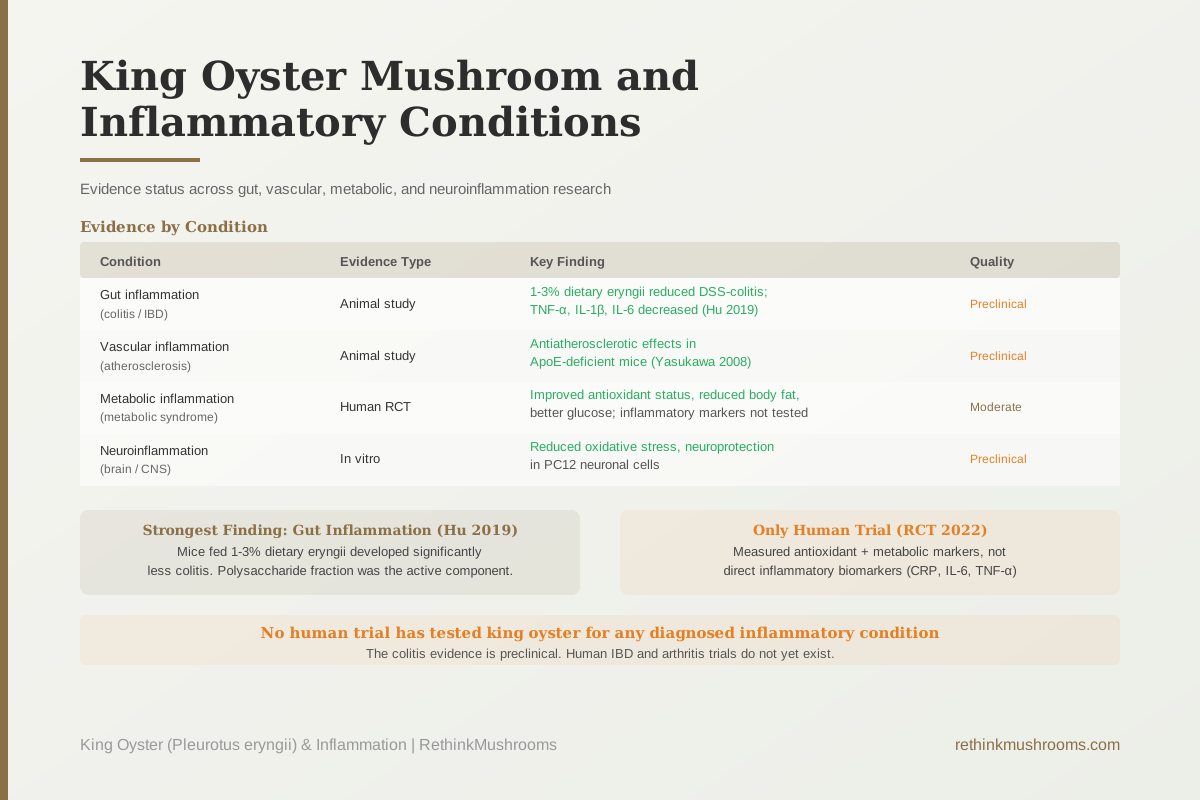
| Condition | Evidence Type | Key Finding | Evidence Quality |
|---|---|---|---|
| Metabolic inflammation | Human RCT (n=100) | IL-6 and ox-LDL decreased; glucose, body fat and vitamin D status improved | Moderate |
| Gut inflammation (colitis/IBD) | Animal + human tissue ex vivo | 1–3% dietary eryngii reduced DSS-colitis severity and raised SCFAs; tight junctions restored in intestinal cells, and barrier integrity preserved with TNF-α, IL-6, IL-1β cut in human colonic biopsies | Preclinical |
| Vascular inflammation (atherosclerosis) | Animal study | Significantly reduced aortic lesion area in apoE-deficient mice | Preclinical |
| Neuroinflammation | In vitro | Ethanol extract only: neuroprotection in PC12 cells, suppressed nitric oxide in microglia | Preclinical |
No human trial has tested king oyster mushroom for any of these conditions in people who carry that diagnosis. The RCT was conducted in metabolically unhealthy adults, a population defined by metabolic rather than inflammatory disease.
Metabolic Inflammation: The Human Evidence, Correctly Stated
Metabolic syndrome — central obesity, high blood sugar, high triglycerides, elevated blood pressure — is sustained by systemic low-grade inflammation. Visceral fat is not inert storage; it actively releases pro-inflammatory cytokines that keep the whole body in a low-level inflammatory state. This is why metabolic syndrome is classified as an inflammatory condition even without the acute symptoms of colitis or arthritis.
Kleftaki and colleagues published the only randomized controlled trial on Pleurotus eryngii with inflammatory outcomes in 2022.[3] One hundred metabolically unhealthy patients consented and were randomized into two arms for three months. Both arms received conventional nutritional counselling for metabolic disorders; the intervention arm additionally ate a daily mushroom snack, baked and then UV-B irradiated to raise its vitamin D2 content.
The Only Human Trial
What the King Oyster RCT Actually Measured
One hundred metabolically unhealthy adults, randomised for three months. Both groups got nutritional counselling; one group also ate a daily baked, UV-B-treated king oyster snack. It is widely repeated that this trial captured only antioxidant and metabolic surrogates. That is not correct — inflammation was an explicit endpoint, and IL-6 fell.
Inflammation & oxidative stress — measured, and they moved
This is the part most summaries of this trial get wrong.
IL-6
A core pro-inflammatory cytokine — the same one implicated in gut, vascular and metabolic inflammation. It decreased in the mushroom group.
Oxidised LDL
The form of LDL that actually triggers immune activation in the artery wall. Its fall is the most directly vascular-relevant human result on this species.
Metabolic & body composition — measured, and they moved
Reported as changes relative to the counselling-only control arm.
Blood glucose
Glucose levels were regulated compared with the control group.
Body weight, fat mass, waist and hip circumference
All reduced versus control — relevant because adipose tissue is itself a source of inflammatory signalling.
Serum 25(OH)D2
Rose significantly. The snack was UV-B irradiated after baking specifically to raise vitamin D2 content.
LDL cholesterol and SGOT
Lower only within the intervention arm — a weaker form of evidence than a between-group difference.
Never reported
The honest limit of this trial.
C-reactive protein (CRP)
The inflammatory marker most people are actually tested for in clinic does not appear among the reported outcomes.
TNF-α
Reduced by king oyster preparations in mouse and human-tissue work, but not reported in this human trial.
Any diagnosed inflammatory disease outcome
Participants were metabolically unhealthy adults. Nobody was enrolled for colitis, arthritis, or any inflammatory diagnosis.
The result most often misreported is this one: the trial measured inflammation directly, and IL-6 decreased in the mushroom group. Oxidised LDL fell as well. A great deal of secondary writing on this mushroom — including an earlier version of this article — states that the trial captured only antioxidant and metabolic surrogates and that any inflammatory relevance is indirect. That is not what the paper reports. Interleukin-6 is a first-line pro-inflammatory cytokine, and its reduction in a randomized human trial is the single strongest piece of evidence that exists for king oyster mushroom and inflammation in people.
The trial's honest limits are real and worth stating plainly. C-reactive protein and TNF-α — the markers most people are actually tested for, and the ones reduced by king oyster preparations in animal and tissue work — do not appear among the reported outcomes. LDL cholesterol and SGOT improved only within the intervention arm rather than against the control group, which is a weaker form of evidence than a between-group difference. And the participants had metabolic disease, not an inflammatory diagnosis.
For context on the ergothioneine angle specifically, see King Trumpet for Longevity: The Ergothioneine Connection.
Gut Inflammation: The Colitis Study That Consumer Content Never Cites
The most directly relevant animal evidence is a 2019 study by Hu and colleagues in Molecular Nutrition and Food Research.[1]
Hu and colleagues fed mice Pleurotus eryngii at 1% and 3% of total diet by weight. At both concentrations, the mushroom alleviated colonic inflammation: the disease index decreased, colon length increased, and pro-inflammatory cytokines in the colonic mucosa were reduced.
Hu, Yuan, Wu, et al. (2019) · Molecular Nutrition & Food Research
- Population
- Mice with dextran-sodium-sulfate-induced colitis
- Intervention
- Whole P. eryngii mushroom at 1% and 3% of diet by weight
- Comparator
- DSS-challenged control mice on standard diet
- Finding
- Decreased disease index, increased colon length, and reduced pro-inflammatory cytokines in the colonic mucosa. 16S rRNA sequencing showed the mushroom significantly altered microbiota structure and partially reversed the DSS-induced shift, while short-chain fatty acids in the cecum increased.
positive Strong, coherent preclinical result — but a mouse injury model, not human IBD.
Hu Q, Yuan B, Wu X, et al. Mol Nutr Food Res. 2019;63(17):e1801265. PMID 31125180.
The microbiome half of this result is the part consumer coverage misses entirely. The mushroom did not only damp down cytokines — it restructured the gut bacterial community and partially reversed the disruption DSS had caused, and short-chain fatty acid levels in the cecum rose. Short-chain fatty acids such as butyrate are the primary fuel for colon lining cells and are themselves anti-inflammatory, which offers a mechanism for the cytokine result rather than merely an association with it. The authors framed the mushroom explicitly as a potential prebiotic agent. That thread is picked up in King Oyster Mushroom and Microbiome Diversity.
In 2025, Kerezoudi and colleagues moved this line of work into human tissue.[5] Working with Caco-2 intestinal cells and, more importantly, colonic biopsies taken from healthy adult donors, they tested a king oyster preparation fermented with human fecal microbiota against a bile-acid stressor that disrupts the gut barrier. In the Caco-2 cells, where the stressor had suppressed ZO-1, occludin and claudin-1, the preparation restored ZO-1 and claudin-1 without harming cell viability. In the human biopsies it maintained tissue integrity and selectively reduced transcellular permeability while leaving the paracellular route unaffected. Across both systems it cut the pro-inflammatory cytokines TNF-α, IL-6 and IL-1β. It acted through the TLR-4 and dectin-1 receptors — dectin-1 being the specific receptor that recognises fungal beta-glucans, which puts a named molecular address on the vague claim that mushroom polysaccharides "interact with gut immune cells."
This is still not a clinical trial. It is human tissue in a dish rather than a person with a disease. But it is a meaningful step above a mouse model, and it is the closest thing to human gut evidence that exists for this species. For the molecular pathway detail, see Pleurotus eryngii and NF-κB Inhibition.
The critical caveat stands: no human IBD trial on Pleurotus eryngii exists. A dietary level of 1–3% would correspond to a meaningful daily mushroom intake in a person, but dose equivalence across species is uncertain.
Vascular Inflammation: The Atherosclerosis Connection
Atherosclerosis is fundamentally an inflammatory disease. Oxidised cholesterol particles trigger an immune response in artery walls, and chronic inflammatory signalling drives plaques to grow and become unstable. Drugs that reduce vascular inflammation, not just cholesterol, are among the most important in modern cardiovascular medicine.
Mori and colleagues tested three edible mushrooms, including Pleurotus eryngii, in apolipoprotein E-deficient mice in 2008.[2] ApoE-deficient mice lack a protein needed to clear cholesterol from the bloodstream and develop atherosclerotic plaques spontaneously, which makes them the standard model for cardiovascular inflammation research. The mice were fed a normal diet containing 3% dried mushroom powder for ten weeks, and lesion area was measured in cross-sections of the aortic root.
Atherosclerotic lesions were significantly smaller in the king oyster group than in controls. But the details matter, and they cut against an enthusiastic reading. Serum total cholesterol in the eryngii group was significantly lower than control at only one timepoint — twelve weeks of age — rather than throughout. There was no difference in triglycerides in any group. And of the three mushrooms tested, Bunashimeji (Hypsizygus marmoreus), not king oyster, had the strongest antiatherosclerotic effect. The authors concluded that the effect was "partly via lowering of serum TC" and stated explicitly that further mechanisms should be investigated.
That last point is worth holding onto, because it is often overwritten. It is frequently claimed that king oyster's antiatherosclerotic effect works through LDL oxidation and direct anti-inflammatory action in the arterial wall. The 2008 paper does not demonstrate that; it reports a lesion-area result, a weak and transient cholesterol effect, and an open question about mechanism. The Kleftaki trial's finding that oxidised LDL fell in humans is genuine independent support for the oxidation half of that idea — but it comes from the 2022 trial, not from the mouse study.
This study is nearly two decades old, conducted in one mouse model, and has not been replicated in humans. It establishes a mechanistic rationale. It does not constitute clinical evidence for cardiovascular disease benefit.
Neuroinflammation: Promising Preclinical Data, With an Important Catch
The fourth area is neuroinflammation: inflammation in the brain and nervous system that underlies conditions from chronic headaches to Alzheimer's disease to multiple sclerosis.
Kushairi and colleagues compared hot water and ethanol extracts of Pleurotus eryngii across three activities in cell culture in 2020.[4] The results were not uniform, and the difference between the two extracts is the whole story.
Hydrogen peroxide cut the viability of PC12 neuronal cells to roughly 68%. The ethanol extract restored viability dose-dependently, reaching about 98% at 400 µg/mL — but the hot water extract showed no neuroprotective activity at all. In BV2 microglia stimulated with bacterial lipopolysaccharide, nitric oxide release rose more than tenfold; the ethanol extract significantly reduced it, and again the hot water extract was ineffective. Only on neurite outgrowth did both extracts work, and there the hot water extract was actually the stronger of the two, raising neurite-bearing cells from about 5% to roughly 21%.
Preparation matters
Does cooking king oyster mushroom deliver its anti-inflammatory effects?
The claim
“King oyster extracts protect neurons and calm inflammation, so eating or brewing the mushroom delivers those effects.”
Secondary coverage tends to report 'extracts of P. eryngii' as a single category, collapsing the ethanol and hot water results into one finding.
What research shows
Context DependentIn the direct head-to-head comparison, only the ethanol extract was neuroprotective against oxidative damage and only the ethanol extract suppressed nitric oxide in activated microglia. The hot water extract — the preparation most similar to cooking or tea — showed no activity on either measure.
Both extracts did promote neurite outgrowth, and the hot water extract was stronger there. So water-soluble compounds are not inert; they simply do not carry the neuroprotective and anti-inflammatory activity. Separately, the whole-food evidence for gut and metabolic inflammation comes from eating the mushroom, not from extracts, and that evidence still stands.
Kushairi N, Phan CW, Sabaratnam V, et al. Int J Med Mushrooms. 2020;22(12):1171-1181. PMID 33463934.
These are promising mechanistic findings, but they are entirely in cell culture, and the extract that worked is not the one your dinner produces. This research is covered in depth in King Oyster and Neuroinflammation: COX-2 and iNOS Suppression, and King Trumpet and Oxidative Stress-Driven Inflammation covers the oxidative-stress mechanism.
Is King Oyster Mushroom Good for Arthritis?
Arthritis is not among the conditions king oyster mushroom has been tested for in any study. Rheumatoid arthritis is driven by autoimmune-triggered inflammation; osteoarthritis involves cartilage degradation with a secondary inflammatory component. Both involve cytokine pathways — including IL-6, the cytokine that fell in the human trial — that king oyster preparations have been shown to affect elsewhere.
The honest answer is that the mechanisms identified are relevant to inflammation generally, which includes arthritic inflammation. But no arthritis-specific data on Pleurotus eryngii exists in either animal or human research. Extrapolating from a cytokine reduction in metabolically unhealthy adults, or from receptor signalling in colonic tissue, to symptom relief in a human arthritis patient involves several scientific steps that have not been taken.
Using this information
ModerateKing oyster is a food, not a treatment for a diagnosed inflammatory disease
Concern
Because the mechanistic and preclinical evidence is genuinely broad, it is easy to read it as licence to manage an inflammatory condition with diet. No trial has tested king oyster mushroom in anyone with a diagnosed inflammatory disease, and delaying or substituting established treatment for IBD, rheumatoid arthritis, or cardiovascular disease carries real risk of irreversible harm.
What the research says
Treat king oyster as one component of an anti-inflammatory dietary pattern alongside, not instead of, prescribed treatment. Any change to a treatment plan for a diagnosed condition belongs with the clinician managing it.
Particularly relevant for: People with diagnosed inflammatory bowel disease, rheumatoid arthritis, or cardiovascular disease
What to do
Discuss dietary changes with your physician before altering any treatment regimen. This article is research summary, not medical advice.
No human trial of Pleurotus eryngii has enrolled participants with a diagnosed inflammatory condition; the sole RCT (Kleftaki 2022) studied metabolically unhealthy adults.
What the Evidence Does and Doesn't Say
- Cell culturecompleted
Ethanol extract protects PC12 neurons and suppresses nitric oxide in microglia; hot water extract inactive on both (Kushairi 2020)
- Animal modelscompleted
Colitis severity, colonic cytokines and microbiota in mice (Hu 2019); aortic lesion area in apoE-deficient mice (Mori 2008)
- Human tissue, ex vivocompleted
Tight-junction proteins restored in intestinal cells; barrier integrity preserved and TNF-α, IL-6, IL-1β reduced in colonic biopsies from healthy donors via TLR-4 and dectin-1 (Kerezoudi 2025)
- Randomized controlled trialcurrent
100 metabolically unhealthy adults, 3 months: IL-6 and oxidised LDL decreased, glucose and body composition improved (Kleftaki 2022)
- Trial in a diagnosed inflammatory diseasemissing
No trial has enrolled people with IBD, arthritis, or any inflammatory diagnosis and measured whether their disease improved
- Meta-analysismissing
Impossible with a single human trial on this species
The chain runs unbroken from cell culture to human tissue to one randomized trial with a positive inflammatory endpoint — which is further than most culinary mushrooms get. What is missing is the top rung: nobody has given king oyster to patients who have an inflammatory disease and asked whether it helped.
Kushairi 2020 (PMID 33463934); Hu 2019 (PMID 31125180); Mori 2008 (PMID 19083429); Kerezoudi 2025 (PMID 40005021); Kleftaki 2022 (PMID 36358485).
What it establishes:
- In a randomized trial of 100 adults, a daily king oyster snack lowered IL-6 and oxidised LDL alongside improvements in glucose regulation, body composition and vitamin D status
- At 1% and 3% of the diet, Pleurotus eryngii reduces DSS-induced colitis in mice, lowers colonic pro-inflammatory cytokines, restructures gut microbiota and raises short-chain fatty acids
- A fermented king oyster preparation restores tight-junction proteins in intestinal cells and, in human colonic tissue ex vivo, preserves barrier integrity while reducing TNF-α, IL-6 and IL-1β through TLR-4 and dectin-1 signalling
- King oyster significantly reduced atherosclerotic lesion area in an apoE-deficient mouse model, though it was outperformed by another mushroom in the same experiment
- The ethanol extract, specifically, is neuroprotective and anti-inflammatory in neuronal and microglial cell culture
What it does not establish:
- That king oyster mushroom improves outcomes in people diagnosed with an inflammatory disease — no such trial exists
- That the doses used in animal studies translate to practical human dietary intake levels
- That C-reactive protein or TNF-α move in humans; neither was reported in the only human trial
- That cooked or brewed king oyster carries the neuroprotective and anti-inflammatory activity seen in cell culture, since the hot-water extract was inactive on both measures
- Clinical benefit for arthritis specifically, where no animal or human data exists at all
The framing that fits the evidence: king oyster mushroom as part of an anti-inflammatory dietary pattern is supported, and better supported than for most culinary mushrooms, because one randomized human trial moved a real inflammatory marker. As a standalone treatment for a specific inflammatory condition, the evidence does not support that claim. The colitis and colonic-tissue data are promising enough to warrant a human IBD trial, but that trial has not been conducted.
For the full anti-inflammatory research picture for king oyster, see King Trumpet and Inflammation: Research Review.
The Bottom Line
Pleurotus eryngii (king oyster mushroom) has been studied across gut, vascular, metabolic and neuro-inflammation. The strongest evidence is human: a 2022 randomized controlled trial in 100 metabolically unhealthy adults measured inflammation directly and found IL-6 and oxidised LDL both decreased over three months, alongside better glucose regulation and reduced body fat. Preclinically, dietary eryngii at 1–3% reduced DSS-colitis in mice while restructuring gut microbiota and raising short-chain fatty acids, and a fermented preparation restored tight junctions in intestinal cells while preserving barrier integrity and cutting TNF-α, IL-6 and IL-1β in human colonic biopsies via TLR-4 and dectin-1. In apoE-deficient mice it reduced atherosclerotic lesion area, though transiently and less effectively than Bunashimeji. In neuronal cell culture only the ethanol extract was active — the hot-water extract was not. No human trial has enrolled anyone with a diagnosed inflammatory disease, and CRP and TNF-α were never reported in humans.
Frequently Asked Questions
Sources & References
- 1RTHM-00560·Hu, Qiuhui et al. (2019). “Dietary Intake of Pleurotus eryngii Ameliorated Dextran-Sodium-Sulfate-Induced Colitis in Mice..” Molecular nutrition & food research.Study breakdown →PubMed →↩
- 2RTHM-00267·Mori, Koichiro et al. (2008). “Antiatherosclerotic effect of the edible mushrooms Pleurotus eryngii (Eringi), Grifola frondosa (Maitake), and Hypsizygus marmoreus (Bunashimeji) in apolipoprotein E-deficient mice..” Nutrition research (New York.Study breakdown →PubMed →↩
- 3RTHM-00771·Kleftaki, Stamatia-Angeliki et al. (2022). “A Randomized Controlled Trial on Pleurotus eryngii Mushrooms with Antioxidant Compounds and Vitamin D2 in Managing Metabolic Disorders..” Antioxidants (Basel.Study breakdown →PubMed →↩
- 4RTHM-01224·Kushairi, Naufal et al. (2020). “Comparative Neuroprotective, Anti-Inflammatory and Neurite Outgrowth Activities of Extracts of King Oyster Mushroom, Pleurotus eryngii (Agaricomycetes)..” International journal of medicinal mushrooms.Study breakdown →PubMed →↩
- 5RTHM-02104·Kerezoudi, Evangelia N et al. (2025). “Pleurotus eryngii Mushrooms Fermented with Human Fecal Microbiota Protect Intestinal Barrier Integrity: Immune Modulation and Signalling Pathways Counter Deoxycholic Acid-Induced Disruption in Healthy Colonic Tissue..” Nutrients.Study breakdown →PubMed →↩