Shiitake (Lentinula edodes)
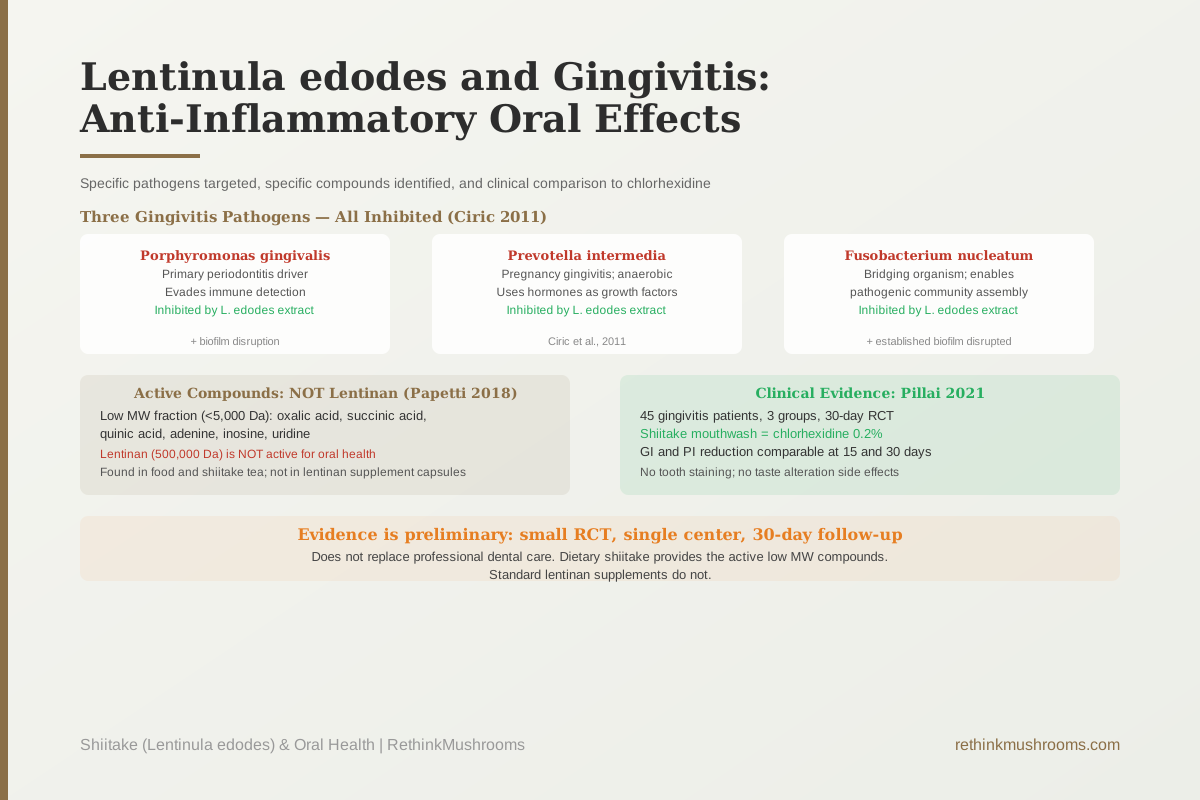
3 pathogens responsible for gingivitis all inhibited by Lentinula edodes extract (Ciric 2011)
Ciric and colleagues tested shiitake extract against the three bacteria that cause gum disease and found it killed all three while also disrupting established biofilms. A 2021 clinical trial then found shiitake mouthwash comparable to chlorhexidine for gingivitis.
Ciric et al., Journal of Biomedicine & Biotechnology, 2011
P. gingivalis
the primary driver of periodontitis (severe gum disease), inhibited by shiitake extract in vitro
low MW fraction
the active compounds are small molecules under 5,000 Da, NOT lentinan (Papetti 2018)
Pillai 2021
45-patient RCT: shiitake mouthwash reduced gingival index comparably to chlorhexidine at 30 days
Ciric et al., Journal of Biomedicine & Biotechnology, 2011
 View as image ↗
Gingivitis affects the majority of adults at some point in their lives and is the entry point for periodontitis, the severe form of gum disease that is associated with tooth loss and systemic inflammatory conditions. The standard pharmaceutical treatment for gingivitis is chlorhexidine mouthwash, which works well but produces side effects including tooth staining, altered taste perception, and disruption of the oral microbiome with prolonged use.
The research on Lentinula edodes (shiitake mushroom) and gum disease is specific, mechanistic, and almost entirely absent from mainstream health content. This article covers what the research shows: which bacteria shiitake extract targets, which compounds are responsible, and what a clinical trial in gingivitis patients found.
For a broader view of shiitake's oral health evidence, see Shiitake for Oral Health: Can It Fight Cavities and Gum Disease?. For a general introduction to shiitake mushroom and its health properties, see What Is Shiitake Mushroom? The Culinary Mushroom with Medicinal Power.
Key Takeaways
- Ciric and colleagues (Journal of Biomedicine and Biotechnology, 2011) tested Lentinula edodes extract against Porphyromonas gingivalis, Prevotella intermedia, and Fusobacterium nucleatum: the three primary bacteria responsible for gingivitis; all three were significantly inhibited and established biofilms were disrupted
- Papetti and colleagues (Food and Function, 2018) identified the specific compounds responsible for shiitake's anti-biofilm activity: oxalic acid, succinic acid, quinic acid, adenine, inosine, and uridine from the low molecular weight fraction (under 5,000 Da)
- The active oral health compounds are NOT lentinan; lentinan is too large (molecular weight approximately 500,000 Da) to produce the same local antibacterial effects; this distinction has practical implications for which shiitake products are relevant for oral health
- Pillai and colleagues (Journal of Oral Hygiene and Health, 2021) conducted a 45-patient clinical trial comparing shiitake mouthwash against chlorhexidine 0.2% and scaling and root planing alone; shiitake mouthwash showed significant reductions in gingival index and plaque index comparable to chlorhexidine at both 15-day and 30-day follow-up
- The anti-inflammatory mechanism is dual: shiitake compounds both kill gingivitis bacteria directly and reduce gingival inflammation through mechanisms that include inhibition of pro-inflammatory cytokine production
- The active oral health compounds are found in shiitake tea, broth, and food preparations; standard lentinan extract capsules do not provide the same low molecular weight compounds
What Causes Gingivitis: The Three Bacterial Culprits
Gingivitis is inflammation of the gingiva (gum tissue) caused by bacterial overgrowth in the dental biofilm (plaque) that forms along the gum line. When bacteria accumulate faster than oral hygiene removes them, certain pathogenic species dominate the plaque community and trigger an immune-inflammatory response in the surrounding gum tissue.
Three species are central to this process:
Porphyromonas gingivalis is the most pathogenic of the three and the primary driver of the progression from gingivitis to periodontitis. It produces protease enzymes that break down gum tissue, evades immune detection, and disrupts the host's inflammatory response in ways that allow chronic infection to persist. It is sometimes described as a "keystone pathogen" because relatively small amounts of P. gingivalis can dysregulate the entire gum microbial community.
Prevotella intermedia is associated with both gingivitis and periodontal disease. It is particularly implicated in pregnancy-associated gingivitis, as it can use hormones as growth factors. P. intermedia produces toxins that damage gum tissue and contributes to the anaerobic conditions in which pathogenic biofilm communities thrive.
Fusobacterium nucleatum acts as a bridging organism: it connects early-colonizing bacteria (which are generally less pathogenic) to late-colonizing bacteria (which are more pathogenic). By serving as a scaffold for community assembly, F. nucleatum helps create the conditions in which P. gingivalis can establish and persist.
Understanding these bacteria matters because any research on oral health interventions can be evaluated against the question: does it actually target the organisms that drive the disease?
What Ciric 2011 Found: All Three Targeted
Ciric and colleagues published a 2011 study in the Journal of Biomedicine and Biotechnology specifically designed to assess the antigingivitis potential of shiitake mushroom extract.[1]
The study tested Lentinula edodes extract against all three major gingivitis pathogens: Porphyromonas gingivalis, Prevotella intermedia, and Fusobacterium nucleatum. All three were significantly inhibited by the extract. Additionally, the study tested shiitake extract against established biofilms (not just planktonic bacteria) and found disruption of the biofilm structure.
This second finding matters because the pathogenic bacteria in gingivitis exist primarily in biofilm form, not as free-floating single cells. Biofilm bacteria are substantially more resistant to antibacterial agents than the same species in suspension, typically 100 to 1,000 times more resistant. An extract that disrupts established biofilms, rather than just killing free bacteria, has more clinical relevance.
The Ciric 2011 study validated shiitake extract as a potential antigingivitis agent with specific pathogen targets that match the bacterial drivers of the disease.
The Active Compounds: Not Lentinan
Lentinan is shiitake's most famous bioactive compound, a beta-glucan polysaccharide with documented immune-modulating and anti-cancer adjuvant effects. It is the compound most consumers think of when they consider shiitake supplements.
For gingivitis and oral health specifically, lentinan is not the relevant compound. Papetti and colleagues published a 2018 study in Food and Function identifying the specific compounds in Lentinula edodes responsible for antibiofilm activity against both caries and gingivitis bacteria.[2]
The active fraction was the low molecular weight fraction: compounds under 5,000 Daltons in molecular weight. Lentinan has a molecular weight of approximately 500,000 Daltons, placing it far outside the active fraction. The compounds Papetti 2018 identified were: oxalic acid, succinic acid, quinic acid, adenine, inosine, and uridine.
These are small organic acids and nucleoside compounds present in shiitake tissue. They are water-soluble and are released when shiitake is cooked, steeped in hot water (as in shiitake tea or broth), or otherwise prepared as food. They are present in the liquid that comes from cooking shiitake.
The practical implication: a shiitake tea or broth provides the low molecular weight compounds with gingivitis-inhibitory activity. A standard lentinan extract capsule or supplement does not, because the extraction and purification process concentrates the high molecular weight polysaccharide (lentinan) and removes the small molecule fraction.
For a deeper analysis of which shiitake compounds are responsible for dental plaque disruption, see Shiitake and Dental Plaque: Antibiofilm Research.
The Clinical Evidence: Shiitake vs. Chlorhexidine
The strongest piece of evidence in this cluster is a clinical trial, though it is small and from an open-access journal.
Pillai and colleagues published a 2021 study in the Journal of Oral Hygiene and Health evaluating Lentinula edodes mouthwash in patients with diagnosed gingivitis. The trial enrolled 45 patients with gingivitis and assigned them to one of three groups: shiitake mouthwash plus scaling and root planing (SRP), chlorhexidine 0.2% mouthwash plus SRP, or SRP alone.
Two clinical outcomes were measured: the Gingival Index (GI, a standardized measure of gum inflammation based on color, contour, consistency, and bleeding on probing) and the Plaque Index (PI, a standardized measure of dental plaque accumulation). Both were assessed at baseline, 15 days, and 30 days.
The result: the shiitake mouthwash group showed significant reductions in both GI and PI at both follow-up timepoints. There was no statistically significant difference in GI or PI reduction between the shiitake mouthwash group and the chlorhexidine group. Both active treatment groups showed greater improvement than the SRP-alone group.
Chlorhexidine 0.2% is the pharmaceutical gold standard for antibacterial mouthwash in gingivitis treatment. Comparable performance to chlorhexidine in a clinical trial, without chlorhexidine's known side effects (tooth staining, altered taste perception, dysbiosis effects on the oral microbiome), is a meaningful result.
The limitations are equally important to state clearly: 45 patients is a small sample. Single-center trials can reflect local conditions and patient selection. Thirty-day follow-up does not establish long-term efficacy or safety. Open-access journal publication requires careful evaluation. This is a promising pilot result, not a definitive clinical recommendation.
The Anti-Inflammatory Mechanism
Shiitake's effects on gingivitis are not limited to direct antibacterial activity. There is a secondary anti-inflammatory mechanism worth understanding.
Gingivitis is fundamentally an inflammatory disease. The bacteria do not directly cause the tissue damage associated with gum disease; the host immune-inflammatory response to the bacteria does. Chronic bacterial stimulation triggers the release of pro-inflammatory cytokines (IL-1beta, TNF-alpha, IL-6) and prostaglandins in gum tissue, and it is this sustained inflammatory state that damages gum tissue and bone over time.
Shiitake compounds have documented anti-inflammatory properties through mechanisms that include inhibition of COX-2 (cyclooxygenase-2, the enzyme that produces prostaglandins) and suppression of NF-kB signaling (which drives inflammatory cytokine production). These are the same pathways targeted by non-steroidal anti-inflammatory drugs and by many pharmaceutical anti-inflammatory agents.
This dual mechanism, direct antibacterial killing of the pathogens and reduction of the inflammatory response those pathogens trigger, makes the oral health picture for shiitake more complex than simple antibacterial activity. An agent that both reduces pathogen load and dampens the inflammatory response to remaining bacteria may offer advantages over purely antibacterial approaches.
What This Means Practically
The research supports shiitake as a dietary and topical oral health ingredient with a specific evidence base, not as a replacement for professional dental care.
For dietary use: regular consumption of cooked shiitake mushrooms provides the low molecular weight compounds (oxalic acid, succinic acid, quinic acid, adenine, inosine, uridine) that Papetti 2018 identified as the active oral health fraction. Shiitake in soups, stir-fries, or as a tea provides these compounds in their bioavailable water-soluble form.
For mouthwash use: the Pillai 2021 trial used a shiitake mushroom aqueous extract as a mouthwash. This is essentially shiitake tea used as a rinse. Commercial shiitake mouthwash products are not widely available, but preparing shiitake tea (steeping dried or fresh shiitake in hot water, straining, and cooling to comfortable temperature for rinsing) is a straightforward preparation that provides the active compounds.
For supplement users: standard lentinan capsules and shiitake polysaccharide supplements do not provide the low molecular weight gingivitis-active fraction. If oral health is the goal, food preparation or aqueous extract (tea) is more relevant than concentrated lentinan supplements.
For the broader shiitake mouthwash evidence, including preparation guidance, see Shiitake Mouthwash: Is It Effective?.
The Bottom Line
Lentinula edodes (shiitake mushroom) extract showed significant antibacterial activity against all three major gingivitis pathogens (Porphyromonas gingivalis, Prevotella intermedia, Fusobacterium nucleatum) and disrupted established biofilms (Ciric 2011). The active compounds are low molecular weight small molecules (oxalic acid, succinic acid, quinic acid, adenine, inosine, uridine in the fraction under 5,000 Da), not lentinan (Papetti 2018). A 45-patient clinical trial (Pillai 2021) found shiitake mouthwash produced gingival index and plaque index reductions comparable to chlorhexidine 0.2% at 30 days. The evidence is preliminary but specific and mechanistically coherent.
Frequently Asked Questions
Sources & References
- 1RTHM-00391·Ciric, Lena et al. (2011). “In vitro assessment of shiitake mushroom (Lentinula edodes) extract for its antigingivitis activity..” Journal of biomedicine & biotechnology.Study breakdown →PubMed →↩
- 2RTHM-00990·Papetti, Adele et al. (2018). “Components in Lentinus edodes mushroom with anti-biofilm activity directed against bacteria involved in caries and gingivitis..” Food & function.Study breakdown →PubMed →↩