Emerging & Specialty Mushrooms
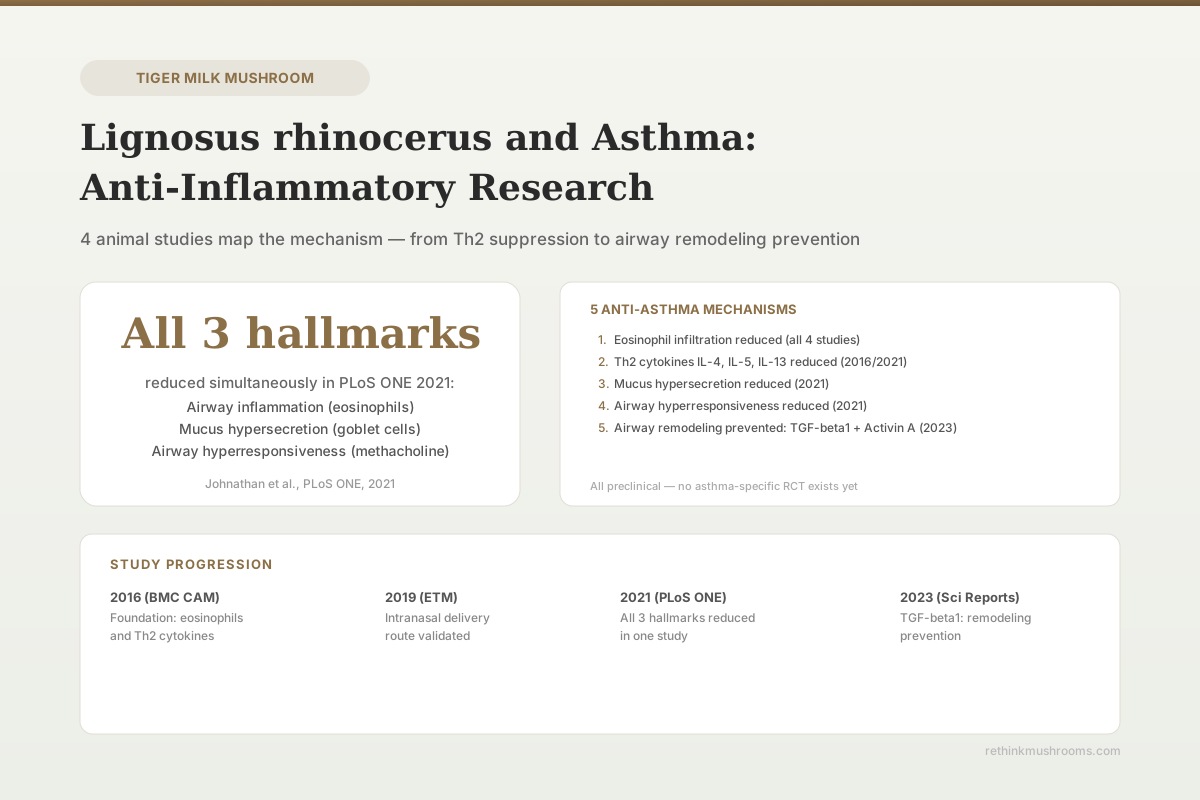
All 3 hallmarks of asthma reduced simultaneously
Johnathan et al. (2021) found Lignosus rhinocerus reduced all three key features of asthma in a single murine model: airway inflammation, mucus hypersecretion, and airway hyperresponsiveness.
Johnathan et al., PLoS ONE, 2021
Th2 suppression
Lignosus rhinocerus reduces IL-4, IL-5, IL-13, the cytokines that drive the allergic arm of asthma (Johnathan 2016)
TGF-beta1 attenuation
2023: Lignosus prevents airway remodeling by suppressing TGF-beta1 and Activin A, drivers of permanent airway structural changes (Muhamad 2023)
Eosinophil reduction
reduced eosinophil infiltration in all four animal studies; eosinophils are the primary inflammatory cells in asthmatic airways
Johnathan et al., PLoS ONE, 2021
 View as image ↗
For centuries, Orang Asli indigenous peoples of the Malaysian peninsula used an underground mushroom sclerotium called cendawan susu rimau (tiger milk mushroom) specifically to treat cough and asthma. Modern pharmacological research on Lignosus rhinocerus (the mushroom's scientific name) has now produced four animal model studies documenting why this traditional use has a mechanistic basis.
The evidence is preclinical. No randomized controlled trial has specifically tested L. rhinocerus in asthma patients. But the animal studies map the anti-asthma mechanisms in precise detail, covering five distinct pathways: eosinophil infiltration, Th2 cytokine reduction, mucus hypersecretion, airway hyperresponsiveness, and airway remodeling prevention. For clinical evidence from the first human study on this mushroom (general respiratory health, not asthma-specific), see tiger milk mushroom for respiratory health: clinical evidence.
Key Takeaways
- Johnathan et al. (2016) showed Lignosus rhinocerus extract inhibited ovalbumin-induced airway inflammation in mice by reducing eosinophil infiltration and Th2 cytokines IL-4, IL-5, and IL-13
- Johnathan et al. (2021) expanded this to all three major asthma hallmarks simultaneously: (1) airway inflammation, (2) mucus hypersecretion (reduced goblet cell metaplasia), and (3) airway hyperresponsiveness (reduced bronchial constriction to methacholine)
- Muhamad et al. (2019) found that intranasal administration of L. rhinocerotis extract directly to the airway produced significant anti-asthma effects, connecting traditional inhalation practices to modern pharmacology
- Muhamad et al. (2023) addressed long-term asthma damage: L. rhinocerotis extract suppressed TGF-beta1 and Activin A in a prolonged asthma model, addressing airway remodeling, the permanent structural airway changes that cause irreversible narrowing in chronic asthma
- All four studies used established murine asthma models (ovalbumin-sensitization); no human asthma RCT has been conducted for this mushroom specifically
- The mechanistic profile closely parallels conventional asthma therapy targets (Th2 suppression, eosinophil reduction), but through natural polyphenol/polysaccharide mechanisms rather than pharmaceutical compounds
What Asthma Inflammation Looks Like, and Why the Th2/Eosinophil Loop Matters
Asthma is not a single disease state but a chronic inflammatory syndrome of the airways. Its defining features are three interrelated processes that reinforce each other:
Airway inflammation: Eosinophils (white blood cells specialized for parasitic infections but chronically misdeployed in allergy and asthma) infiltrate the airway wall and lining. They release inflammatory mediators that damage epithelial cells and amplify the inflammatory signal.
Mucus hypersecretion: Goblet cells in the airway lining increase in number (metaplasia) and overproduce thick mucus. This narrows the airway lumen and creates the characteristic difficulty breathing out that defines asthma.
Airway hyperresponsiveness: The inflamed airway becomes abnormally sensitive to triggers including cold air, exercise, allergens, and irritants. Airways constrict in response to stimuli that would not affect a non-asthmatic person.
Underlying all three is a Th2-dominant immune state. In allergic asthma, T helper cells polarize toward the Th2 phenotype, which produces a specific set of cytokines: IL-4 (drives IgE production and Th2 differentiation), IL-5 (promotes eosinophil growth, maturation, and survival), and IL-13 (stimulates goblet cell metaplasia and mucus production). These three cytokines are the primary targets of modern biologic asthma drugs. If Lignosus rhinocerus reduces all three in animal models, it is targeting the same upstream pathway.
The 2016 Foundation: Eosinophil Infiltration and Th2 Cytokines
Johnathan and colleagues provided the first detailed mechanistic analysis of Lignosus rhinocerus in an asthma model in 2016.[1] They sensitized mice to ovalbumin (the standard murine asthma model using egg white protein as the allergen) and then challenged them with ovalbumin aerosol to induce airway inflammation.
L. rhinocerus extract significantly inhibited the key asthma inflammation markers: eosinophil infiltration into the airway was reduced, and levels of Th2 cytokines IL-4, IL-5, and IL-13 were decreased compared to untreated asthmatic controls.
The phytochemical analysis of the extract identified the likely active compounds: polyphenols, flavonoids, and polysaccharides. These three compound classes have documented anti-inflammatory activities through various mechanisms, and their combination in L. rhinocerus extract likely acts through multiple simultaneous pathways rather than a single target.
This foundational study established that the traditional use of tiger milk mushroom for respiratory conditions has a measurable mechanistic basis. The specific targeting of Th2 cytokines is particularly relevant because these are the same cytokines targeted by modern biologic drugs (dupilumab targets IL-4/IL-13, mepolizumab targets IL-5), though through very different mechanisms.
The 2021 Landmark: All Three Asthma Hallmarks in One Study
The Johnathan 2021 study in PLoS ONE expanded the evidence significantly by testing whether L. rhinocerus affects all three major asthma features rather than only inflammation markers.[2]
Airway inflammation: Eosinophil counts in bronchoalveolar lavage fluid (the fluid recovered from the airway) were significantly reduced in the L. rhinocerus treatment groups. Histological examination of airway tissue showed reduced eosinophil infiltration in the airway wall.
Mucus hypersecretion: Goblet cell hyperplasia and mucin production in the airway were assessed by PAS staining (a histochemical technique that shows mucus-producing cells). The L. rhinocerus-treated groups showed significantly reduced goblet cell numbers and mucin staining, directly addressing the "sticky mucus" symptom of asthma.
Airway hyperresponsiveness: The treated mice showed significantly reduced bronchial constriction response to methacholine challenge compared to untreated asthmatic controls. Methacholine is a bronchoconstrictor used to quantify airway reactivity; reduced response indicates reduced airway twitchiness. This is the functional outcome most directly relevant to asthma symptoms: it means the airway is less likely to constrict in response to triggers.
The simultaneous reduction of all three features in a single study is the most compelling aspect of this data. Each feature involves different cellular mechanisms: inflammation involves eosinophil recruitment and Th2 signaling; mucus hypersecretion involves goblet cell differentiation driven by IL-13; airway hyperresponsiveness involves smooth muscle dysfunction and neural sensitization. A compound that reduces all three is acting either at a very upstream point in the pathological cascade or at multiple points simultaneously.
The Intranasal Route: Modern Science Meets Traditional Practice
Most oral pharmaceutical agents have poor bioavailability in the lung; they must be absorbed systemically and then reach the lung through circulation. Many traditional respiratory treatments were administered via inhalation, steam, or nasal application specifically to deliver active compounds directly to the site of inflammation.
Muhamad and colleagues tested intranasal delivery of Lignosus rhinocerotis extract directly to the nasal and airway mucosa in a murine allergic asthma model.[3] The intranasal route produced significant attenuation of airway inflammation, including reduced eosinophil infiltration and Th2 cytokine levels.
Comparing oral versus intranasal routes, the intranasal administration showed some measures of superiority in reducing airway-specific inflammation, which is consistent with the local delivery advantage. This study provides a mechanistic explanation for traditional respiratory preparations: when the mushroom was administered through inhalation-adjacent routes, it may have been delivering active compounds directly to airway immune tissue rather than relying on systemic absorption and redistribution.
The practical implication for modern supplementation is limited; most commercial products are oral capsules or extracts, but the intranasal study adds scientific context for the respiratory-specific traditional use.
Preventing Permanent Damage: The Airway Remodeling Problem
Acute asthma inflammation is potentially reversible. Airway remodeling is not.
In chronic poorly-controlled asthma, repeated inflammatory episodes trigger structural changes in the airway wall: subepithelial fibrosis (scar tissue formation), smooth muscle hypertrophy (thickening), and increased mucus gland mass. These changes permanently narrow the airway and reduce airflow, regardless of anti-inflammatory treatment. The key molecular drivers are TGF-beta1 (transforming growth factor beta-1) and Activin A, both of which signal fibroblasts to produce collagen and other structural proteins that stiffen the airway wall.
Muhamad and colleagues (2023) specifically tested Lignosus rhinocerotis extract against a prolonged asthma model designed to induce remodeling changes rather than just acute inflammation.[4] The extract significantly attenuated TGF-beta1 and Activin A levels, directly targeting the molecular drivers of airway remodeling.
This is a different clinical implication than acute anti-inflammatory effects. Drugs that suppress only acute inflammation do not prevent remodeling and may miss the most serious long-term consequence of asthma. A compound that reduces both acute Th2 inflammation and the downstream fibrotic signaling could theoretically address the full spectrum of asthma pathology from initial inflammation to structural damage. This 2023 finding positions L. rhinocerus as a candidate for investigating structural airway protection, not just symptom management.
How This Fits Into the Broader Beta-Glucan Picture
The mechanistic basis for Lignosus rhinocerus's anti-asthma effects is believed to be primarily its polysaccharide fractions, particularly beta-glucans, alongside polyphenols and flavonoids. Beta-glucans from various mushroom sources activate immune cells through pattern recognition receptors (Dectin-1, TLRs) and modulate the Th1/Th2 balance, which is precisely the imbalance that underlies allergic asthma. For the broader context of how beta-glucans reprogram immune cells at the epigenetic level, see how beta-glucans epigenetically reprogram immune cells.
The specific Th2-suppressing effects of L. rhinocerus parallel the mechanisms of anti-asthma biologics at a higher level of the pathway, though through different molecular mechanisms. Where biologic drugs block individual cytokines directly, L. rhinocerus appears to modulate the upstream immune balance that drives those cytokines.
The Evidence Limits
Four well-designed animal studies provide a mechanistic evidence base that is stronger than many natural compounds in respiratory research. But several important limitations frame what these studies do and do not establish.
All four studies used ovalbumin-sensitized mouse models. This is the gold standard preclinical asthma model but has known limitations in translating to human asthma, which has multiple phenotypes (allergic, non-allergic, eosinophilic, non-eosinophilic) that may respond differently.
The human clinical trial of L. rhinocerus (Tan et al., 2021, published in Scientific Reports) tested general respiratory health outcomes in 50 participants, not specifically asthma patients. It found reduced IL-1beta, IL-8, and oxidative stress markers, which is consistent with the animal model data but does not constitute asthma-specific evidence.
No randomized controlled trial has enrolled asthma patients, measured asthma-specific outcomes (FEV1, ACQ score, exacerbation rate), and used L. rhinocerus as the intervention. That trial has not yet been completed. A registered Phase 2 clinical trial (NCT06451328) represents the pathway to that evidence.
The Bottom Line
Lignosus rhinocerus demonstrates anti-asthma activity across four animal studies: reducing eosinophil infiltration and Th2 cytokines IL-4, IL-5, and IL-13 (Johnathan 2016); simultaneously addressing all three asthma hallmarks: inflammation, mucus hypersecretion, and airway hyperresponsiveness (Johnathan 2021, PLoS ONE); delivering effects via the intranasal route (Muhamad 2019); and preventing airway remodeling through TGF-beta1 and Activin A suppression (Muhamad 2023, Scientific Reports). The mechanistic profile targets the same pathways as modern biologic asthma drugs. The evidence gap is human asthma RCT data, which does not yet exist for this mushroom.
Frequently Asked Questions
Sources & References
- 1RTHM-00791·Johnathan, M et al. (2016). “Phytochemical profiles and inhibitory effects of Tiger Milk mushroom (Lignosus rhinocerus) extract on ovalbumin-induced airway inflammation in a rodent model of asthma..” BMC complementary and alternative medicine.Study breakdown →PubMed →↩
- 2RTHM-01370·Johnathan, Malagobadan et al. (2021). “Lignosus rhinocerotis Cooke Ryvarden ameliorates airway inflammation, mucus hypersecretion and airway hyperresponsiveness in a murine model of asthma..” PloS one.Study breakdown →PubMed →↩
- 3RTHM-01108·Muhamad, Siti Aminah et al. (2019). “Intranasal administration of Lignosus rhinocerotis (Cooke) Ryvarden (Tiger Milk mushroom) extract attenuates airway inflammation in murine model of allergic asthma..” Experimental and therapeutic medicine.Study breakdown →PubMed →↩
- 4RTHM-01758·Muhamad, Siti-Aminah et al. (2023). “Lignosus rhinocerotis extract ameliorates airway inflammation and remodelling via attenuation of TGF-β1 and Activin A in a prolonged induced allergic asthma model..” Scientific reports.Study breakdown →PubMed →↩