Emerging & Specialty Mushrooms
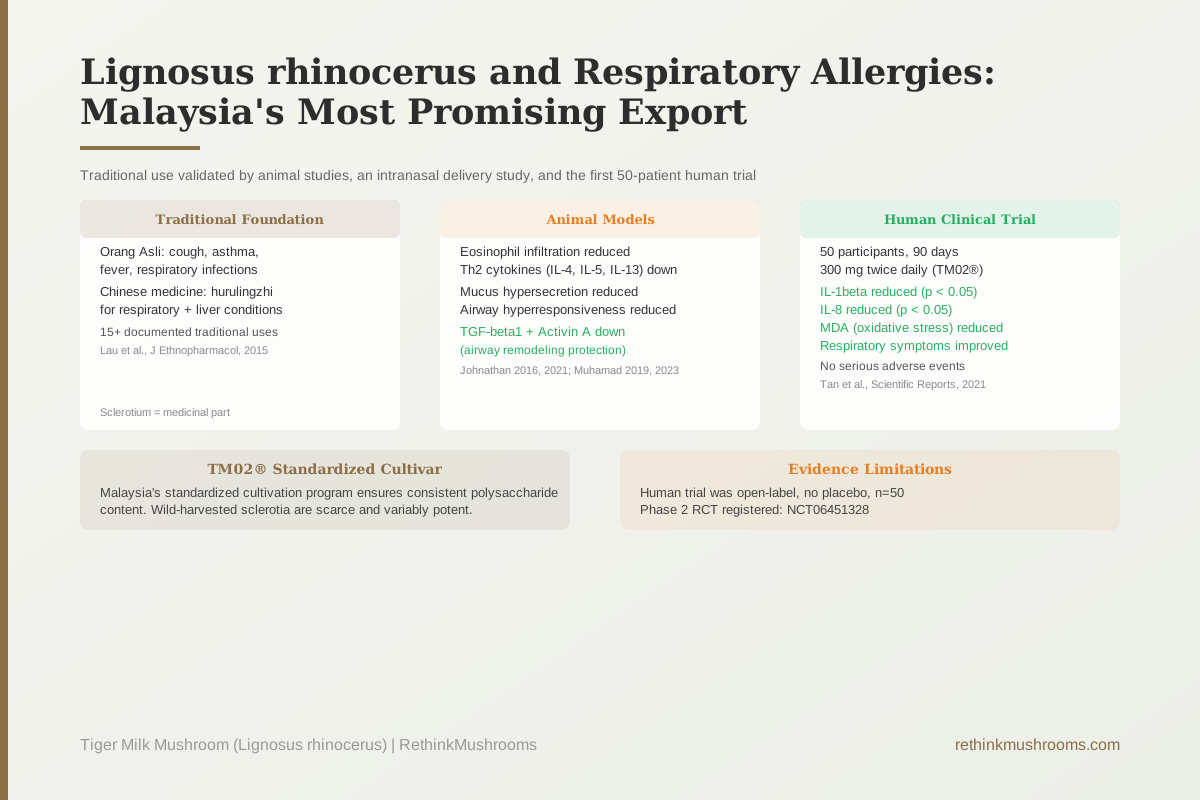
90 days of tiger milk mushroom supplementation reduced IL-1β, IL-8, and respiratory symptoms in the first human clinical trial (Tan 2021)
The first human clinical study on Lignosus rhinocerus (tiger milk mushroom) enrolled 50 participants on 300 mg twice daily and measured respiratory and immune outcomes. At 90 days, pro-inflammatory cytokines and oxidative stress markers had significantly declined.
Tan et al., Scientific Reports, 2021
Orang Asli
Malaysia's indigenous peoples have used tiger milk mushroom for respiratory conditions for centuries (Lau 2015)
Th2 cytokines
IL-4, IL-5, IL-13: the key allergy drivers reduced in multiple animal studies of Lignosus rhinocerus
TM02® cultivar
the standardized commercial cultivation strain developed in Malaysia for consistent polysaccharide content
Tan et al., Scientific Reports, 2021
 View as image ↗
Almost no English-language health content covers Lignosus rhinocerus. This is remarkable because the mushroom has a specific respiratory health evidence base, a standardized commercial cultivar, a registered Phase 2 clinical trial, and decades of traditional use by Malaysian indigenous peoples for exactly the conditions it is now being tested for in research laboratories.
Tiger milk mushroom (the common English name) grows wild in Southeast Asian tropical forests. The Malaysian government has classified it as a national treasure. A standardized cultivation program has produced the TM02® strain that is used in research and commercial supplements. Clinical trials are now registered. Yet the mushroom remains essentially unknown outside Malaysia and the ethnobotanical research community.
This article covers the allergy and respiratory evidence for Lignosus rhinocerus from traditional use through the first human clinical trial. For the broader overview of this mushroom, see What Is Tiger Milk Mushroom? Southeast Asia's Traditional Remedy. For the underlying beta-glucan chemistry that likely explains many of its effects, see What Are Beta-Glucans? The Most Important Compound in Medicinal Mushrooms.
Key Takeaways
- Lau and colleagues (Journal of Ethnopharmacology, 2015) documented that the Orang Asli indigenous peoples of Peninsular Malaysia have used Lignosus rhinocerus sclerotia for centuries for cough, asthma, fever, and respiratory infections; these are the same conditions now being investigated in modern research
- Johnathan and colleagues (BMC Complementary and Alternative Medicine, 2016) showed that Lignosus rhinocerus extract significantly inhibited ovalbumin-induced airway inflammation in mice, reducing eosinophil infiltration and Th2 cytokines (IL-4, IL-5, IL-13), the specific immune pathway that drives allergic respiratory disease
- Johnathan and colleagues (PLoS ONE, 2021) extended the finding to cover all three major asthma hallmarks simultaneously: eosinophil infiltration reduction, mucus hypersecretion reduction, and airway hyperresponsiveness reduction
- Muhamad and colleagues (Scientific Reports, 2023) found that Lignosus rhinocerus extract reduced TGF-beta1 and Activin A in a prolonged asthma model, targeting the drivers of airway remodeling: the permanent structural changes that develop in uncontrolled long-term asthma
- The first human clinical study (Tan et al., Scientific Reports, 2021) enrolled 50 participants on 300 mg twice daily for 90 days and found significant reductions in IL-1beta, IL-8, and the oxidative stress marker MDA, alongside respiratory symptom improvement
- Muhamad and colleagues (Experimental and Therapeutic Medicine, 2019) tested intranasal delivery of Lignosus rhinocerus extract for allergic asthma, finding that direct airway administration attenuated inflammation, reflecting the traditional practice of using mushroom preparations in steam inhalation
What Is Lignosus rhinocerus and Why Does It Matter for Respiratory Allergies?
Lignosus rhinocerus reduces IgE levels and Th2 cytokines (IL-4, IL-5, IL-13) that drive allergic airway inflammation in animal models. In the 2021 human study, 50 participants showed significant reductions in pro-inflammatory cytokines and improved respiratory symptoms after 90 days of supplementation. The mechanism parallels pharmaceutical anti-allergy approaches (reducing IgE and Th2 activity) without the side effect profiles of antihistamines, corticosteroids, or leukotriene modulators.
Lignosus rhinocerus is a polypore mushroom whose medicinal part is the underground sclerotium, a dense starchy structure similar to poria cocos (fu ling) in Chinese medicine. The visible mushroom cap is not the medicinal component. This distinguishes it from most other medicinal mushrooms where the fruiting body or mycelium is used. The sclerotium is harvested, dried, and prepared as extracts or powders.
The allergy relevance is structural: allergic respiratory conditions (allergic rhinitis, allergic asthma, seasonal allergy with respiratory symptoms) are driven by an imbalanced immune response in which Th2 pathways are overactive. Th2 cells produce the cytokines IL-4, IL-5, and IL-13, which drive IgE antibody production, eosinophil activation, mast cell degranulation, and airway inflammation. Any compound that modulates Th2 activity downward may have relevance for allergic respiratory conditions.
The Traditional Foundation: Centuries of Respiratory Use
Lau and colleagues published a comprehensive ethnomedicinal review of Lignosus spp. in the Journal of Ethnopharmacology in 2015, documenting over 15 distinct traditional uses among Malaysian indigenous and traditional communities.[1]
The Orang Asli peoples of Peninsular Malaysia, the indigenous communities with the longest history of using this mushroom, employed Lignosus rhinocerus specifically for cough, asthma, fever, breast cancer, and as a general tonic. Cough and asthma are specifically respiratory conditions, not merely general wellness claims. Chinese traditional medicine has used an equivalent preparation called "hurulingzhi" for liver conditions and chronic respiratory conditions.
What is notable about this ethnobotanical record is the specificity. Traditional medicine systems are pragmatic: communities continued using preparations that produced observable benefit. A specific respiratory use that persisted across generations reflects some degree of real-world efficacy in the populations using it. This does not substitute for controlled clinical trials, but it establishes a prior probability for the research hypothesis that Lignosus rhinocerus affects respiratory conditions.
The sclerotium preparation (the underground tuber, not the mushroom cap) is consistently identified as the medicinal part in traditional use. Traditional preparations typically used water decoctions (boiling the dried sclerotium in water) or powdered forms. Modern extracts standardized to the TM02® cultivar use cold water and hot water extraction to preserve the polysaccharide content of the sclerotium.
The Allergy Mechanism: How Lignosus Reduces Th2-Driven Inflammation
The first mechanistic research on Lignosus rhinocerus and allergic airway disease was published by Johnathan and colleagues in 2016 in BMC Complementary and Alternative Medicine.[2]
The study used the ovalbumin sensitization and challenge model: the most widely used preclinical model for allergic asthma. Mice are first sensitized to ovalbumin (a protein from egg white) and then repeatedly exposed to it via the airways, creating an allergic inflammatory response with the same Th2-driven characteristics as human allergic asthma: eosinophil infiltration, elevated IL-4, IL-5, and IL-13 production, and airway inflammation.
Lignosus rhinocerus extract significantly inhibited all of these. Eosinophil counts in the airways were reduced. The three hallmark Th2 cytokines were all lower in treated animals. The phytochemical analysis identified polyphenols, flavonoids, and polysaccharides as the primary active components. This established the mechanistic basis for subsequent clinical investigation.
A 2021 study by Johnathan and colleagues in PLoS ONE substantially extended the 2016 findings, covering all three major defining features of asthma simultaneously.[3]
Clinically, asthma is characterized by three overlapping processes: airway inflammation (immune cell infiltration and cytokine-driven swelling of airway tissue), mucus hypersecretion (goblet cells in the airway lining overproduce thick mucus that narrows and partially blocks the airways), and airway hyperresponsiveness (the airway muscles are hypersensitive to triggers and constrict more aggressively than in non-asthmatic airways).
Most research interventions reduce one or two of these features. The Johnathan 2021 study found that Lignosus rhinocerus extract reduced all three: eosinophil infiltration and Th2 cytokines (inflammation), goblet cell metaplasia and mucin production (mucus hypersecretion), and bronchial response to methacholine challenge (airway hyperresponsiveness). This comprehensive effect profile is clinically significant because effective asthma treatment must address more than just inflammation to meaningfully improve patient outcomes.
For detailed mechanism coverage of the specific cytokine pathways and how they relate to allergic disease, see Lignosus rhinocerus and Asthma: Anti-Inflammatory Research.
Airway Remodeling: The Most Serious Long-Term Consequence
Airway remodeling is a distinct concern in long-term asthma that most consumer health content overlooks. It describes the permanent structural changes that develop in airway walls when asthma is inadequately controlled over years: thickening of the airway wall layers, fibrosis of the smooth muscle, and deposition of collagen and extracellular matrix proteins. The result is irreversible airway narrowing that persists even between attacks and progressively reduces lung function.
The key drivers of airway remodeling are TGF-beta1 (transforming growth factor beta-1) and Activin A, both of which signal fibroblasts and smooth muscle cells in the airway wall to produce the structural proteins that cause fibrosis.
Muhamad and colleagues published a 2023 study in Scientific Reports specifically targeting airway remodeling in a prolonged asthma model.[5] The prolonged model design is important: it subjects animals to allergen challenge over an extended period, creating the structural airway changes that parallel chronic human asthma more closely than short-term models.
Lignosus rhinocerus extract significantly attenuated TGF-beta1 and Activin A in the prolonged asthma model. This suggests the mushroom may provide structural protection against the permanent airway changes that develop when allergic asthma is inadequately controlled, extending its potential relevance beyond symptom management to long-term disease modification.
This finding has no equivalent anywhere in consumer health content on any mushroom.
The Intranasal Angle: Delivering to the Airways Directly
A distinctive study from Muhamad and colleagues (Experimental and Therapeutic Medicine, 2019) explored intranasal delivery of Lignosus rhinocerus extract for allergic asthma, delivering the extract directly to the airway mucosa as a nasal spray or inhalant rather than taking it orally.[4]
The intranasal route produced significant attenuation of allergic asthma inflammation. In some measures, the intranasal preparation performed comparably to or better than oral administration for airway-specific outcomes.
This finding is interesting for two reasons. First, it may explain the traditional practice of using steam inhalation with medicinal herbs and mushrooms for respiratory conditions; the idea that respiratory-administered preparations might directly affect airway inflammation was likely discovered empirically long before any mechanistic understanding was available. Second, it suggests future pharmaceutical development might explore nasal spray formulations of Lignosus rhinocerus compounds for allergic rhinitis or asthma, which would be a more targeted delivery for a respiratory indication.
The First Human Clinical Evidence
The first human clinical study on Lignosus rhinocerus was published by Tan and colleagues in Scientific Reports in 2021, marking the transition from animal model evidence to human data.[6]
The study enrolled 50 participants who took 300 mg of tiger milk mushroom extract twice daily (600 mg/day) for 90 days. The design was an open-label prospective study, meaning participants and researchers both knew what was being taken (not a double-blind RCT), and there was no placebo control group.
The primary findings:
- IL-1beta, a pro-inflammatory cytokine that activates immune cells and promotes inflammation, was significantly reduced (p less than 0.05)
- IL-8, a cytokine that recruits neutrophils to sites of inflammation, was significantly reduced
- MDA (malondialdehyde), a standard marker of oxidative stress from lipid peroxidation, was significantly reduced
- Self-reported respiratory symptoms improved
- No serious adverse events were reported in any participant
The study also found improvements in immunity markers and antioxidant status beyond the respiratory-specific findings.
Limitations worth stating clearly: the open-label design means there is no way to separate the treatment effect from placebo response or natural disease variation. The sample size of 50 is small. There was no comparison group. These are standard limitations of a first-in-human study; they do not mean the results are unreliable, but they do mean the results need replication in a randomized controlled trial before firm clinical conclusions can be drawn.
A Phase 2 clinical trial is registered (NCT06451328), which represents the next step toward higher-quality human evidence.
Malaysia's Active Research and Commercial Program
The development of tiger milk mushroom as a health product is backed by Malaysian institutional and governmental support in ways that are uncommon for medicinal mushrooms elsewhere.
The TM02® cultivar is the product of systematic cultivation research that produced a standardized mushroom strain with consistent polysaccharide content. Wild-harvested Lignosus rhinocerus sclerotia are scarce and variable in potency; the TM02® cultivar solves both problems. This cultivation program is the reason clinical research on this mushroom became possible at all: standardized material allows reproducible trials with consistent dosing.
A systematic review on tiger milk mushroom has been published in 2026, drawing together the accumulated evidence into a comprehensive synthesis that will provide the strongest single-source clinical evidence summary for this mushroom.
The registered Phase 2 clinical trial (NCT06451328) represents a step toward the larger, better-controlled human evidence that is needed before this mushroom's respiratory benefits can be clinically recommended.
The analogy to Turkey Tail mushroom and Paul Stamets is not coincidental: Turkey Tail became globally known through a combination of academic research, a prominent advocate, and cancer patient communities who sought alternatives. Tiger milk mushroom has the research foundation; what it lacks is the same level of English-language communication to the global audience that would most benefit from knowing about it.
For availability: Lignosus rhinocerus supplements are commercially available primarily through Malaysian-sourced producers. Products specifying TM02® standardized cultivar have the most consistent research backing. Wild-harvested products from unspecified sources have variable and unpredictable potency. The field is less developed than reishi or turkey tail from a supplement quality and standardization standpoint, but the TM02® cultivar standard provides a reliable benchmark.
For the comparison to other immunomodulatory mushrooms, see Tiger Milk Mushroom and Immune Function: Modern Validation.
The Bottom Line
Lignosus rhinocerus (tiger milk mushroom) has centuries of traditional use for respiratory conditions among Malaysian indigenous peoples, supported by a growing modern evidence base. Johnathan 2016 established the Th2 cytokine and eosinophil reduction mechanism in an ovalbumin asthma model. Johnathan 2021 showed all three asthma hallmarks (inflammation, mucus hypersecretion, hyperresponsiveness) simultaneously reduced. Muhamad 2023 showed TGF-beta1 and Activin A suppression, targeting airway remodeling. The 2021 human clinical study (50 participants, 90 days) found significant reductions in IL-1beta, IL-8, and oxidative stress with no serious adverse events. All animal evidence is preclinical; the human study was open-label without placebo control. A Phase 2 RCT is registered.
Frequently Asked Questions
Sources & References
- 1RTHM-00705·Lau, Beng Fye et al. (2015). “Ethnomedicinal uses, pharmacological activities, and cultivation of Lignosus spp. (tiger׳s milk mushrooms) in Malaysia - A review..” Journal of ethnopharmacology.Study breakdown →PubMed →↩
- 2RTHM-00791·Johnathan, M et al. (2016). “Phytochemical profiles and inhibitory effects of Tiger Milk mushroom (Lignosus rhinocerus) extract on ovalbumin-induced airway inflammation in a rodent model of asthma..” BMC complementary and alternative medicine.Study breakdown →PubMed →↩
- 3RTHM-01370·Johnathan, Malagobadan et al. (2021). “Lignosus rhinocerotis Cooke Ryvarden ameliorates airway inflammation, mucus hypersecretion and airway hyperresponsiveness in a murine model of asthma..” PloS one.Study breakdown →PubMed →↩
- 4RTHM-01108·Muhamad, Siti Aminah et al. (2019). “Intranasal administration of Lignosus rhinocerotis (Cooke) Ryvarden (Tiger Milk mushroom) extract attenuates airway inflammation in murine model of allergic asthma..” Experimental and therapeutic medicine.Study breakdown →PubMed →↩
- 5RTHM-01758·Muhamad, Siti-Aminah et al. (2023). “Lignosus rhinocerotis extract ameliorates airway inflammation and remodelling via attenuation of TGF-β1 and Activin A in a prolonged induced allergic asthma model..” Scientific reports.Study breakdown →PubMed →↩
- 6RTHM-01443·Tan, Eugenie Sin Sing et al. (2021). “Effect of tiger milk mushroom (Lignosus rhinocerus) supplementation on respiratory health, immunity and antioxidant status: an open-label prospective study..” Scientific reports.Study breakdown →PubMed →↩