Lion's Mane and Focus and Attention
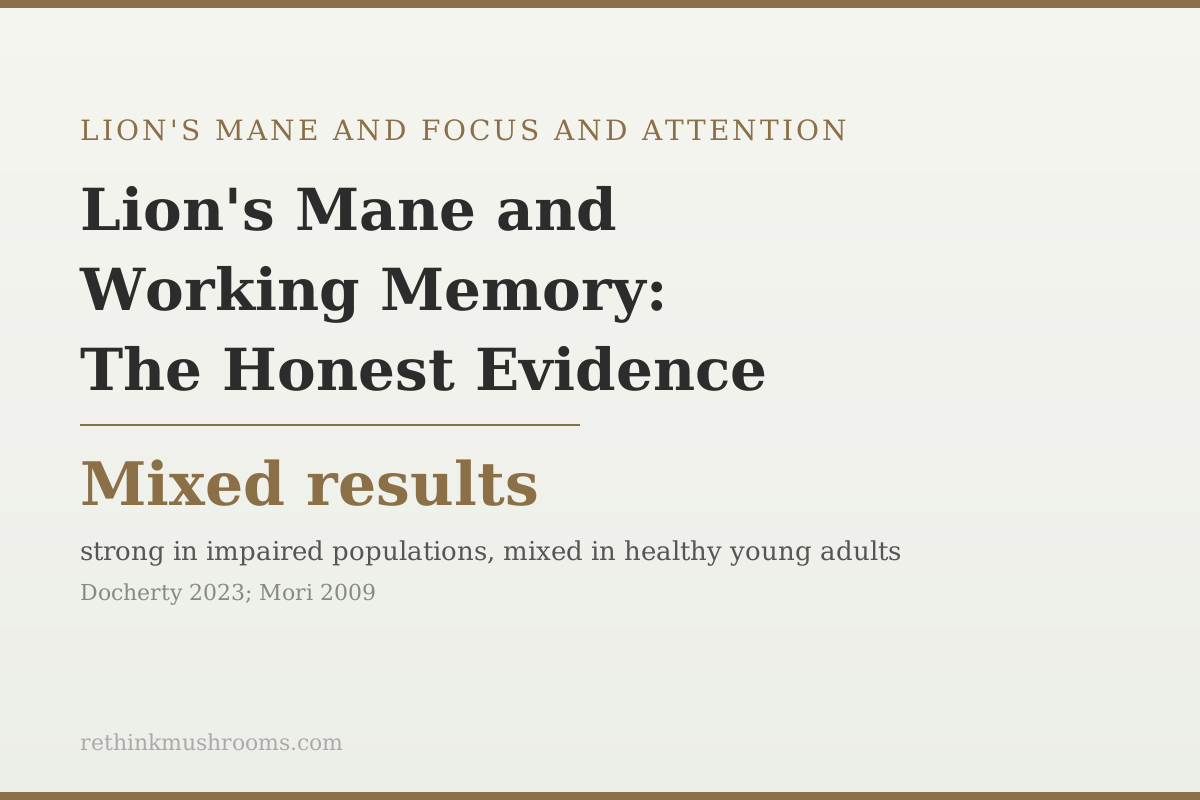
Mixed results in working memory research: worse delayed recall in healthy young adults vs. consistent improvement in MCI patients
In the only randomized controlled trial testing chronic lion's mane in healthy young adults, participants who took lion's mane for 4 weeks performed slightly worse on delayed word recall than the placebo group (Docherty et al., 2023). Separately, lion's mane consistently improves cognitive scores in older adults with mild cognitive impairment. These populations are not interchangeable.
Docherty et al., 2023; Mori et al., 2009
ERK1/2 hippocampus
Martinez-Marmol et al. (2023) showed hericerin derivatives activate ERK1/2 in hippocampal neurons and improve spatial memory in mice, the mechanistic basis for expecting working memory effects in humans
Ceiling effect
healthy young adults with normal working memory may have limited room for measurable improvement, explaining why lion's mane shows clear effects in cognitively impaired populations but mixed results in healthy adults
16 weeks MCI data
Mori et al. (2009) found significant cognitive improvement in MCI patients over 16 weeks, the population where lion's mane evidence for cognitive function is most consistent
Docherty et al., 2023; Mori et al., 2009
 View as image ↗
Working memory is not general memory. It is the ability to hold information in mind and use it while doing something else: following multi-step instructions, reading a paragraph and remembering what came before, doing mental arithmetic. It is hippocampus-dependent, central to executive function, and genuinely impaired in ADHD, aging, and early cognitive decline.
The animal and mechanistic evidence for lion's mane and hippocampal function is compelling. The human evidence for working memory in healthy young adults is not. One controlled trial found worse delayed recall in the lion's mane group compared to placebo at 4 weeks. No competitor article covers this finding. Presenting it honestly, alongside the evidence that does support lion's mane for working memory in impaired populations, is more useful than cherry-picking the positive results. For the broader lion's mane overview, see what is lion's mane mushroom: a science-based overview.
Key Takeaways
- Martinez-Marmol and colleagues (2023) showed hericerin derivatives from lion's mane activate ERK1/2 in hippocampal neurons and improve spatial memory in mice; spatial memory and working memory are both hippocampus-dependent, making this the mechanistic basis for expecting working memory effects
- Docherty and colleagues (2023) found that at 4 weeks of lion's mane supplementation, healthy young adults in the lion's mane group performed slightly WORSE on delayed word recall than the placebo group, the most relevant human working memory data for this population
- Surendran and colleagues (2025) found acute cognitive improvements (processing speed, executive function measures) following a single dose in healthy young adults, suggesting faster-acting mechanisms that differ from the 4-week chronic trajectory
- Mori and colleagues (2009) found significant cognitive improvement in MCI patients over 16 weeks; Saitsu (2019) extended this to a 30-week observation in adults with cognitive concerns; both show lion's mane works where there is an underlying deficit
- Spangenberg and colleagues' 2025 systematic review confirmed erinacines support BDNF, NGF, and neurotrophin-3 production in preclinical models, establishing the hippocampal neurotrophic mechanism that underlies the expected cognitive effects
- The honest summary: lion's mane has strong evidence for working memory and cognitive function in people with existing impairment (MCI, early AD); the evidence for improving already-functional working memory in healthy young adults is at best mixed and at worst suggests no benefit or slight worsening in the short term
What Working Memory Is and Why It Matters
Working memory is the cognitive system that temporarily holds and manipulates information. It is not the same as long-term memory storage. When you multiply 37 by 8 in your head, working memory holds the intermediate results while you calculate. When you follow a three-step spoken instruction, working memory holds steps 1 and 2 while you execute step 3. When you read this sentence, working memory holds the earlier words while you process the later ones.
Working memory is hippocampus-dependent: the hippocampus coordinates the temporary storage and active manipulation of information. It is also the most impaired cognitive domain in ADHD, where working memory deficits are a core feature rather than a side effect. It declines with age and is one of the first domains affected in mild cognitive impairment.
A compound that genuinely improves hippocampal function and working memory would be one of the most practically valuable cognitive enhancers available, given working memory's central role in everyday executive function. The question is whether lion's mane is that compound, and for whom.
The Mechanistic Case: Hippocampal ERK1/2 and Spatial Memory
Martinez-Marmol and colleagues (2023) identified the specific mechanism connecting lion's mane to hippocampal function: hericerin derivatives activate a pan-neurotrophic pathway converging on ERK1/2 signaling in hippocampal neurons.[3]
In addition to the cellular signaling findings, the Martinez-Marmol study measured behavioral outcomes in mice and found improvements in spatial memory tasks. Spatial memory, like working memory, depends heavily on hippocampal function. The finding that hericerin treatment improves hippocampus-dependent spatial memory in mice is the mechanistic evidence most directly relevant to expecting working memory benefits in humans.
Spangenberg and colleagues (2025) published a systematic review of erinacines' roles in neuroprotection, documenting their effects on BDNF, NGF, and neurotrophin-3 production across preclinical models.[4] These neurotrophic factors support the hippocampal neuroplasticity that underlies both spatial memory and working memory. The mechanistic foundation for expecting hippocampal-dependent cognitive improvements from lion's mane is well-established in preclinical evidence.
The Human Data for Healthy Young Adults: The Inconvenient Result
Docherty and colleagues (2023) conducted a double-blind, parallel-groups pilot study of lion's mane in healthy young adults aged 18-45.[1]
The study measured multiple cognitive outcomes at multiple time points. The most relevant finding for working memory: at 4 weeks of supplementation, participants taking lion's mane performed slightly worse on delayed word recall compared to the placebo group.
Delayed word recall is a working memory-adjacent measure: it tests the ability to recall previously presented words after a delay, engaging both storage and retrieval mechanisms that depend on hippocampal function. The lion's mane group's worse performance compared to placebo at this time point is the most specific working memory data available from a controlled human trial in healthy adults.
This contradicts most supplement marketing. It is the result that most coverage of lion's mane cognitive effects omits entirely.
What to make of it: the Docherty study was a pilot (small sample), the time point was 4 weeks, and the difference was slight rather than dramatic. The direction of the difference (worse than placebo) does not support the narrative that lion's mane boosts working memory in healthy young adults who take it for a month. It is a null result at best and a counterproductive result at worst for this specific use case.
Acute Effects: A Different Picture
The 4-week chronic supplementation result contrasts with acute findings. Surendran and colleagues (2025) found measurable cognitive improvements in healthy young adults from a single dose of lion's mane, including effects on processing speed and executive function measures.[2]
This suggests lion's mane may have faster-acting cognitive effects through signaling mechanisms (such as immediate ERK1/2 activation) that differ from the slower neuroplasticity-based mechanisms that require weeks of NGF-driven structural changes. Acute cognitive benefits and chronic working memory improvement are different outcomes that might depend on different mechanisms with different time courses.
The practical implication: if there is a role for lion's mane in supporting working memory, it may be more relevant for the acute 60-minute window than for chronic supplement use. This is the opposite of what most lion's mane marketing implies (take daily for lasting improvement), but it is what the current human evidence most directly supports.
Where the Evidence Is Strong: Older Adults with Impairment
The clearest and most consistent human evidence for lion's mane cognitive benefits involves people with existing cognitive impairment, not healthy adults.
Mori and colleagues (2009) found significant improvement on cognitive function scales in MCI patients over 16 weeks.[6] Saitsu and colleagues (2019) found similar improvement in Japanese adults with subjective cognitive concerns over 30 weeks.[5]
Both of these populations have working memory impairment as a component of their cognitive profile. Both show measurable improvement from lion's mane. The consistent positive signal in impaired populations alongside the mixed-to-null signal in healthy adults creates a clear pattern in the existing evidence.
Why the Gap Exists: The Ceiling Effect
The most plausible explanation for why lion's mane shows benefits in MCI patients but mixed results in healthy young adults is a ceiling effect.
Healthy young adults with normal working memory are already operating near their cognitive capacity for these tests. There is limited room for measurable improvement: a working memory that is already functional cannot easily be pushed measurably higher in short-term clinical testing. A working memory compromised by MCI or early cognitive decline has more structural deficit that NGF-driven hippocampal neuroplasticity can address.
This does not mean lion's mane has no value for healthy adults. It means that working memory test scores in healthy adults may not be the right outcome measure to detect whatever cognitive support lion's mane provides. Stress reduction, mood improvement, and cognitive protection against future decline are all possible benefits that would not show up as working memory score improvements in a 4-week trial of healthy adults.
The Bottom Line
Animal and mechanistic evidence supports lion's mane for hippocampal function: hericerins activate ERK1/2 in hippocampal neurons and improve spatial memory in mice (Martinez-Marmol 2023); erinacines support BDNF/NGF/NT-3 (Spangenberg 2025). Human evidence is population-dependent. Docherty 2023 found healthy young adults taking lion's mane performed slightly worse on delayed word recall at 4 weeks than placebo. Mori 2009 (16 weeks, MCI) and Saitsu 2019 (30 weeks, cognitive concerns) show consistent improvement in impaired populations. Lion's mane is best supported for working memory in people with existing impairment; evidence for improving healthy young adult working memory is not positive.
Frequently Asked Questions
Sources & References
- 1RTHM-00821·Docherty, Sarah et al. (2023). “The Acute and Chronic Effects of Lion's Mane Mushroom Supplementation on Cognitive Function, Stress and Mood in Young Adults: A Double-Blind, Parallel Groups, Pilot Study..” Nutrients.Study breakdown →PubMed →↩
- 2RTHM-00952·Surendran, Geyan et al. (2025). “Acute effects of a standardised extract of Hericium erinaceus (Lion's Mane mushroom) on cognition and mood in healthy younger adults: a double-blind randomised placebo-controlled study..” Frontiers in nutrition.Study breakdown →PubMed →↩
- 3RTHM-01746·Martínez-Mármol, Ramón et al. (2023). “Hericerin derivatives activates a pan-neurotrophic pathway in central hippocampal neurons converging to ERK1/2 signaling enhancing spatial memory..” Journal of neurochemistry.Study breakdown →PubMed →↩
- 4RTHM-02184·Spangenberg, E T et al. (2025). “Unveiling the role of erinacines in the neuroprotective effects of Hericium erinaceus: a systematic review in preclinical models..” Frontiers in pharmacology.Study breakdown →PubMed →↩
- 5RTHM-00585·Saitsu, Yuusuke et al. (2019). “Improvement of cognitive functions by oral intake of Hericium erinaceus..” Biomedical research (Tokyo.Study breakdown →PubMed →↩
- 6RTHM-00165·Mori, Koichiro et al. (2009). “Improving effects of the mushroom Yamabushitake (Hericium erinaceus) on mild cognitive impairment: a double-blind placebo-controlled clinical trial..” Phytotherapy research : PTR.Study breakdown →PubMed →↩