Mushrooms and ALS / Motor Neuron Disease
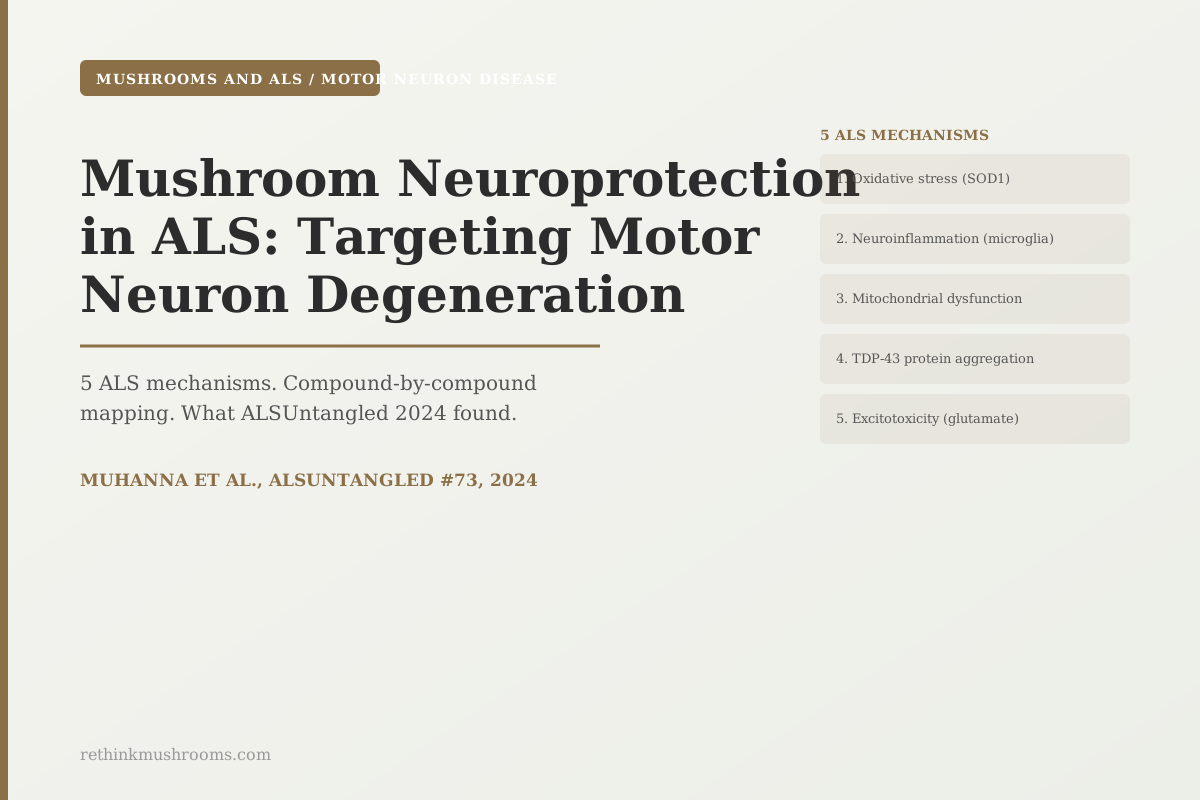
5 pathways in ALS that mushroom compounds theoretically address
ALS researchers have identified at least five distinct biological mechanisms driving motor neuron death: oxidative stress, neuroinflammation, mitochondrial failure, protein aggregation, and excitotoxicity. No mushroom compound has been tested in ALS. But the compound-pathway mapping is more specific than most discussions acknowledge.
Szućko-Kociuba et al., International Journal of Molecular Sciences, 2023
Zero
human trials or ALS animal model studies for any mushroom compound; the research gap is complete
~27%
longer survival in SMA mice from ergothioneine (mean 8.9 to 11.3 days), a motor neuron disease mechanistically related to ALS (Cadile et al., 2025)
ALSUntangled
the ALS medical community's 2024 review: lion's mane mechanisms are theoretically relevant but no ALS evidence exists (Muhanna et al., 2024)
Szućko-Kociuba et al., International Journal of Molecular Sciences, 2023
 View as image ↗
ALS is not caused by a single mechanism. Researchers have identified at least five distinct biological processes that contribute to motor neuron death in ALS patients, and this complexity is one reason the disease has resisted treatment: riluzole, the primary approved drug, extends survival by two to three months on average by targeting only one of those mechanisms. The question of whether mushroom compounds have any relevance to ALS is often posed as a simple yes-or-no. The more useful question is whether specific mushroom compounds address specific ALS mechanisms, and at what level of evidence. The answer is more differentiated than either optimistic wellness content or dismissive skepticism acknowledges. This article is part of a broader look at mushrooms and cognitive aging across neurodegenerative conditions.
Key Takeaways
- ALS involves at least five targetable mechanisms: oxidative stress, neuroinflammation, mitochondrial dysfunction, TDP-43 protein aggregation, and excitotoxicity
- No mushroom compound has been tested in ALS cell lines, ALS animal models, or ALS patients; all evidence is indirect from related disease models
- The ALS medical community's official 2024 review (ALSUntangled #73) concluded lion's mane has theoretically relevant mechanisms but no ALS-specific evidence; it appears safe (Muhanna et al., 2024)
- Erinacines from lion's mane mycelium stimulate the neurotrophins NGF and BDNF and cross the blood-brain barrier in preclinical models; these growth factors support motor neuron survival (Spangenberg et al., 2025)
- Ergothioneine extended survival roughly 27% in spinal muscular atrophy mice (mean 8.9 to 11.3 days) via mitophagy plus an antioxidant response (NRF2, GPX); SMA and ALS share motor neuron vulnerability (Cadile et al., 2025)
- Cordycepin protected dopaminergic neurons in a Parkinson's model through anti-inflammatory (NLRP3 inflammasome), antioxidant, and mitochondrial-protective pathways (Zhang et al., 2021)
The Five ALS Mechanisms Worth Understanding Before Evaluating Any Treatment
ALS is a disease with multiple simultaneous biological failures, which makes it resistant to single-target therapies and makes it important to map any candidate compound against the actual pathology rather than treating "neuroprotection" as a monolithic concept.
The five mechanisms researchers consider most relevant are distinct enough to warrant brief description.
Oxidative stress refers to damage caused by chemically reactive molecules, called reactive oxygen species or free radicals, that cells cannot neutralize quickly enough. In ALS, mutations in the SOD1 gene (superoxide dismutase 1), which normally functions as an antioxidant enzyme, impair the cell's defense against these molecules. TDP-43 protein aggregation (described below) also generates reactive oxygen species as a byproduct.
Neuroinflammation describes the inflammatory activation of immune cells in the central nervous system, particularly microglia (the brain's resident immune cells). When microglia become chronically activated in ALS, they release inflammatory signaling molecules that create a toxic environment for motor neurons. Neuroinflammation is now considered one of the primary drivers of motor neuron death in ALS and a leading therapeutic target.
Mitochondrial dysfunction reflects the energy failure in motor neurons. Motor neurons are among the most energy-demanding cells in the body. In ALS, mitochondria (the cellular energy generators) malfunction early in the disease course, impairing neurons' ability to maintain their function and survive.
Protein aggregation is the hallmark of most ALS cases at the molecular level. A protein called TDP-43 forms insoluble toxic clumps inside motor neurons in approximately 97% of ALS cases. These aggregates impair normal cell function and trigger cell death through multiple downstream pathways.
Excitotoxicity occurs when excess glutamate, the main excitatory signaling molecule in the nervous system, overstimulates motor neurons to the point of killing them. Riluzole works primarily through this mechanism, reducing glutamate release.
The Compound-Mechanism Map: What the Research Actually Shows
No study has tested any mushroom compound in ALS specifically. What follows is not a claim that mushrooms treat ALS. It is a mapping of which compound classes address which ALS-relevant mechanisms in the models where they have been studied, allowing a more precise assessment of the scientific rationale.
| ALS Mechanism | Mushroom Compound | Evidence Source | Evidence Type |
|---|---|---|---|
| Oxidative stress | Ergothioneine | Cadile 2025 (SMA mice) | Animal model, motor neuron disease |
| Oxidative stress | Erinacines (lion's mane mycelium) | Spangenberg 2025 | Preclinical review, NRF2 activation |
| Neuroinflammation | Hericenones (lion's mane fruiting body) | Szućko-Kociuba 2023 | Preclinical review, anti-inflammatory |
| Neuroinflammation | Cordycepin (Cordyceps) | Zhang 2021 | Animal model, Parkinson's |
| Neuroinflammation | Beta-glucan polysaccharides | Szućko-Kociuba 2023 | Preclinical review, macrophage modulation |
| Mitochondrial dysfunction | Ergothioneine (mitophagy) | Cadile 2025 | Animal model, motor neuron disease |
| Mitochondrial dysfunction | BDNF from erinacines | Spangenberg 2025 | Preclinical review, mitochondrial biogenesis |
| Protein aggregation | Ergothioneine (metal chelation) | Cadile 2025 / Szućko-Kociuba 2023 | Preclinical, mechanism inferred |
| Excitotoxicity | Limited mushroom evidence | None identified | Research gap |
| Motor neuron survival | Erinacines (NGF, BDNF) | Spangenberg 2025 | Preclinical review, neurotrophins |
Reading this table honestly requires holding two things simultaneously: the mechanisms are real and have been demonstrated in relevant models, and none of this has been tested in ALS. The most important column in the table is the last one.
- Cell & Lab Studiescompleted
Mechanistic work on erinacines (NGF, BDNF), ergothioneine (mitophagy, antioxidant response), and cordycepin (NLRP3 inflammasome) — all in non-ALS systems such as glial cultures and PC12 neurons
- Animal Studiescurrent
Ergothioneine in an SMA mouse model (Cadile 2025) and cordycepin in a rotenone Parkinson's model (Zhang 2021) — related neurodegeneration, not ALS. Zero studies in ALS animal models (SOD1, TDP-43, C9orf72)
- Case Reports & Early Seriesmissing
No reports of any mushroom compound used in people with ALS
- Small Human Trialsmissing
No human trial of any mushroom compound in ALS
- Large Randomized Trialsmissing
None
- Meta-Analyses & Systematic Reviewsmissing
No ALS-specific evidence exists to synthesize
For ALS specifically, no rung has been climbed. Every result sits in an adjacent motor-neuron or neurodegeneration model, not ALS. The 'current' rung reflects related-disease animal data — the ALS-specific evidence base is empty at every level.
Cadile 2025; Zhang 2021; Spangenberg 2025; Muhanna 2024 (ALSUntangled #73)
Erinacines and the Neurotrophin Pathway
Lion's mane mushroom (Hericium erinaceus) contains two distinct groups of bioactive compounds: hericenones in the fruiting body, and erinacines in the mycelium. For motor neuron biology specifically, erinacines are the more relevant group.
Spangenberg and colleagues published a 2025 systematic review of erinacine neuroprotective effects across preclinical models.[2] They documented that erinacines stimulate two neurotrophic proteins in cellular and rodent models: nerve growth factor (NGF, which promotes motor neuron survival and axon maintenance; induced by erinacines A through C, H, and I) and brain-derived neurotrophic factor (BDNF, which supports the survival of spinal cord motor neurons specifically; increased by erinacine C). A third neurotrophin, neurotrophin-3 (NT-3), supports the fast motor neuron subtypes that ALS preferentially destroys in its early stages, but the review did not find evidence that erinacines stimulate NT-3, so that particular pathway remains a theoretical target rather than a demonstrated effect.
These neurotrophins are not arbitrary. Neurotrophin levels in ALS-affected regions of the spinal cord are reduced compared to healthy tissue, and providing exogenous neurotrophins has been a long-pursued therapeutic strategy in ALS research. The failure of direct neurotrophin infusion in clinical trials is attributed primarily to the neurotrophins' inability to cross the blood-brain barrier and reach the spinal cord motor neurons in sufficient concentrations.
Erinacines cross the blood-brain barrier via passive diffusion, which the Spangenberg review documents and which is one reason the mycelial erinacines are considered relevant to central nervous system disease. The question of whether erinacines activate enough neurotrophin production to matter clinically in ALS has not been tested.
The Szućko-Kociuba review from 2023 also documented lion's mane's anti-inflammatory and antioxidant properties in non-ALS models, covering both hericenones and erinacines.[1] The anti-inflammatory activity appears to reduce the kind of chronic microglial activation that drives neuroinflammation in ALS. The antioxidant effects counter the oxidative stress that SOD1 mutations leave motor neurons vulnerable to.
Ergothioneine and the Mitochondrial Pathway
The most direct motor neuron disease data for any mushroom compound involves ergothioneine, which is found at highest concentrations in oyster mushrooms, king oyster mushrooms, and porcini.
Cadile and colleagues tested ergothioneine supplementation in a mouse model of spinal muscular atrophy (SMA), a motor neuron disease caused by the loss of lower motor neurons in the spinal cord.[3] The ergothioneine-treated mice survived roughly 27% longer than controls, with mean survival rising from 8.9 to 11.3 days (log-rank P = 0.002). The study linked the benefit to stimulation of mitophagy (the cellular process of identifying and clearing damaged mitochondria), measured in isolated diaphragm muscle, alongside an antioxidant response tracked through NRF2 (the master switch for the cell's own antioxidant production system) and the antioxidant enzyme GPX.
In the context of ALS pathology, all three mechanisms are relevant. Damaged mitochondria accumulate in ALS motor neurons and contribute to energy failure and cell death. NRF2 activation counters the oxidative stress that SOD1 mutations fail to suppress. Antioxidant enzyme upregulation provides broader defense against the reactive oxygen species that TDP-43 aggregation generates.
SMA and ALS are different diseases with different genetic causes. The lower motor neuron vulnerability they share makes SMA a reasonable experimental proxy, but a direct SMA result does not translate to ALS without ALS-specific testing. The SMA data provides a mechanistic proof of concept, not a clinical evidence base for ALS treatment.
Cadile et al. (2025) · FEBS Letters
- Population
- SMNΔ7 transgenic mouse model of spinal muscular atrophy — a lower motor neuron disease
- Intervention
- Prenatal ergothioneine supplementation
- Comparator
- Untreated SMA littermate controls
- Finding
- Mean survival rose roughly 27%, from 8.9 to 11.3 days (log-rank P = 0.002), alongside improved locomotor ability. Diaphragm muscle showed increased mitophagy, and NRF2 and the antioxidant enzyme GPX tracked an antioxidant response.
preliminary SMA is a different disease from ALS. The shared lower-motor-neuron vulnerability makes this a proof-of-concept proxy, not ALS evidence.
Cadile et al., FEBS Letters, 2025
The Peripheral Nerve Angle: Where the Evidence Is Actually Stronger
ALS affects both upper motor neurons (in the brain's motor cortex) and lower motor neurons (in the spinal cord). The preclinical evidence for lion's mane is weaker for central nervous system protection than for peripheral nervous system regeneration.
Wong and colleagues reviewed the neuroregenerative potential of lion's mane specifically for peripheral nerve injury in 2012.[5] The evidence for lion's mane stimulating peripheral nerve regeneration through NGF pathways is stronger and more directly relevant than the central nervous system evidence. In ALS, peripheral components include the neuromuscular junctions (the connections between motor neurons and the muscles they control), which may offer a point of intervention even when central motor neurons have already been damaged.
This is a nuance that most discussions of mushrooms and ALS miss: the most evidence-supported mechanism for lion's mane is peripheral nerve support, and ALS does involve peripheral motor nerve deterioration, even if the central disease process is the primary driver.
The ALS Medical Community's Position
The ALS medical community runs an evidence review series called ALSUntangled, which systematically evaluates complementary treatments that ALS patients are commonly investigating. In 2024, Muhanna and colleagues published the ALSUntangled review of lion's mane mushroom.[6]
Their conclusion: lion's mane has anti-inflammatory, neuroprotective, and neurite-promoting mechanisms demonstrated in non-ALS models that are theoretically relevant to ALS. Zero studies have been conducted specifically in ALS cell models, ALS animal models, or ALS patients. The review team assessed lion's mane as having a plausible theoretical mechanism, insufficient evidence to recommend, and an acceptable safety profile.
This assessment was published in the leading ALS specialty journal, Amyotrophic Lateral Sclerosis and Frontotemporal Degeneration. It represents the closest thing to a consensus statement from ALS clinicians on mushroom compounds, and its framing is accurate: promising mechanism, no ALS evidence, appears safe.
The review addressed only lion's mane. Ergothioneine and cordycepin have not been reviewed through the ALSUntangled framework.
Fact check
Do mushrooms treat ALS?
The claim
“Lion's mane and other medicinal mushrooms protect motor neurons and can slow ALS.”
Wellness marketing extrapolating from lion's mane's nerve-growth-factor and neuroprotection findings in unrelated models.
What research shows
UnsupportedNo mushroom compound has been tested in ALS cell lines, ALS animal models, or ALS patients. The mechanisms are real, but the ALS evidence base is empty.
The ALS medical community's own 2024 review (ALSUntangled #73) rated lion's mane as mechanistically plausible, unproven in ALS, and apparently safe. Related-disease animal data in SMA and Parkinson's is suggestive but does not transfer to ALS without direct testing.
Muhanna et al., ALSUntangled #73, 2024; Spangenberg 2025; Cadile 2025
The Honest Assessment
For readers living with ALS or caring for someone who is, the research currently shows the following.
The mechanisms are real: several mushroom compounds address biological processes that are active in ALS. The SMA animal data for ergothioneine is the most specific evidence in any motor neuron disease model. The erinacine neurotrophin pathway is the most mechanistically specific rationale for lion's mane in ALS. Neither has been tested in ALS.
The research gap exists for structural reasons: ALS is a rare disease, mushroom compounds are unpatentable and therefore attract limited pharmaceutical investment, and the laboratory steps (cell line testing, ALS animal models) that would precede any clinical research have not been taken yet.
Regular dietary mushroom consumption, including oyster mushrooms for ergothioneine and lion's mane for erinacines, is low-risk and provides access to these compounds. The expectation that this substitutes for standard ALS care or clinical trial participation is not supported by the current evidence.
For readers who want the compound-specific deep dive, mushroom compounds and motor neuron protection covers each compound class individually. For the broader context of how mushrooms relate to neurodegeneration, mushrooms and ALS: emerging neuroprotective research covers the research landscape. For the Parkinson's angle, where ergothioneine also has emerging evidence, mushrooms and Parkinson's disease covers that connection.
Safety
ModerateMushroom supplements are not an ALS treatment
Concern
Because these compounds are heavily marketed for brain health, people with ALS may be tempted to substitute mushroom supplements for evidence-based care or to forgo clinical trial participation. No mushroom compound has any ALS efficacy data.
What the research says
Treat dietary mushrooms and lion's mane as low-risk foods, not therapy. Continue standard ALS care — including riluzole and multidisciplinary management — and review any supplement with the treating neurologist, since product quality and drug interactions vary. This article is educational and not medical advice.
Particularly relevant for: People living with ALS and their caregivers
What to do
Do not replace prescribed ALS care or trial participation with mushroom supplements; review any supplement with your neurology team.
Muhanna et al., ALSUntangled #73, 2024
The Bottom Line
ALS involves five distinct biological mechanisms: oxidative stress, neuroinflammation, mitochondrial dysfunction, TDP-43 protein aggregation, and excitotoxicity. Mushroom compounds address several of these mechanisms in non-ALS models: erinacines from lion's mane activate neurotrophins supporting motor neuron survival; ergothioneine from oyster mushrooms improved survival in an SMA motor neuron disease model by clearing damaged mitochondria and activating antioxidant defenses; cordycepin showed anti-inflammatory neuroprotection in a Parkinson's model. No mushroom compound has been tested in ALS. The ALS medical community's official review concluded lion's mane has theoretically relevant mechanisms, no ALS evidence, and an acceptable safety profile.
Frequently Asked Questions
Sources & References
- 1RTHM-01798·Szućko-Kociuba, Izabela et al. (2023). “Neurotrophic and Neuroprotective Effects of Hericium erinaceus..” International journal of molecular sciences.Study breakdown →PubMed →↩
- 2RTHM-02184·Spangenberg, E T et al. (2025). “Unveiling the role of erinacines in the neuroprotective effects of Hericium erinaceus: a systematic review in preclinical models..” Frontiers in pharmacology.Study breakdown →PubMed →↩
- 3RTHM-02062·Cadile, Francesca et al. (2025). “Ergothioneine supplementation improves pup phenotype and survival in a murine model of spinal muscular atrophy..” FEBS letters.Study breakdown →PubMed →↩
- 4RTHM-00735·Zhang, Xiao-Ling et al. (2021). “Anti-inflammatory and neuroprotective effects of natural cordycepin in rotenone-induced PD models through inhibiting Drp1-mediated mitochondrial fission..” Neurotoxicology.Study breakdown →PubMed →↩
- 5RTHM-00500·Wong, Kah-Hui et al. (2012). “Neuroregenerative potential of lion's mane mushroom, Hericium erinaceus (Bull.: Fr.) Pers. (higher Basidiomycetes), in the treatment of peripheral nerve injury (review)..” International journal of medicinal mushrooms.Study breakdown →PubMed →↩
- 6RTHM-00896·Muhanna, Maya et al. (2024). “ALSUntangled #73: Lion's Mane..” Amyotrophic lateral sclerosis & frontotemporal degeneration.Study breakdown →PubMed →↩