Mushroom Powder Usage
6 species, ranked
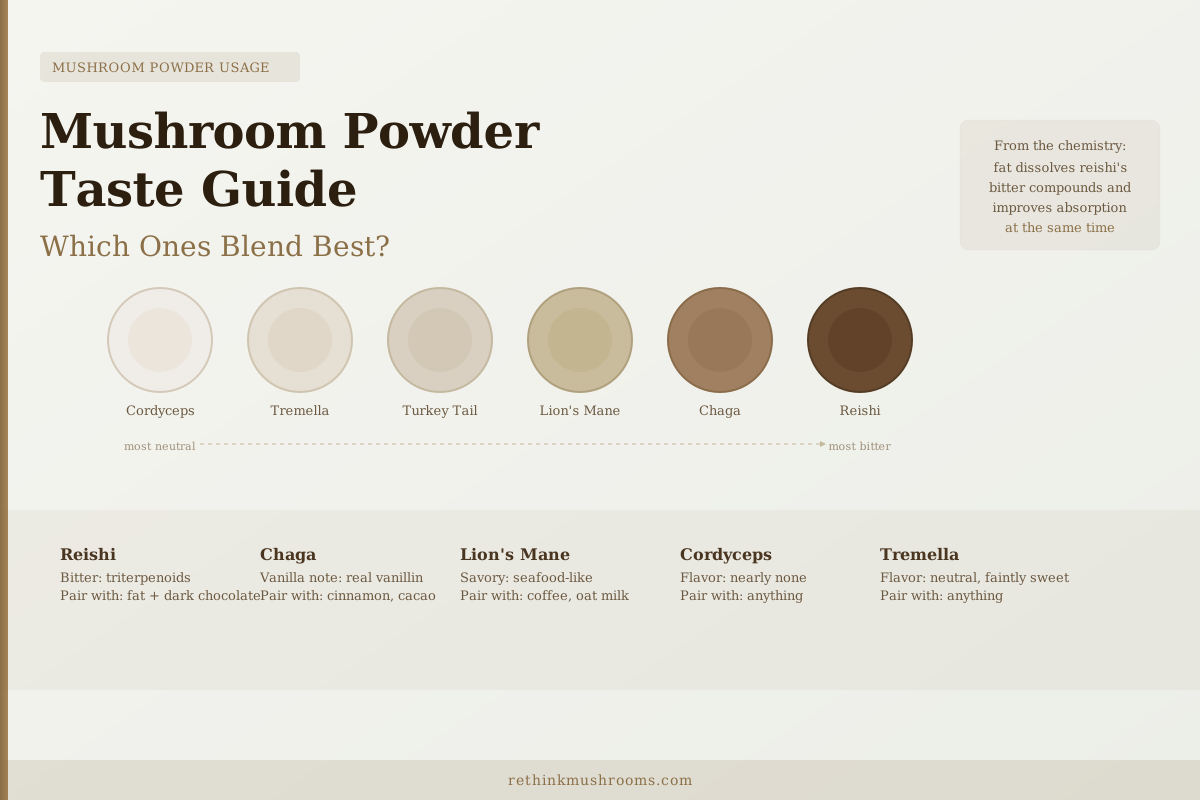
Mushroom powders range from nearly tasteless to intensely bitter, and the chemistry behind each flavor tells you exactly what to pair it with.
Flavor chemistry analysis, 6 functional mushroom species
Most neutral
Cordyceps: barely registers in any blend
Most bitter
Reishi: triterpenoid compounds are why
Natural vanilla
Chaga contains actual vanillin
Flavor chemistry analysis, 6 functional mushroom species
 View as image ↗
Six mushroom species. Six completely different flavor profiles. And almost no guidance online about why each one tastes the way it does.
Most mushroom powder reviews stop at "earthy and slightly bitter," which technically describes reishi, chaga, lion's mane, cordyceps, tremella, and turkey tail while being usefully accurate for none of them. Reishi is bitter in a specific way that responds to specific ingredients. Chaga is earthy, yes, but it also contains vanillin, the same compound that gives vanilla extract its flavor. Knowing what is behind each taste profile tells you far more about blending than any generic descriptor can.
This mushroom powder taste guide covers what each of the six major functional mushroom species actually tastes like, why, and what pairs well with each. For a broader overview of mushroom coffee, powders, and functional formats, see our guide to mushroom coffee and functional products.
Key Takeaways
- Cordyceps and tremella are the most neutral mushroom powders; they add almost no detectable flavor to smoothies or coffee
- Reishi's bitterness comes from compounds called triterpenoids (specifically ganoderic acids); blending with fat (coconut milk, nut butter) masks the bitterness and helps the body absorb these compounds more efficiently
- Chaga contains actual vanillin, the compound behind vanilla flavor, which makes warm-spice pairings like cinnamon and cardamom a natural match rather than an accidental one
- Lion's mane is mildly savory with a faint seafood-like note that disappears completely in oat milk or coffee; it is the most forgiving powder for beginners
- Reishi in citrus-heavy smoothies is one of the worst flavor combinations; citrus amplifies bitterness rather than counteracting it
- Shiitake powder, common in culinary blends, should be treated as a savory ingredient only; it clashes sharply with sweet smoothie bases
The Flavor Spectrum: Ranked From Nearly Tasteless to Full-On Bitter
Understanding where each mushroom falls on the flavor spectrum saves a lot of trial and error.
From most neutral to most intense:
Cordyceps tastes like almost nothing. The active compound in cordyceps, called cordycepin, contributes very little to the powder's flavor. Most people describe it as mildly earthy, but only if they are paying close attention. It is the easiest mushroom powder to hide in any blend.
Tremella has a neutral to slightly sweet profile, with a faint almond or coconut note. Its high polysaccharide content, which is where the functional compounds live, is essentially tasteless. The mild sweetness comes from the protein fraction of the dried mushroom rather than from sugars.
Turkey tail is mild and slightly woody. Like tremella, its main bioactive compounds (structural polysaccharides known as PSK and PSP) are flavorless. Turkey tail is tolerable in almost any application without adjustment.
Lion's mane sits at the mild end of the spectrum but has a distinct character: savory, slightly seafood-like, faintly reminiscent of crab broth. It is noticeable if you taste it straight from a spoon, but it disappears quickly in anything with a stronger base flavor.
Chaga is earthy and woody with a complexity the others don't have. Dark pigment compounds called melanins give it its deep color and earthy notes. But chaga also has a genuine vanilla undertone, not as a flavor metaphor but because chaga actually contains vanillin, the compound that makes vanilla taste like vanilla.
Reishi is the strongest and most divisive. Intensely bitter, with earthy and slightly chocolatey undertones, the bitterness dominates in any unmasked blend. Understanding why reishi tastes this way is what makes the flavor manageable.
Reishi: Bitter by Design, and Why Fat Changes the Equation
Reishi's bitterness is not random. It comes from a group of compounds called triterpenoids, specifically ganoderic acids, that account for much of reishi's biological interest to researchers.
The same property that makes these compounds of interest is what makes reishi bitter: triterpenoids are fat-soluble, not water-soluble. In a glass of water or a water-heavy smoothie, they don't dissolve properly. They remain as bitter-tasting particles on the palate. And because they don't dissolve well in water, the body cannot access them as efficiently either.
Blending reishi with a fat-based ingredient changes this on both levels. The fat dissolves the triterpenoids. The bitterness becomes distributed through the fat rather than hitting the palate directly and intensely. And because the compounds are now dissolved in a fat matrix, the body can absorb them more readily.
This is why the reishi and dark chocolate pairing works better than it seems like it should. Both reishi and cacao contain bitter compounds. When combined, the bitter-receptor pathways on the palate become somewhat desensitized, the same principle behind how bitter aperitifs paired with food become enjoyable rather than unpleasant. The dark chocolate doesn't cancel the bitterness. It makes the overall experience more tolerable by distributing the load across both ingredients.
Best pairings for reishi:
- Dark chocolate and a fat-rich base (shared bitter compounds desensitize the palate)
- Banana (sweetness provides direct contrast to bitterness)
- Dates and nut butter (sweet and fat-rich in one ingredient)
- Cacao powder and coconut milk (fat, bitterness, and sweetness working together)
Pairings to avoid:
- Citrus-heavy blends: lemon, orange, pineapple, and similar fruits amplify bitterness rather than counteracting it
- Plain water or plain ice water: the bitter compounds have no fat to dissolve into, and the bitterness sits unmasked
For more on how fat-solubility affects what the body absorbs from different supplement forms, see our article on bioavailability by supplement form.
Chaga: Earthy With a Real Vanilla Twist
Chaga looks and smells like a chunk of charcoal. The dark color comes from melanin pigments that form inside the sclerotium, the dense hardened mass that grows on birch trees. When dried and powdered, those same pigments give chaga its deep earthy notes.
But chaga has a dimension most earthy-flavored ingredients don't. It contains vanillin, the same compound that vanilla beans are prized for. This is not a flavor analogy. When you smell chaga powder up close, there is an actual faint vanilla note underneath the earthiness. In a blend with complementary spices, this becomes useful.
This is why chaga pairs well with warm baking spices. Cinnamon, cardamom, and vanilla extract all amplify what is already naturally present in chaga rather than clashing with it. Almond milk and cacao powder are strong partners, both carrying earthy and nutty profiles that complement chaga's base notes without competing.
Where chaga goes wrong is bright, fruity smoothies. Berry-banana bases or tropical fruit combinations work against chaga's deep earthiness the same way that adding mushrooms to lemonade would. The flavors don't neutralize each other. They clash.
Best pairings for chaga:
- Cinnamon and cardamom (warm spice notes amplify chaga's natural complexity)
- Vanilla extract (amplifies the vanillin already present in chaga)
- Almond milk base (earthy and nutty profiles are compatible)
- Cacao powder (shared deep earthiness)
Pairings to avoid:
- Tropical fruit bases: mango, pineapple, and passionfruit in bright sweet blends
- High-citrus blends: the same sharp-against-earthy mismatch occurs as with reishi
Lion's Mane: The Gateway Powder, Mild, Savory, and Forgiving
Lion's mane is the easiest mushroom powder to work with because its flavor profile almost disappears once it meets a dominant base ingredient. The powder has a faint savory, seafood-like character that is noticeable tasted straight but extremely submissive in any blend.
Coffee is the most natural fit. The roasty bitterness of coffee overwhelms lion's mane's mild character entirely. People who want the mushroom's functional properties without any mushroom taste in their morning coffee find lion's mane the obvious choice. This is why lion's mane is the most common species found in mushroom coffee products.
Oat milk smoothies work the same way. Oat milk's natural sweetness and slight creaminess absorbs the savory note. Add banana and vanilla extract and there is nothing left of the seafood character.
The one place lion's mane can go slightly wrong is in very strong-flavored fruit bases like dragonfruit or passionfruit, where the savory note might peek through. But it is a mild intrusion rather than an unpleasant one. Lion's mane has no meaningful pairings to avoid.
Best pairings for lion's mane:
- Coffee (the most complete flavor mask available)
- Vanilla protein shake base (savory disappears in vanilla)
- Oat milk and banana (creaminess absorbs it fully)
- Any berry smoothie (berry flavor is dominant; lion's mane becomes invisible)
If you're weighing lion's mane powder against capsules or tinctures for taste and convenience, our mushroom capsules vs. powder comparison covers the tradeoffs.
Cordyceps: The Powder You Will Not Taste in Your Smoothie
Cordyceps is the mushroom powder you will forget you added. The primary active compound, cordycepin, contributes almost no flavor to the finished powder. Dried and ground, cordyceps is mildly earthy, but only mildly, and only if you are specifically looking for it.
This neutrality makes cordyceps compatible across almost any application. Pre-workout smoothies are a natural fit for functional reasons as well, since cordyceps is often used for energy and endurance purposes. Mango and pineapple blends work well: bright tropical flavors dominate, mushroom is invisible. Coffee works. Tea works. Virtually any smoothie base works.
There is no meaningful avoid-with list for cordyceps. It is the powder you add when you want the functional compounds without introducing any flavor signature to the blend.
Tremella and Turkey Tail: Neutral by Nature
Tremella and turkey tail occupy the same low-intensity flavor territory as cordyceps, for a similar chemical reason: their primary bioactive compounds are polysaccharides, and polysaccharides are essentially tasteless.
Tremella has a mild sweetness and a faint almond or coconut note. The sweetness comes from the protein fraction of the dried mushroom. In a smoothie, tremella adds nothing detectable. Tropical fruit bases, plant-based milks, and skin-health stacks (tremella and collagen is a common pairing) all work without any flavor adjustment.
Turkey tail is slightly more woody and forest-floor in character than tremella, but still mild overall. The traditional preparation is tea, brewed slow and long, which suits its woody notes. In a smoothie, it is largely undetectable. Immunity blends with citrus work well because the citrus fruit takes flavor center stage and turkey tail follows quietly.
Neither powder has meaningful pairings to avoid. Both are beginner-friendly and useful in combination with stronger-flavored powders when you want to stack species without multiplying the bitterness challenge.
Mushroom Powder Taste by Species: Quick Reference
| Species | Flavor Profile | Best Pairings | Avoid With |
|---|---|---|---|
| Cordyceps | Nearly tasteless, faintly earthy | Any blend; pre-workout smoothies | Nothing |
| Tremella | Neutral, slightly sweet | Tropical smoothies, plant milk bases, skin stacks | Nothing |
| Turkey Tail | Mild, slightly woody | Tea, immunity blends, any smoothie | Nothing |
| Lion's Mane | Mild, savory, faint seafood note | Coffee, oat milk, banana smoothies | Nothing specific |
| Chaga | Earthy, woody, vanilla undertone | Spiced blends, cacao, almond milk | Tropical fruit, citrus |
| Reishi | Intensely bitter, slightly chocolatey | Dark chocolate, banana, nut butter, fat-rich bases | Citrus, plain water |
The Combinations That Make Mushroom Powder Taste Worse
Every mushroom powder taste guide tells you what to blend. Almost none tell you what to avoid, and the avoid list is where people make the most consistent mistakes.
Reishi and citrus is the most common bad combination. Citrus acids don't counteract bitterness; they amplify it. Lemon, orange, pineapple, and similar fruits in a reishi blend will make the bitterness more pronounced, not less. The same bitter receptors activated by reishi's ganoderic acids become more sensitive rather than less when exposed to acidic compounds.
Chaga and tropical fruit is a subtler clash but noticeable. Bright, sweet tropical flavors like mango and passionfruit create a tonal mismatch with chaga's deep, woody earthiness. The result is neither pleasant nor unpleasant in a definable way. Both flavors are fine separately. They don't build into anything together.
Shiitake powder in sweet smoothie bases is worth flagging if you use culinary mushroom blends. Shiitake is a common inclusion in mixed mushroom powders and in culinary mushroom products. Its deep umami character, the savory intensity associated with glutamate compounds, is an asset in soups and savory cooking. In a banana smoothie, it is aggressively wrong. If your blend includes shiitake, treat it as a savory-only ingredient and read the species label on any mixed mushroom powder before adding it to a sweet base.
Any powder stirred directly into plain cold water produces a poor result for a mechanical reason: mushroom powders don't mix easily with water alone and tend to clump on the surface. The flavor sits undiluted in clumps rather than dispersing through the liquid. Adding the powder to a small amount of warm water first, stirring until dissolved, then adding cold water or ice solves this. Fat-based milks solve it more completely. For a full breakdown of mixing techniques and heat stability across different preparation methods, see how to use mushroom powders in smoothies, cooking, and more.
The Chemistry of a Good Pairing, in Plain Terms
Three principles cover most of what makes a mushroom powder pairing work or fail.
Fat dissolves fat-soluble compounds. Reishi's triterpenoids don't mix with water. They do mix with fat. Coconut milk, nut butter, full-fat oat milk, any fat-containing ingredient improves both the taste and the body's access to these compounds at the same time. One tablespoon of nut butter or a quarter cup of coconut milk is enough to change the experience significantly.
Dominant flavors mask mild mushroom notes. Lion's mane's savory character vanishes in a strong coffee or berry smoothie. Cordyceps vanishes in tropical fruit. Tremella vanishes in everything. The strategy for neutral-to-mild powders is to pair them with whatever you would normally drink. The powder adds nothing detectable to the flavor.
Bitterness needs blunting, not canceling. There is no ingredient that directly neutralizes bitter taste at the receptor level. But sweetness provides contrast, fat distributes the bitter compounds so they hit less intensely, and competing bitter compounds like dark chocolate desensitize the palate to both at once. For reishi, the goal is not to eliminate the bitterness. It is to surround it with flavors that make the overall drink pleasant despite it.
For complete smoothie recipes built around these pairing principles, see mushroom powder smoothie recipes that don't taste like dirt. For dosing guidance on how much of each powder to actually add per serving, see mushroom powder dosing: how much per serving.
The Bottom Line
Mushroom powders vary dramatically in flavor intensity, from the nearly tasteless cordyceps and tremella to the intensely bitter reishi. The chemistry behind each flavor profile determines what pairs well: reishi's triterpenoids are fat-soluble, so fat-based ingredients mask the bitterness and improve absorption simultaneously. Chaga's vanillin content makes warm spices a natural complement rather than a creative experiment. For the four milder species, any strong base flavor handles the masking. The avoid list, particularly reishi in citrus and chaga in tropical fruit, is where most blending mistakes happen.