Mushrooms & Gut Health
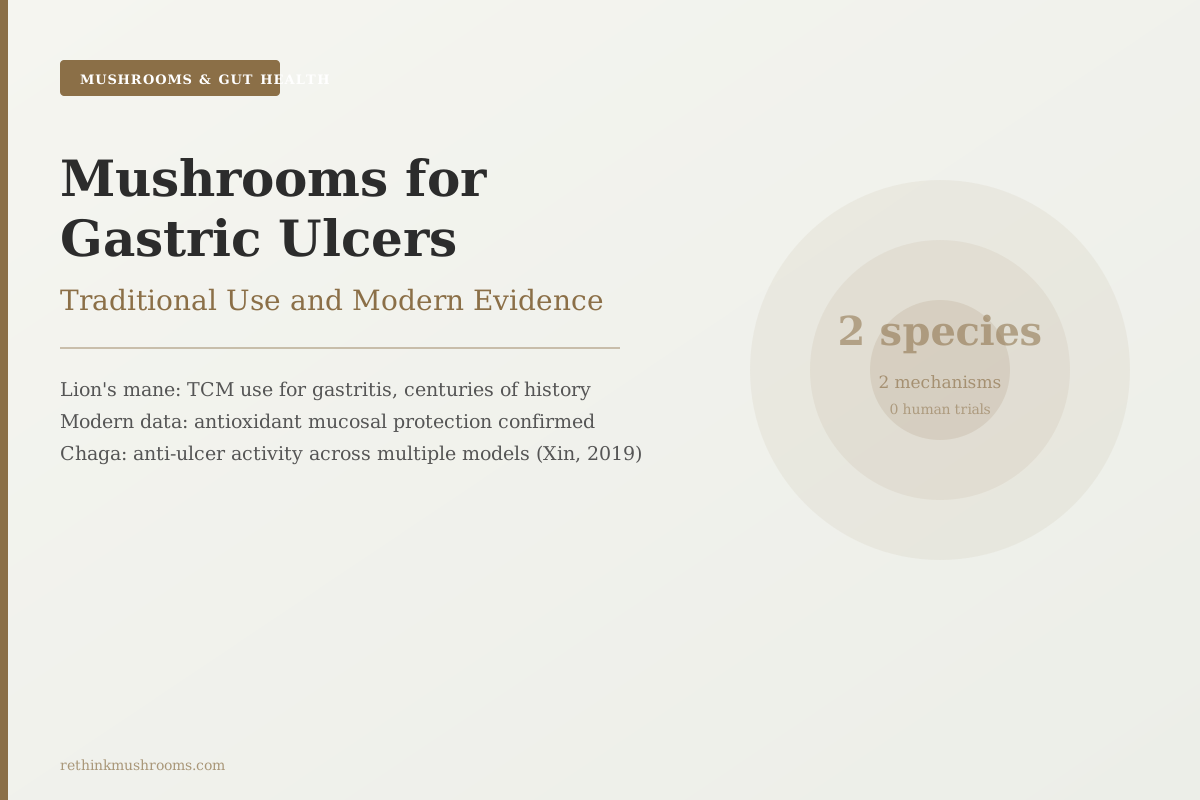
2 species
Both lion's mane and Chaga show gastroprotective activity in animal ulcer models through distinct mechanisms. No human clinical trial for mushrooms in gastric ulcer treatment has been published.
Wong et al., EBCAM, 2013; Xin et al., International Journal of Medicinal Mushrooms, 2019
2 mechanisms
lion's mane protects the stomach lining: antimicrobial (H. pylori) and antioxidant mucosal
200 mg/kg
Chaga dose showing anti-ulcer activity across multiple rat models with no toxicity (Xin, 2019)
0
human clinical trials testing any mushroom species for gastric ulcer treatment
Wong et al., EBCAM, 2013; Xin et al., International Journal of Medicinal Mushrooms, 2019
 View as image ↗
The use of lion's mane mushroom for stomach problems in traditional Chinese medicine was not random folk practice. It was specific: traditional practitioners prescribed it for chronic superficial gastritis, an inflammatory condition of the stomach lining. Modern researchers testing H. erinaceus extract in animal ulcer models found a plausible mechanism behind that centuries-old observation — the mushroom protects the stomach lining through antioxidant pathways that reduce the oxidative damage underlying mucosal injury.
This is the kind of alignment between traditional knowledge and modern evidence that makes plant and fungus research interesting. Traditional use pointed toward the stomach. Laboratory work found something real there. The honest framing: the modern evidence is entirely preclinical — animal models and cell studies — with no human clinical trial for any mushroom species in gastric ulcer treatment published to date.
This article is part of our guide on mushrooms as prebiotics and gut health. Here we examine which mushrooms have been studied for gastric ulcers, what mechanisms have been identified, and where traditional use and modern research converge.
Key Takeaways
- Lion's mane (Hericium erinaceus) has been documented in traditional Chinese medicine as a treatment for chronic superficial gastritis — a use that modern preclinical research has begun to investigate through two distinct mechanisms: antimicrobial (against H. pylori) and antioxidant protection of the stomach lining
- Wong et al. (2013) found that lion's mane aqueous extract significantly reduced ethanol-induced gastric ulcer area in rats, reduced oxidative damage (lipid peroxidation), and increased the activity of protective antioxidant enzymes in gastric tissue (SOD and catalase)
- Chaga (Inonotus obliquus) showed anti-ulcer activity in multiple ulcer models in rats at 200 mg/kg with no observed toxicity (Xin et al., 2019), working through mucosal cytoprotection and anti-inflammatory effects — a different mechanism from lion's mane
- Lion's mane extracts also show anticancer activity against gastrointestinal cancer cell lines (Li et al., 2014), relevant because H. pylori — the leading cause of gastric ulcers — is also the leading cause of gastric cancer
- No human clinical trial has tested any mushroom species for gastric ulcer treatment; all evidence is from animal models or cell studies; dosing in humans remains unknown
- The traditional use of these mushrooms for gastric conditions aligns with the mechanisms modern research has identified, though traditional preparation methods (aqueous decoctions) differ from modern standardized extracts
How Traditional Chinese Medicine Identified Lion's Mane for Stomach Problems
Traditional Chinese medicine has used Hericium erinaceus — known in Mandarin as Hóu Tóu Gū, meaning "monkey head mushroom" — for gastrointestinal conditions for centuries. The specific indication in historical records is not vague "digestive support" but a specific condition: chronic superficial gastritis, the persistent low-grade inflammation of the stomach lining that precedes and often underlies gastric ulcer formation.
This level of specificity is notable. Traditional medicine systems tend to accumulate uses through careful observation across generations. When modern ethnopharmacology researchers investigate lion's mane and GI conditions — as Li and colleagues did in a 2014 paper published in the Journal of Ethnopharmacology — they are typically working backward from a traditional use claim, testing whether the biology supports what practitioners already believed.[3]
Ganoderma (Ganoderma lucidum, reishi) and shiitake (Lentinula edodes) also appear in traditional medical literature from East Asia in contexts related to digestion and gastrointestinal health, though the documentation for lion's mane in gastric conditions is particularly specific. Traditional preparations typically involved aqueous decoctions — boiling the dried mushroom and consuming the tea. This matters for interpreting modern research, which uses standardized extracts whose composition may differ meaningfully from what traditional practitioners were administering.
The traditional use did not require a mechanism to work. Practitioners observed outcomes over generations. Modern research tries to identify what the mushroom is doing at a cellular level, and in the case of gastric protection, the mechanism found turned out to be biologically compelling.
The Two Pathways That Damage the Stomach Lining (and Why Antioxidants Help)
Gastric ulcers form when the stomach lining is damaged faster than it can repair itself. The stomach lining is normally protected by a mucus layer that insulates it from the acid it secretes for digestion. When that protection fails, acid reaches the lining directly and causes erosion.
Two major causes drive that failure. The first is Helicobacter pylori, a bacterium that burrows into the mucus layer and disrupts its protective function while also triggering chronic inflammation. About 70-80% of gastric ulcers are associated with H. pylori infection. The second is oxidative stress from various sources: non-steroidal anti-inflammatory drugs (NSAIDs like ibuprofen), alcohol, and stress-related physiological responses all generate damaging reactive oxygen species that can erode the mucosal barrier.
The antioxidant pathway is why compounds like lion's mane and Chaga show up in gastroprotection research. Both mushrooms are rich in polysaccharides and phenolic compounds that reduce oxidative damage. The antioxidant mechanism targets the second cause directly: it neutralizes the reactive oxygen species that damage the mucosal lining before they can cause erosion.
The antimicrobial mechanism — lion's mane's inhibitory activity against H. pylori — addresses the first cause. This creates two distinct entry points for mushroom research into gastric ulcer biology, covered in more detail in our article on mushrooms and H. pylori antimicrobial activity.
Lion's Mane and Gastric Ulcers: What the Animal Model Data Shows
Wong and colleagues published the key gastroprotection study on lion's mane in 2013 in Evidence-Based Complementary and Alternative Medicine.[1] They used an ethanol-induced ulcer model in rats, one of the standard experimental approaches for testing gastroprotective compounds. Oral pre-treatment with lion's mane aqueous extract significantly reduced the ulcer area compared to untreated animals.
The mechanism investigation was the most informative part of Wong's findings. Pre-treatment with lion's mane extract reduced lipid peroxidation in gastric tissue, and increased the activity of two protective antioxidant enzymes: SOD (superoxide dismutase) and catalase (CAT).
To translate those terms: lipid peroxidation is a form of oxidative damage to cell membranes, the kind of cellular injury that occurs when reactive oxygen species overwhelm a tissue's defenses. SOD and catalase are the stomach lining's built-in defenses against that oxidative damage — they convert reactive oxygen species into less harmful molecules before they can damage tissue. When lion's mane extract raised the activity of both enzymes while reducing lipid peroxidation, it showed that the gastroprotective effect was not random. The extract was doing something specific to the oxidative damage pathway.
This antioxidant mechanism is entirely separate from lion's mane's anti-H. pylori activity. The anti-H. pylori work happens via antimicrobial compounds in specific extract fractions — a bactericidal mechanism, not an antioxidant one. A single mushroom addressing both major causes of gastric ulcers through different pathways is the conceptually interesting finding here.
Worth noting: the aqueous extract used by Wong, a water-based preparation, resembles the traditional decoction more closely than alcohol or other solvent extracts do. This is partial mechanistic validation of the traditional preparation method.
Chaga's Gastroprotective Evidence: A Different Species, A Different Mechanism
While lion's mane has the most specific gastric research among mushrooms, it is not the only species with gastroprotective preclinical evidence.
Xin and colleagues published a 2019 study in the International Journal of Medicinal Mushrooms specifically on Chaga (Inonotus obliquus) and gastric mucosal ulceration.[2] They tested Chaga ethanolic extract in several different ulcer models in rats and found anti-ulcer activity across multiple models. The effective dose was 200 mg/kg, and Xin's toxicity assessment found no observed toxicity at that dose. The mechanisms identified included mucosal cytoprotection — direct protection of stomach lining cells — and anti-inflammatory effects.
Chaga is particularly rich in polyphenols, including betulinic acid and inotodiol, as well as melanin pigments that contribute to its antioxidant capacity. Chaga has no established anti-H. pylori activity in the same way lion's mane does. Its gastroprotection appears to come primarily from its antioxidant and anti-inflammatory properties protecting the mucosa from oxidative damage, not from direct antimicrobial action against the bacteria responsible for most ulcers.
This makes the two mushrooms mechanistically complementary for gastric protection rather than redundant:
- Lion's mane: addresses H. pylori (antimicrobial mechanism) plus oxidative mucosal damage (antioxidant mechanism)
- Chaga: addresses oxidative mucosal damage and inflammatory damage (antioxidant and cytoprotective mechanisms)
For readers curious how these species compare across multiple gastroprotective criteria, see the mushroom stomach lining comparison.
The Cancer Connection: Why Gastric Ulcer Research Matters Beyond Ulcers
Gastric ulcers are painful and debilitating, but the stakes are higher than the immediate injury.
H. pylori is classified by the World Health Organization as a Class I carcinogen — the highest-risk category, indicating sufficient evidence of a direct causal link to cancer. Chronic H. pylori infection drives a progression from gastritis to gastric ulcer to gastric atrophy to, in some cases, gastric adenocarcinoma. Gastric cancer is the fifth most common cancer globally and one of the leading causes of cancer death. Most cases are associated with H. pylori.
This means research on mushrooms for gastric protection has implications beyond ulcer management. Li and colleagues published a 2014 study in the Journal of Ethnopharmacology testing H. erinaceus extracts against human gastrointestinal cancer cell lines, including gastric cancer cells.[3] Multiple fractions showed anticancer activity. This laboratory evidence does not prove lion's mane prevents gastric cancer in humans. But it establishes biological plausibility for a compound that already has anti-H. pylori activity and gastroprotective effects to also have direct anti-gastric cancer activity.
The connection between ulcer prevention, H. pylori inhibition, and gastric cancer prevention creates a coherent biological story even if each individual link remains at the preclinical stage. For the full H. pylori evidence picture, including the antimicrobial data and the antibiotic resistance context, see mushrooms and H. pylori eradication.
Where Traditional Knowledge and Modern Data Align (and Where They Don't)
The most striking alignment between traditional use and modern evidence is the specificity of the traditional indication.
Traditional Chinese medicine practitioners used lion's mane not for vague "gut health" but for chronic superficial gastritis, the persistent inflammatory condition of the stomach lining that precedes ulcer formation. Modern preclinical research found that lion's mane extract protects the gastric mucosa through antioxidant mechanisms that directly address the oxidative damage driving that inflammation. The traditional use pointed at the right organ condition, and the modern research found a mechanism that explains why it might have worked.
Where the alignment is less clean: traditional preparations were aqueous decoctions — essentially mushroom teas. Modern research uses standardized extracts, often with defined polysaccharide concentrations, solvent-based extractions, or dried powder concentrates. What is in an aqueous decoction prepared from whole dried lion's mane may not match what is in a commercial extract capsule standardized to beta-glucan content. The Wong 2013 study used an aqueous extract, which is the closest equivalent to the traditional preparation, and that study showed protective effects. Whether modern standardized supplement products produce the same gastric tissue concentrations of active compounds as traditional preparations is not directly established.
The most important gap: no human clinical trial has tested any mushroom for gastric ulcer treatment. All the evidence described here is from animal models and cell studies. Animal ulcer models are validated predictors for some compounds — several pharmaceutical ulcer drugs were initially identified in these models — but the translation from animal data to human outcomes fails for a meaningful proportion of candidates. Without human trial data, the preclinical findings are signals worth taking seriously, not conclusions worth acting on as medical recommendations.
What Would Actually Move the Evidence Forward
The evidence base for mushrooms and gastric ulcers has two specific needs.
First, bioavailability data: the animal model studies use doses and preparation methods that do not directly translate to what someone consuming a lion's mane or Chaga supplement would absorb in their gastric tissue. Pharmacokinetic studies tracking the actual gastric tissue concentrations achievable from oral supplementation would close this gap.
Second, human clinical trials: the most meaningful step would be a randomized controlled trial in patients with confirmed gastric ulcers or H. pylori-associated gastritis, comparing standard of care with and without mushroom extract supplementation. Given the preclinical evidence and the established safety profile of lion's mane across human studies, this trial is ethically feasible. It has not been run.
The traditional use record and the preclinical biology are more consistent than for many natural compound candidates in gastric research. What remains is the translation from cell and animal data to human outcomes.
The Bottom Line
Lion's mane and Chaga both show gastroprotective activity in animal ulcer models through distinct mechanisms: lion's mane via antioxidant mucosal protection and anti-H. pylori activity, Chaga via mucosal cytoprotection and anti-inflammation. Traditional Chinese medicine use of lion's mane specifically for chronic gastritis predates this research and aligns with the mechanism modern studies found. The honest limit: no human clinical trial has tested any mushroom for gastric ulcers. Animal model data and traditional use together create a plausible research case, not a proven treatment.
Frequently Asked Questions
Sources & References
- 1RTHM-00564·Wong, Jing-Yang et al. (2013). “Gastroprotective Effects of Lion's Mane Mushroom Hericium erinaceus (Bull.:Fr.) Pers. (Aphyllophoromycetideae) Extract against Ethanol-Induced Ulcer in Rats..” Evidence-based complementary and alternative medicine : eCAM.Study breakdown →PubMed →↩
- 2RTHM-00600·Xin, Xin et al. (2019). “Assessment of the Gastroprotective Effect of the Chaga Medicinal Mushroom, Inonotus obliquus (Agaricomycetes), Against the Gastric Mucosal Ulceration Induced by Ethanol in Experimental Rats..” International journal of medicinal mushrooms.Study breakdown →PubMed →↩
- 3RTHM-00614·Li, Guang et al. (2014). “Anticancer potential of Hericium erinaceus extracts against human gastrointestinal cancers..” Journal of ethnopharmacology.Study breakdown →PubMed →↩