Oyster Mushroom Antimicrobial Research
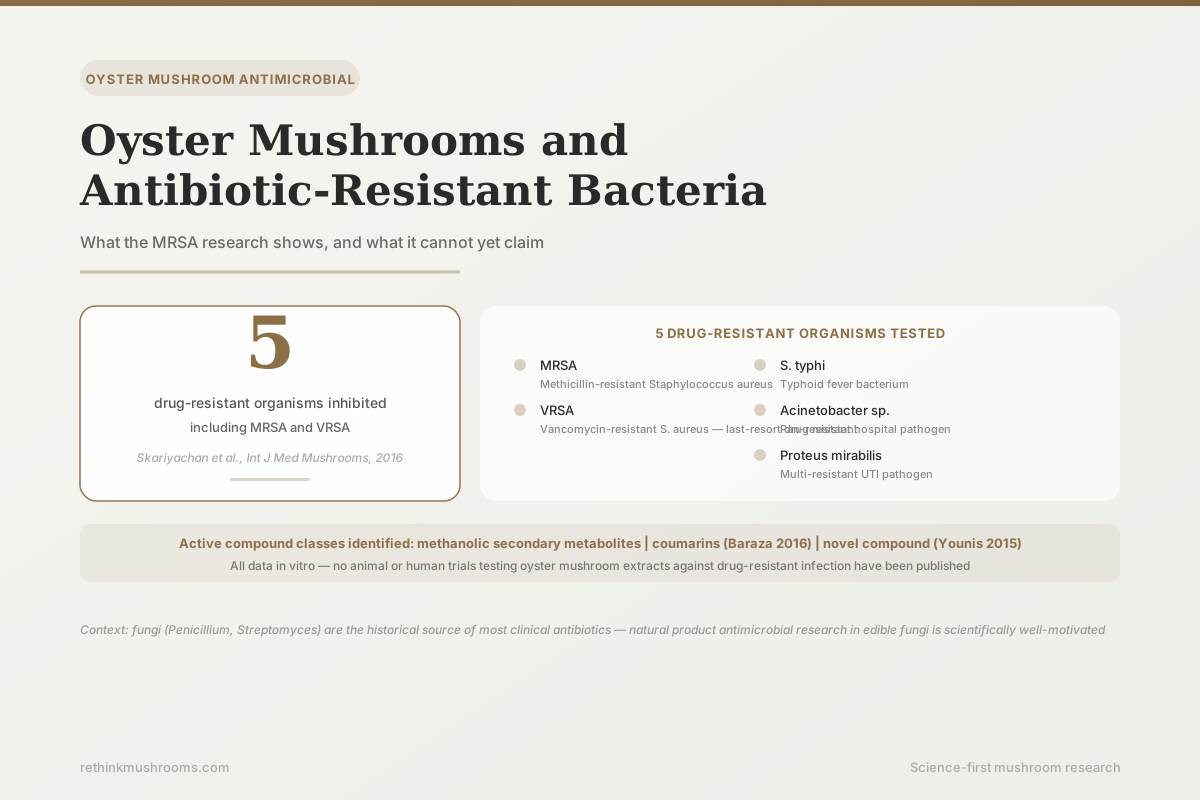
5 drug-resistant organisms tested
Methanolic oyster mushroom extracts showed activity against five antibiotic-resistant organisms including MRSA and VRSA, outperforming current-generation antibiotics in vitro.
Skariyachan et al., Int J Med Mushrooms, 2016
MRSA + VRSA
Two of the five organisms: methicillin-resistant and vancomycin-resistant Staphylococcus aureus, among the most dangerous drug-resistant bacteria in hospitals
Methanolic extract
The preparation with the greatest activity, capturing secondary metabolites across multiple compound classes from the fruiting body
In vitro only
No human or animal trials have tested oyster mushroom extracts against MRSA infections; clinical translation is years away
Skariyachan et al., Int J Med Mushrooms, 2016
 View as image ↗
In 2016, researchers tested oyster mushroom extracts against some of the most dangerous drug-resistant bacteria in existence. Their result: methanolic extracts of Pleurotus ostreatus were more effective than current-generation antibiotics against methicillin-resistant Staphylococcus aureus (MRSA), a bacterium responsible for an estimated 100,000 hospitalizations annually in the United States alone.[1]
That finding is not in a single consumer-facing article about oyster mushrooms and antibiotic resistance. It is not overclaimed here as a treatment breakthrough, because it is not one. It is an in vitro result (a lab dish experiment), and the gap between a lab dish and a treated patient is enormous. But the finding is real, it was published in a peer-reviewed journal, and it is a genuine research lead in a field, natural product antimicrobials, that medicine increasingly needs to explore. This article explains what the study found, what compounds appear responsible, and what the evidence can and cannot tell us. For a broader overview of oyster mushroom's antimicrobial research across all mechanisms, see our complete antimicrobial activity research review, and our complete oyster mushroom guide.
Key Takeaways
- A 2016 in vitro study found methanolic extracts of Pleurotus ostreatus outperformed present-generation antibiotics against MRSA, vancomycin-resistant S. aureus (VRSA), S. typhi, Acinetobacter sp., and Proteus mirabilis (Skariyachan et al.)
- Oyster mushroom contains multiple compound classes with antimicrobial activity: polysaccharides, lectins (carbohydrate-binding proteins), coumarins, and secondary metabolites recovered by methanolic extraction
- A 2015 study identified a novel antimicrobial compound from P. ostreatus fruiting body extracts, and water extracts showed activity against Candida albicans, Cryptococcus humicola, and S. aureus (Younis et al.)
- A 2016 study isolated novel coumarin compounds from a Kenyan P. ostreatus strain with direct antibacterial activity, establishing that oyster mushroom's antimicrobial chemistry extends beyond polysaccharides and lectins (Baraza et al.)
- All current oyster mushroom anti-MRSA data is in vitro; no animal model or human trial has tested these extracts against drug-resistant infection
- Historically, fungi are the primary source of antibiotics in clinical use, making the discovery of new antimicrobial activity in edible fungi a legitimate and well-funded research priority
Why Natural Products Are a Legitimate Antibiotic Research Focus
Antimicrobial resistance is one of the most serious challenges in modern medicine. Bacteria accumulate resistance mutations when exposed to antibiotics, and the pipeline of new antibiotic classes has been largely empty for decades. The WHO estimates that drug-resistant infections already cause over 700,000 deaths globally each year, with projections of 10 million by 2050 if trends continue.
Natural products have historically been the dominant source of antibiotics in clinical use. Penicillin came from Penicillium mold. Streptomycin, tetracycline, erythromycin, and vancomycin all came from soil bacteria or fungi. The pharmaceutical industry has largely abandoned the natural product search in favor of synthetic chemistry, but academic research continues, and fungi are a prime target because they produce an enormous diversity of secondary metabolites evolved to compete with bacteria in their environment.
Oyster mushrooms, like all macrofungi, produce secondary metabolites as part of their ecology: compounds that protect against competing organisms, facilitate nutrient acquisition, or signal between individuals. When researchers screen these compounds against clinical bacterial strains, they are asking whether fungi have already solved, in evolutionary time, some of the same chemical competition problems that antibiotic resistance creates.
The 2016 Study: What Skariyachan Found Against MRSA
Skariyachan and colleagues published their results in the International Journal of Medicinal Mushrooms in 2016.[1] Their study tested extracts from Pleurotus ostreatus fruiting bodies against a panel of multidrug-resistant clinical isolates.
The organisms they tested represent a cross-section of the antibiotic resistance problem:
MRSA (methicillin-resistant Staphylococcus aureus) is a strain of S. aureus that no longer responds to methicillin or most standard beta-lactam antibiotics. It is responsible for severe skin infections, pneumonia, and bloodstream infections in both hospitals and community settings.
VRSA (vancomycin-resistant S. aureus) has also developed resistance to vancomycin, the antibiotic typically used as a last resort when MRSA fails to respond to other treatments. VRSA is rare but represents the end of the current treatment line.
S. typhi is the bacterium that causes typhoid fever, a major cause of mortality in lower-income countries where it is increasingly resistant to first-line fluoroquinolone antibiotics.
Acinetobacter sp. is a family of bacteria increasingly documented as resistant to every available antibiotic class. It is particularly associated with hospital-acquired infections in intensive care units.
Proteus mirabilis is a frequent cause of urinary tract infections and hospital-acquired infections, increasingly demonstrating resistance to multiple antibiotic classes.
Against all five of these organisms, methanolic extracts of Pleurotus ostreatus showed inhibitory activity. Against MRSA and VRSA specifically, the extracts outperformed the reference antibiotics tested in the same assay. The study compared oyster mushroom extract activity to "present-generation antibiotics" and found the mushroom extract more potent in the in vitro assay.
This is the finding that no consumer-facing oyster mushroom article currently reports. It deserves accurate framing: it is a cell-free laboratory experiment measuring bacterial growth inhibition by extracted compounds at controlled concentrations. The extract concentration used in the lab cannot be replicated by eating oyster mushrooms.
Why Methanolic Extract Specifically?
The Skariyachan study used methanolic extraction, which is notable. Different solvents capture different compound classes from the mushroom.
Aqueous (water-based) extraction captures primarily polysaccharides, including beta-glucans. Methanolic extraction captures the secondary metabolite fraction: terpenoids, phenolics, coumarins, alkaloids, and small organic molecules that are water-insoluble or only partially soluble. This is the fraction most likely to contain novel antimicrobial compounds not previously characterized.
When the Skariyachan study found the methanolic fraction outperforming antibiotics, it pointed specifically to this secondary metabolite class as the active pool. This aligns with findings from two other studies that investigated oyster mushroom antimicrobial chemistry directly.
New Compounds Being Found: Younis 2015 and Baraza 2016
In 2015, Younis and colleagues screened multiple extract types from Pleurotus ostreatus fruiting bodies and identified a previously unknown antimicrobial compound.[2] Water extracts showed the greatest activity against fungal pathogens including Candida albicans (a common opportunistic fungal infection) and the emerging pathogens Cryptococcus humicola and Trichosporon cutaneum. Among bacteria, S. aureus was the most susceptible test organism. The study's contribution is dual: it confirmed broad antimicrobial activity and added a structurally novel compound to the known oyster mushroom antimicrobial chemistry.
The following year, Baraza and colleagues isolated coumarin compounds from a Kenyan P. ostreatus strain and documented their direct antibacterial activity.[3] Coumarins are a class of organic compounds found in plants and fungi that have been studied for antimicrobial activity in other species, but their presence as a separate antimicrobial compound class in oyster mushroom was a new finding. The Kenyan strain result demonstrates that the chemical diversity of oyster mushroom antimicrobial compounds extends beyond polysaccharides and lectins (the carbohydrate-binding proteins that most oyster mushroom antimicrobial discussion focuses on) to include small organic molecules from a completely different chemical family.
Taken together, the Younis and Baraza papers establish that researchers are still finding new antimicrobial compound classes in a mushroom that has been eaten for thousands of years. The secondary metabolite chemistry is not fully characterized.
For a detailed look at the peptide and lectin compound classes specifically, including the carbohydrate-binding mechanism by which mushroom lectins block bacterial adhesion to host cells, see our article on oyster mushroom antibacterial peptides.
What In Vitro Results Mean and Don't Mean
The MRSA finding from Skariyachan 2016 is a genuine scientific result that warrants serious research attention. It is not a treatment.
Several gaps separate the in vitro finding from a clinical application:
Concentration achievability. The extract concentration in a laboratory assay is controlled and precise. It bears no relationship to what concentrations of these compounds reach systemic circulation after oral consumption of oyster mushrooms. The gastrointestinal tract, liver metabolism, and distribution to tissue sites create enormous differences between what is active in a dish and what is active in a body.
Delivery to the infection site. MRSA infections occur in skin, lungs, blood, and bones. Even if the right compounds reached the bloodstream after ingestion, whether they would accumulate at sufficient concentrations at infection sites is an entirely separate question.
Selectivity. Laboratory assays measure killing or inhibition of the target organism. They do not measure selectivity against human cells, which would be required to establish safety for clinical use. Secondary metabolites active against bacteria may also be cytotoxic at high concentrations.
No animal or human data. No published study has tested oyster mushroom extracts against MRSA infections in animals, let alone humans. The research pipeline from promising in vitro finding to clinical drug routinely takes 15-20 years and fails most of the time.
None of this diminishes the scientific significance of the finding. The fact that an extract from a common edible mushroom inhibits MRSA more effectively than current antibiotics in a cell assay is a meaningful research lead. It identifies specific compound classes that might yield new antimicrobial agents with a different mechanism of action than current antibiotics. That is exactly the kind of research the antibiotic resistance crisis requires more of.
What it does not mean is that eating oyster mushrooms protects against MRSA infection, treats an ongoing MRSA infection, or should be used in place of standard medical care for any drug-resistant bacterial infection.
For the broader picture of oyster mushroom's antimicrobial research spanning antibacterial, antiviral, and food pathogen data, see Oyster Mushroom Antimicrobial Activity: Research Review. For the antiviral side, including a human trial showing Pleuran reduced herpes simplex severity, see Pleurotus ostreatus Laccase and Antiviral Properties. For food safety applications of oyster mushroom antimicrobial activity, see Oyster Mushroom for Food-Borne Pathogen Prevention. The ergothioneine compound in oyster mushrooms, which has separate early-stage antimicrobial and antiviral research, is covered in ergothioneine in oyster mushrooms.
The Bottom Line
A 2016 in vitro study found oyster mushroom methanolic extracts outperformed current antibiotics against MRSA, VRSA, and three other drug-resistant organisms. Two adjacent studies from 2015 and 2016 identified novel antimicrobial compounds from oyster mushroom fruiting bodies, including a previously unknown compound and coumarin molecules, confirming that the antibacterial chemistry of this common edible mushroom is still being fully characterized. All data is in vitro. No animal or human study has tested oyster mushroom extracts against drug-resistant bacterial infections. The findings are legitimate research leads, not clinical applications.
Frequently Asked Questions
Sources & References
- 1. Source details for this reference are not yet available.
- 2. Source details for this reference are not yet available.
- 3. Source details for this reference are not yet available.