Oyster Mushroom
HSV-1 reduced in humans
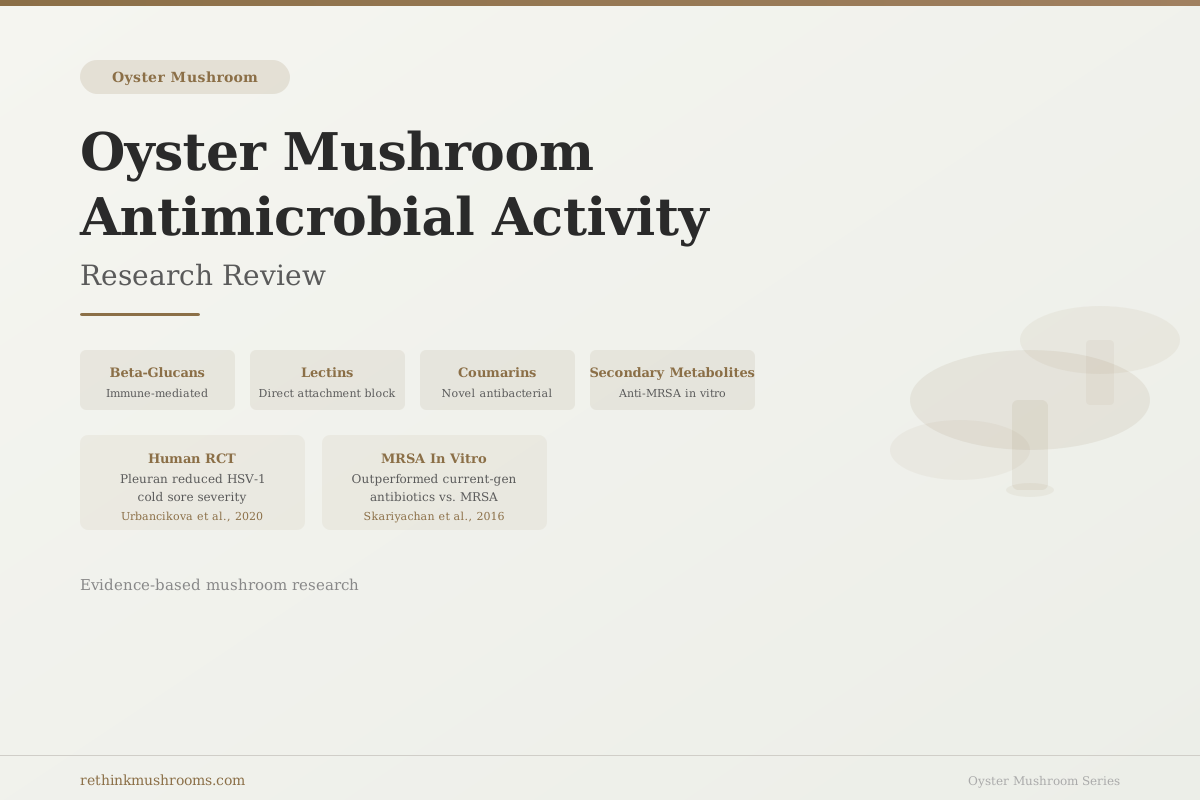
In the only human RCT on oyster mushroom antimicrobial activity, Pleuran (the beta-glucan from Pleurotus ostreatus) significantly reduced duration and severity of labial herpes simplex type 1 infections versus placebo.
Urbancikova et al., Evidence-Based Complementary and Alternative Medicine, 2020
vs. MRSA
oyster mushroom methanolic extract outperformed current-generation antibiotics in vitro (Skariyachan et al., 2016)
H1N1 + HSV-2
Pleurotus ostreatus inhibited both influenza and herpes simplex type 2 in cell culture (Krupodorova et al., 2014)
4 classes
of antimicrobial compounds identified: beta-glucans, lectins, coumarins, and novel secondary metabolites
Urbancikova et al., Evidence-Based Complementary and Alternative Medicine, 2020
 View as image ↗
Oyster mushrooms (Pleurotus ostreatus) have antimicrobial properties documented across antibacterial, antiviral, and antifungal research. The evidence covers a range from individual compound classes to a human clinical trial. In 2020, a randomized controlled trial found that Pleuran, a specific beta-glucan derived from oyster mushrooms, reduced the severity and healing time of labial herpes simplex type 1 (cold sore) infections compared to placebo.[6] In vitro studies have found that oyster mushroom extracts are active against influenza H1N1, herpes simplex type 2, MRSA, vancomycin-resistant bacteria, and multiple Candida species.
What makes the oyster mushroom antimicrobial data scientifically interesting is that multiple compound classes are involved, each working through a different mechanism. This article maps the evidence by compound class and evidence tier. It is part of the broader Oyster Mushroom guide.
Key Takeaways
- In the only human RCT on the topic, Pleuran (the beta-glucan from Pleurotus ostreatus) significantly reduced duration and blister severity of labial HSV-1 (cold sores) versus placebo (Urbancikova et al., 2020)
- Oyster mushroom methanolic extracts outperformed present-generation antibiotics against MRSA, vancomycin-resistant S. aureus, S. typhi, Acinetobacter, and Proteus mirabilis in vitro (Skariyachan et al., 2016); this finding has not been replicated in clinical settings
- Oyster mushroom was among 10 basidiomycetes tested that inhibited H1N1 influenza in cell culture; it was also effective against HSV-2 alongside turkey tail, Fomes fomentarius, and Auriporia aurea (Krupodorova et al., 2014)
- Researchers have identified a novel antimicrobial compound from oyster mushroom fruiting body extracts (water extracts most effective against Candida and Cryptococcus) alongside known coumarins as a second distinct compound class (Younis et al., 2015; Baraza et al., 2016)
- Oyster mushroom polysaccharides show dual activity in the gut environment: prebiotic (feeding beneficial bacteria) and antimicrobial (inhibiting the growth of harmful gut bacteria) simultaneously (Törős et al., 2023)
- All in vitro antimicrobial data involves concentrated extracts at laboratory conditions; the HSV-1 human trial used a specific branded extract (Pleuran), not eating mushrooms; the distinction matters for interpreting what the evidence applies to
Oyster Mushroom's Antimicrobial Arsenal: Four Compound Classes
Consumer content summarizes oyster mushroom's antimicrobial activity as a single property. The research is more granular: four distinct compound classes have documented antimicrobial activity, and they work through different mechanisms.
Beta-glucans (particularly Pleuran) work primarily through immune modulation. The beta-glucan from oyster mushroom binds to receptors on immune cells (Dectin-1 and toll-like receptors) and activates the body's own defenses against pathogens. The antiviral effect against HSV-1 in the Urbancikova 2020 RCT was mediated this way: Pleuran did not kill the virus directly; it enhanced the host immune response.
Lectins are carbohydrate-binding proteins produced by oyster mushrooms including pleurotolysins and agglutinins. Lectins can bind directly to surface glycoproteins on viruses and bacteria, blocking their ability to attach to host cells. The mechanism is physical obstruction at the point of initial infection, before the pathogen enters a cell.
Coumarins are a chemical class distinct from polysaccharides and proteins. Baraza and colleagues isolated novel coumarin compounds with antimicrobial activity from a Kenyan strain of P. ostreatus, demonstrating that oyster mushroom's antibacterial activity is not limited to beta-glucans or lectins.[4]
Novel secondary metabolites represent a fourth category still being characterized. Younis and colleagues identified a new antimicrobial compound from oyster mushroom fruiting body extracts that had not been previously described, suggesting that the full compound inventory from this common edible mushroom is not yet complete.[3]
For deeper coverage of the antibacterial peptides and proteins, see Oyster Mushroom and Antibacterial Peptides.
The Human Evidence: Pleuran and HSV-1 Cold Sores
Most of the antimicrobial data for oyster mushrooms is preclinical (cell culture or animal studies). The Urbancikova 2020 trial stands apart as the only human RCT.[6]
The trial tested Pleuran, a commercially branded beta-glucan derived from P. ostreatus, in patients with recurring labial herpes simplex type 1 infections (cold sores). Participants received either Pleuran or a matched placebo and were followed through the next outbreak.
The Pleuran group showed significantly shorter healing time and reduced blister severity compared to the placebo group. The study authors characterized this as the first human study confirming a beneficial effect of oyster mushroom beta-glucans in managing labial herpes.
Three things about this study are worth noting carefully. First, Pleuran is a specific branded extract, not a general "oyster mushroom product." The active ingredient is the beta-glucan fraction at a specific concentration and formulation. Second, the mechanism is immune support rather than direct antiviral killing: Pleuran activates immune cells that then suppress the virus. Third, HSV-1 management is distinct from HSV-1 prevention: the study enrolled people who already experienced recurrent outbreaks.
The finding that a beta-glucan from a common edible mushroom can measurably affect herpes simplex course in a randomized placebo-controlled trial is clinically meaningful. It is also an isolated finding: one human trial. Replication with larger samples and different populations would strengthen the evidence.
Against Viruses: Influenza, HSV-2, and the Cell Culture Data
Beyond the HSV-1 human trial, the antiviral data comes from cell culture studies.
Krupodorova and colleagues tested 10 basidiomycete species against influenza type A (H1N1) and herpes simplex type 2 (HSV-2) in cell culture.[2] All 10 species showed inhibitory activity against H1N1. Pleurotus ostreatus was among four species that were also effective against HSV-2 in cell culture, alongside turkey tail (Trametes versicolor), Fomes fomentarius, and Auriporia aurea.
Cell culture studies establish that a compound has the right biological properties to affect a pathogen. They do not establish that those properties survive digestion, enter the bloodstream, and reach viral replication sites in a living person. H1N1 inhibition in cell culture is a starting point for antiviral research, not a clinical claim.
What the Krupodorova data establishes is that oyster mushroom's antiviral activity extends to both influenza and herpes simplex, suggesting a mechanism broad enough to affect structurally different viruses rather than a narrow, pathogen-specific compound interaction.
The MRSA Finding: Outperforming Antibiotics in Vitro
The most striking antibacterial data in this area comes from Skariyachan and colleagues, published in 2016.[5]
The researchers tested methanolic extracts of P. ostreatus fruit bodies against a panel of multidrug-resistant bacterial isolates: methicillin-resistant S. aureus (MRSA), vancomycin-resistant S. aureus (VRSA), Salmonella typhi, Acinetobacter species, and Proteus mirabilis. These represent some of the most clinically problematic antibiotic-resistant bacteria in current medicine.
The result: oyster mushroom methanolic extract was more effective than present-generation antibiotics against these organisms in laboratory conditions.
This is a dramatic finding that requires equally careful framing. Laboratory conditions and clinical medicine are not the same. A methanolic extract tested at laboratory concentration against bacteria in culture is a fundamentally different situation from an extract that must survive oral ingestion, reach systemic circulation, and achieve sufficient concentration at an infected site. No clinical translation has been demonstrated.
What the Skariyachan finding does establish is that oyster mushroom contains compounds active against organisms that have defeated conventional antibiotics. In the context of a genuine global antibiotic resistance crisis, that is a meaningful scientific lead. It identifies oyster mushroom extracts as worth investigating for antibiotic development, not as a current clinical treatment.
The compound class responsible for the activity in the Skariyachan study was the methanolic extract fraction, which captures a broad range of secondary metabolites rather than a single pure compound. Identifying which specific compound or compounds in that extract are driving the MRSA activity is the necessary next step before pharmaceutical development could begin. Younis and colleagues had identified a novel antimicrobial compound in water extracts effective against Candida and Cryptococcus; whether similar novel compounds account for the MRSA data is an open question.
For in-depth coverage of the MRSA research and what it would take to translate to medicine, see Oyster Mushroom and Antibiotic-Resistant Bacteria: A Natural Antimicrobial.
Dual Action in the Gut: Prebiotics and Pathogen Inhibition
The most recently published review in this area, by Törős and colleagues in Foods (2023), covers an angle that connects antimicrobial properties to everyday dietary context.[7]
Törős and colleagues describe how Pleurotus polysaccharides and secondary metabolites exert dual activity in the gut environment: the non-digestible carbohydrates (chitin and glucan) selectively feed beneficial bacteria (functioning as a prebiotic), while the same bioactive fraction can help prevent the growth and spread of harmful bacteria in the gut. The combination of prebiotic and antimicrobial activity in the same compound class is unusual and clinically interesting: an ideal gut health intervention would support beneficial bacteria while suppressing pathogenic ones simultaneously.
Earlier work by Hearst and colleagues documented the baseline antibacterial and antifungal properties of oyster mushroom extracts against S. aureus and fungal pathogens, establishing gram-positive bacteria as more sensitive than gram-negative due to cell wall composition differences.[1] The Törős review extends this with a functional dietary context. For more on the food safety implications, see Oyster Mushroom for Food-Borne Pathogen Prevention.
What the Evidence Applies To (and What It Does Not)
Across the antimicrobial research on oyster mushrooms, several distinctions matter for honest interpretation. The evidence sorts into tiers of human relevance, and the strength of any given claim depends on which tier it comes from.
Four Evidence Tiers
The Strength of the Claim Depends on the Tier
Oyster mushroom’s antimicrobial evidence is not one thing. The most dramatic findings — extracts outperforming antibiotics against MRSA — sit at the widest, most artificial tier. The only human evidence is a single antiviral trial. Bar width reflects how much direct evidence sits at each tier; narrower toward the top means closer to a real-world human effect but less data.
In vitro extracts (antibacterial / antifungal)
Which compounds are active?Skariyachan 2016 · Hearst 2009 · Younis 2015 · Baraza 2016
Broadest, most-studied tier: methanolic extract outperformed present-generation antibiotics against MRSA, VRSA, S. typhi, Acinetobacter and Proteus mirabilis; gram-positive bacteria more sensitive than gram-negative; a novel compound active against Candida and Cryptococcus; and antibacterial coumarins isolated from a Kenyan strain
Cell culture (antiviral)
Do they work on viruses in cells?Krupodorova 2014
All 10 basidiomycetes tested inhibited influenza H1N1; Pleurotus ostreatus was among four species also effective against HSV-2 (alongside Trametes versicolor, Fomes fomentarius, and Auriporia aurea)
Human randomized controlled trial
Does it help a person?Urbancikova 2020
The only human evidence: Pleuran (the branded beta-glucan from P. ostreatus) significantly shortened healing time and reduced blister severity of recurrent labial HSV-1 versus placebo — an immune-mediated effect, not direct viral killing
Human antibacterial / antifungal trial
The open questionDoes not yet exist
No human trial has tested oyster mushroom extracts against MRSA, Candida, or any bacterial or fungal infection — so the striking in-vitro antibacterial data has no clinical translation yet
How to read it: a claim is only as strong as the tier it comes from. The antibacterial data is the most striking and the least human — concentrated extracts against bacteria in a dish. The single human trial is antiviral and immune-mediated, and used a standardized extract (Pleuran), not eating mushrooms. The missing top tier — a human antibacterial or antifungal trial — is the honest limit on the “natural antibiotic” framing, not a weakness of the leads below it.
Sources: Hearst 2009 [1]; Krupodorova 2014 [2]; Younis 2015 [3]; Baraza 2016 [4]; Skariyachan 2016 [5]; Urbancikova 2020 [6]; Törős 2023 [7]. Bar widths are illustrative of evidence depth and human relevance per tier, not quantitative effect sizes.
Extracts versus eating mushrooms. The Skariyachan MRSA data used methanolic extracts at laboratory concentrations. The Krupodorova antiviral data used cell culture. The Younis and Baraza compound isolation studies used specific fractions of mushroom material. None of these conditions correspond to eating cooked oyster mushrooms at a typical serving size. The ergothioneine and nutritional research establishes what dietary consumption provides (see Oyster Mushroom Nutritional Profile: Complete Breakdown). The antimicrobial research uses different preparation methods at different concentrations.
The Pleuran distinction. The Urbancikova 2020 human RCT used Pleuran, a specific commercial beta-glucan extract. This is not the same as eating oyster mushrooms or taking a general oyster mushroom supplement. Pleuran is a standardized preparation of the beta-glucan fraction.
In vitro to clinical translation is not guaranteed. Most compounds that show antimicrobial activity in cell culture fail in animal models or clinical trials. The MRSA finding, the antiviral data, and the novel compound research all identify legitimate leads that warrant further investigation. None currently supports a clinical claim.
What the compound taxonomy and evidence base collectively show is that oyster mushroom produces a chemically diverse set of antimicrobial agents through multiple pathways. That diversity is precisely what makes this a productive research area, and exactly what most consumer content misses by flattening it into a vague claim about "antimicrobial properties."
The Bottom Line
Oyster mushroom (Pleurotus ostreatus) contains at least four chemically distinct compound classes with documented antimicrobial activity: beta-glucans (Pleuran, immune-mediated antiviral), lectins (direct viral attachment blocking), coumarins (antibacterial secondary metabolites), and novel uncharacterized compounds. The evidence spans one human RCT showing Pleuran reduced HSV-1 cold sore severity versus placebo, cell culture data against H1N1 and HSV-2, an in vitro finding of greater effectiveness than current-generation antibiotics against MRSA, and a review showing dual prebiotic-antimicrobial activity in the gut. All in vitro data requires clinical translation; the Pleuran HSV-1 trial is a single human study awaiting replication. The compound diversity makes this a scientifically rich area of ongoing research.
Frequently Asked Questions
Sources & References
- 1RTHM-00294·Hearst, Rachel et al. (2009). “An examination of antibacterial and antifungal properties of constituents of Shiitake (Lentinula edodes) and oyster (Pleurotus ostreatus) mushrooms..” Complementary therapies in clinical practice.Study breakdown →PubMed →↩
- 2RTHM-00331·Krupodorova, Tetiana et al. (2014). “Antiviral activity of Basidiomycete mycelia against influenza type A (serotype H1N1) and herpes simplex virus type 2 in cell culture..” Virologica Sinica.Study breakdown →PubMed →↩
- 3RTHM-00753·Younis, Ahmed M et al. (2015). “Antimicrobial Activity of Extracts of the Oyster Culinary Medicinal Mushroom Pleurotus ostreatus (Higher Basidiomycetes) and Identification of a New Antimicrobial Compound..” International journal of medicinal mushrooms.Study breakdown →PubMed →↩
- 4RTHM-00762·Baraza, Lilechi D et al. (2016). “Antimicrobial Coumarins from the Oyster Culinary-Medicinal Mushroom, Pleurotus ostreatus (Agaricomycetes), from Kenya..” International journal of medicinal mushrooms.Study breakdown →PubMed →↩
- 5RTHM-00827·Skariyachan, Sinosh et al. (2016). “Exploring the Medicinal Potential of the Fruit Bodies of Oyster Mushroom, Pleurotus ostreatus (Agaricomycetes), against Multidrug-Resistant Bacterial Isolates..” International journal of medicinal mushrooms.Study breakdown →PubMed →↩
- 6RTHM-01296·Urbancikova, Ingrid et al. (2020). “Efficacy of Pleuran (β-Glucan from Pleurotus ostreatus) in the Management of Herpes Simplex Virus Type 1 Infection..” Evidence-based complementary and alternative medicine : eCAM.Study breakdown →PubMed →↩
- 7RTHM-00855·Törős, Gréta et al. (2023). “Modulation of the Gut Microbiota with Prebiotics and Antimicrobial Agents from Pleurotus ostreatus Mushroom..” Foods (Basel.Study breakdown →PubMed →↩