Psilocybin and the Mystical Experience
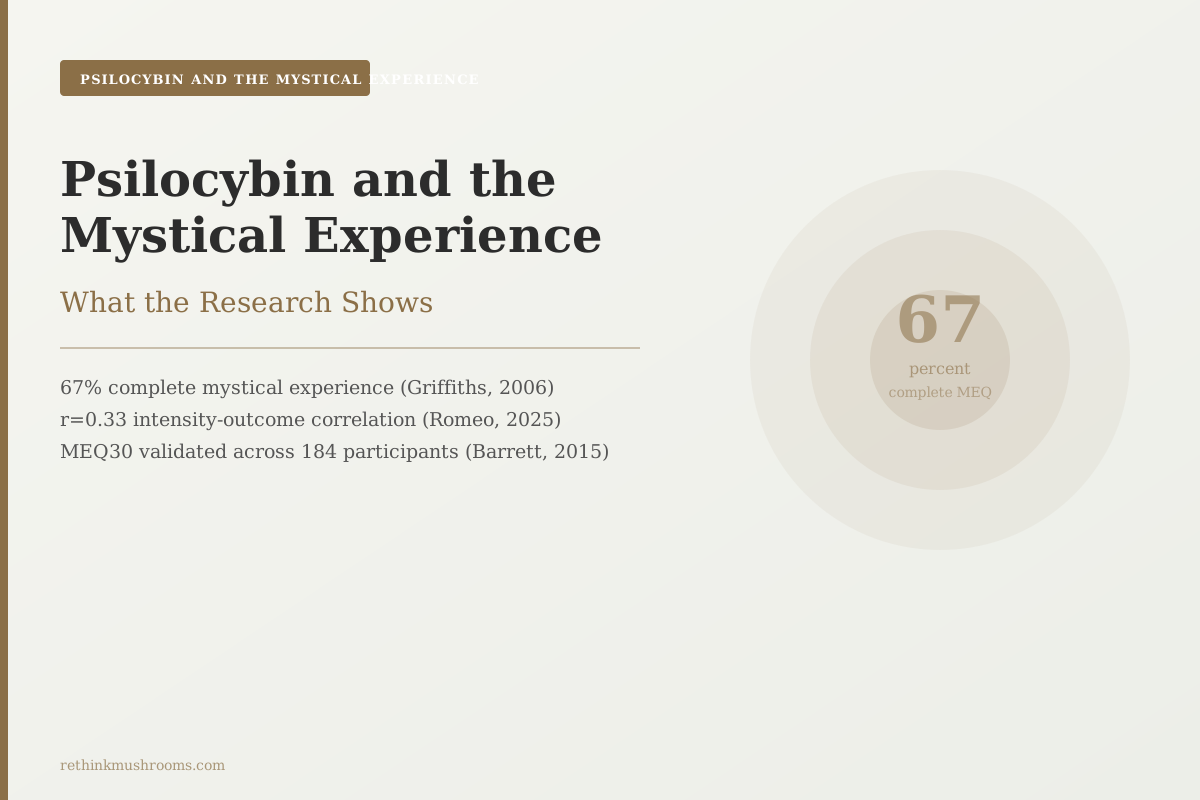
67% had a complete mystical experience
In a double-blind, placebo-controlled trial at Johns Hopkins, 67% of 36 hallucinogen-naive adults given a high dose of psilocybin had a complete mystical experience, rating it among the five most personally meaningful events of their lives.
Griffiths et al., Psychopharmacology, 2006
r=0.33
correlation between psychedelic experience intensity and clinical improvement across all studies in a 2025 meta-analysis, rising to r=0.41 for mood disorders (Romeo et al.)
80%
6-month biochemically verified tobacco abstinence rate in a psilocybin trial, with MEQ30 score significantly predicting success (Garcia-Romeu, 2014)
r=0.50
experience-outcome correlation in protocol-based clinical settings specifically, vs. r=0.14 in naturalistic use (Romeo, 2025)
Griffiths et al., Psychopharmacology, 2006
 View as image ↗
A 2025 meta-analysis pooling data across studies found that the intensity of the psychedelic experience correlates significantly with clinical improvement (r=0.33, p<0.0001), rising to r=0.41 for mood disorders and r=0.50 in structured clinical trial settings.[1] That correlation is the reason researchers track what happens subjectively during a psilocybin mystical experience at all: the quality of the inner experience appears to be a genuine therapeutic variable, not a side effect.
The science of this has been accumulating for 20 years. What makes it unusual in pharmacology is that the subjective state during a session predicts whether the treatment works afterward. That relationship has now been documented across depression, addiction, and cancer distress, and it raises a question that researchers still debate: what exactly is a mystical experience, how do you measure it reliably, and why does the intensity of it matter for outcomes months later?
For the broader pharmacological context, including how psilocybin works at the receptor level, the complete psilocybin pharmacology guide covers the foundational science.
Key Takeaways
- A 2025 meta-analysis (Romeo et al., Neurosci Biobehav Rev) found experience intensity correlates with clinical improvement across studies (r=0.33, p<0.0001), with stronger effects in mood disorders (r=0.41) and clinical trial settings (r=0.50) than in naturalistic use (r=0.14)
- A mystical experience on psilocybin is formally defined by four dimensions measured by the validated 30-item MEQ30: mystical/unitive experience, positive mood, transcendence of time and space, and ineffability (Barrett et al., 2015, validated across 184 participants)
- Griffiths and colleagues (2006) found 67% of 36 hallucinogen-naive adults had a complete mystical experience at high psilocybin doses; at 14-month follow-up (Griffiths et al., 2008), 58% still ranked it among the five most personally meaningful experiences of their lives
- Garcia-Romeu and colleagues (2014) found an 80% biochemically verified tobacco abstinence rate at 6 months in a psilocybin trial; MEQ30 score correlated significantly with abstinence, while general drug intensity did not, isolating the mystical experience as the predictive variable
- MacLean and colleagues (2011) found that participants who had a complete mystical experience showed significant increases in Openness (one of the Big Five personality traits) at 14-month follow-up, the first documented personality change in adults from any single intervention
- Not everyone has a mystical experience on psilocybin: the Griffiths 2011 dose-response study found the proportion increases with dose, establishing that set, setting, and dose all influence whether a complete mystical experience occurs
What Researchers Mean by 'Mystical Experience': The MEQ30 and Its Four Dimensions
A mystical experience on psilocybin is not simply a pleasant or unusual trip. In research, it refers specifically to a state with a particular phenomenological signature: a sense of unity or oneness with the universe, transcendence of ordinary time and space, deeply felt positive mood, a quality of sacredness or awe, and a noetic character (the feeling of knowing something profound without deriving it through reasoning).
A mystical experience on psilocybin refers to a state characterized by a sense of unity or oneness, transcendence of time and space, deeply felt positive mood, awe, profound meaning, and ineffability, the feeling that the experience cannot be adequately described in words. It is formally measured using the validated 30-item Mystical Experience Questionnaire (MEQ30).
Barrett and colleagues validated the MEQ30 across 184 participants in five experiments, establishing four reliable factors: mystical/unitive experience, positive mood, transcendence of time and space, and ineffability.[2] The key finding from this validation: MEQ30 latent scores predicted persisting positive changes in attitudes and wellbeing at follow-up, while controlling for general drug-effect intensity. The questionnaire specifically captures whether someone had the meaningful experience, not just whether the drug had a potent subjective effect. Those are separable.
The Ko 2022 systematic review later identified which MEQ30 dimensions matter most therapeutically: the "Mysticality" and "Positive Mood" subscales showed stronger associations with lasting positive outcomes than the "Transcendence of Time and Space" or "Ineffability" subscales.[7] The most therapeutically meaningful part of the mystical experience appears to be the felt sense of unity and positive affect, not the sense of timelessness or the inability to describe what happened.
This distinction matters for understanding why psilocybin research measures experience quality at all. A person can feel a strong drug effect (perceptual distortions, altered thinking) without having a mystical experience in the MEQ30 sense. And the data shows it is the latter that predicts outcomes, not the former.
The Griffiths 2006 Study: First Proof That Psilocybin Can Reliably Occasion These States
Before 2006, the question of whether psilocybin could reliably produce experiences that researchers could measure and that participants would value was largely unanswered in modern clinical research. Walter Pahnke had conducted his 1962 Good Friday Experiment, but its methodology had been criticized. For four decades, the field had no well-controlled data.
Roland Griffiths and colleagues at Johns Hopkins designed a study to change that. They enrolled 36 hallucinogen-naive adults with no personal or family history of psychosis, screened them extensively, and gave them a high dose of psilocybin (30mg/70kg) or an active placebo (methylphenidate) under carefully controlled conditions: two trained monitors, prepared set and setting, music, eye shades, and a protocol designed to support whatever experience emerged.[3]
The result: 67% of participants had a complete mystical experience on the psilocybin session, scoring above the threshold on all four MEQ dimensions. At 2-month follow-up, 79% rated the experience among the five most personally meaningful of their lives. At the time, this was a result without precedent in modern clinical research. It was a drug reliably producing experiences that people described in terms previously reserved for transformative life events.
The 14-month follow-up, published by Griffiths and colleagues in 2008, reinforced this picture.[4] Across 14 months, 58% still ranked the experience among the five most personally meaningful of their lives. 67% rated it spiritually significant. 64% reported increased wellbeing or life satisfaction. These effects had not been induced by therapy, exercise, or deliberate behavioral change. They followed from a single-session pharmacological experience.
For a deep analysis of the study's design and why it was scientifically distinctive from earlier psilocybin research, the Griffiths 2006 study analysis covers the methodology in full.
The Concrete Outcome: An 80% Quit Rate and the Mystical Experience as the Predictive Variable
The most striking single demonstration that mystical experience quality predicts outcomes comes from Garcia-Romeu and colleagues (Current Drug Abuse Reviews, 2014), who analyzed the Hopkins smoking cessation trial.[5]
The trial enrolled 15 smokers who had already tried to quit using other methods and hadn't. After two or three psilocybin sessions, biochemically verified abstinence at 6-month follow-up was 80%. By comparison, the 6-month quit rate with nicotine replacement therapy is typically around 10-15%.
The more important finding was the mechanistic analysis. Garcia-Romeu's team found that MEQ30 scores correlated significantly with smoking cessation success. The intensity of the mystical experience during the session predicted whether someone had quit. General drug effect intensity (how strong the overall trip felt) did not show the same predictive relationship.
This is the cleanest direct evidence that the mystical experience is the therapeutic variable rather than pharmacological intensity generically. Two people could have the same dose and similar overall drug effects, but different mystical experience quality, and the quality predicted outcome. The drug's pharmacology creates the conditions for mystical experience. The experience itself carries the therapeutic signal.
For readers who want to understand how this mystical experience mediator fits across addiction contexts more broadly, the how the mystical experience predicts therapeutic outcomes article covers the cancer distress and depression data as well.
The 2025 Meta-Analysis: r=0.33 Across Studies, Strongest in Clinical Settings
Romeo and colleagues (Neurosci Biobehav Rev, 2025) conducted the most rigorous synthesis to date of the experience-outcome relationship.[1] Pooling data from clinical trials across multiple conditions, they found a significant positive correlation between psychedelic experience intensity and clinical improvement (r=0.33, p<0.0001).
The subgroup analyses are as informative as the overall finding. For mood disorders, the correlation was stronger at r=0.41. For addictions, it was lower at r=0.19. For studies conducted in protocol-based clinical settings, the correlation rose to r=0.50. For naturalistic psychedelic use (outside clinical protocols), it dropped to r=0.14.
The clinical setting gap (r=0.50 vs. r=0.14) is the most important finding for understanding what the mystical experience data actually means. The same molecule, taken at similar doses, produces a much weaker experience-outcome correlation when taken outside a structured therapeutic context. Set, setting, preparation, and integration are not additions to the treatment. They are the conditions under which mystical experience quality becomes therapeutically meaningful.
The r=0.33 overall correlation is not a large effect by psychological research standards. It is, however, a consistent effect across conditions, and the Romeo meta-analysis represents the best-powered evidence available. The correlation was statistically robust and replicated the direction found in individual studies by Griffiths, Ross, and Garcia-Romeu going back to 2006.
For readers interested in the overlapping question of whether psilocybin's benefits require mystical experience or can occur through other mechanisms, the psilocybin and depression brain scan evidence covers the neuroplasticity argument.
The Personality Finding: Complete Mystical Experiences Reshaped the Big Five at 14 Months
MacLean, Johnson, and Griffiths (Journal of Psychopharmacology, 2011) found something that personality psychology had not previously documented from a single intervention: lasting changes in trait Openness.[6]
In 51 participants, those who had a complete mystical experience during a high-dose psilocybin session showed significant increases in Openness at 14-month follow-up compared to participants who received psilocybin but did not have a complete mystical experience. Openness is one of the Big Five personality traits, capturing intellectual curiosity, aesthetic sensitivity, and willingness to consider new ideas. Trait personality is generally considered stable in adults after age 25; that a single pharmacological experience could shift it and have that shift persist to 14 months was unexpected.
The specificity of the finding is important: the Openness increase was observed only in participants who had a complete mystical experience. Participants who received psilocybin without crossing the mystical experience threshold did not show comparable changes. This is another demonstration that the mystical experience itself, not just psilocybin exposure, is the active variable.
Not Everyone Has a Mystical Experience: What Determines Whether One Occurs
Griffiths and colleagues (2011) conducted a dose-response study specifically examining what predicts mystical experience intensity.[8] The central finding: higher psilocybin doses produce more complete mystical experiences. The proportion of participants meeting the complete mystical experience threshold increases with dose. This established dose as one controllable lever for maximizing the likelihood of the experience.
Dose is not the only variable. Set and setting (the participant's mindset, the physical environment, the quality of guide support, preparation, and integration) all appear to influence whether pharmacological conditions translate into the subjective mystical experience. This is the interpretive framework for why the Romeo 2025 meta-analysis found a much weaker correlation in naturalistic settings: the same drug at similar doses, without the structured container, produces less consistent access to the specific experiential state that predicts outcomes.
Honest framing requires noting that not having a complete mystical experience does not mean psilocybin has failed. Some research suggests neuroplasticity mechanisms operate independently of subjective experience quality. The mystical experience is the best-documented therapeutic mediator, not necessarily the only one. The debate about whether experience quality is causally necessary or merely correlational is active in the field, and the current evidence supports correlation more strongly than causal necessity.
For the deeper question of what differentiates helpful versus challenging aspects of ego dissolution, the oceanic boundlessness and ego dissolution article covers that distinction with the quantitative Roseman 2017 data. For the dose question specifically, the psilocybin dose-response article covers what doses produce what effects across studies. For the molecular mechanism through which 5-HT2A activation produces these states, see how 5-HT2A agonism creates the psychedelic experience.
The Bottom Line
Research on the psilocybin mystical experience has produced a consistent finding across 20 years of studies: the intensity of the subjective experience during a session correlates with therapeutic outcomes, with the strongest effects observed in structured clinical settings (Romeo 2025 meta-analysis, r=0.50). The experience is formally measured using the MEQ30, which captures four dimensions (mystical/unitive, positive mood, transcendence, and ineffability), with the first two showing the strongest outcome associations. Griffiths' foundational 2006 study established that 67% of hallucinogen-naive adults had a complete mystical experience at high doses, with effects persisting to 14 months. Not everyone has such an experience, and dose and setting substantially influence whether one occurs. The mechanism linking mystical experience to therapeutic benefit remains under study; neuroplasticity independent of subjective experience is a competing hypothesis.
Frequently Asked Questions
Sources & References
- 1RTHM-02171·Romeo, B et al. (2025). “The intensity of the psychedelic experience is reliably associated with clinical improvements: A systematic review and meta-analysis..” Neuroscience and biobehavioral reviews.Study breakdown →PubMed →↩
- 2RTHM-00672·Barrett, Frederick S et al. (2015). “Validation of the revised Mystical Experience Questionnaire in experimental sessions with psilocybin..” Journal of psychopharmacology (Oxford.Study breakdown →PubMed →↩
- 3. Source details for this reference are not yet available.
- 4RTHM-00250·Griffiths, Roland R et al. (2008). “Mystical-type experiences occasioned by psilocybin mediate the attribution of personal meaning and spiritual significance 14 months later..” Journal of Psychopharmacology.Study breakdown →PubMed →↩
- 5RTHM-00321·Garcia-Romeu, Albert et al. (2014). “Psilocybin-occasioned mystical experiences in the treatment of tobacco addiction..” Current drug abuse reviews.Study breakdown →PubMed →↩
- 6RTHM-00422·MacLean, Katherine A et al. (2011). “Mystical experiences occasioned by the hallucinogen psilocybin lead to increases in the personality domain of openness..” Journal of psychopharmacology (Oxford.Study breakdown →PubMed →↩
- 7RTHM-01552·Ko, Kwonmok et al. (2022). “Psychedelics, Mystical Experience, and Therapeutic Efficacy: A Systematic Review..” Frontiers in psychiatry.Study breakdown →PubMed →↩
- 8RTHM-00396·Griffiths, Roland R et al. (2011). “Psilocybin occasioned mystical-type experiences: immediate and persisting dose-related effects..” Psychopharmacology.Study breakdown →PubMed →↩