Emerging & Specialty Mushrooms
2 anti-cancer compound classes in Sanghuang
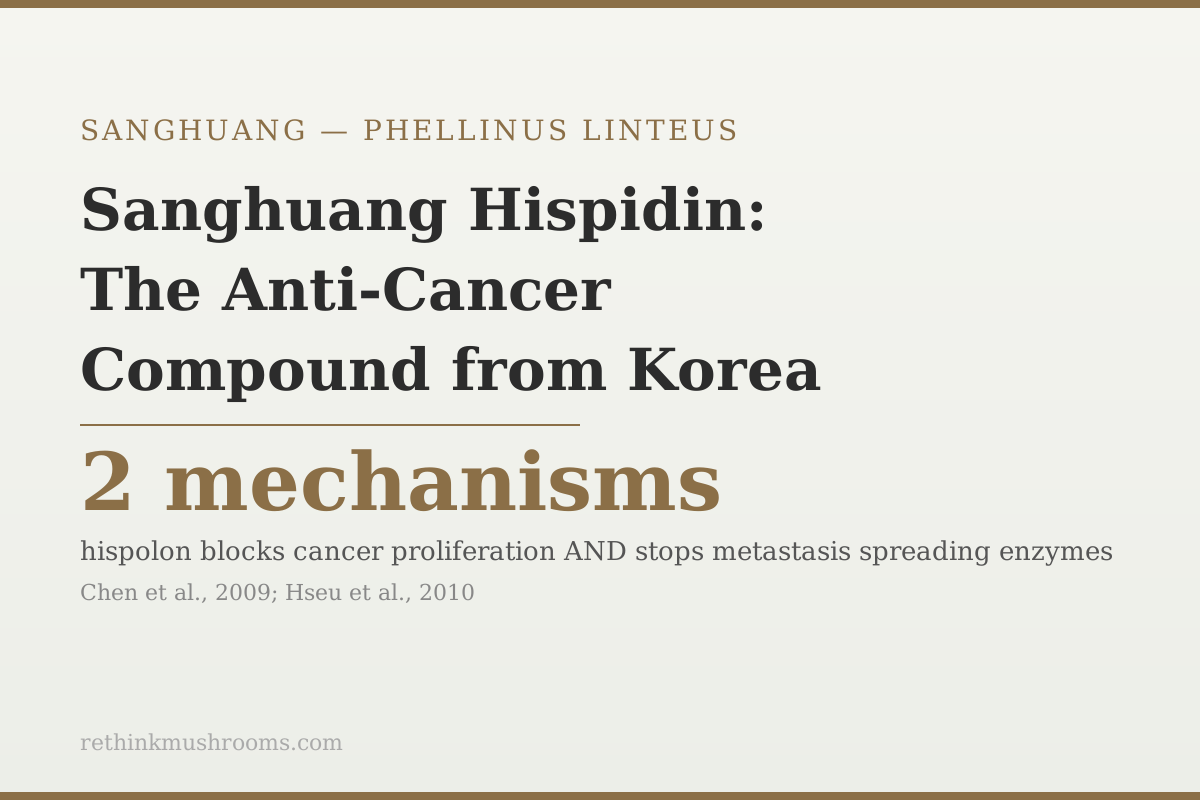
Sanghuang contains polysaccharides that activate the immune system and hispolon/hispidin polyphenols that directly kill cancer cells. Most mechanistic research since 2009 has focused on hispolon, which targets cancer proliferation, metastasis, and survival through pathways distinct from immune activation.
Lu et al., Food and Chemical Toxicology, 2009
MDM2/ERK
the cancer proliferation pathway hispolon blocks in bladder cancer cells, a mechanism completely different from polysaccharide immune activation
MMP-2 + MMP-9
invasion enzymes hispolon suppresses in liver cancer cells, the molecular tools cancer cells use to break through tissue and spread
G2/M arrest
the cell division checkpoint that Phellinus protein-bound polysaccharide triggers in colon cancer cells, halting tumor growth
Lu et al., Food and Chemical Toxicology, 2009
 View as image ↗
Berries, green tea, and dark chocolate get most of the attention in discussions of dietary polyphenols. Hispidin and hispolon, the polyphenolic compounds concentrated in Sanghuang mushrooms, belong to a completely different chemical family and don't exist in those foods at all. They are found in meaningful quantities only in Phellinus and related fungi, which is why Sanghuang has attracted sustained attention in Korean and Chinese pharmacology research that rarely appears in Western consumer health writing.
Sanghuang's anti-cancer research divides along two distinct compound lines. The first line is polysaccharides: large sugar-chain molecules that activate the immune system to fight cancer, similar to the beta-glucan mechanisms documented in other medicinal mushrooms. The second line is hispolon and hispidin: small polyphenolic compounds that appear to kill cancer cells directly, through mechanisms that do not depend on immune activation. This article focuses on the second line: the compound-specific evidence for hispidin, hispolon, and the anti-cancer mechanisms they work through. For the broader Sanghuang species overview, see what is sanghuang: Korea's cancer-fighting mushroom.
Key Takeaways
- Hispidin and hispolon are polyphenolic compounds found only in Phellinus and related fungi, not present in common dietary sources; Sanghuang is among the richest natural sources of both
- Hispolon and hispidin are structurally related but distinct: hispolon is the more oxidized form and has been more extensively studied for direct cancer cytotoxicity; hispidin functions primarily as an antioxidant
- Lu et al. (2009) showed hispolon inhibited bladder cancer cell growth by targeting MDM2 (a protein that suppresses the cell's natural tumor-suppressor machinery) and ERK, a growth-signaling protein[1]
- Huang et al. (2010) showed hispolon suppressed liver cancer cell metastasis by inhibiting MMP-2 and MMP-9, the enzymes cancer cells use to cut through tissue and spread, and a companion plasminogen activator involved in tumor invasion[2]
- Li et al. (2004) showed Phellinus protein-bound polysaccharide (not hispolon) triggered cell division arrest in colon cancer cells through a different pathway, activating the molecular scissors cells use to self-destruct[3]
- Sanghuang research divides between Korean (Phellinus linteus, sold as Mesima) and Chinese (Sanghuangporus sanghuang) species; most of the hispolon research cited here was conducted on P. linteus, and taxonomy matters for product selection
Hispidin and Hispolon: Related Compounds with Different Jobs
Hispidin and hispolon sound similar because they are chemically related. Hispolon is essentially a more oxidized form of the hispidin structure. But their biological roles differ substantially.
Hispidin is a polyphenolic antioxidant. Its primary documented activity is neutralizing free radicals and activating the cell's own antioxidant defense systems. It is classified as a styrylpyrone (a ring structure attached to a chain ending in a pyrone ring), and this structure is essentially unique to Phellinus and related fungi. You cannot get meaningful amounts of hispidin from vegetables, fruits, or other mushrooms.
Hispolon is a chemically related but more reactive compound. The slight structural difference from hispidin translates into substantially different biological activity: hispolon has direct cytotoxic effects on cancer cell lines in laboratory studies, meaning it can kill cancer cells independently of immune system activation. This direct cytotoxicity makes hispolon particularly interesting because it operates through pathways that are entirely different from the immune-modulating polysaccharides that dominate the medicinal mushroom literature.
The practical implication: Sanghuang's anti-cancer profile has two mechanistically separate layers. The polysaccharides train the immune system to recognize and attack tumors. The hispolon directly attacks cancer cell survival and spreading mechanisms. This dual-layer profile is one of the reasons Sanghuang attracts more research interest than its obscurity in Western consumer content would suggest. For a broader look at Sanghuang's cancer research across multiple tumor types, see sanghuang and cancer: research on Phellinus igniarius.
Hispolon's Direct Cytotoxicity: The MDM2/ERK Bladder Cancer Mechanism
Lu and colleagues (2009) examined hispolon from Phellinus linteus against bladder cancer cells and found antiproliferative activity through a specific molecular pathway.[1]
The pathway involves two proteins with distinct roles in cancer biology.
MDM2 is a protein that suppresses p53, the cell's main tumor-suppressor gene, sometimes called the "guardian of the genome." When MDM2 is overactive, it keeps p53 suppressed, allowing cancer cells to avoid the internal signals that would normally trigger self-destruction. Many cancer cell types overexpress MDM2 precisely because it protects them from p53's tumor-suppressing activity.
ERK (extracellular signal-regulated kinase) is a growth-signaling protein. When ERK is active, it tells cells to keep growing and dividing. Cancer cells often have chronically active ERK.
Hispolon interfered with both. By reducing MDM2 activity and modulating ERK signaling, hispolon disrupted the cancer cells' ability to suppress their own anti-cancer machinery and to maintain the growth signals that keep them dividing.
The significance here extends beyond the specific result in bladder cancer. The MDM2/p53 relationship is present in many cancer types, including breast, colon, liver, and lung, because p53 suppression is a common cancer survival strategy. A compound that targets this interaction has potential anti-cancer relevance across tumor types, not just bladder cancer.
This mechanism is entirely distinct from polysaccharide-based immune activation. Hispolon does not rely on the immune system to reach and kill cancer cells. It targets the cancer cells' own internal regulation.
How Hispolon Stops Cancer from Spreading: MMP Inhibition
The second major hispolon mechanism addresses not cancer cell growth but cancer cell movement.
Metastasis, the spread of cancer cells from the original tumor to other parts of the body, is responsible for the majority of cancer deaths. For cancer cells to metastasize, they must accomplish several physical feats: break through the membrane surrounding the original tumor, travel through the bloodstream or lymph system, and invade the tissue at new locations. These movements require enzymes that physically cut through biological barriers.
Huang and colleagues (2010) showed hispolon disrupts this process in liver cancer cells.[2] The compound inhibited MMP-2 and MMP-9, matrix metalloproteinases (protein-cutting enzymes cancer cells use to degrade the protein scaffolding of surrounding tissue and make space to invade). The study also documented inhibition of urokinase-type plasminogen activator (uPA), another enzyme used in the same invasion process, and traced the effect to the PI3K/Akt and ERK signaling pathways.
The result in cell culture: SK-Hep1 liver cancer cells treated with hispolon showed significantly reduced ability to migrate and invade through extracellular matrix barriers, the biological equivalent of the tissue cancer must cross to spread.
Suppressing tumor invasion without necessarily killing the primary tumor is a different anti-cancer strategy. Some researchers consider anti-metastatic compounds potentially more valuable than anti-proliferative ones, because the primary tumor is often manageable while metastases to vital organs are what proves fatal. A compound that blocks the tools cancer cells need to spread addresses the lethality pathway directly.
The Polysaccharide Side: Cell Cycle Arrest in Colon Cancer
Li and colleagues (2004) demonstrated a distinct compound class at work: protein-bound polysaccharide (PBP) from Phellinus linteus, separate from hispolon, in colon cancer cells.[3]
PBP induced G2/M cell cycle arrest in SW480 human colon cancer cells. To understand this: cells that are dividing normally pass through checkpoints in a cycle (G1, S phase, G2, and M phase) before completing division. Each checkpoint verifies that everything is proceeding correctly before authorizing the next step. G2/M is the checkpoint between finishing DNA copying and beginning the actual division of the cell in half. When PBP triggered arrest at this checkpoint, the colon cancer cells stopped their division process and could not complete copying.
Li 2004 also documented activation of caspase-3 and caspase-8, molecular protein-cutters that execute programmed cell death (apoptosis). Cells that activate their own caspase machinery are triggering self-destruction from within. The combination of stopping cell division AND triggering self-destruction in the same cells makes PBP's colon cancer effect particularly comprehensive.
This mechanism operates through completely different chemistry than hispolon's MDM2/ERK action. The polysaccharide interacts with immune receptors on cell surfaces; hispolon's smaller polyphenol structure penetrates into cells and interacts with internal signaling proteins. Two compound classes, two different entry points into the cancer cell's vulnerabilities.
The Most Recent Research: Sanghuangporus and Lung Cancer
Wang and colleagues (2023), using modern taxonomy that identifies the mushroom as Sanghuangporus sanghuang rather than Phellinus linteus, added lung cancer to the research portfolio.[4] The study documented anti-proliferative and anti-invasive activity in lung cancer cells, both in vitro and in a mouse model. Its use of the modern genus name Sanghuangporus reflects the 2019 reclassification of Chinese sanghuang into the new genus.
The study matters both scientifically and taxonomically. Scientifically: lung cancer joins colon, bladder, liver, breast, and prostate as tumor types where Sanghuang-related mushrooms have shown in vitro activity. Taxonomically: it provides direct evidence that Chinese sanghuang species, not just the Korean Phellinus linteus most widely studied, have anti-cancer activity in cell models.
Taxonomy Note: Korean Sanghuang vs. Chinese Sanghuang
Anyone researching Sanghuang for medical or supplement purposes encounters a naming problem that can lead to significant confusion.
In Korea, the traditional sanghuang mushroom is Phellinus linteus, now officially reclassified as Tropicoporus linteus but still widely catalogued as Phellinus linteus in the research literature. It is sold commercially in Japan as "Mesima." The majority of the English-language anti-cancer research reviewed in this article, including Lu 2009, Huang 2010, and Li 2004, was conducted using this Korean species.
In China, "sanghuang" (桑黄, literally "mulberry yellow") traditionally refers to mushrooms growing on mulberry trees, which belong to the Sanghuangporus genus following a 2019 taxonomic revision. These are distinct species from P. linteus, with potentially different compound profiles.
Han and colleagues (2016) addressed this confusion in a dedicated taxonomy paper on the species identity of Korean sanghuang and concluded that Korean sanghuang and Chinese sanghuang refer to different organisms.[5] Most of the English-language cancer research corresponds to the Korean species (P. linteus), not the Chinese species (Sanghuangporus sanghuang). For consumers evaluating supplements labeled "sanghuang," the species identity on the label indicates which research body is relevant. For a full explanation of this taxonomy puzzle, see what is sanghuang: Korea's cancer-fighting mushroom, sanghuang vs. Meshima: different species, different research, and the Japanese perspective at Meshima and the immune system.
The Bottom Line
Sanghuang contains two distinct anti-cancer compound classes. Hispolon, a polyphenol unique to Phellinus-type fungi, directly suppresses cancer cell proliferation through MDM2/ERK pathway interference (Lu 2009, bladder cancer) and blocks metastasis by inhibiting the invasion enzymes MMP-2 and MMP-9 (Huang 2010, liver cancer). Protein-bound polysaccharides work through a separate mechanism, triggering cell division arrest and programmed self-destruction in colon cancer cells (Li 2004). The 2023 Sanghuangporus study extended the evidence to lung cancer using modern taxonomy (Wang 2023). All evidence is preclinical; the majority of hispolon research used Korean Phellinus linteus, distinct from Chinese Sanghuangporus sanghuang despite the shared name.
Frequently Asked Questions
Sources & References
- 1RTHM-00306·Lu, Te-Ling et al. (2009). “Hispolon from Phellinus linteus has antiproliferative effects via MDM2-recruited ERK1/2 activity in breast and bladder cancer cells..” Food and chemical toxicology : an international journal published for the British Industrial Biological Research Association.Study breakdown →PubMed →↩
- 2RTHM-00344·Huang, Guan-Jhong et al. (2010). “Hispolon suppresses SK-Hep1 human hepatoma cell metastasis by inhibiting matrix metalloproteinase-2/9 and urokinase-plasminogen activator through the PI3K/Akt and ERK signaling pathways..” Journal of agricultural and food chemistry.Study breakdown →PubMed →↩
- 3RTHM-00140·Li, Ge et al. (2004). “Protein-bound polysaccharide from Phellinus linteus induces G2/M phase arrest and apoptosis in SW480 human colon cancer cells..” Cancer letters.Study breakdown →PubMed →↩
- 4RTHM-01817·Wang, Weike et al. (2023). “Sanghuangporus sanghuang extract inhibits the proliferation and invasion of lung cancer cells in vitro and in vivo..” Nutrition research and practice.Study breakdown →PubMed →↩
- 5RTHM-00783·Han, Jae-Gu et al. (2016). “Species identity of Phellinus linteus (sanghuang) extensively used as a medicinal mushroom in Korea..” Journal of microbiology (Seoul.Study breakdown →PubMed →↩