Meshima & Immune System
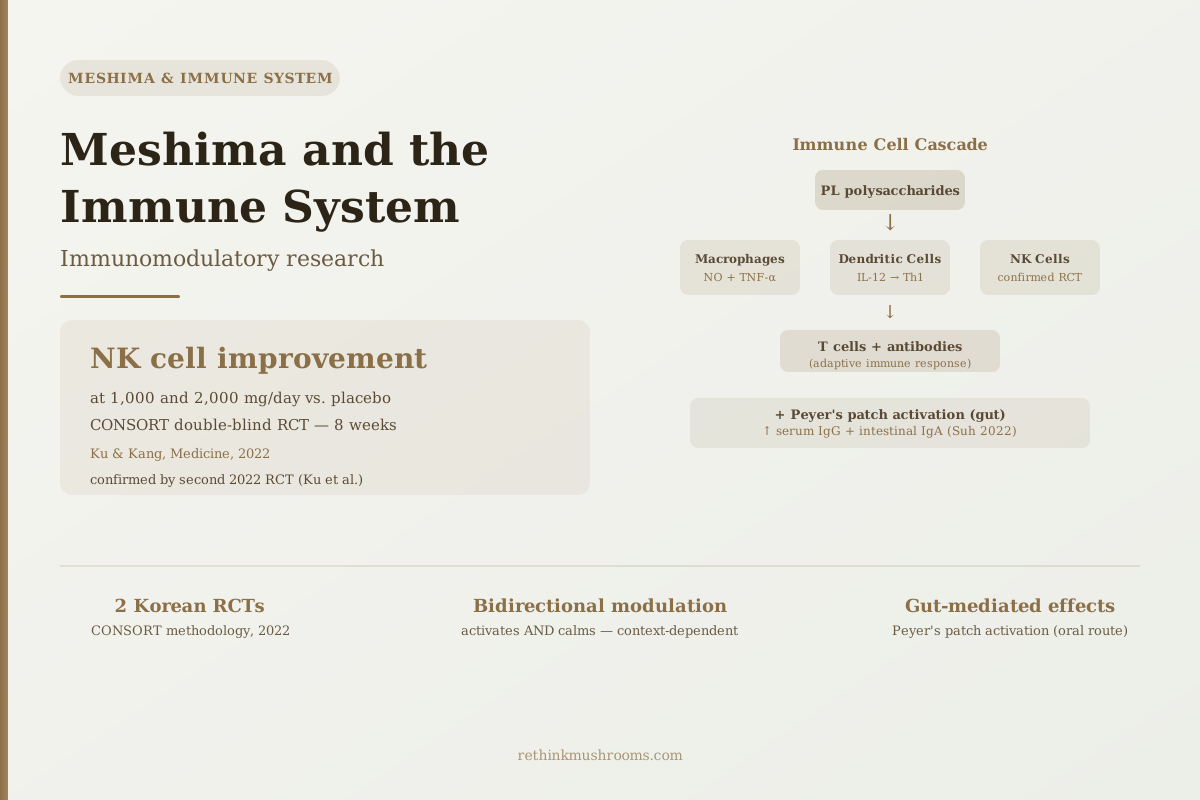
NK cell improvement
The first CONSORT randomized, double-blind, placebo-controlled trial of Phellinus linteus extract found significant NK cell activity improvement at 1,000 and 2,000 mg/day versus placebo over 8 weeks — the most rigorous human immune evidence for any Meshima preparation.
Ku & Kang, Medicine, 2022
2 RCTs
two separate 2022 Korean RCTs on PL immune enhancement, both CONSORT methodology
Bidirectional
PL activates immune cells AND suppresses inflammatory overactivation — not a simple booster
Peyer's patch
oral PL activates gut-associated lymphoid tissue, increasing systemic IgG and IgA (Suh 2022)
Ku & Kang, Medicine, 2022
 View as image ↗
WebMD's page on Phellinus linteus concludes: "There isn't enough scientific evidence to support the use of black hoof mushroom for any condition." It cites none of the two 2022 Korean randomized controlled trials, none of the dendritic cell mechanistic research, and none of the 2023 systematic review. Consumer content on Meshima and the immune system is almost uniformly either unsupported marketing ("immune booster!") or outdated skepticism. Neither accurately reflects what the research actually shows.
What the research shows is more interesting than both. Meshima (Phellinus linteus) works as an immune modulator — activating macrophages, natural killer cells, and dendritic cells while simultaneously suppressing excessive inflammatory signaling through NF-kB inhibition. The same mushroom can be both immune-activating and anti-inflammatory depending on the biological context it encounters. And as of 2022, there are two randomized controlled trials showing it improves NK cell activity in healthy human subjects.
For background on Meshima's research history and its major bioactive compounds, see what Meshima mushroom is and why it's called Korea's anti-cancer mushroom.
Key Takeaways
- Phellinus linteus is an immune modulator, not a simple immune booster: it activates macrophages, NK cells, and dendritic cells while also suppressing NF-kB-driven inflammatory overactivation
- Two CONSORT randomized, double-blind, placebo-controlled trials published in 2022 confirmed PL extract significantly improves NK cell activity in humans at 1,000 and 2,000 mg/day
- Macrophage activation by acidic PL polysaccharides occurs through PTK and PKC signaling, producing both NO for direct pathogen killing and TNF-alpha for downstream immune signaling
- Oral PL activates Peyer's patches — immune surveillance structures in the gut — increasing serum IgG and intestinal IgA (Suh et al., 2022), a systemic immune effect mediated through the gut
- Polysaccharide structure (branching pattern and molecular weight) determines immune potency — products without standardization cannot be compared to clinical study doses
- The same compounds that activate immune responses against pathogens also suppress inflammatory overactivation in LPS-stimulated macrophages — bidirectional modulation is a defining property
Immune claims
'Immune booster' versus what the research actually shows
The claim
“Meshima is an immune booster that simply turns the immune system up.”
Supplement marketing language, used when the evidence doesn't support anything more specific.
What research shows
Context DependentPhellinus linteus is bidirectional. Its polysaccharides activate macrophages, NK cells, and dendritic cells against pathogens and tumors, while suppressing NF-kB/MAPK-driven inflammatory mediators when macrophages are over-stimulated with LPS.
A booster turns everything up; a modulator distinguishes immune activation appropriate to the context from inflammatory overactivation that damages the host. And in some tissues — hepatocellular carcinoma, for one — PL's effects are not even uniformly anti-tumor.
Kim et al., J Ethnopharmacol (2007); Shin et al. (2021); Chen et al. (2024)
Immune Modulator, Not Immune Booster: What That Distinction Means
"Immune boosting" is a phrase supplement labels use when the evidence doesn't support anything more specific. Meshima's immune research describes something more precise: bidirectional modulation.
Kim and colleagues showed in 2007 that Phellinus linteus suppresses NF-κB and MAPK activation in LPS-stimulated macrophages, reducing inflammatory mediators like iNOS, COX-2, nitric oxide, and PGE2.[5] LPS (lipopolysaccharide) is the bacterial compound used in labs to simulate an overwhelming immune challenge. When macrophages are over-stimulated with LPS, they produce runaway inflammatory mediators — the same process implicated in sepsis and cytokine storm. PL extract dampened this response.
Separately, Shin and colleagues found in 2021 that Phellinus linteus mycelium elevated the IFN-γ/IL-4 ratio in immune cells — shifting the immune balance toward Th1-dominant responses associated with anti-pathogen and anti-cancer activity.[9] IFN-γ is a key cytokine driving the cellular immune response that kills virus-infected cells and cancer cells. The same study found PL suppressed nitric oxide and PGE2 in LPS-stimulated macrophages.
Together, these findings describe a mushroom that promotes the immune responses you want (anti-pathogen, anti-cancer Th1 activity) while dampening the responses that cause tissue damage (NF-κB-driven inflammatory cytokines under over-stimulation). This isn't the same as "boosting." A simple immune booster turns everything up. A modulator distinguishes between immune activation appropriate to the context and inflammatory overactivation that damages the host.
Mechanism · One Compound, Two Directions
Why Phellinus linteus Is a Modulator, Not a Booster
A booster turns everything up. The Meshima literature describes something more precise: the same polysaccharides activate immune effectors against pathogens and tumors, yet suppress inflammatory over-activation when macrophages are pushed too hard. Each row traces to a cited study at the evidence level shown.
↑ Activates — pathogen & tumor defense
Macrophages switch on
Acidic PL polysaccharides drive nitric oxide and TNF-alpha through PTK/PKC signaling — direct pathogen and tumor-cell killing.
Kim 2003 [2] · Kim 2004 [3] · In vitro / animal
Dendritic cells mature
Upregulated CD80/CD86/MHC and IL-12 secretion prime the adaptive response.
Park 2003 [6] · In vitro
Th1 tilt
The IFN-gamma/IL-4 ratio rises, favoring anti-pathogen and anti-cancer cellular immunity.
Shin 2021 [9] · In vitro
NK-cell activity rises
The strongest human signal: two 2022 CONSORT RCTs found improved NK-cell activity in healthy adults.
Ku 2022 [10] · Human RCT
Antibodies & gut IgA
Oral PL activates Peyer’s patches, raising serum IgG and intestinal secretory IgA.
Kim 1996 [1] · Suh 2022 [12] · Animal
↓ Suppresses — inflammatory over-activation
NF-kB / MAPK damped
In LPS-over-stimulated macrophages, PL cuts iNOS, COX-2, nitric oxide, and PGE2 — reining in runaway inflammation.
Kim 2007 [5] · In vitro
Cytokine rebalancing
PL blocks NF-kB nuclear translocation via AMPK, lowering TNF-alpha/IL-1beta/IL-6/IL-12 while raising anti-inflammatory IL-4 and IL-10.
Xie 2019 [8] · In vitro / animal
Mediators quieted under challenge
The same mycelium that raises the Th1 ratio suppresses NO and PGE2 when macrophages are LPS-challenged.
Shin 2021 [9] · In vitro
Context matters · modulation is not uniformly beneficial
Direction depends on the tissue. In hepatocellular carcinoma, high-dose PL acting through FAK signaling increased regulatory T cells and M2 macrophage polarization — cell types that can help tumors evade immunity. “Immune booster” framing misses this entirely.
Chen 2024 [15]
Sources: Kim et al. (1996) [ref 1]; Kim et al. (2003) [ref 2]; Kim et al. (2004) [ref 3]; Kim et al. (2007) [ref 5]; Park et al. (2003) [ref 6]; Xie et al. (2019) [ref 8]; Shin et al. (2021) [ref 9]; Ku & Kang (2022) [ref 10]; Suh et al. (2022) [ref 12]; Chen et al. (2024) [ref 15]
The 2022 Korean RCTs: What Happened When Researchers Gave Meshima to Healthy People
The most significant development in the Meshima immune literature in recent years is a pair of randomized controlled trials published by Ku and colleagues in Medicine in 2022.
The first study — a CONSORT-methodology double-blind, placebo-controlled pilot trial — enrolled 30 participants and tested PL extract at 1,000 mg and 2,000 mg per day versus placebo for 8 weeks.[10] The primary endpoint was NK cell activity, measured at the 12.5:1 effector-to-target ratio. Both dose groups showed significantly improved NK cell activity versus placebo.
NK cells — natural killer cells — are innate immune cells that kill virus-infected cells and cancer cells without requiring prior sensitization to specific antigens. NK cell activity is a practical biomarker for the immune protection relevant to both infectious disease and cancer surveillance. A supplement that demonstrably improves NK cell activity in healthy humans is making a mechanistically specific claim with direct clinical relevance.
The second 2022 study confirmed the immune parameter improvements in a larger, fully powered trial using the same protocol.[11] Two separate publications from the same research group, both CONSORT-methodology, both showing positive results, provide stronger evidence than a single trial would.
The limitations are worth stating: both studies are from a single Korean research group, both are pilot-scale or moderate-scale, and neither has been independently replicated by an unaffiliated group. The results are promising but should not be interpreted as definitive until independent replication is published. The appropriate characterization: these are the most rigorous human evidence available for Meshima's immune effects, and they point in a consistent direction.
Ku & Kang (2022) · Medicine
- Population
- 30 healthy adults (double-blind, placebo-controlled pilot)
- Intervention
- PL extract 1,000 or 2,000 mg/day for 8 weeks
- Comparator
- Placebo
- Finding
- Both dose groups showed significantly improved NK-cell activity (measured at the 12.5:1 effector-to-target ratio) versus placebo. A second 2022 trial from the same group, using the same protocol, confirmed the immune-parameter improvements.
preliminary Two positive CONSORT-methodology RCTs, but both from a single Korean research group and not yet independently replicated — promising rather than established.
Ku & Kang, Medicine (2022)
Macrophage Activation: The First Link in the Immune Chain
Macrophages are the immune system's first-line responders — patrolling tissues, engulfing pathogens, and coordinating downstream immune responses. The Meshima macrophage research predates the RCTs by nearly 25 years.
Kim and colleagues established in 1996 that Phellinus linteus polysaccharide enhanced both humoral immunity (antibody production) and cellular immunity (T cell activity) in animal models — the foundational study showing bidirectional immune stimulation.[1]
The intracellular mechanism became clearer in 2003. Kim et al. showed that acidic PL polysaccharide activated macrophage nitric oxide production specifically through protein tyrosine kinase (PTK) and protein kinase C (PKC) signaling pathways.[2] When macrophages produce nitric oxide, they gain direct tumoricidal ability — NO kills cancer cells and pathogens in the immediate vicinity. The PKT/PKC pathway identification specified the molecular entry point for PL's macrophage activation.
A follow-up study confirmed that this macrophage activation wasn't limited to cultured cell lines. Kim et al. (2004) tested PL acidic polysaccharide on primary peritoneal macrophages — immune cells isolated directly from mouse abdominal cavities rather than maintained in cell culture — and found the same enhanced NO and TNF-α production.[3] Primary cell validation matters because cultured cell lines sometimes respond differently from their counterparts in living tissue.
Dendritic Cells, NK Cells, and the Broader Immune Cascade
Macrophage activation is the entry point, but the immune cascade extends further. PL polysaccharides also activate dendritic cells — the immune system's antigen-presenting specialists that bridge innate and adaptive immunity.
Park and colleagues showed in 2003 that PL acidic polysaccharides induced phenotypic and functional maturation of dendritic cells: increased expression of CD80, CD86, MHC I, and MHC II on the cell surface, enhanced IL-12 secretion, and greater potency for activating T cells.[6] PL-matured DCs also migrated preferentially toward lymphoid tissues — where T cell priming occurs. The full mechanistic pathway — polysaccharide → TLR2/4 → DC maturation → IL-12 → Th1 T cell priming — was confirmed by subsequent studies.
The broader implication is that PL's immune effects don't stop at macrophage and NK cell activation. By maturing DCs and driving IL-12 production, Meshima polysaccharides help prime the adaptive immune response — T cells learning to recognize and respond more aggressively to specific threats. This DC-mediated bridge between innate and adaptive immunity is covered in more depth in how Meshima bridges innate and adaptive immunity.
A protein-polysaccharide complex isolated from PL by Kim et al. (2006) also showed immunostimulatory effects, establishing that immune-active compounds include protein-bound polysaccharide conjugates — not just free polysaccharides — which has implications for which extraction methods preserve the most biologically active fraction.[4]
For the detailed dendritic cell pathway and TLR2/4 receptor cascade, see Meshima polysaccharides and dendritic cell activation. For the Th1/Th2 balance research, see Meshima and Th1/Th2 balance: precision immune tuning research.
Gut Immunity: The Mechanism Nobody Covers
When people think about how a supplement affects the immune system, they picture direct contact — compounds entering the blood and reaching immune cells. Meshima's oral immune effects may work partly through a different route.
Suh and colleagues published a 2022 study in Pharmaceuticals testing postbiotics prepared from Phellinus linteus mycelial culture in mice receiving oral administration for four weeks.[12] The findings: serum IgG increased significantly. Small intestinal IgA increased significantly. Peyer's patch cytokine production (IFN-γ, TNF-α, IL-6) increased. Immune cell counts in the spleen increased.
Peyer's patches are organized clusters of immune tissue embedded in the small intestinal wall. They function as surveillance stations — sampling what's passing through the gut and initiating immune responses when they detect threats or beneficial microorganisms. When oral PL reached the Peyer's patches, it triggered the production of immune mediators that then traveled systemically, increasing IgG in the blood and IgA in the intestinal lining.
IgA is particularly important for mucosal immunity — it's the antibody that protects the gut and respiratory tract lining. An increase in intestinal IgA from oral Meshima supplementation suggests enhanced first-line protection at the body's most exposed surfaces.
This gut-mediated immune activation is the mechanism that makes oral supplementation work differently from injected extract in lab studies, and explains why the clinical trials using oral administration can still show systemic immune effects. The gut is doing part of the work.
Polysaccharide Structure Determines Immune Potency
Not all Meshima supplements are equivalent, and the reason comes down to polysaccharide structure.
Volman and colleagues compared beta-glucan polysaccharide extracts from multiple mushroom species, including Phellinus linteus, in 2010, measuring NO production and NF-kB transactivation.[7] The key finding: polysaccharide branching pattern was a significant determinant of immunomodulatory activity magnitude. Different structural configurations produced different response profiles even from the same species.
Xie and colleagues (2019) showed that PL polysaccharides blocked NF-kB nuclear translocation via AMPK activation, simultaneously decreasing pro-inflammatory cytokines (TNF-α, IL-1β, IL-6, IL-12) while increasing anti-inflammatory IL-4 and IL-10.[8] The direction and magnitude of these effects depended on polysaccharide structural features.
The 2023 systematic review by Qin and colleagues synthesized decades of PL polysaccharide structure-activity data, confirming that molecular weight, degree of branching, and extraction conditions are the primary determinants of immunomodulatory potency.[13] The 2024 Kou review added detail on which beta-glucan linkage patterns (specifically beta-1,3/1,6 branching) correlate most strongly with biological activity, and identified drug delivery approaches that may improve the bioavailability of the most active fractions.[14]
The practical takeaway: a supplement label that says "500 mg Phellinus linteus" without specifying polysaccharide standardization or extraction method cannot be compared to the doses and preparations used in the Ku 2022 RCTs or the mechanistic research. Standardized polysaccharide content, documented extraction method, and specified molecular weight range are the relevant quality markers.
For the compound-level chemistry behind what's being standardized, see Phellinus linteus bioactive compounds: polysaccharides and phenols. For how Meshima's immune activity compares to other mushrooms studied for the same effects, see Enoki and the immune system: immunomodulatory research.
The Evidence Limitations Worth Knowing
The Ku 2022 RCTs are the best human evidence in the Meshima immune literature. They are also pilot-scale and from a single research group. Until independent replication is published, the NK cell findings should be treated as promising rather than established.
Most of the mechanistic research — macrophage activation, DC maturation, NF-kB modulation — is in cell culture. The jump from cell culture to clinical effect involves multiple steps that haven't been tested in humans for most of these specific mechanisms.
One nuance worth holding: the 2024 study by Chen and colleagues in Cancer Immunology Immunotherapy found that in hepatocellular carcinoma specifically, high-dose PL activity via FAK signaling increased regulatory T cells (Tregs) and M2 macrophage polarization — immune cell types that can support tumor immune evasion in liver cancer contexts.[15] PL's immune effects are not uniformly anti-tumor. This context-dependency is a sophisticated biological reality that simple "immune booster" framing misses entirely.
Autoimmune conditions are a legitimate caution flag. Compounds that enhance Th1 immune responses and macrophage/NK cell activity could theoretically worsen autoimmune conditions where the immune system is already overactive. No clinical study has tested Meshima in autoimmune patients, and the theoretical concern from the mechanistic data is worth flagging. For Meshima's application in cancer treatment support, see Meshima for immune enhancement during cancer treatment.
Safety — immune modulation in context
ModerateImmune activation is not automatically safe for everyone
Concern
Phellinus linteus promotes Th1-dominant immunity and macrophage/NK-cell activation. For people with autoimmune disease, those on immunosuppressive medication, or anyone approaching surgery, increased immune activity could in principle work against their treatment. Every human trial to date enrolled only healthy adults, so these interactions have not been studied directly.
What the research says
Treat immune-modulating supplements as something to clear with a clinician if you have an autoimmune condition, take immunosuppressants, or have surgery scheduled. The benefits shown in the trials were in healthy people with normal immune systems.
Particularly relevant for: People with autoimmune disease, on immunosuppressants, or scheduled for surgery
What to do
Consult a physician before use if any of the above applies. This article is research analysis, not medical advice.
Safety framing based on the Th1-promoting mechanism (Shin et al., 2021), the healthy-only populations of the Ku & Kang 2022 trials, and the tissue-context dependency shown by Chen et al. (2024)
The Bottom Line
Meshima (Phellinus linteus) modulates immunity through macrophage NO activation, NK cell enhancement, dendritic cell maturation, and Th1-promoting cytokine shifts — while simultaneously suppressing NF-kB-driven inflammatory overactivation. Two 2022 Korean RCTs with CONSORT methodology confirmed significant NK cell activity improvement in healthy humans at 1,000 and 2,000 mg/day over 8 weeks. Oral administration activates gut-associated Peyer's patches, increasing serum IgG and intestinal IgA. Polysaccharide structure determines potency. Bidirectional modulation — not simple boosting — is the defining property.
Frequently Asked Questions
Sources & References
- 1RTHM-00020·Kim, H M et al. (1996). “Stimulation of humoral and cell mediated immunity by polysaccharide from mushroom Phellinus linteus..” International journal of immunopharmacology.Study breakdown →PubMed →↩
- 2RTHM-00057·Kim, Gi-Young et al. (2003). “Acidic polysaccharide isolated from Phellinus linteus induces nitric oxide-mediated tumoricidal activity of macrophages through protein tyrosine kinase and protein kinase C..” Biochemical and biophysical research communications.Study breakdown →PubMed →↩
- 3RTHM-00072·Kim, Gi-Young et al. (2004). “Acidic polysaccharide isolated from Phellinus linteus enhances through the up-regulation of nitric oxide and tumor necrosis factor-alpha from peritoneal macrophages..” Journal of ethnopharmacology.Study breakdown →PubMed →↩
- 4RTHM-00102·Kim, Gi-Young et al. (2006). “Partial characterization and immunostimulatory effect of a novel polysaccharide-protein complex extracted from Phellinus linteus..” Bioscience.Study breakdown →PubMed →↩
- 5RTHM-00116·Kim, Ho Gyoung et al. (2007). “Phellinus linteus inhibits inflammatory mediators by suppressing redox-based NF-kappaB and MAPKs activation in lipopolysaccharide-induced RAW 264.7 macrophage..” Journal of ethnopharmacology.Study breakdown →PubMed →↩
- 6RTHM-00117·Park, Soon-Kew et al. (2003). “Acidic polysaccharides isolated from Phellinus linteus induce phenotypic and functional maturation of murine dendritic cells..” Biochemical and biophysical research communications.Study breakdown →PubMed →↩
- 7RTHM-00200·Volman, Julia J et al. (2010). “Effects of mushroom-derived beta-glucan-rich polysaccharide extracts on nitric oxide production by bone marrow-derived macrophages and nuclear factor-kappaB transactivation in Caco-2 reporter cells: can effects be explained by structure?.” Molecular nutrition & food research.Study breakdown →PubMed →↩
- 8RTHM-00599·Xie, Zhenglu et al. (2019). “Anti-inflammatory activity of polysaccharides from Phellinus linteus by regulating the NF-κB translocation in LPS-stimulated RAW264.7 macrophages..” International journal of biological macromolecules.Study breakdown →PubMed →↩
- 9RTHM-01435·Shin, Mi-Rae et al. (2021). “Immunomodulatory and anti-inflammatory effects of Phellinus linteus mycelium..” BMC complementary medicine and therapies.Study breakdown →PubMed →↩
- 10RTHM-01555·Ku, Yong Ho et al. (2022). “Efficacy of Phellinus linteus extract on immunity enhancement: A CONSORT-randomized, double-blind, placebo-controlled pilot trial..” Medicine.Study breakdown →PubMed →↩
- 11RTHM-01556·Ku, Yong Ho et al. (2022). “Effects of Phellinus linteus extract on immunity improvement: A CONSORT-randomized, double-blinded, placebo-controlled trial..” Medicine.Study breakdown →PubMed →↩
- 12RTHM-01620·Suh, Min Geun et al. (2022). “Immunostimulatory Effect of Postbiotics Prepared from Phellinus linteus Mycelial Submerged Culture via Activation of Spleen and Peyer's Patch in C3H/HeN Mice..” Pharmaceuticals (Basel.Study breakdown →PubMed →↩
- 13RTHM-01770·Qin, Dandan et al. (2023). “Polysaccharides from Phellinus linteus: A systematic review of their extractions, purifications, structures and functions..” International journal of biological macromolecules.Study breakdown →PubMed →↩
- 14RTHM-01920·Kou, Fang et al. (2024). “Phellinus linteus polysaccharides: A review on their preparation, structure-activity relationships, and drug delivery systems..” International journal of biological macromolecules.Study breakdown →PubMed →↩
- 15RTHM-01867·Chen, Feihua et al. (2024). “Phellinus linteus activates Treg cells via FAK to promote M2 macrophage polarization in hepatocellular carcinoma..” Cancer immunology.Study breakdown →PubMed →↩
- 16RTHM-01082·Lee, Sung Hwan et al. (2019). “Potential Impact of Phellinus linteus on Adherence to Adjuvant Treatment After Curative Resection of Pancreatic Ductal Adenocarcinoma: Outcomes of a Propensity Score-Matched Analysis..” Integrative cancer therapies.Study breakdown →PubMed →↩