Meshima (Phellinus linteus)
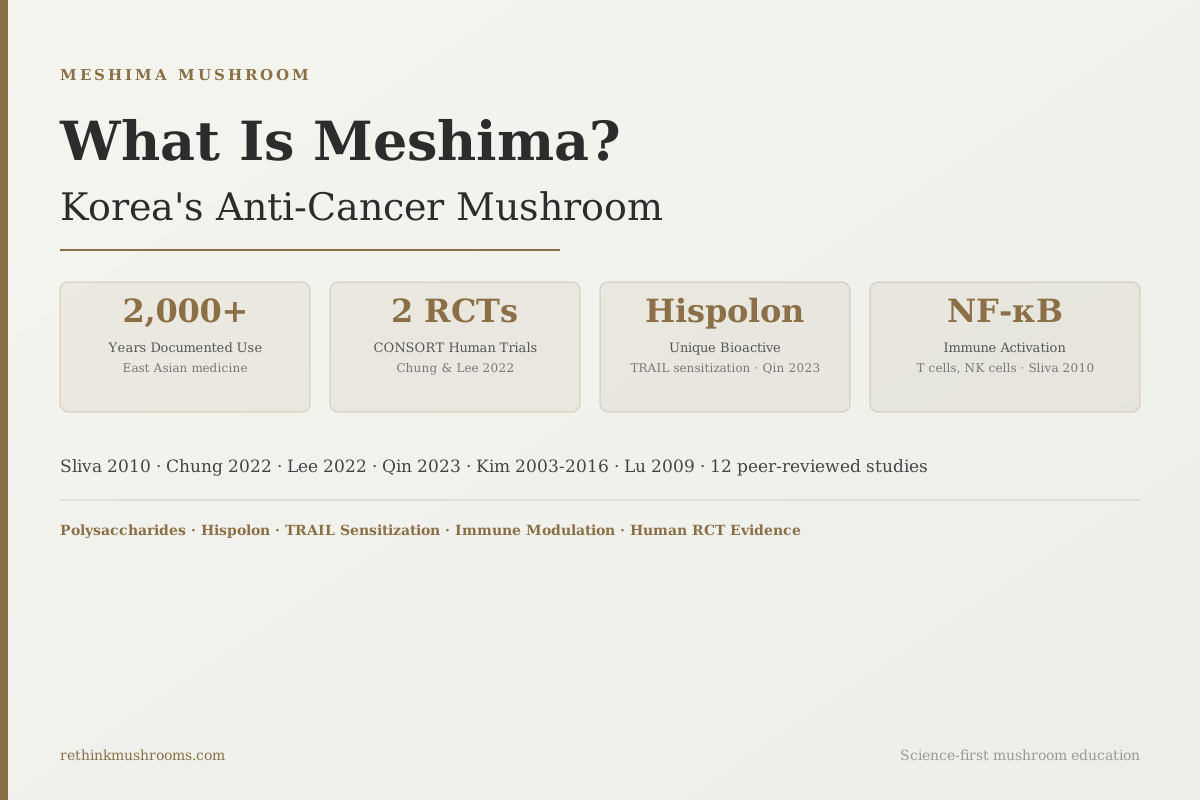
2,000+ Years of Documented Use
Phellinus linteus (meshima) has been used in Korean, Chinese, and Japanese traditional medicine for over two millennia — and 1970s Japanese antitumor screening found it ranked first in antitumor activity out of roughly 600 mushrooms tested.
Sliva, Experimental and Therapeutic Medicine, 2010
2 RCTs
CONSORT-compliant human clinical trials confirmed immune enhancement (Chung 2022, Lee 2022) — the only published human evidence
5
confirmed biological activities in a 2023 systematic review: antitumor, immunomodulatory, anti-inflammatory, antioxidant, antidiabetic (Qin 2023)
3
independent case reports of tumor regression documented in the peer-reviewed literature (Sliva 2010)
Sliva, Experimental and Therapeutic Medicine, 2010
 View as image ↗
Meshima mushroom (Phellinus linteus) is not well known in the West. It outsells Lion's Mane in Korea and has been used in Korean, Chinese, and Japanese traditional medicine for over 2,000 years. In the 1970s, Japanese researchers systematically tested roughly 600 mushrooms for antitumor activity and placed Phellinus linteus first. In 2022, it became the first medicinal mushroom supported by two CONSORT-compliant (the gold standard reporting format for clinical trials) randomized controlled trials showing immune benefits in humans.
Most Western health sites have never mentioned meshima mushroom. The research literature has accumulated for decades. This article introduces what it is, what the science shows, and what the evidence does not yet prove.
Key Takeaways
- Meshima (Phellinus linteus) is a bracket fungus that grows primarily on mulberry trees and has been used in Korean, Chinese, and Japanese traditional medicine for over 2,000 years under different names (sangwhang in Korea, sanghuang in China, meshimakobu in Japan)
- Two 2022 CONSORT-compliant RCTs (Chung et al., Phytomedicine; Lee et al., Nutrients) confirmed significant immune enhancement in human participants — the only published controlled human clinical evidence for the species
- Meshima contains two distinct bioactive classes with different mechanisms: polysaccharides (which activate the immune system and reduce inflammation) and hispolon (a phenolic compound that directly inhibits cancer cell growth)
- A 2023 systematic review of 140+ polysaccharide studies confirmed five biological activities: antitumor, immunomodulatory, anti-inflammatory, antioxidant, and antidiabetic
- Anti-cancer evidence in humans is limited to three case reports of tumor regression — the laboratory and animal data is extensive but not yet replicated in controlled human cancer trials
- A critical species naming problem exists: what is commercially sold as "Phellinus linteus" may include related but distinct Phellinus species; consumers should verify species identity in supplements
What Is Meshima? Definition and Names
Meshima mushroom is Phellinus linteus, a polypore bracket fungus in the family Hymenochaetaceae. It grows preferentially on mulberry trees, though it can be found on other hardwoods across East Asia. The fruiting body is a hard, hoof-shaped bracket ranging from deep brown to blackish on the exterior, with an orange-brown interior.
The same fungus carries different names across cultures. In Japanese, it is called meshimakobu (meaning "mushroom lump from Meshima Island"). In Korean, it is sangwhang. In Chinese medicine, it is sanghuang, meaning "mulberry yellow." In Western literature, it is most frequently referred to by its Latin binomial, Phellinus linteus, though recent taxonomic reclassification has moved some closely related species into the genus Sanghuangporus — a distinction that creates genuine confusion in both research literature and commercial markets.
The mushroom's closest competitors in Western awareness are Turkey Tail (Trametes versicolor), Reishi (Ganoderma lucidum), and Lion's Mane (Hericium erinaceus). Meshima is less familiar but carries a comparably deep research base.
Two bioactive classes define its pharmacology. Polysaccharides (primarily beta-glucan-based structures) mediate immune activation and anti-inflammatory effects through interactions with immune cells. Hispolon, a phenolic compound unique to this species, exerts direct anti-cancer activity through mechanisms that operate independently of immune modulation. This dual-pathway structure distinguishes P. linteus from most other medicinal mushrooms, which rely primarily on polysaccharide immunomodulation.
For the full structural and mechanistic breakdown of these compounds, see Phellinus linteus Bioactive Compounds: Polysaccharides and Phenols.
A 2,000-Year History: Traditional Use Across Three Countries
The earliest documented reference to sanghuang in Chinese texts places it in classical pharmacopeia. Used in Korean traditional medicine (hanbang) for cancer prevention, immune support, and inflammatory conditions, sangwhang was considered among the most valuable of medicinal fungi precisely because mulberry trees — its host — were already revered for their association with silk cultivation and had their own deep medicinal history.
In Japan, the mushroom grew on the coastal island of Meshima, and the island's name became the mushroom's name. Traditional Japanese medicine used meshimakobu similarly to Korean and Chinese practice: as an immune tonic, for management of gastrointestinal conditions, and for anti-aging purposes.
Modern scientific interest in P. linteus began in earnest in the 1970s, when Japanese researchers conducted systematic antitumor screening of approximately 600 mushroom species in animal models. Phellinus linteus produced the strongest antitumor inhibition result of all species tested, with studies showing Sarcoma 180 tumor inhibition rates of approximately 96.7%. This finding launched decades of mechanistic research that would eventually identify the polysaccharide and hispolon pathways as the responsible compounds.
Sliva, reviewing the accumulated evidence in Experimental and Therapeutic Medicine in 2010, documented three independent published case reports in which patients with advanced cancers showed tumor regression associated with P. linteus supplementation.[1] Case reports are the lowest tier of clinical evidence and cannot establish causation. But three independent tumor regression reports, combined with the antitumor screening results, constituted enough of a signal to justify systematic mechanistic research.
For the complete documented history of meshima across Korean, Chinese, and Japanese traditional medicine systems, see The History of Meshima in Korean Traditional Medicine.
The Only Human Clinical Trials: Two 2022 CONSORT RCTs
The standard in clinical evidence is the randomized controlled trial, conducted and reported according to the CONSORT (Consolidated Standards of Reporting Trials) guidelines that define how trials should be designed, run, and reported to minimize bias and allow comparison across studies.
In 2022, two independent research groups published CONSORT-compliant randomized controlled trials of Phellinus linteus extract in humans — the first and only published human clinical trials of this species conducted to this standard.
Chung and colleagues, publishing in Phytomedicine in 2022, found that Phellinus linteus extract significantly improved immune function markers versus placebo in human participants.[2]
Lee and colleagues, publishing in Nutrients in 2022, independently replicated this finding: Phellinus linteus extract improved immunity measures in humans compared to placebo, with CONSORT-compliant design and reporting.[3]
Together, these two trials constitute the first controlled human clinical evidence for Phellinus linteus. The outcome measured was immune function specifically, not cancer or any other disease endpoint. The trials confirm that the mushroom extract produces measurable effects on the human immune system — the foundational finding the research field needed. They do not confirm anti-cancer effects in humans, where the evidence remains preclinical.
The Two Bioactive Classes: What Polysaccharides and Hispolon Do
Phellinus linteus contains hundreds of identified compounds, but two classes have received the most mechanistic attention.
Polysaccharides are complex carbohydrate structures that make up the majority of the mushroom's dry weight. A 2023 systematic review by Qin and colleagues in the International Journal of Biological Macromolecules analyzed the extraction, purification, structural characterization, and confirmed biological functions of Phellinus linteus polysaccharides across more than 140 published studies.[4] Five biological activities were confirmed: antitumor, immunomodulatory, anti-inflammatory, antioxidant, and antidiabetic.
Structurally, P. linteus polysaccharides have a beta-glucan backbone with specific branching patterns responsible for their immunomodulatory effects. The acidic polysaccharide fractions are particularly active.
The mechanism by which polysaccharides fight cancer is indirect: they activate the immune system's own capabilities to recognize and destroy tumor cells. Kim and colleagues, publishing in the Archives of Pharmacal Research in 2003, showed that acidic polysaccharide from P. linteus induced macrophage production of nitric oxide, a molecule that macrophages use to destroy nearby cells including cancer cells.[5] Kim and colleagues extended this in a 2004 study in Immunology Letters, showing the acidic polysaccharide also caused macrophages to produce interferon-gamma and TNF-alpha — two cytokines critical for anti-tumor and anti-viral immune responses.[6]
Hispolon operates through an entirely different mechanism. It is a polyphenolic compound (a type of antioxidant molecule) unique to the Phellinus genus that directly enters cancer cells and disrupts their growth machinery, independently of any immune activation.
Lu and colleagues, publishing in Food and Chemical Toxicology in 2009, showed hispolon inhibited breast and bladder cancer cell growth via the MDM2-ERK1/2 signaling pathway — a pathway that regulates how quickly cells divide.[7] Kim and colleagues, publishing in the International Journal of Oncology in 2016, demonstrated a particularly significant finding: hispolon sensitized cancer cells to a naturally occurring anti-cancer protein called TRAIL (Tumor Necrosis Factor-Related Apoptosis-Inducing Ligand).[8]
TRAIL is selectively toxic to cancer cells — it can kill tumor cells while largely sparing normal cells. The challenge is that many cancer cells evolve TRAIL resistance. Hispolon reverses this resistance by upregulating the cancer cell's death receptors (DR4 and DR5), making them more responsive to TRAIL. This sensitization effect is of clinical interest because TRAIL is already being investigated as an anti-cancer therapy, and a compound that could make tumors more vulnerable to it would have practical value.
This dual-class structure means polysaccharides and hispolon in P. linteus work simultaneously through complementary pathways: polysaccharides recruit immune cells to attack tumors; hispolon directly disrupts cancer cell survival mechanisms and sensitizes cells to immune-derived killing signals.
How Meshima Activates the Immune System
The immune activation pathways of Phellinus linteus operate at both the innate immune level (the body's rapid, non-specific first line of defense) and the adaptive immune level (the slower, targeted T cell and antibody response).
Kim and colleagues, in a 2007 study in Biochemical Pharmacology, showed P. linteus inhibited NF-κB and MAPK signaling in macrophages — two master regulators of the body's inflammatory response.[9] NF-κB (covering the acronym with your thumb: one of the most important genetic switches that turns inflammation on and off) activation drives the production of inflammatory cytokines. By suppressing NF-κB, P. linteus reduces excessive inflammation while maintaining productive immune activity. Li and colleagues confirmed and extended this mechanism in 2019 in the International Journal of Biological Macromolecules, identifying specific steps in the NF-κB pathway (including IKK phosphorylation, a critical molecular event that triggers the inflammatory cascade) inhibited by P. linteus polysaccharides.[10]
At the adaptive immune level, Lee and colleagues, publishing in International Immunopharmacology in 2016, showed P. linteus polysaccharides modulate T cell polarization — specifically supporting Th1-type immune responses.[11] Th1 responses (named after the T helper cell type that leads them) are associated with anti-cancer and anti-viral immunity. Th2 responses, by contrast, are associated with allergy and some immune evasion strategies used by tumors. A compound that shifts the immune balance toward Th1 would theoretically support the immune system's ability to detect and respond to cancer cells.
This combination of innate immune activation (macrophage nitric oxide, IFN-gamma, TNF-alpha) and adaptive immune modulation (Th1 polarization) explains how P. linteus polysaccharides support both immediate immune function and longer-term anti-tumor surveillance.
The Anti-Cancer Evidence: What Lab Studies Show
The most extensive anti-cancer research on Phellinus linteus concerns breast cancer. Lin and colleagues, in a 2008 study in the Journal of Cellular Biochemistry, demonstrated that P. linteus extract inhibited breast cancer cell growth, blocked the formation of new blood vessels that tumors need to grow (a process called angiogenesis, via VEGF suppression), and reduced the cancer cells' ability to invade surrounding tissue — all three through inhibition of the AKT signaling pathway.[12]
AKT (covering this with your thumb: a protein that acts like an "on switch" for cell survival and growth) is one of the most frequently overactivated pathways in human cancer. When AKT is overactive, cancer cells survive longer, grow faster, and invade tissue more aggressively. The Lin 2008 study showed P. linteus could suppress all three of these AKT-driven behaviors simultaneously in breast cancer cells.
The Sliva 2010 review synthesized the broader anti-cancer evidence base available at that time: apoptosis (programmed cell death) induction, cell cycle arrest (pausing cancer cell division), angiogenesis inhibition, and immune activation — four complementary anti-cancer mechanisms operating through different molecular targets.[1]
The critical limitation of all this data: it comes from cell culture (in-vitro) and animal model studies. These experiments confirm that Phellinus linteus compounds can kill cancer cells under controlled laboratory conditions and reduce tumor growth in animals. They do not prove that taking P. linteus extract will prevent or treat cancer in humans. Moving from laboratory evidence to confirmed human anti-cancer efficacy requires randomized controlled clinical trials in cancer patients — which have not been conducted for Phellinus linteus to date.
The three case reports documented in Sliva 2010 describe individual patients who showed tumor regression while using P. linteus alongside other treatments. Case reports are not controlled experiments and cannot establish that the mushroom caused the tumor regression.
For how meshima's cancer evidence compares to other medicinal mushrooms with more human trial data, see Meshima vs. Other Anti-Cancer Mushrooms: Where It Fits. For the most studied medicinal mushroom in cancer research, see Trametes versicolor: The Most-Studied Medicinal Mushroom for Cancer.
The Species Naming Problem: Why "Phellinus linteus" May Not Be What You Buy
Anyone researching meshima supplements encounters an immediate practical problem: the species called Phellinus linteus in Korean research may not be the same species sold under that name internationally.
Taxonomic research has revealed that what is collectively called "sanghuang" in Chinese and Korean medicine encompasses multiple Phellinus species, not all of which are the same as authentic Phellinus linteus as described in the original botanical literature. A related species, Phellinus igniarius, is morphologically similar and has historically been confused with P. linteus. Further complicating the matter, recent molecular phylogenetic work has reclassified several species previously grouped as Phellinus into a new genus, Sanghuangporus, with Sanghuangporus sanghuang emerging as the name for one of the species most commonly referred to as sanghuang in Chinese literature.
For consumers, this means that a supplement labeled "Phellinus linteus" or "meshima" or "sanghuang" may contain any of several related but biochemically distinct fungi. The specific polysaccharide profiles and hispolon content differ between species — meaning that the mechanistic research on authentic P. linteus may not apply equally to all commercial products sold under the name.
This is not a reason to dismiss the research. It is a reason to look for products that specify the species by both common name and Latin binomial, and ideally provide third-party testing documentation. For practitioners and researchers, it is a reason to scrutinize the botanical source in any study claiming P. linteus findings.
What the Evidence Does and Does Not Show
After five decades of Phellinus linteus research, here is an accurate accounting.
Established with controlled evidence: The 2022 CONSORT RCTs (Chung and Lee) establish that P. linteus extract produces measurable immune enhancement in human participants. The laboratory evidence confirms at least five biological activities (Qin 2023 systematic review) and specific mechanisms including NF-κB suppression, macrophage activation, T cell polarization, and hispolon-mediated direct anti-cancer activity.
Established only in preclinical models: Anti-cancer activity in breast cancer, leukemia, and other tumor cell lines is well-documented. Tumor growth inhibition in animal models is documented. Three case reports describe tumor regression in humans. None of this constitutes controlled human trial evidence for cancer prevention or treatment.
Not established: Whether P. linteus can prevent or treat any cancer in humans has not been tested in randomized controlled trials. Whether the immune enhancement observed in the 2022 RCTs translates to better clinical outcomes in immune-compromised or cancer patient populations is unknown.
What this means practically: Meshima has the strongest preclinical anti-cancer evidence base of almost any medicinal mushroom and now has controlled human evidence for immune effects. Its research profile is similar in depth to Turkey Tail, which also has extensive preclinical data but derives its clinical credibility primarily from human trials in cancer patients using the specific PSK and PSP polysaccharide extracts. For meshima, those human cancer trials have not been run.
For the full comparison with Turkey Tail and other anti-cancer medicinal mushrooms, see Meshima vs. Other Anti-Cancer Mushrooms: Where It Fits. For why meshima deserves more attention from Western health audiences, see Phellinus linteus: Why Korea's Most Prized Medicinal Mushroom Deserves Attention.
For the cancer-specific evidence in detail, see Meshima and Cancer: The Complete Research Review.
The Bottom Line
Meshima (Phellinus linteus) is a bracket fungus with over 2,000 years of documented use in Korean, Chinese, and Japanese medicine. Its research base is unusually deep for a mushroom rarely seen in Western supplement markets: five confirmed biological activities in a 2023 systematic review, two 2022 CONSORT-compliant human RCTs showing immune enhancement, and a unique anti-cancer compound (hispolon) found in no other common medicinal mushroom. All human clinical evidence is for immune function; anti-cancer data remains preclinical. A species naming problem requires attention: what is sold as "meshima" or "sanghuang" may include multiple related Phellinus species with different biochemical profiles.
Frequently Asked Questions
Sources & References
- 1RTHM-00364·Sliva, Daniel (2010). “Medicinal mushroom Phellinus linteus as an alternative cancer therapy..” Experimental and therapeutic medicine.Study breakdown →PubMed →↩
- 2. Source details for this reference are not yet available.
- 3. Source details for this reference are not yet available.
- 4RTHM-01770·Qin, Dandan et al. (2023). “Polysaccharides from Phellinus linteus: A systematic review of their extractions, purifications, structures and functions..” International journal of biological macromolecules.Study breakdown →PubMed →↩
- 5. Source details for this reference are not yet available.
- 6. Source details for this reference are not yet available.
- 7RTHM-00306·Lu, Te-Ling et al. (2009). “Hispolon from Phellinus linteus has antiproliferative effects via MDM2-recruited ERK1/2 activity in breast and bladder cancer cells..” Food and chemical toxicology : an international journal published for the British Industrial Biological Research Association.Study breakdown →PubMed →↩
- 8RTHM-00792·Kim, Ji-Hun et al. (2016). “Hispolon from Phellinus linteus induces apoptosis and sensitizes human cancer cells to the tumor necrosis factor-related apoptosis-inducing ligand through upregulation of death receptors..” Oncology reports.Study breakdown →PubMed →↩
- 9RTHM-00116·Kim, Ho Gyoung et al. (2007). “Phellinus linteus inhibits inflammatory mediators by suppressing redox-based NF-kappaB and MAPKs activation in lipopolysaccharide-induced RAW 264.7 macrophage..” Journal of ethnopharmacology.Study breakdown →PubMed →↩
- 10. Source details for this reference are not yet available.
- 11. Source details for this reference are not yet available.
- 12. Source details for this reference are not yet available.