Meshima (Phellinus linteus)
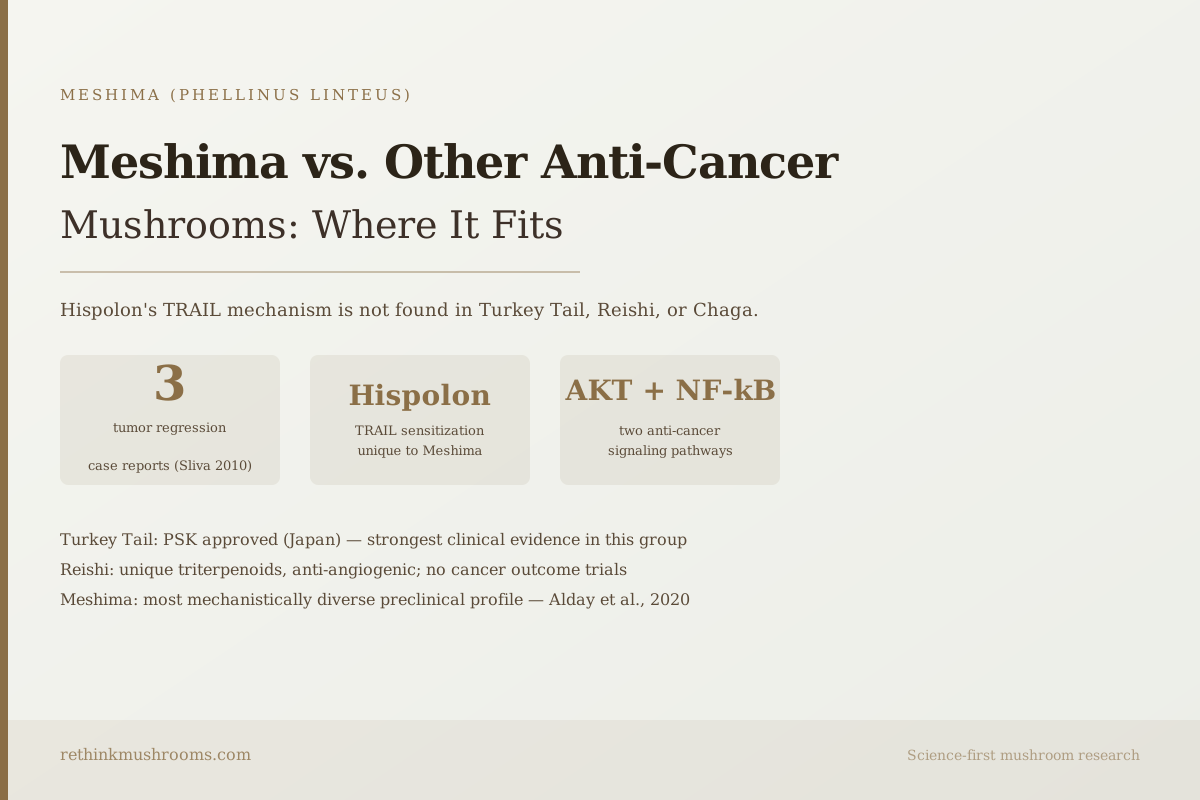
3 documented tumor regression cases
Sliva's 2010 review of Phellinus linteus documented three independent case reports of tumor regression following extract use, the kind of preliminary human signal that precedes clinical trials.
Sliva, Experimental and Therapeutic Medicine, 2010
Hispolon
direct cancer cell killer not found in Turkey Tail or Reishi
NF-κB + AKT
two separate anti-cancer signaling pathways targeted
40+ years
of anti-cancer screening research on this species
Sliva, Experimental and Therapeutic Medicine, 2010
 View as image ↗
When readers ask "which anti-cancer mushroom should I use," they are usually not getting a useful answer. Most content either refuses to compare at all ("all mushrooms have benefits!") or compares without honest calibration of evidence quality. A mushroom cited in one cell line study is described as equivalent to a mushroom with decades of clinical trial data.
This article does the comparison differently: with explicit attention to what type of evidence each claim rests on, what each mushroom's unique mechanism is, and where Phellinus linteus (meshima) fits in that landscape. The short answer is that Turkey Tail has more clinical evidence, Reishi has unique triterpenoids, and Meshima has something none of the others have: hispolon, a compound that kills cancer cells through a completely different pathway.
For the full overview of what meshima is and its research history, see What Is Meshima Mushroom? Korea's Anti-Cancer Mushroom.
Key Takeaways
- Wong et al. (2020) reviewed mushroom extracts and compounds with suppressive action on breast cancer across cultured cells, tumor-bearing animals, and clinical trials, the comparative landscape in which Phellinus linteus can be positioned
- Sliva et al. (2008) showed P. linteus extract inhibited breast cancer cell growth, VEGF-driven angiogenesis, and invasion simultaneously via AKT pathway suppression
- Kim et al. (2016) demonstrated hispolon sensitizes cancer cells to TRAIL-induced death by upregulating death receptors DR4 and DR5, a mechanism not documented for Turkey Tail, Reishi, or Chaga
- Sliva's 2010 review documented three independent case reports of tumor regression following Phellinus linteus use, providing rare anecdotal human signals
- Kim et al. (2007) and Xie et al. (2019) documented P. linteus suppression of NF-κB signaling in LPS-stimulated macrophage models, an anti-inflammatory mechanism it shares with Reishi
- Two CONSORT-randomized human trials (Ku et al., 2022) tested P. linteus extract for immune enhancement; Turkey Tail's PSK remains the most clinically validated mushroom compound for cancer outcomes (approved in Japan as a cancer adjunct)
Why Most Anti-Cancer Mushroom Comparisons Get It Wrong
The comparison problem in medicinal mushroom content comes from treating all evidence levels as equivalent. A study showing a mushroom extract inhibits a cancer cell line in a dish is not equivalent to a randomized controlled trial showing it extends survival in cancer patients. Both count as evidence, but for very different things.
A useful comparison needs to answer three questions separately for each mushroom:
- What type of evidence exists (cell culture, animal, human trial)?
- What specific mechanism is documented?
- What is this mushroom uniquely good at that others are not?
Wong et al. (2020) published a review of mushroom extracts and compounds with suppressive action on breast cancer, drawing on evidence from cultured cancer cells, tumor-bearing animals, and clinical trials.[1] This review provides the comparative breast cancer research landscape against which Phellinus linteus can be positioned alongside Turkey Tail, Reishi, and other mushrooms.
The Evidence Map: How Four Major Anti-Cancer Mushrooms Compare
| Mushroom | Key unique compounds | Strongest evidence type | Human RCTs | Mechanistic strength |
|---|---|---|---|---|
| Turkey Tail (Trametes versicolor) | PSK, PSP (protein-bound polysaccharides) | Cancer adjunct RCTs (PSK approved Japan) | Many (PSK clinical trials) | Strong clinical; immune activation |
| Reishi (Ganoderma lucidum) | Triterpenoids, beta-glucans | Immune function, quality of life | Limited | Triterpenoids unique; anti-angiogenic |
| Meshima (Phellinus linteus) | Polysaccharides, hispolon | Preclinical anti-cancer; immune RCTs (2022) | 2 RCTs (immune only) | Hispolon (TRAIL); AKT; NF-κB |
| Chaga (Inonotus obliquus) | Betulin, betulinic acid, polysaccharides | Anti-inflammatory, antioxidant | Minimal | Betulin anti-cancer; weaker immune data |
Turkey Tail holds the strongest clinical position in this group: PSK (krestin), its protein-bound polysaccharide, has been approved as a cancer adjunct in Japan since the 1970s based on clinical trial data showing survival benefit in colorectal and gastric cancer patients. That regulatory approval is the strongest human evidence for any single mushroom compound in the anti-cancer literature.
Meshima, by contrast, has two CONSORT-randomized, double-blind human trials from 2022, both testing P. linteus extract for immune enhancement.[7][8] Neither trial measured cancer outcomes. For cancer specifically, Meshima's evidence base is entirely preclinical, as is Reishi's and Chaga's for most indications.
This comparison is not a reason to dismiss Meshima. It is a reason to understand where in the evidence hierarchy different mushrooms currently sit.
Evidence Tiers
Four Anti-Cancer Mushrooms, Ranked by Human Evidence
Turkey Tail (Trametes versicolor)
Human cancer RCTsImmune modulation
DocumentedDirect cancer-cell killing
Not documentedPSK is approved in Japan as a cancer adjunct on the strength of survival-benefit RCTs. Works through immunity, not direct cytotoxicity.
Meshima (Phellinus linteus)
Immune RCTs + preclinicalImmune modulation
DocumentedDirect cancer-cell killing
DocumentedTwo 2022 CONSORT-randomized immune trials plus three case reports; cancer outcomes remain preclinical. Uniquely pairs immune modulation with hispolon-driven direct killing.
Reishi (Ganoderma lucidum)
QoL evidence + preclinicalImmune modulation
DocumentedDirect cancer-cell killing
Limited / indirectBest evidence for quality-of-life outcomes in integrative oncology. Triterpenoids give some direct cytotoxic and anti-angiogenic activity; no cancer-outcome RCTs.
Chaga (Inonotus obliquus)
Minimal human dataImmune modulation
Limited / indirectDirect cancer-cell killing
Limited / indirectBetulin and polysaccharides supply antioxidant and anti-inflammatory activity. Weakest cancer-specific mechanism evidence and least clinical trial data of the four.
Rank reflects human evidence, not preclinical volume. Only Turkey Tail (PSK) has cancer-outcome RCTs and regulatory approval; Meshima, Reishi, and Chaga remain preclinical for cancer outcomes. The two mechanism columns show why Meshima is not interchangeable with the others: it is the only species here that couples immune modulation with a documented direct-cytotoxic compound (hispolon; Kim 2016), alongside AKT-pathway suppression (Sliva 2008) and two 2022 immune trials (Ku 2022).
Turkey Tail: The Benchmark for Human Clinical Evidence
Turkey Tail (Trametes versicolor) is the most clinically studied medicinal mushroom for cancer, and its position reflects decades of Japanese and Chinese clinical investment in PSK as an adjunct therapy alongside standard chemotherapy. The comparison to Meshima is not about which has better preclinical data. It is about which has been taken further in clinical testing.
The mechanism underlying Turkey Tail's clinical use is predominantly immunomodulation. PSK activates natural killer cells and T-lymphocytes, boosting the immune system's surveillance capacity for tumor cells. This is the same general category as many of Meshima's polysaccharide mechanisms.
What Turkey Tail lacks is a direct cancer cell killing compound. PSK works through immunity, not through direct cytotoxicity. This is where Meshima's hispolon creates a genuine mechanistic gap between the two mushrooms.
For deep coverage of Turkey Tail's evidence: Trametes versicolor: The Most-Studied Medicinal Mushroom for Cancer and What Is Turkey Tail Mushroom? A Science-Based Introduction.
Reishi: Unique Triterpenoids, Different Niche
Reishi (Ganoderma lucidum) produces triterpenoids, a compound class not found in Turkey Tail, Meshima, or Chaga in significant quantities. Triterpenoids have documented anti-angiogenic effects (inhibiting blood vessel formation to tumors) and some direct cytotoxic activity, giving Reishi a distinct mechanism from polysaccharide-dominated mushrooms.
Reishi also overlaps with Meshima on the NF-κB anti-inflammatory pathway. Both mushrooms suppress the signaling protein NF-κB, a master switch for inflammation that tumors frequently exploit to maintain their survival environment. But the upstream mechanisms are different: Reishi's triterpenoids and Meshima's polysaccharides enter this pathway at different points.
In the breast cancer comparative landscape reviewed by Wong et al. (2020), both Reishi and Phellinus linteus appear among mushrooms with documented suppressive activity.[1] Their mechanistic overlap at NF-κB and their differences in upstream mechanisms (triterpenoids vs. polysaccharides/hispolon) make them potentially complementary rather than substitutable.
Meshima's Irreplaceable Angle: Hispolon and TRAIL
The strongest argument for Meshima's unique position among anti-cancer mushrooms is hispolon. Turkey Tail does not contain it. Reishi does not contain it. Chaga does not contain it in significant quantities. Hispolon is, as far as the current research literature documents, a Phellinus linteus-specific compound class with a mechanism that none of the other major anti-cancer mushrooms possess.
Sliva et al. (2008) showed Phellinus linteus extract inhibited breast cancer cell growth, suppressed VEGF (the protein that drives tumor blood vessel formation), and blocked tumor cell invasion, all through inhibition of the AKT signaling pathway.[3] AKT is one of cancer biology's most important survival and proliferation pathways. Blocking it simultaneously reduces growth, cuts off blood supply, and limits spread. This is the mechanistic profile documented in Sliva 2008, and no analogous study exists for Turkey Tail or Chaga.
Kim et al. (2016) showed hispolon specifically sensitizes cancer cells to TRAIL, a protein in the tumor necrosis factor family that selectively triggers programmed cell death in cancer cells while leaving normal cells unharmed.[4] The mechanism is specific: hispolon upregulates DR4 and DR5, the "death receptors" on the cancer cell surface that TRAIL binds to. More death receptors means the cancer cell is more responsive to TRAIL-triggered death.
Why does this matter compared to other mushrooms? TRAIL's cancer selectivity makes it one of the most promising targets in cancer immunotherapy. A compound that sensitizes cancer cells to TRAIL is potentially a combination therapy partner, not just a standalone agent. No equivalent TRAIL sensitization mechanism has been documented for Turkey Tail, Reishi, or Chaga polysaccharides.
For the detailed compound mechanism, see Phellinus linteus Bioactive Compounds: Polysaccharides and Phenols.
What Meshima Shares With the Others: NF-κB Anti-Inflammatory Mechanisms
Despite its unique characteristics, Meshima does share the NF-κB anti-inflammatory mechanism with Reishi and several other medicinal mushrooms. Kim et al. (2007) showed Phellinus linteus inhibited both NF-κB and MAPK activation in macrophages, reducing the production of inflammatory mediators that tumors use to create a permissive growth environment.[5]
Xie et al. (2019) reinforced this axis, showing P. linteus polysaccharides suppress inflammation by blocking NF-κB translocation to the nucleus in LPS-stimulated macrophages, one of the more mechanistically characterized descriptions of how this species targets the NF-κB pathway.[6]
This shared mechanism has a practical implication: mushrooms that inhibit NF-κB target chronic inflammation, which is a contributing factor to tumor development, survival, and metastasis. In that sense, Meshima, Reishi, and Turkey Tail are working in the same general direction on inflammation, even if they arrive there through different molecular entry points.
The difference is that Meshima additionally brings hispolon's direct cytotoxic mechanism. It is both an immune modulator (polysaccharides) and a direct cancer cell killer (hispolon). None of the other mushrooms in this comparison have that dual-mechanism profile at the compound level.
The Three Documented Tumor Regression Cases
Sliva's 2010 review of Phellinus linteus as an alternative cancer therapy documented three independent case reports of tumor regression following extract use in human patients.[2] Case reports are not clinical trials. They are anecdotal observations from individual patients and cannot establish causation.
But case reports matter in a specific way: they are the human signal that occasionally precedes clinical investigation. If a compound shows no human activity signal at all, even anecdotally, that is itself informative. Three independent case reports across different patients and clinical contexts suggests the preclinical evidence is not entirely disconnected from human biology.
This does not mean Meshima treats cancer. It means there are human observations, however limited, that parallel the preclinical data. Turkey Tail has moved well beyond case reports into RCTs. Meshima has not yet been tested in cancer outcome trials. Whether the case report signal is ever followed by a controlled human cancer trial remains to be determined.
For the full cancer evidence trail, see Meshima and Cancer: The Complete Research Review.
What the Evidence Actually Says About Choosing Between Them
The honest map of these four mushrooms by evidence level:
Turkey Tail: If clinical trial evidence is your primary criterion, Turkey Tail is the only mushroom in this group with regulatory approval (PSK, Japan) and multiple completed RCTs for cancer outcomes. Choose Turkey Tail if you want the strongest human evidence base.
Reishi: If you want triterpenoids specifically (anti-angiogenic, direct cytotoxic mechanisms not present in the other three), Reishi is the only source among the four. Reishi also has the most evidence for quality of life outcomes in integrative oncology settings, including fatigue and immune function.
Meshima: If you are interested in the hispolon mechanism, TRAIL sensitization, or the AKT pathway inhibition in cancer cells, Meshima is the only mushroom in this group with those documented mechanisms. It has two human RCTs for immune function and a substantial preclinical anti-cancer evidence base. Its clinical evidence for cancer outcomes is currently zero, but so is Reishi's and Chaga's.
Chaga: If antioxidant and anti-inflammatory activity is the priority, Chaga's betulin compounds and polysaccharide content provide those effects. Of the four, Chaga has the weakest cancer-specific mechanism evidence and the least clinical trial data.
The comparison is not about which mushroom is "best for cancer." It is about understanding what each one actually does at the molecular level, what human evidence exists for those effects, and what gaps remain. Meshima's gap is clinical cancer trials. Its strength is mechanistic uniqueness. None of this is medical advice: anyone considering a medicinal mushroom alongside cancer treatment should talk to their oncologist first, because some of these compounds can interact with chemotherapy or immunotherapy.
Within the breast cancer preclinical literature surveyed by Wong et al. (2020), Phellinus linteus stands out for the breadth of mechanisms documented across the primary studies: AKT pathway inhibition, angiogenesis suppression, and immune modulation in one species.[1] Whether that preclinical depth translates to clinical efficacy awaits the trials that have not yet been done.
The Bottom Line
Among the four major anti-cancer mushrooms, Turkey Tail has the strongest human clinical evidence (PSK approved in Japan based on cancer RCTs), while Meshima, Reishi, and Chaga remain in the preclinical phase for cancer-specific outcomes. Meshima's mechanistic uniqueness lies in hispolon, a phenolic compound with documented TRAIL sensitization activity (Kim 2016) not found in the other three. P. linteus also inhibits AKT-driven tumor angiogenesis and invasion (Sliva 2008) and suppresses NF-κB signaling in macrophage models (Xie 2019). Three case reports of tumor regression (Sliva 2010) and two 2022 CONSORT-randomized immune function trials (Ku 2022) provide the only human signals. The evidence supports Meshima's value as a mechanistically distinct and preclinically well-studied option, while clinical cancer trial data remains absent.
Frequently Asked Questions
Sources & References
- 1RTHM-00664·Wong, Jack Ho et al. (2020). “Mushroom extracts and compounds with suppressive action on breast cancer: evidence from studies using cultured cancer cells, tumor-bearing animals, and clinical trials..” Applied microbiology and biotechnology.Study breakdown →PubMed →↩
- 2RTHM-00364·Sliva, Daniel (2010). “Medicinal mushroom Phellinus linteus as an alternative cancer therapy..” Experimental and therapeutic medicine.Study breakdown →PubMed →↩
- 3RTHM-00271·Sliva, D et al. (2008). “Phellinus linteus Extract in Breast-Cancer Cell Models: What This 2008 Study Actually Found.” British journal of cancer.Study breakdown →PubMed →↩
- 4RTHM-00792·Kim, Ji-Hun et al. (2016). “Hispolon from Phellinus linteus induces apoptosis and sensitizes human cancer cells to the tumor necrosis factor-related apoptosis-inducing ligand through upregulation of death receptors..” Oncology reports.Study breakdown →PubMed →↩
- 5RTHM-00116·Kim, Ho Gyoung et al. (2007). “Phellinus linteus inhibits inflammatory mediators by suppressing redox-based NF-kappaB and MAPKs activation in lipopolysaccharide-induced RAW 264.7 macrophage..” Journal of ethnopharmacology.Study breakdown →PubMed →↩
- 6RTHM-00599·Xie, Zhenglu et al. (2019). “Anti-inflammatory activity of polysaccharides from Phellinus linteus by regulating the NF-κB translocation in LPS-stimulated RAW264.7 macrophages..” International journal of biological macromolecules.Study breakdown →PubMed →↩
- 7RTHM-01555·Ku, Yong Ho et al. (2022). “Efficacy of Phellinus linteus extract on immunity enhancement: A CONSORT-randomized, double-blind, placebo-controlled pilot trial..” Medicine.Study breakdown →PubMed →↩
- 8RTHM-01556·Ku, Yong Ho et al. (2022). “Effects of Phellinus linteus extract on immunity improvement: A CONSORT-randomized, double-blinded, placebo-controlled trial..” Medicine.Study breakdown →PubMed →↩