Meshima (Phellinus linteus)
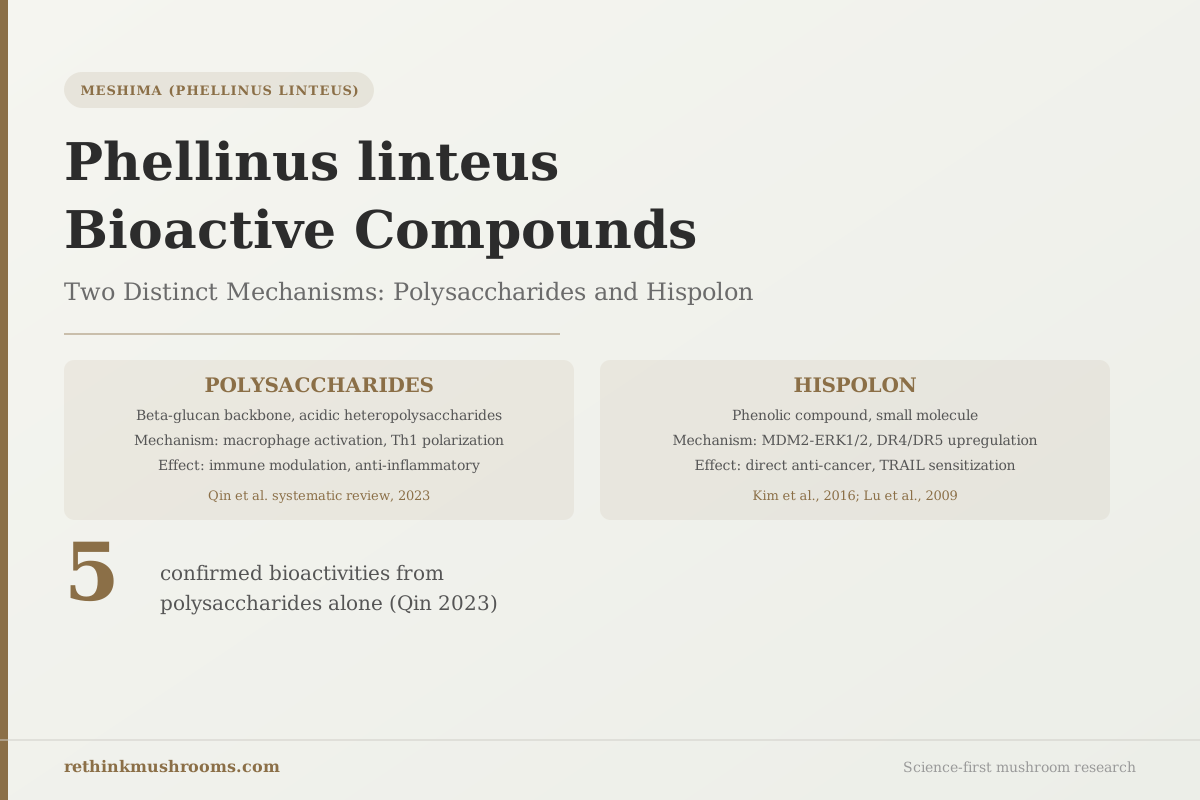
5 confirmed bioactivities
A 2023 systematic review confirmed five distinct biological functions from Phellinus linteus polysaccharides alone: antitumor, immunomodulatory, anti-inflammatory, antioxidant, and antidiabetic activity.
Qin et al., International Journal of Biological Macromolecules, 2023
2 classes
polysaccharides and hispolon act through completely independent mechanisms
DR4/DR5
death receptors upregulated by hispolon, sensitizing cancer cells to TRAIL-induced death (Kim et al., 2016)
1996–2023
span of studies mapping the full mechanism landscape of both compound classes
Qin et al., International Journal of Biological Macromolecules, 2023
 View as image ↗
Most mushrooms get credit for one thing. Reishi is known for triterpenoids. Turkey Tail for PSK. Beta-glucan immune activation is the blanket explanation that covers most of the rest.
Phellinus linteus is different. It contains two distinct classes of bioactive compounds that work through completely independent mechanisms. The first is a family of polysaccharides that activate immunity indirectly, triggering macrophages, shifting T cells, suppressing inflammatory pathways. The second is hispolon, a small phenolic molecule that enters cancer cells and directly induces their death, through a pathway that has nothing to do with immunity.
The 2023 systematic review by Qin and colleagues mapped the polysaccharide side of this in the most comprehensive analysis to date, confirming five distinct biological functions from the polysaccharide class alone.[1] The hispolon mechanisms, documented in a separate body of research, add a layer that no competitor has adequately explained.
This article covers both classes and why the distinction matters. For the broader introduction to Phellinus linteus and its historical use, see what is meshima mushroom.
Key Takeaways
- Phellinus linteus contains two distinct bioactive classes, polysaccharides and phenols, that work through completely independent mechanisms (Qin et al., 2023 systematic review)
- A 2023 systematic review confirmed five biological activities from polysaccharides alone: antitumor, immunomodulatory, anti-inflammatory, antioxidant, and antidiabetic
- Polysaccharides activate macrophages, triggering nitric oxide production and cytokines including IFN-γ and TNF-α (Kim et al., 2003 and 2004)
- Hispolon, a phenolic compound specific to this mushroom, inhibits cancer cell proliferation via the MDM2-ERK1/2 pathway in breast and bladder cancer cells (Lu et al., 2009)
- Hispolon sensitizes cancer cells to TRAIL-induced death by upregulating death receptors DR4 and DR5, without harming normal cells (Kim et al., 2016)
- Lee et al. (2016) showed that polysaccharides specifically shift T cells toward a Th1 immune response, the arm most active in anti-cancer and anti-viral defense
Two Compound Classes, Two Completely Different Mechanisms
The framing matters here. Most articles about Phellinus linteus list a set of benefits and attribute them all to "the mushroom's bioactive compounds." This obscures a distinction that changes how you interpret the evidence.
Polysaccharides and phenolic compounds like hispolon are structurally different molecules. They reach different molecular targets inside cells. They activate different signaling pathways. One class works primarily through the immune system; the other works directly inside cancer cells.
| Compound Class | Key Examples | Molecular Target | Primary Effect |
|---|---|---|---|
| Polysaccharides | Beta-glucans, acidic heteropolysaccharides, protein complexes | Macrophage receptors, NF-κB, MAPK pathways | Immune activation, anti-inflammatory |
| Phenolic compounds | Hispolon | MDM2-ERK1/2, DR4/DR5 death receptors, p21/p27 | Direct anti-cancer, cell cycle arrest, apoptosis |
The practical consequence: the immune-modulating effects and the direct anti-cancer effects of Phellinus linteus come from different molecules acting on different targets. Research on polysaccharides tells you about one mechanism; research on hispolon tells you about another. Combining the two tells a fuller story than either alone.
Polysaccharides: Structure, Backbone, and the Protein Complex
The polysaccharide fraction of Phellinus linteus includes several compound types: beta-glucan-dominated backbones, heteropolysaccharides, and polysaccharide-protein complexes.
Shon and colleagues in 2006 isolated and partially characterized a polysaccharide-protein complex from the liquid culture broth of Phellinus linteus. The complex showed specific immunostimulatory activity and was one of the earliest structural characterizations of the biologically active compound class.[2]
Chen and colleagues in 2015 went deeper, performing detailed structural analysis of Phellinus linteus polysaccharides and identifying the specific features responsible for immunomodulatory effects. The key finding: the beta-glucan backbone is not sufficient on its own. The branching pattern, specifically how often and where side chains attach to the main glucose chain, determines biological activity. Polysaccharides with the specific branching architecture found in Phellinus linteus are the ones that trigger immune receptors.[3]
This structure-activity relationship matters for anyone evaluating supplements. A product that contains beta-glucans in general (say, from oats or barley) has a completely different branching structure from Phellinus linteus polysaccharides. The immune-activating effects documented in Phellinus linteus research don't automatically apply to other beta-glucan sources.
The 2023 systematic review by Qin and colleagues provided the most comprehensive synthesis of what these polysaccharides do, covering extraction methods, structural characterization, and confirmed biological functions across the accumulated research literature.[1]
How Polysaccharides Activate the Immune System
The chain of events from Phellinus linteus polysaccharides to immune activation is now well-mapped at the molecular level.
Macrophage activation and nitric oxide. Kim and colleagues in 2003 isolated an acidic polysaccharide from Phellinus linteus and tested it on macrophages. The polysaccharide induced nitric oxide production in macrophages through a specific signaling pathway.[4] Nitric oxide is the molecule macrophages use to kill bacteria, viruses, and tumor cells; it's a frontline weapon in innate immune defense. The finding established that Phellinus linteus polysaccharides don't just passively stimulate the immune system in a vague sense; they activate a specific killing mechanism.
Cytokine production. The follow-up study in 2004 by Kim and colleagues extended this picture. The same acidic polysaccharide fraction upregulated IFN-gamma and TNF-alpha from peritoneal macrophages.[5] IFN-gamma is a cytokine that activates the anti-viral and anti-tumor arms of the immune system. TNF-alpha is a direct inducer of programmed cell death in tumor cells. Together, these two cytokines represent the core of what an anti-cancer immune response looks like at the molecular level.
T cell polarization toward Th1. Lee and colleagues in 2016 showed that Phellinus linteus polysaccharides don't just activate innate immune cells; they also shape how the adaptive immune response develops. Specifically, they shifted T cell polarization toward a Th1 response, the arm of the immune system responsible for fighting intracellular pathogens and cancer cells.[10] A Th2-dominant response is associated with allergy and parasite defense. Th1 dominance is the configuration most relevant for anti-tumor immunity.
The historical anchor. Suzuki and colleagues in 1996 provided the earliest study confirming that Phellinus linteus polysaccharides stimulated both arms of the immune system simultaneously: both humoral (antibody production) and cell-mediated (T cell) immunity.[6] At the time, achieving dual immune arm stimulation from a single plant or fungal compound was notable; it established the breadth of Phellinus linteus immune activity nearly 30 years ago.
For the full mechanism of NF-κB pathway inhibition by Phellinus linteus polysaccharides, see the dedicated article on meshima and inflammation: NF-κB pathway research. For how the innate and adaptive arms are coordinated, see how meshima bridges innate and adaptive immunity.
Hispolon: The Phenolic Compound That Works Differently
Hispolon is a polyphenol (a small aromatic molecule with hydroxyl groups) found in the fruiting body of Phellinus linteus. It is chemically distinct from the polysaccharides. It's smaller, more lipophilic, and it enters cells more easily than large polysaccharide chains.
The consequence is a different biological interaction. Where polysaccharides bind to surface receptors on immune cells and trigger signaling cascades outward, hispolon enters tumor cells and disrupts the internal machinery that keeps cancer cells dividing.
The MDM2-ERK1/2 mechanism. Lu and colleagues in 2009 established the foundational hispolon study, testing it against breast cancer and bladder cancer cell lines. Hispolon inhibited cancer cell proliferation through a pathway involving MDM2 and ERK1/2.[7] MDM2 is a protein that normally suppresses p53, the tumor suppressor gene that triggers cell death when DNA is damaged. ERK1/2 is a signaling protein involved in cell growth and survival.
The Lu 2009 mechanism is distinct from what standard MDM2-targeting drugs do. Existing MDM2 inhibitors work by restoring p53 function directly. Hispolon uses a different path, through ERK1/2 rather than by releasing p53 from MDM2 suppression. This matters because it means hispolon's anti-proliferative activity doesn't depend on p53 being functional, which is important because many cancers have mutated p53.
G0/G1 cell cycle arrest. Chen and colleagues in 2013 tested hispolon on NB4 human leukemia cells and found it induced arrest at the G0/G1 phase of the cell cycle.[8] G0/G1 is the growth phase before DNA replication. Stopping cells here prevents them from copying their DNA and dividing. The mechanism involved upregulation of p21 and p27, proteins that act as brakes on the cell cycle machinery. A cancer cell arrested in G0/G1 cannot replicate; if the arrest is sustained, the cell undergoes apoptosis (programmed death).
Hispolon and TRAIL: The Most Clinically Relevant Finding
The most significant hispolon finding in the research literature is also the least discussed by competitors.
Kim and colleagues in 2016 tested whether hispolon could sensitize cancer cells to TRAIL-induced apoptosis.[9] TRAIL (Tumor Necrosis Factor-Related Apoptosis-Inducing Ligand) is a protein that the immune system produces to kill cancer cells. TRAIL is selectively toxic to tumor cells; it induces apoptosis in cancer cells while largely sparing normal healthy cells. This cancer selectivity has made TRAIL a focus of drug development for decades.
The clinical problem with TRAIL as a therapy is that many cancer cells develop resistance to it. They do this by reducing the expression of DR4 and DR5, the surface receptors that TRAIL binds to in order to trigger apoptosis. Without enough DR4/DR5 on their surface, cancer cells can ignore the TRAIL signal.
Hispolon, Kim and colleagues found, specifically upregulates DR4 and DR5 expression in cancer cells. It makes cancer cells restore the very receptors they had downregulated to escape TRAIL-induced death. The combination of hispolon plus TRAIL was more effective at inducing cancer cell apoptosis than either alone.[9]
Why this matters for research: TRAIL combination strategies are an active area of oncology drug development. The idea is to pair something that sensitizes cancer cells with TRAIL itself, achieving selective tumor killing without harming normal tissue. Hispolon's ability to restore DR4/DR5 expression fits exactly that model. This is a mechanistic finding that goes beyond generic "anti-cancer" activity; it identifies a specific combination rationale.
The important caveat: this is in vitro research. Kim 2016 used cancer cell lines, not animals, not humans. Whether hispolon reaches tumor tissue in adequate concentrations when consumed orally, and whether it maintains this mechanism in a complex biological environment, is unknown.
Evidence Limits: Cell Lines vs. Clinical Reality
The research on Phellinus linteus bioactive compounds covers nearly 30 years and 10 mechanistic studies in this review. The picture is detailed. The evidence quality for clinical application is modest.
Nearly all of the mechanism data reviewed here comes from in vitro experiments, meaning cancer cells or immune cells grown in dishes and exposed to Phellinus linteus extracts or isolated compounds. Cell line data establishes that a mechanism exists. It doesn't establish that the mechanism operates in a living person who consumes the mushroom.
The gap between cell line evidence and clinical efficacy is wide and full of failures. Many compounds that kill cancer cells in a dish do nothing in clinical trials, because they don't absorb adequately, or they're metabolized before reaching the tumor, or the concentration needed to have an effect far exceeds what's achievable from dietary intake.
The 2022 CONSORT randomized controlled trials, published in the same year by Chung et al. in Phytomedicine and Lee et al. in Nutrients, tested Phellinus linteus extract on immune function in humans. Both confirmed immune enhancement. But these trials measured immune markers, not cancer outcomes, and they were conducted with extracts, not isolated polysaccharides or hispolon. The gap between "immune markers improved" and "cancer was prevented or treated" is substantial.
For readers interested in how Phellinus linteus compares to other medicinal mushrooms with more clinical data, see meshima vs. other anti-cancer mushrooms and the deep-dive on Turkey Tail (Trametes versicolor), which has decades of human trial data behind PSK.
The honest summary for the bioactive compounds: the mechanisms are real, the molecular interactions are documented, and the structure-activity relationships are well-mapped by the 2023 systematic review. The translation of those mechanisms to clinical anti-cancer efficacy in humans remains unproven. This is an accurate description of where the research stands, not a dismissal, and not an overclaim.
The Bottom Line
Phellinus linteus contains two mechanistically distinct compound classes: polysaccharides that activate immunity via macrophage receptors, cytokine induction, and T cell Th1 polarization; and hispolon, a phenolic compound that directly inhibits cancer cell proliferation through MDM2-ERK1/2 and sensitizes cancer cells to TRAIL-induced death by restoring DR4/DR5 receptor expression. A 2023 systematic review confirmed five biological functions from the polysaccharide class. The evidence base is rich in in vitro mechanism data spanning nearly 30 years; clinical translation to anti-cancer efficacy in humans remains unproven.
Frequently Asked Questions
Sources & References
- 1RTHM-01770·Qin, Dandan et al. (2023). “Polysaccharides from Phellinus linteus: A systematic review of their extractions, purifications, structures and functions..” International journal of biological macromolecules.Study breakdown →PubMed →↩
- 2. Source details for this reference are not yet available.
- 3. Source details for this reference are not yet available.
- 4. Source details for this reference are not yet available.
- 5. Source details for this reference are not yet available.
- 6. Source details for this reference are not yet available.
- 7RTHM-00306·Lu, Te-Ling et al. (2009). “Hispolon from Phellinus linteus has antiproliferative effects via MDM2-recruited ERK1/2 activity in breast and bladder cancer cells..” Food and chemical toxicology : an international journal published for the British Industrial Biological Research Association.Study breakdown →PubMed →↩
- 8RTHM-00514·Chen, Yi-Chuan et al. (2013). “Hispolon from Phellinus linteus induces G0/G1 cell cycle arrest and apoptosis in NB4 human leukaemia cells..” The American journal of Chinese medicine.Study breakdown →PubMed →↩
- 9RTHM-00792·Kim, Ji-Hun et al. (2016). “Hispolon from Phellinus linteus induces apoptosis and sensitizes human cancer cells to the tumor necrosis factor-related apoptosis-inducing ligand through upregulation of death receptors..” Oncology reports.Study breakdown →PubMed →↩
- 10. Source details for this reference are not yet available.