Meshima (Phellinus linteus)
2,000+ years of documented use
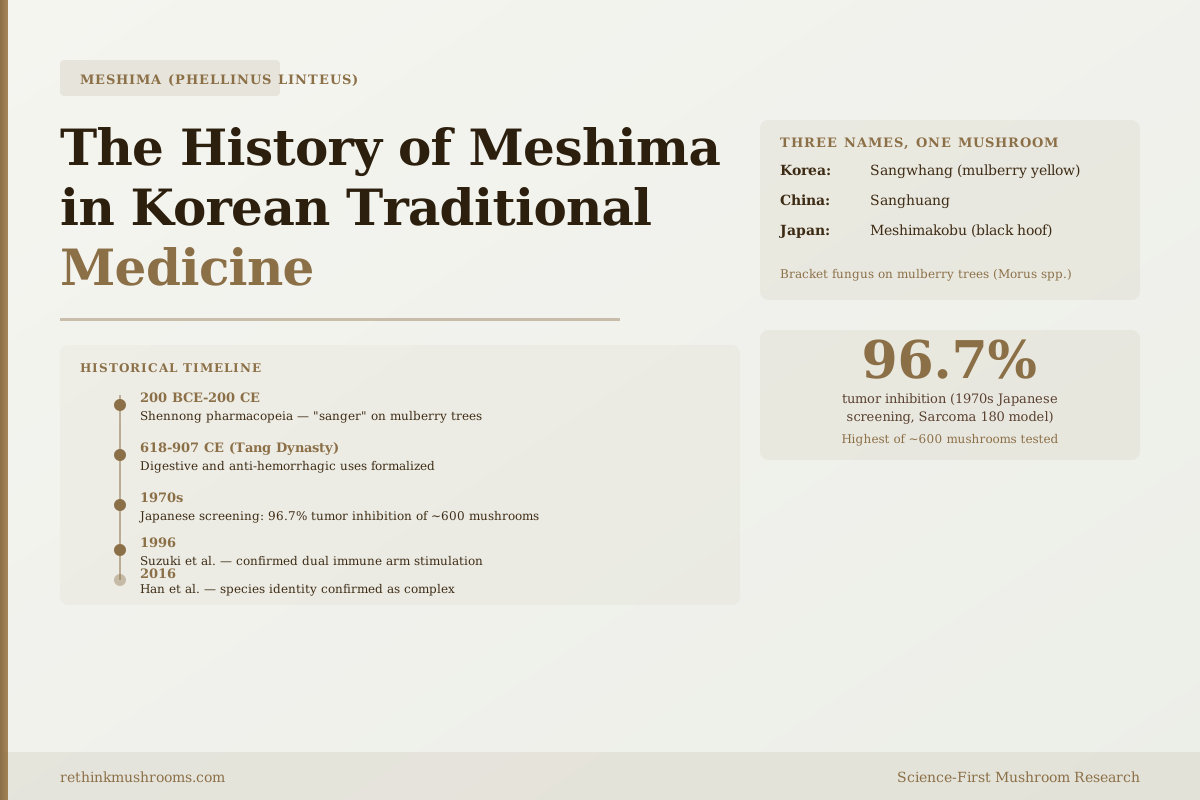
Phellinus linteus appears in East Asian herbal records spanning more than two millennia, and in the 1970s, Japanese researchers testing approximately 600 mushrooms found it produced the strongest antitumor activity of any species examined.
Sliva, Experimental and Therapeutic Medicine, 2010; Han et al., Mycobiology, 2016
96.7%
tumor inhibition in 1970s Japanese mushroom screening (Sarcoma 180 model)
3
independent tumor regression case reports in modern literature (Sliva 2010)
2016
Han et al. confirmed species identity complexity in Korean sangwhang
Sliva, Experimental and Therapeutic Medicine, 2010; Han et al., Mycobiology, 2016
 View as image ↗
In the 1970s, Japanese researchers systematically tested approximately 600 mushroom species for antitumor activity. One species produced the strongest result: Phellinus linteus, inhibiting tumor growth by 96.7% in a standard mouse cancer model. Korean healers had been using this same mushroom for two millennia before that study was run.
The history of meshima in Korean traditional medicine is the story of a fungus that moved from herbal prescription to laboratory subject without the culture that first documented it ever losing confidence in its importance. For a broader overview of what the research currently shows, see What Is Meshima Mushroom? Korea's Anti-Cancer Mushroom.
Key Takeaways
- Phellinus linteus (meshima/sangwhang) appears in East Asian herbal texts stretching back over 2,000 years, used primarily for digestive conditions, hemorrhage, and later as a cancer preventive
- In the 1970s, Japanese researchers screening approximately 600 mushrooms for antitumor activity found P. linteus produced the highest inhibition rate (96.7% in Sarcoma 180 mouse tumor models), launching the modern research era
- The mushroom is known by different names across three cultures: sangwhang in Korea (meaning "mulberry yellow"), sanghuang in China, and meshimakobu in Japan; all refer to the same bracket fungus growing on mulberry trees
- A 2016 genetic study by Han and colleagues found that commercial Korean "sangwhang" products often include multiple Phellinus species, not exclusively P. linteus, raising authenticity concerns that apply equally to supplements today
- Early scientific validation came through Suzuki et al. (1996), who confirmed that P. linteus polysaccharides stimulated both the antibody-producing (humoral) and cell-killing (cellular) branches of the immune response
- Three independent case reports of tumor regression in patients using P. linteus were documented in a 2010 review, forming the only anecdotal human evidence for anti-cancer effects outside of controlled trials
Two Thousand Years: The Historical Record
The earliest documented references to Phellinus linteus in the written record appear in the Shennong Bencao Jing, the foundational Chinese pharmacopoeia traditionally attributed to the legendary emperor Shennong (the Divine Farmer). While the text itself was compiled during the Han Dynasty (roughly 200 BCE to 200 CE), it draws on even older oral traditions about medicinal plants and fungi. In this text, a bracket fungus from mulberry trees, referred to as "sanger," is described as beneficial for conditions associated with inflammation and internal bleeding.
By the Tang Dynasty (618-907 CE), the mushroom's medicinal profile had become more specific. Tang-era herbalists documented uses for dysentery, abnormal menstrual bleeding, and what we would now recognize as digestive inflammatory conditions. The association between mulberry-tree fungus and restorative health properties was well established enough to appear in multiple Tang-era pharmacopeias.
Korean traditional medicine, known as hanbang, developed its own extensive pharmacopeia from Chinese herbal foundations but evolved distinct emphases and formulations. The bracket fungus from mulberry trees became particularly prized in Korean practice under the name sangwhang. The name is revealing: "sang" means mulberry tree in Korean, and "whang" (or "hwang") means yellow, describing the distinctive ochre-yellow inner surface of the bracket when cut. The mushroom was used as a tonic for aging-related weakness and, by the Joseon Dynasty period (14th-19th centuries CE), it was specifically associated with preventing and treating conditions that later generations would recognize as cancer.
The cancer-preventive framing in traditional Korean practice predated modern oncology by centuries. Korean herbal practitioners categorized certain conditions as involving abnormal tissue growth and used sangwhang as part of formulations targeting these states. Whether the traditional preparation methods were effective, and if so through what mechanisms, is a question that twentieth-century researchers began to address with laboratory methods.
The traditional use created a cultural framework that gave Korean researchers particular motivation when modern cancer pharmacology emerged as a field. When Japanese scientists ran their famous mushroom screening study in the 1970s, Korean scientists had a cultural reason to pay close attention to the result.
Sangwhang, Sanghuang, Meshimakobu: Why Three Cultures Named the Same Mushroom
Before examining the research history, there is a naming problem worth understanding. The same bracket fungus carries different names across the three cultures that have used it longest, and those names have created significant confusion in both the scientific literature and the supplement market.
In China, the mushroom is sanghuang. In Korea, sangwhang. In Japan, meshimakobu (meaning "black hoof of the island," referring to the dark outer surface of mature specimens that can resemble a horse's hoof). The Japanese term was shortened to meshima in the Western supplement trade.
All three names refer to Phellinus linteus growing on mulberry trees (genus Morus). But the fungal taxonomy in this group has been unstable for decades. The species P. linteus is a white-rot wood-decomposing polypore in the family Hymenochaetaceae, closely related to several other species that also grow on mulberry and other hardwoods. These related species look similar and were historically grouped together under the "sanghuang" category in Chinese and Korean herbal medicine.
A 2016 study by Han and colleagues examined the actual species identity of mushrooms sold and prescribed as "sangwhang" in Korea.[1] Using genetic and morphological analysis, they confirmed that commercial "sangwhang" in Korea regularly includes not only Phellinus linteus but also related species such as Phellinus baumii, Phellinus igniarius, and what has since been reclassified as Sanghuangporus sanghuang (the Chinese sanghuang). The names are nearly identical; the fungi are distinct.
The Han 2016 finding is historically significant because it raises a question that applies to centuries of traditional use: when historical texts prescribed "sanghuang" or "sangwhang," which species were practitioners actually using? The answer appears to be that traditional herbal medicine in East Asia treated several related Phellinus species as functionally equivalent under a common category. This may have been practically reasonable (the species share bioactive compounds, though in different proportions), but it means that the research record conflates multiple species under a single name.
The Japanese Screening That Launched Modern Research
The turning point in modern scientific interest in Phellinus linteus was a series of antitumor screening studies conducted by Japanese researchers in the 1970s. The methodology was systematic: extract preparations from hundreds of mushroom species were tested against Sarcoma 180, a standard mouse tumor model used to identify potential antitumor agents. A review by Sliva documents that P. linteus produced the highest antitumor inhibition rate of all species screened, at approximately 96.7%.[2]
To understand what this number means and how much weight to give it: the Sarcoma 180 assay was a widely used but imperfect screening tool. It identified compounds worth investigating further, not compounds proven to work in humans. Many substances that show dramatic activity in mouse tumor models do not translate to human benefit. The 96.7% inhibition figure from 1970s Japanese screening does not mean that Phellinus linteus is a proven anti-cancer treatment. What it means is that the result was striking enough to justify decades of subsequent investigation.
That subsequent investigation is substantial. The Japanese screening result put P. linteus on the short list of medicinal mushrooms worth serious laboratory study, alongside species like Trametes versicolor (Turkey Tail) and Grifola frondosa (maitake). For context on how Meshima compares to Turkey Tail, the most extensively clinically studied of these mushrooms, see Trametes versicolor: The Most-Studied Medicinal Mushroom for Cancer.
The 1970s screening result also gave Korean traditional practitioners a specific validation anchor. Sangwhang had been used in Korean medicine for cancer-related conditions for centuries without a mechanistic explanation. The Japanese antitumor data provided a molecular bridge between traditional observation and scientific hypothesis. Korean researchers who had grown up in a culture that prized sangwhang now had a scientific justification for prioritizing it in their own research programs.
Early Scientific Validation: The First Studies
The first studies to characterize what P. linteus contains and confirm its biological activity in controlled experimental conditions emerged through the 1990s. A 1996 study by Suzuki and colleagues was among the early anchoring works, establishing that polysaccharides (long-chain sugar molecules) extracted from P. linteus stimulated both major branches of the immune response in animal models.[3]
The two branches the Suzuki study demonstrated are called humoral immunity (the branch that produces antibodies through B cells) and cellular immunity (the branch that uses T cells to directly attack abnormal cells). The significance of stimulating both was that it showed P. linteus polysaccharides were not narrowly immunostimulatory in one direction, but broadly activating across the immune network. This had implications for understanding why traditional practitioners might have observed general immune-strengthening effects alongside more specific cancer-related responses.
The 1990s and early 2000s saw a wave of Korean research programs characterizing the specific polysaccharide structures responsible for the immune effects and beginning to map their mechanisms. This research base was almost entirely preclinical (cell lines and animal models), but it built the mechanistic case that the traditional observations and 1970s screening data might reflect real pharmacological activity, not coincidence.
The research in this period was concentrated in Korea and Japan, with minimal Western engagement. Phellinus linteus remained essentially unknown to Western practitioners and consumers throughout this era, while accumulating a substantial East Asian research literature.
Three Cases That Couldn't Be Explained Away
Alongside the laboratory evidence, three independent case reports documented in modern medical literature describe unexpected tumor regression in patients who had used Phellinus linteus preparations. A 2010 review by Sliva catalogued these cases alongside the experimental evidence.[2]
Case reports in oncology are the weakest form of clinical evidence. They cannot establish causation: a patient who uses a mushroom extract and experiences tumor regression might have experienced that regression for any number of reasons unrelated to the extract. Spontaneous remission, the effects of concurrent conventional treatment, or simple misdiagnosis are all possible explanations. Three cases, even if all genuine, cannot support a therapeutic claim.
What case reports can do is motivate controlled research. Three independent cases across different investigators, different patient populations, and different cancer types, all pointing in the same direction, constitute a signal worth investigating. They are hypothesis-generating, not evidence.
The Sliva review situates these cases within the laboratory evidence, making the case that the direction of effect in the case reports is at least mechanistically plausible given the preclinical data. This is the standard scientific use of case reports: not proof, but a pointer toward questions worth answering in properly controlled trials.
For the full cancer evidence review, including what the preclinical data and clinical trials have shown since these case reports were documented, see Meshima and Cancer: The Complete Research Review.
The Authenticity Problem Modern Buyers Should Understand
The Han 2016 species identity finding has direct implications for anyone using commercial meshima or sanghuang products today. The genetic analysis showed that multiple species are regularly sold under the same traditional names, without consumers or even some practitioners being aware of which species they are actually using.
This is not a minor labeling technicality. Different Phellinus species have been studied with different intensity, and their polysaccharide and phenolic compound profiles are not identical. A product labeled "Phellinus linteus" or "sanghuang" or "meshima" that actually contains Phellinus baumii or another related species may have similar properties, or it may not. The existing research base cannot answer this question because the studies have not been consistently species-verified. As Han and colleagues note, authentic species identification using genetic methods is the only reliable way to confirm what a commercial product contains.
The traditional herbal practitioners who used sangwhang over 2,000 years presumably developed their practices based on whatever species grew on mulberry trees in their local environment. Those local species may have varied. The aggregated traditional wisdom may therefore represent experience with a collection of related species rather than a single one.
What this means practically for evaluating the historical record: the long documented use of "sangwhang" for immune support and cancer-related conditions is real, and there is enough shared biochemistry across related Phellinus species to make it plausible that multiple species contributed to the historical observations. But anyone seeking to replicate what the Korean or Chinese traditional record describes should prioritize products from suppliers who can provide documented species verification, ideally through genetic analysis of the source material.
The Bottom Line
Phellinus linteus has been documented in East Asian herbal medicine for over two millennia, used across Chinese, Korean, and Japanese traditions under different names for overlapping indications. The modern research era was launched by a 1970s Japanese screening study that found P. linteus had the strongest antitumor activity of approximately 600 mushrooms tested. Early scientific work confirmed the polysaccharide immune-stimulating properties traditional practitioners had observed, while three documented case reports of tumor regression in modern patients kept researcher interest sustained. A 2016 genetic study introduced an important caveat: commercial "sangwhang" and "meshima" products regularly include multiple related Phellinus species rather than authenticated P. linteus, raising questions that apply to both the historical record and current supplement buyers.
Frequently Asked Questions
Sources & References
- 1RTHM-00783·Han, Jae-Gu et al. (2016). “Species identity of Phellinus linteus (sanghuang) extensively used as a medicinal mushroom in Korea..” Journal of microbiology (Seoul.Study breakdown →PubMed →↩
- 2RTHM-00364·Sliva, Daniel (2010). “Medicinal mushroom Phellinus linteus as an alternative cancer therapy..” Experimental and therapeutic medicine.Study breakdown →PubMed →↩
- 3. Source details for this reference are not yet available.