Meshima (Phellinus linteus)
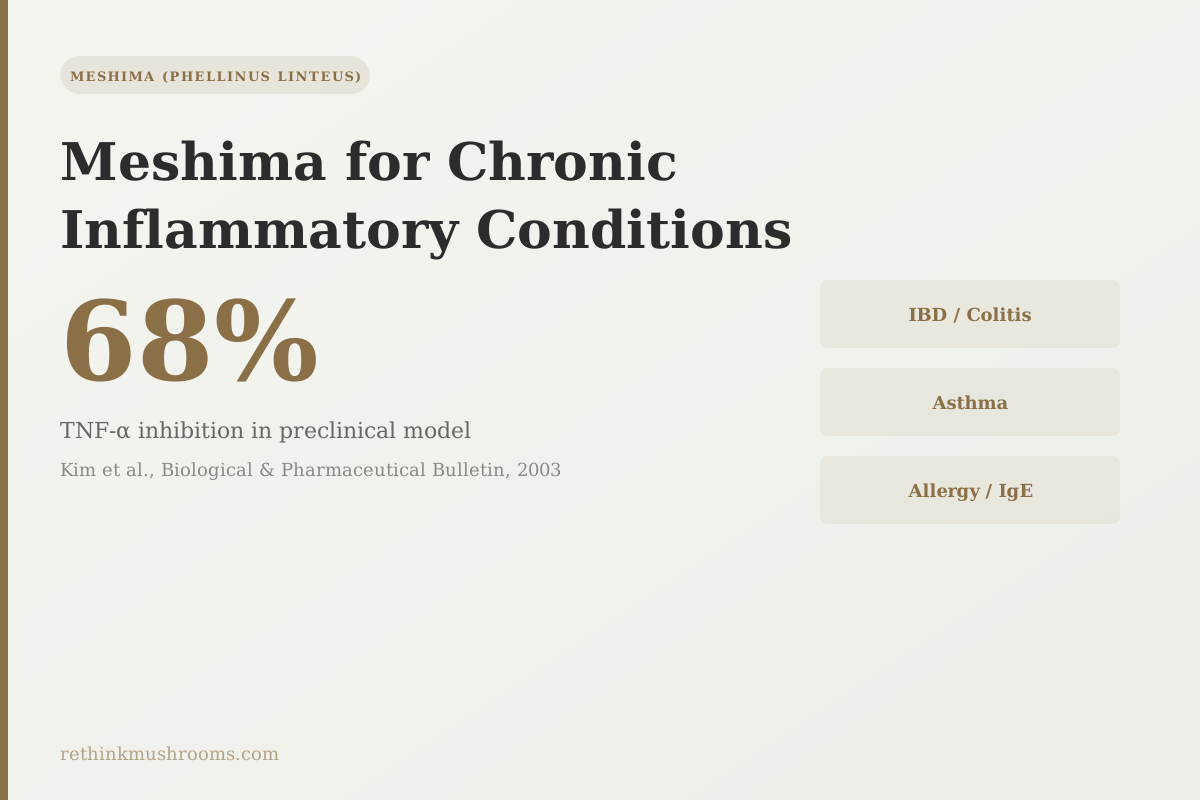
68% TNF-α inhibition in preclinical model
In a preclinical septic shock model, Phellinus linteus acidic polysaccharide pre-treatment cut circulating TNF-α by 68%, IL-12 by 45%, and IL-1β by 23%, with significant improvement in survival outcomes.
Kim et al., Biological & Pharmaceutical Bulletin, 2003
3 conditions
IBD/colitis, asthma, and allergy studied in preclinical models
2 RCTs
only confirmed human immune evidence, both from 2022
2024
most recent colitis study: PLAP reduces TNF-α, IL-6, IL-1β in mouse model
Kim et al., Biological & Pharmaceutical Bulletin, 2003
 View as image ↗
Three chronic inflammatory conditions have now been studied in preclinical models using meshima (Phellinus linteus): inflammatory bowel disease, asthma, and allergy. The most recent study appeared in 2024, when Hu and colleagues treated DSS-induced colitis mice with an acidic polysaccharide fraction from Phellinus linteus and observed reductions in TNF-α, IL-6, and IL-1β alongside increased IL-10, the anti-inflammatory cytokine that signals immune cells to stand down.[1] The research on meshima chronic inflammation is considerably more specific than the generic "anti-inflammatory" label on most supplement product pages suggests.
For the background on what meshima is and its history in Korean and East Asian traditional medicine, the guide to meshima mushroom covers the full context. This article focuses specifically on what preclinical and clinical research has found for three distinct inflammatory disease categories.
Key Takeaways
- A 2024 study found that Phellinus linteus acidic polysaccharide (PLAP) reduced colon histopathological damage and lowered TNF-α, IL-6, and IL-1β while increasing IL-10 in DSS-induced colitis mice (Hu et al., 2024)
- Phellinus linteus grown on germinated brown rice produced greater anti-inflammatory potency in a colitis model compared to standard cultivation, demonstrating that the growth substrate changes the biological activity of the final preparation (Song et al., 2014)
- Oral Phellinus linteus extract reduced eosinophilic airway inflammation and suppressed IL-4, IL-5, and IL-13 in an OVA-induced asthma mouse model by downregulating NF-kB and p38 MAPK signaling (Yan et al., 2014)
- A Phellinus preparation grown on germinated brown rice suppressed IgE production in mesenteric lymph node lymphocytes by shifting Th1/Th2 balance toward Th1, suggesting anti-allergy effects through immune rebalancing (Lim et al., 2005)
- Two CONSORT randomized double-blind trials from 2022 confirmed improved immune markers vs. placebo in human participants, the only confirmed human trial data for Phellinus linteus; neither trial tested IBD, asthma, or allergy specifically
- All IBD, asthma, and allergy data come from mouse models; the human trials tested general immune function, and the translation to specific chronic conditions in humans is not yet confirmed
The 2024 Colitis Data: Phellinus linteus Acidic Polysaccharide in a Mouse Model
Hu and colleagues' 2024 study in the International Journal of Biological Macromolecules used a specific fraction of Phellinus linteus called PLAP (Phellinus linteus acidic polysaccharide).[1] The researchers induced ulcerative colitis in mice using DSS, a chemical that disrupts the intestinal barrier and triggers the kind of immune dysregulation that resembles human UC.
PLAP treatment produced measurable tissue-level improvement: colon histopathological damage was reduced, meaning the visible destruction that DSS causes to colon tissue was less severe in treated mice. The cytokine changes were in the anti-inflammatory direction: TNF-α, IL-6, and IL-1β all fell, while IL-10 increased. IL-10 is the cytokine that tells the immune system to reduce its inflammatory output.
This is the most recent Phellinus linteus IBD data published and is not yet covered in any competitor mushroom content. No dose-response data translating directly to supplementation are reported, and the DSS mouse model is an approximation of human UC pathology rather than a direct equivalent. But the 2024 study establishes that the acidic polysaccharide fraction specifically, not just crude extracts, can shift the cytokine environment in an inflamed colon. The oxidative stress dimension of colitis protection, which operates through different compound pathways in Phellinus, is covered in the meshima and oxidative stress article.
Earlier Colitis Research: How the Growth Substrate Changes Anti-Inflammatory Potency
Song and colleagues published a 2014 colitis study that introduced a variable most researchers had not examined: the substrate on which Phellinus linteus grows.[2]
Standard Phellinus linteus cultivation typically uses hardwood or rice-based substrates. Song's team grew the mushroom on germinated brown rice, then tested both the DSS colitis model in mice and LPS-activated macrophages in the lab. The germinated brown rice preparation produced greater anti-inflammatory effects than standard mycelium preparations, reducing colitis severity and suppressing inflammatory markers more substantially.
The reason is likely compositional. Germination changes the phenolic and polysaccharide content available to the growing mycelium. The mushroom incorporates substrate-derived compounds and alters its metabolite profile depending on what it grows on. Two products labeled "Phellinus linteus extract" produced from different substrates may behave differently in inflammatory models.
This substrate-dependency is underappreciated in mushroom supplement discussions but has real implications for interpreting study results. A study using standard mycelium preparation and a study using germinated brown rice mycelium may produce different effect sizes for reasons entirely related to production methodology rather than the mushroom's inherent properties. The bioactive compounds article on Phellinus linteus covers how the specific polysaccharide and phenolic compounds account for these differences.
Asthma Research: Phellinus linteus Reduces Airway Inflammation in Animal Studies
The OVA (ovalbumin) mouse model of asthma sensitizes mice to a harmless protein and then re-exposes them, producing IgE-mediated airway inflammation that resembles the eosinophilic airway inflammation in human asthma, the specific immune cell infiltration pattern that narrows airways and drives asthmatic symptoms.
Yan and colleagues tested oral Phellinus linteus extract in this model in 2014.[3] The extract significantly inhibited eosinophilic airway inflammation. The mechanism ran through NF-kB and p38 MAPK, two of the major inflammatory signaling pathways that activate the Th2 cytokines characteristic of asthma. By downregulating both pathways, the extract reduced IL-4, IL-5, and IL-13 (the Th2 cytokines that recruit and activate eosinophils), along with eotaxin (a chemokine that specifically calls eosinophils to the airways) and the cell adhesion molecules that allow immune cells to migrate into inflamed tissue.
The NF-kB suppression mechanism here is one of three distinct compound-specific pathways documented in Phellinus linteus, involving separate compounds acting through different upstream signals. The meshima and NF-kB pathway research article maps all three mechanisms. For the hispolon-specific iNOS inhibition pathway that also contributes to anti-inflammatory activity, see the meshima hispolon article.
The asthma finding is mechanistically coherent with the allergy data discussed below: both asthma and allergy are Th2-dominant conditions, and Phellinus linteus consistently reduces Th2 cytokines in these animal models.
Allergy and IgE: How Phellinus Shifts Immune Balance Away from Hypersensitivity
IgE is the antibody class that drives allergic reactions. When the immune system produces IgE against a harmless substance, subsequent exposures trigger mast cells and basophils to release histamine and other inflammatory mediators. IgE overproduction is a defining feature of Th2-dominant immune phenotypes.
Lim and colleagues published a 2005 study examining whether Phellinus linteus grown on germinated brown rice could suppress IgE production in mesenteric lymph node lymphocytes.[4] Mesenteric lymph nodes are part of the gut-associated immune tissue that monitors the intestinal contents. The Phellinus preparation increased Th1 cytokines and decreased Th2 cytokines in these lymphocytes, pulling the immune environment away from the Th2-dominant pattern that drives IgE overproduction. IgE levels fell as a consequence of this immune rebalancing.
The mechanism is different from direct antihistamine effects. Rather than blocking histamine receptors or preventing mast cell degranulation, the Phellinus preparation shifted the upstream immune environment that determines how much IgE is produced in the first place. This is a Th1/Th2 rebalancing approach to allergy, not a symptomatic one.
The meshima Th1/Th2 balance article covers the full breadth of Phellinus linteus immune-rebalancing research and places these allergy findings in the broader context of how Phellinus modulates immune polarization.
The Human Data: Two 2022 RCTs and What They Actually Tested
The most important framing for everything above is this: all IBD, asthma, and allergy data come from mouse models. There are no randomized human clinical trials of meshima in patients with any of these specific conditions.
What does exist, as of 2022, is two separate CONSORT randomized, double-blind, placebo-controlled trials from Ku and colleagues, both published in Medicine.[5][6] These are the only confirmed human trial data for Phellinus linteus immune effects.
Both trials showed improved immune function markers in Phellinus linteus participants compared to placebo. The specific parameters measured were general immunity markers. Neither trial measured IBD disease activity, asthma control, allergy symptom severity, or specific cytokine profiles in disease populations. Both trials operated at pilot scale, which means sample sizes were limited and results should be interpreted as preliminary.
The honest summary: two small RCTs confirm that Phellinus linteus extract produces measurable immune changes in humans that exceed what placebo produces. Whether those changes extend to benefit in chronic inflammatory conditions like IBD, asthma, or allergy is an open question. The animal model data provides the biological rationale. The human disease data does not yet exist.
Why Animal Models Matter for Meshima and Chronic Inflammation
Preclinical models of IBD, asthma, and allergy are not perfect approximations of human disease. Mouse immune systems differ from human immune systems in ways that matter for translating results. DSS-induced colitis is a chemical injury model; human IBD has an immunological and genetic complexity the model does not fully capture. OVA-induced asthma is driven by sensitization to a foreign protein; human asthma involves diverse triggers and airway remodeling the mouse model approximates but doesn't replicate.
Despite those limitations, preclinical models accomplish something important: they establish biological plausibility. When multiple separate Phellinus linteus preparations, tested in different models by different research groups, consistently reduce the same categories of pro-inflammatory markers, the finding is biologically robust at the preclinical level.
Shin and colleagues' 2021 study in BMC Complementary Medicine and Therapies confirmed this pattern extends to in vitro conditions as well.[7] Phellinus linteus mycelium elevated the IFN-γ/IL-4 ratio and reduced inflammatory markers in LPS-stimulated macrophages, consistent with the Th1 shift observed in oral administration animal studies. One finding in the Shin study added further nuance: mycelium-derived compounds produced anti-inflammatory effects distinct from those of fruiting body polysaccharides. This mirrors the substrate-dependency from Song 2014. The part of the mushroom used and the conditions under which it grows affect what compounds are present, which affects what biological effects follow.
The next research step is human disease-specific trials. The biological plausibility is established. Clinical confirmation is the stage this research has not yet reached for any of the three chronic conditions studied in animal models.
The Cytokine Thread That Connects All Three Conditions
IBD, asthma, and allergy are mechanistically distinct conditions with different tissue pathologies, different triggering factors, and different clinical presentations. But all three share a cytokine pattern: each involves Th2-dominant immune activation as a central driver.
In IBD, elevated IL-13 and IL-4 contribute to mucosal barrier disruption. In asthma, IL-4, IL-5, and IL-13 drive eosinophilic airway inflammation. In allergy, IL-4 and IL-13 direct B cells to produce IgE. All three converge on the same Th2 cytokine axis.
Phellinus linteus, across multiple animal models and routes of administration, consistently suppresses this axis. Kim and colleagues' 2003 septic shock study showed that acidic polysaccharide pre-treatment inhibited 68% of circulating TNF-α, 45% of IL-12, and 23% of IL-1β, documenting systemic cytokine suppression at the preclinical level.[8] Oh and colleagues' 2006 oral administration study in mice showed that Phellinus increased IFN-γ and IL-2 (Th1 markers) while decreasing IL-4 and IL-5 (Th2 markers) after oral consumption.[9]
The mechanistic coherence is what makes the multi-condition research pattern credible. It is not coincidental that Phellinus linteus shows activity across IBD, asthma, and allergy when all three conditions share a Th2-dominant cytokine architecture that Phellinus consistently modulates across separate studies.
The Phellinus linteus cytokine regulation article covers the specific cytokine data in greater detail, including the dose-dependent and fraction-specific effects. For comparison with how a structurally different compound achieves similar anti-inflammatory outcomes in chronic conditions through an antioxidant-based mechanism, the ergothioneine and chronic inflammatory conditions article offers an instructive cross-pillar comparison.
The Bottom Line
Meshima (Phellinus linteus) has preclinical evidence across three categories of chronic inflammatory conditions: IBD/colitis, asthma, and allergy. The 2024 Hu study established that the acidic polysaccharide fraction specifically reduces colitis markers in a mouse model. The asthma and allergy data show consistent Th2 suppression via NF-kB, p38 MAPK, and cytokine rebalancing. Two CONSORT human RCTs from 2022 confirm immune effects in people, but measured general immunity, not specific chronic conditions. All IBD, asthma, and allergy data remain at the animal model stage; clinical translation is biologically plausible but unconfirmed.
Frequently Asked Questions
Sources & References
- 1RTHM-01903·Hu, Jutuan et al. (2024). “Ameliorative effect of an acidic polysaccharide from Phellinus linteus on ulcerative colitis in a DSS-induced mouse model..” International journal of biological macromolecules.Study breakdown →PubMed →↩
- 2RTHM-00647·Song, Minjung et al. (2014). “Anti-inflammatory effect of Phellinus linteus grown on germinated brown rice on dextran sodium sulfate-induced acute colitis in mice and LPS-activated macrophages..” Journal of ethnopharmacology.Study breakdown →PubMed →↩
- 3RTHM-00660·Yan, Guang Hai et al. (2014). “Phellinus linteus Extract Exerts Anti-asthmatic Effects by Suppressing NF-κB and p38 MAPK Activity in an OVA-induced Mouse Model of Asthma..” Immune network.Study breakdown →PubMed →↩
- 4RTHM-00164·Lim, Beong Ou et al. (2005). “Phellinus linteus grown on germinated brown rice suppresses IgE production by the modulation of Th1/Th2 balance in murine mesenteric lymph node lymphocytes..” Biotechnology letters.Study breakdown →PubMed →↩
- 5RTHM-01555·Ku, Yong Ho et al. (2022). “Efficacy of Phellinus linteus extract on immunity enhancement: A CONSORT-randomized, double-blind, placebo-controlled pilot trial..” Medicine.Study breakdown →PubMed →↩
- 6RTHM-01556·Ku, Yong Ho et al. (2022). “Effects of Phellinus linteus extract on immunity improvement: A CONSORT-randomized, double-blinded, placebo-controlled trial..” Medicine.Study breakdown →PubMed →↩
- 7RTHM-01435·Shin, Mi-Rae et al. (2021). “Immunomodulatory and anti-inflammatory effects of Phellinus linteus mycelium..” BMC complementary medicine and therapies.Study breakdown →PubMed →↩
- 8RTHM-00111·Kim, Gi-Young et al. (2003). “Alleviation of experimental septic shock in mice by acidic polysaccharide isolated from the medicinal mushroom Phellinus linteus..” Biological & pharmaceutical bulletin.Study breakdown →PubMed →↩
- 9RTHM-00198·Oh, Gi-Su et al. (2006). “Effects of oral administration of Phellinus linteus on the production of Th1- and Th2-type cytokines in mice..” Immunopharmacology and immunotoxicology.Study breakdown →PubMed →↩