Meshima & Immune System
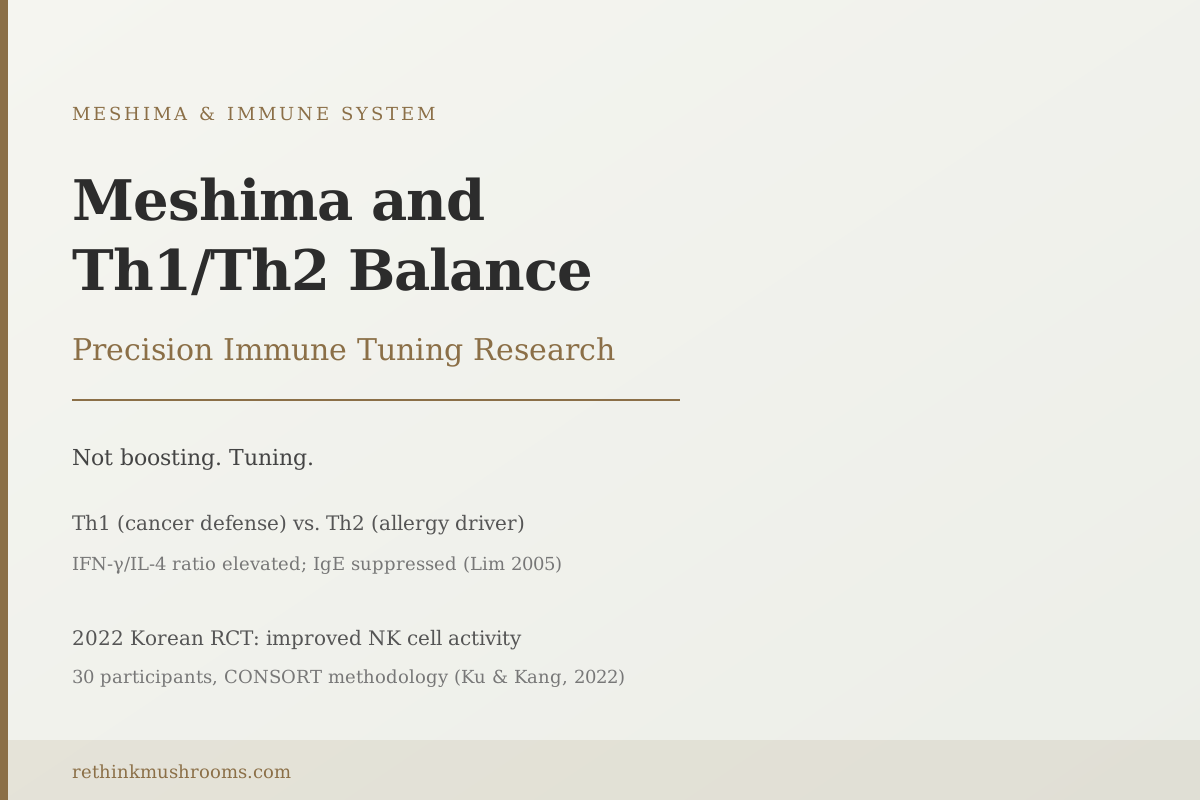
IFN-γ/IL-4 ratio elevated
Meshima mycelium significantly elevated the IFN-γ/IL-4 ratio in mice, the key index of Th1/Th2 balance, while simultaneously suppressing pro-inflammatory mediators in activated macrophages, showing bidirectional immune modulation from one preparation.
Shin et al., BMC Complement Med Ther, 2021
30 participants
in the 2022 Korean pilot RCT confirming improved NK cell activity (Ku & Kang, 2022)
IgE suppressed
Th2-linked allergy antibody reduced by PL grown on germinated brown rice (Lim 2005)
2 directions
meshima both promotes Th1 responses and quiets excessive Th2/inflammatory activation
Shin et al., BMC Complement Med Ther, 2021
 View as image ↗
Most articles about mushrooms and immunity use one word: "boost." It implies the immune system is uniformly underperforming and that more is always better. That framing misrepresents what the research actually shows.
Meshima (Phellinus linteus) does not simply amplify immune activity. Laboratory and animal studies show it shifts the ratio between two types of immune responses (Th1 and Th2) toward the Th1 side while also suppressing specific inflammatory signals that drive overactivation. A 2021 study measuring the IFN-γ/IL-4 ratio, the standard Th1/Th2 index, showed meshima mycelium elevated it in mice while simultaneously reducing pro-inflammatory mediators in macrophages.[1]
That is not boosting. That is tuning.
This article explains what Th1/Th2 balance means, why shifting it toward Th1 matters for allergies and cancer defense, how meshima achieves that shift through dendritic cells and T cells, and what the 2024 research adds about dose-dependent complexity that no consumer article addresses. For a broader look at meshima's immune effects, see what is meshima mushroom and meshima and the immune system: immunomodulatory research.
Key Takeaways
- Th1 immunity fights intracellular pathogens and cancer cells via IFN-γ and IL-12; Th2 immunity manages allergic responses and parasites via IL-4 and IgE. An imbalance toward Th2 drives allergic disease; Th1 dominance supports better cancer immune surveillance
- Shin et al. (2021) found meshima mycelium elevated the IFN-γ/IL-4 ratio (Th1/Th2 index) while suppressing NO and PGE2 in LPS-activated macrophages, resolving the apparent contradiction between "immune activating" and "anti-inflammatory"
- Lim et al. (2005) demonstrated PL grown on germinated brown rice suppressed IgE production in lymph node lymphocytes by shifting them toward Th1 dominance; the most direct allergy-relevant finding
- Kim et al. (2004) established the mechanism: PL proteoglycan activates CD11c+CD8+ dendritic cells via TLR2/4, which secrete IL-12 and prime T cells toward a Th1-dominant antitumor immune state
- A 2022 Korean pilot RCT (Ku & Kang) found PL extract significantly improved NK cell activity in 30 participants over 8 weeks, the first CONSORT-methodology human trial confirming a measurable immune effect
- Chen et al. (2024) found that in hepatocellular carcinoma context, PL activated regulatory T cells (Tregs) and M2 macrophages via FAK, a finding that complicates the simple "meshima boosts anti-cancer Th1 immunity" narrative and warrants attention
The framing problem
Myth vs. evidence
The claim
“Meshima boosts your immune system.”
Supplement marketing borrows one word — boost — from the general wellness vocabulary, implying the immune system is uniformly underperforming and that more activity is always better.
What research shows
MisleadingIn laboratory and animal models, meshima does not raise immune activity uniformly. It shifts the ratio between two immune orientations (Th1 and Th2) toward Th1 while, on a separate axis, suppressing the excessive LPS/NF-κB inflammation that represents dysregulation rather than defense.
Shin et al. (2021) measured both effects from one preparation: the IFN-γ/IL-4 ratio (the Th1/Th2 index) rose while nitric oxide and PGE2 fell in activated macrophages. 'Boost' cannot describe a change that simultaneously raises one immune arm and quiets another. The accurate word is tuning — and a 2024 liver-cancer study shows even the direction of that tuning can be context-dependent.
Shin et al., BMC Complement Med Ther (2021); Chen et al. (2024). Preclinical models.
What Th1 and Th2 Mean: The Balance That Shapes Your Immune Response
The immune system doesn't have one response mode. It has two major orientations that handle different threats, and a healthy immune system switches between them depending on what it encounters.
Th1 cells (type 1 helper T cells) are optimized for fighting intracellular threats: viruses, bacteria that hide inside cells, and abnormal cells like cancer. Their key cytokines are interferon-gamma (IFN-γ) and interleukin-12 (IL-12). IFN-γ activates macrophages and natural killer cells to destroy infected or cancerous cells. IL-12 amplifies this response and drives naive T cells to become more Th1-oriented.
Th2 cells (type 2 helper T cells) are optimized for a different set of threats: parasites and certain extracellular pathogens. Their key cytokines are IL-4, IL-5, and IL-13, and they drive B cells to produce IgE antibodies. IgE is the antibody class responsible for allergic reactions. When Th2 responses fire against harmless environmental triggers (pollen, pet dander, certain foods), the result is allergy.
When one orientation dominates inappropriately, problems follow:
- Th2 dominance: allergic disease, asthma, atopic dermatitis, reduced anti-viral and anti-tumor surveillance
- Th1 dominance: certain autoimmune conditions where the Th1 arm attacks the body's own tissues
The ratio between Th1 and Th2 activity is often measured by the IFN-γ/IL-4 ratio: IFN-γ is the primary Th1 cytokine, IL-4 is the primary Th2 cytokine. When this ratio rises, the immune system is leaning Th1. When it falls, Th2 responses are dominating.
Meshima (Phellinus linteus) polysaccharides and proteoglycans appear to push this ratio toward Th1 by activating the dendritic cells and signaling pathways that favor Th1 priming.
The Allergy Connection: How Meshima Suppresses Th2-Driven IgE
IgE is the antibody class that drives allergic reactions. When Th2 cells are overactive, they signal B cells to produce more IgE, which binds to mast cells. When those IgE-coated mast cells encounter an allergen, they release histamine and other inflammatory mediators: the allergic response.
Suppressing IgE production means shifting away from Th2 dominance.
Lim and colleagues tested this directly in 2005, using Phellinus linteus grown on germinated brown rice, a cultivated form used in Korean functional food and supplement products.[2] They measured the effect on mesenteric lymph node lymphocytes, immune cells from the gut-adjacent lymph tissue that are well-positioned to be affected by orally administered compounds.
The result: PL treatment suppressed IgE production by shifting lymphocytes toward a Th1-dominant response pattern. Across the extract forms tested, IgE concentrations dropped by roughly 43 to 65 percent relative to controls in both serum and lymph node lymphocytes.[2] The Th2 signaling that drives IgE synthesis was reduced.
This study used animal lymphocytes, not human allergy patients. IgE suppression in a cell model is not the same as reducing allergy symptoms in a clinical trial. What the finding does establish: the Th1-shifting effect has a direct mechanistic consequence for IgE and, by extension, for the Th2-driven allergic cascade. Whether that translates into reduced allergy symptoms in humans has not been tested.
The broader immune context for these findings is covered in meshima polysaccharides and dendritic cell activation, which explains how oral PL compounds reach and activate immune cells throughout the gut-associated lymphoid system.
How Meshima Drives the Th1 Shift Through Dendritic Cells
The Th1/Th2 balance is not set by T cells alone. It is largely determined by the dendritic cells (DCs) that present antigens to naive T cells. When a DC secretes large amounts of IL-12 during antigen presentation, the naive T cell it's teaching tends to become a Th1 cell. When a DC secretes low IL-12 (or high IL-10/IL-13), the naive T cell tends toward Th2.
Meshima polysaccharides and proteoglycans activate dendritic cells via TLR2 and TLR4, the pattern-recognition receptors that DCs use to detect pathogen-associated molecular patterns. The downstream cascade runs through ERK, p38, and NF-κB, and the result is DC maturation: increased surface expression of MHC II, CD80, CD86 (the molecules DCs use to present antigens and deliver co-stimulatory signals), and increased IL-12 secretion.
Kim and colleagues demonstrated the downstream consequence in a 2004 animal study: PL proteoglycan activated CD11c+CD8+ dendritic cells and drove the immune system toward a Th1-dominant state with elevated IL-12 and IFN-γ.[3] In the same experiment, tumor growth was inhibited, providing direct in vivo evidence that the DC-to-Th1 pathway has anti-tumor consequences, not just an immunological profile change on paper.
Lin and colleagues confirmed the T cell-level result in 2016, demonstrating that Phellinus linteus directly modulates T cell responses and shifts the Th1/Th2 ratio.[4] Suabjakyong and colleagues (2015) added cytokine-level detail, showing PL polysaccharides modulate the IL-6/IL-10 balance in macrophages, a cytokine pair that shapes the inflammatory environment in which T cell polarization decisions are made.[5]
The mechanistic chain from polysaccharide to Th1 dominance runs: TLR2/4 binding → DC maturation → IL-12 secretion → naive T cells prime toward Th1 → elevated IFN-γ → macrophage and NK cell activation → anti-tumor and anti-viral surveillance.
Tuning, Not Boosting
Two Dials Meshima Turns at Once
“Boost” implies one volume knob turned up. The research describes something more specific: meshima tips the balance between two immune orientations toward Th1 (the arm that handles viruses and cancer) while, on a separate axis, turning down the kind of runaway inflammation that signals immune dysregulation. Reading the two dials together shows why the same extract can look both “immune-activating” and “anti-inflammatory.”
Tips the Th1/Th2 scale toward Th1
Meshima polysaccharides and proteoglycan activate dendritic cells, which secrete IL-12 and prime naive T cells toward Th1. The Th1/Th2 index — the IFN-gamma/IL-4 ratio — rises. On the Th2 side, the same shift suppresses IgE, the antibody class behind allergic reactions, by 43-65% in lymph-node lymphocytes.
Shin 2021 [1] (IFN-gamma/IL-4 ratio up) · Kim 2004 [3] (DC to IL-12 to Th1) · Lim 2005 [2] (IgE down 43-65%) — mouse and in vitro
Turns down runaway LPS/NF-kB inflammation
A targeted Th1 response is not the same as chronic inflammation. Independently of the balance shift, meshima blocks NF-kB activation in LPS-stimulated macrophages, lowering nitric oxide (NO) and prostaglandin E2 (PGE2). That is why one preparation can raise Th1 immunity and quiet excessive inflammation at the same time.
Shin 2021 [1] (NO, PGE2 down) · Kim 2007 [6] (NF-kB, MAPK) · Xie 2019 [7] (NF-kB nuclear translocation) — in vitro
The IFN-gamma/IL-4, IgE, IL-12 and NF-kB results shown are established in mouse and cell-culture models. The one human datapoint for this immune state — improved NK-cell activity — comes from a 30-person pilot trial (Ku & Kang 2022 [8]). This map explains a documented laboratory mechanism; it is not evidence that meshima treats allergy, cancer, or any condition in people. A 2024 liver-cancer study (Chen [9]) shows the direction of these effects can be context-dependent.
Mechanism synthesis; axes from refs [1][2][3][6][7][8] (see references)
The Anti-Inflammatory Paradox: Th1-Promoting That Also Quiets Inflammation
A question this research raises immediately: if meshima promotes Th1 immune responses, and Th1 immunity is associated with inflammation (macrophage activation, cytokine production), why do multiple studies show meshima suppressing inflammatory markers in activated macrophages?
The answer is that Th1 immunity and excessive inflammation are not the same thing.
Adaptive Th1 responses are appropriate and targeted: IFN-γ activates macrophages to destroy specific threats, then the response resolves. The kind of inflammation that meshima appears to suppress is driven by LPS (lipopolysaccharide) stimulation of macrophages through NF-κB activation, which produces excessive NO, prostaglandin E2 (PGE2), and a cascade of pro-inflammatory cytokines. This is the kind of unresolved, chronic inflammation associated with disease rather than productive immune defense.
Kim and colleagues (2007) showed that PL suppresses NF-κB and MAPK activation in LPS-stimulated macrophages, reducing inflammatory mediators.[6] Xie and colleagues (2019) confirmed that PL polysaccharides block NF-κB nuclear translocation in LPS-activated macrophages, reducing NO, PGE2, and pro-inflammatory cytokines.[7]
Shin et al. (2021) showed both effects from the same preparation: elevated IFN-γ/IL-4 ratio (Th1 promoting) AND reduced NO and PGE2 in LPS-stimulated macrophages (anti-inflammatory).[1] This resolves the apparent paradox: meshima supports targeted Th1 immune activity while dampening the kind of excessive, LPS-driven inflammatory activation that represents immune dysregulation rather than appropriate defense.
For the NF-κB pathway in detail, see meshima and inflammation: NF-κB pathway research. For the molecular compounds driving these effects, see Phellinus linteus bioactive compounds: polysaccharides and phenols.
Human Evidence: The 2022 Korean RCT on Immune Parameters
Most of the Th1/Th2 balance data for meshima comes from cell culture and animal studies. That makes the 2022 Korean randomized controlled trial notable.
Ku and Kang enrolled 30 participants in a CONSORT-registered, double-blind, placebo-controlled pilot trial of PL extract at doses of 1000 mg and 2000 mg per day for 8 weeks.[8] The primary outcome was NK cell activity, measured at an effector-to-target cell ratio of 12.5:1. PL extract significantly improved NK cell activity compared to placebo.
Ku & Kang (2022) · Journal (Korean pilot RCT)
- Population
- 30 adults, randomized, double-blind, placebo-controlled (CONSORT-registered pilot)
- Intervention
- PL extract at 1000 mg or 2000 mg per day for 8 weeks
- Comparator
- Placebo
- Finding
- Natural killer (NK) cell activity, measured at a 12.5:1 effector-to-target ratio, improved significantly versus placebo. NK cells sit at the innate/adaptive interface and are activated by the same Th1 cytokines (IFN-γ, IL-12) that the animal and cell studies describe, so this is indirect human support for the Th1-favoring immune state.
preliminary A 30-person pilot with a single immune readout is proof of concept, not proof of efficacy. It shows the preclinical immune-activating effect is detectable in people at a reasonable dose — it does not establish a clinical benefit for allergy, cancer, or infection.
Ku & Kang (2022), Korean pilot RCT.
NK cells are part of the innate immune system, not the adaptive Th1/Th2 system, but they sit at the interface: Th1 cytokines (especially IFN-γ and IL-12) potently activate NK cells, and NK cells in turn produce IFN-γ, reinforcing the Th1 environment. Improved NK cell activity in a human trial is indirect evidence of the same Th1-supporting immune state that the animal and cell studies characterize more directly.
The trial was a pilot: 30 participants is not large enough to establish efficacy definitively, and NK cell activity at a single effector-to-target ratio is one immune parameter among many. What it provides is proof of concept: the immune-activating effects observed in preclinical models are detectable in humans taking a reasonable dose for a defined period.
For the cancer treatment immune support context, including the Lee 2019 pancreatic cancer cohort data, see meshima for immune enhancement during cancer treatment.
The 2024 Complexity: When the Th1 Picture Gets More Nuanced
In 2024, Chen and colleagues published a study that adds a significant complexity to the meshima immune story.[9] In a hepatocellular carcinoma (liver cancer) model, they found that Phellinus linteus activated regulatory T cells (Tregs) via FAK (focal adhesion kinase) signaling and promoted M2 macrophage polarization.
Tregs are a specialized T cell subset that suppresses immune responses. They play an essential role in preventing autoimmunity by calming down overactive immune cells. In the context of cancer, however, tumors can exploit Tregs to shield themselves from immune attack: elevated tumor-infiltrating Tregs are associated with worse prognosis in many cancers. M2 macrophages are similarly context-dependent: they are anti-inflammatory and pro-repair in wound healing, but in tumors, M2-polarized macrophages can support cancer cell survival and suppress anti-tumor immune responses.
The Chen 2024 finding means: in hepatocellular carcinoma specifically, under the conditions tested, PL appeared to promote immune elements that could favor tumor immune evasion rather than tumor elimination.
This does not negate the earlier data. The 2004 Kim study showing Th1-dominant antitumor immunity, the Lim 2005 IgE suppression, the Shin 2021 IFN-γ/IL-4 elevation: those results are real and well-replicated in their specific models. What Chen 2024 shows is that PL's immune effects are context-dependent and dose-dependent. The same extract in a different cancer type, at a specific dose, through specific signaling (FAK), produced a different immune outcome.
This complexity is absent from every consumer article about meshima. It doesn't invalidate the research; it shows that the real biology is more nuanced than "PL boosts anti-cancer immunity."
A practical note from the existing safety literature: meshima is generally cautioned in people with autoimmune conditions where Th1 immunity is already overactive (lupus, multiple sclerosis, rheumatoid arthritis). Theoretically, further Th1 promotion in these conditions could be counterproductive. No clinical trial data in these populations exists to confirm or refute the concern.
Before you act on this
ModerateA Th1-shifting effect is not automatically a good thing for everyone
Concern
The same mechanism that makes meshima interesting — pushing immunity toward Th1 — is a theoretical concern in autoimmune conditions where Th1 activity is already excessive (lupus, multiple sclerosis, rheumatoid arthritis). And the 2024 hepatocellular carcinoma finding shows the direction of meshima's immune effects can flip in specific contexts. None of this has been tested in patients.
What the research says
Treat the Th1/Th2 research as mechanism, not a personalized recommendation. If you have an autoimmune condition, are on immune-modulating medication, or are in cancer treatment, the decision to use meshima belongs with your physician — the immune effects can plausibly interact with your condition or drugs.
Particularly relevant for: People with autoimmune disease, those on immunosuppressants or immunotherapy, and anyone in active cancer treatment
What to do
Talk to your clinician before starting meshima if any of the above applies to you. Do not use it to self-treat allergy, cancer, or an autoimmune condition.
This is general educational information, not medical advice.
For the bridge between innate and adaptive immunity that contextualizes all of these findings, see how meshima bridges innate and adaptive immunity.
The Bottom Line
Meshima (Phellinus linteus) shifts the Th1/Th2 immune balance toward Th1 by activating dendritic cells via TLR2/4 to secrete IL-12, priming T cells toward Th1 responses and elevating the IFN-γ/IL-4 ratio. Simultaneously, it suppresses the LPS-driven NF-κB inflammatory pathway, explaining why it both promotes targeted Th1 immunity and calms excessive inflammation. A 2022 pilot RCT confirmed improved NK cell activity in humans. A 2024 study in hepatocellular carcinoma found context-dependent Treg and M2 macrophage promotion via FAK, adding important nuance: meshima's immune effects are not uniformly Th1-promoting across all conditions and doses.
Frequently Asked Questions
Sources & References
- 1RTHM-01435·Shin, Mi-Rae et al. (2021). “Immunomodulatory and anti-inflammatory effects of Phellinus linteus mycelium..” BMC complementary medicine and therapies.Study breakdown →PubMed →↩
- 2RTHM-00164·Lim, Beong Ou et al. (2005). “Phellinus linteus grown on germinated brown rice suppresses IgE production by the modulation of Th1/Th2 balance in murine mesenteric lymph node lymphocytes..” Biotechnology letters.Study breakdown →PubMed →↩
- 3RTHM-00137·Kim, Gi-Young et al. (2004). “Proteoglycan isolated from Phellinus linteus inhibits tumor growth through mechanisms leading to an activation of CD11c+CD8+ DC and type I helper T cell-dominant immune state..” FEBS letters.Study breakdown →PubMed →↩
- 4RTHM-00434·Lin, Chun-Jung et al. (2016). “Modulation of T cell response by Phellinus linteus..” Journal of bioscience and bioengineering.Study breakdown →PubMed →↩
- 5RTHM-00402·Suabjakyong, Papawee et al. (2015). “Structural characterization and immunomodulatory effects of polysaccharides from Phellinus linteus and Phellinus igniarius on the IL-6/IL-10 cytokine balance of the mouse macrophage cell lines (RAW 264.7)..” Food & function.Study breakdown →PubMed →↩
- 6RTHM-00116·Kim, Ho Gyoung et al. (2007). “Phellinus linteus inhibits inflammatory mediators by suppressing redox-based NF-kappaB and MAPKs activation in lipopolysaccharide-induced RAW 264.7 macrophage..” Journal of ethnopharmacology.Study breakdown →PubMed →↩
- 7RTHM-00599·Xie, Zhenglu et al. (2019). “Anti-inflammatory activity of polysaccharides from Phellinus linteus by regulating the NF-κB translocation in LPS-stimulated RAW264.7 macrophages..” International journal of biological macromolecules.Study breakdown →PubMed →↩
- 8RTHM-01555·Ku, Yong Ho et al. (2022). “Efficacy of Phellinus linteus extract on immunity enhancement: A CONSORT-randomized, double-blind, placebo-controlled pilot trial..” Medicine.Study breakdown →PubMed →↩
- 9RTHM-01867·Chen, Feihua et al. (2024). “Phellinus linteus activates Treg cells via FAK to promote M2 macrophage polarization in hepatocellular carcinoma..” Cancer immunology.Study breakdown →PubMed →↩