Meshima & Immune System
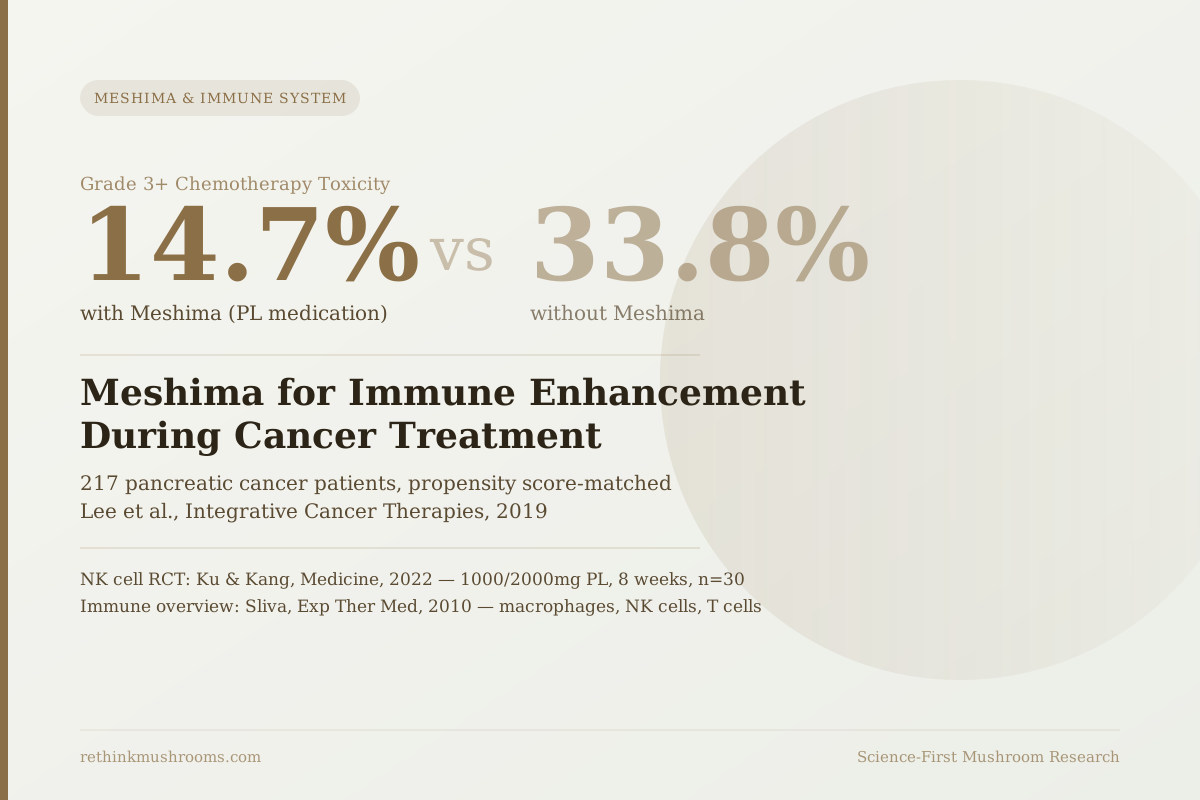
33.8% → 14.7%
In a 217-patient study of pancreatic cancer patients who underwent surgery followed by chemotherapy, those taking Meshima (Phellinus linteus) experienced grade 3+ chemotherapy toxicity at a rate of 14.7% vs 33.8% in those who did not. Chemotherapy completion without dose reduction rose from 63.2% to 83.8%.
Lee et al., Integrative Cancer Therapies, 2019
217
cancer patients in the Lee 2019 propensity score analysis
30
participants in the 2022 Korean NK cell RCT (Ku & Kang)
1996
year of the foundational Phellinus linteus immunity study
Lee et al., Integrative Cancer Therapies, 2019
 View as image ↗
In 2019, Korean researchers published a study that most people outside oncology circles have never heard of. They followed 217 patients who had undergone surgery for pancreatic ductal adenocarcinoma, one of the most aggressive cancers and one where adjuvant chemotherapy is both essential and severely toxic. Patients who had been taking Meshima mushroom medication completed adjuvant chemotherapy without dose reduction at a rate of 83.8%, compared to 63.2% in those who had not. Grade 3 or higher chemotherapy toxicity occurred in 14.7% of the Meshima group versus 33.8% in the control group.
This is the most concrete clinical signal on Meshima and immune support during cancer treatment in the published literature. It is also the finding most absent from consumer health content.
Meshima, the Japanese and Korean name for Phellinus linteus, is a bracket fungus with a long research history in East Asian oncology. It is not a household name in Western countries, but it has been studied in Korean and Japanese cancer research programs since the 1990s. For foundational context on what Meshima is and how its bioactive compounds work, see what is Meshima mushroom and why Korea studies it as an anti-cancer agent.
This article reviews the clinical and mechanistic evidence for Meshima immune support during cancer treatment: what the Lee 2019 data shows and what it cannot prove, what two Korean randomized trials found on NK cell function, what animal studies reveal about the immune mechanism, and a 2024 finding that adds important nuance to the picture.
Key Takeaways
- A 217-patient propensity score-matched analysis found that Meshima (PL) medication was the only significant predictor for completing adjuvant chemotherapy: grade 3+ toxicity fell from 33.8% to 14.7%, and completion without dose reduction rose from 63.2% to 83.8% (Lee et al., Integr Cancer Ther, 2019)
- A 2022 CONSORT-registered randomized controlled trial found PL extract at 1,000 or 2,000 mg per day for 8 weeks significantly improved NK cell activity at a 12.5:1 effector-to-target ratio vs. placebo in healthy participants (Ku & Kang, Medicine, 2022)
- A second 2022 double-blind RCT confirmed PL extract improves immune parameters in humans, providing replication for the NK cell finding (Ku et al., Medicine, 2022)
- Animal studies show oral PL mycelial culture significantly increases T cell counts, IL-12, IFN-gamma, TNF-alpha secretion, NK cell activity, and phagocytic function in tumor-bearing mice (Huang et al., 2011)
- A 2024 study in hepatocellular carcinoma found that PL may activate regulatory T cells via the FAK pathway and promote M2 macrophage polarization, a finding that adds important complexity to the picture and shows PL's effects depend on tumor type and dose
- The Lee 2019 finding is from a retrospective cohort analysis, not a randomized trial; the NK cell RCTs were in healthy participants, not cancer patients; caution is warranted in interpreting the clinical significance
The 2019 Clinical Data: Toxicity Halved in Pancreatic Cancer Patients Taking Meshima
The most striking clinical finding on Meshima and cancer treatment comes from Lee and colleagues, published in Integrative Cancer Therapies in 2019.[1]
The study enrolled 217 patients who had undergone curative resection for pancreatic ductal adenocarcinoma and were subsequently treated with adjuvant chemotherapy. The researchers used propensity score matching to compare outcomes between patients who took PL medication alongside their treatment and those who did not. The comparison is important: propensity score matching attempts to control for the differences between groups that would otherwise confound a retrospective analysis (sicker patients, for instance, might be less likely to take supplements and also less likely to complete chemotherapy).
The results were striking across multiple endpoints:
| Outcome | With Meshima (PL) | Without Meshima |
|---|---|---|
| Grade 3+ chemotherapy toxicity | 14.7% | 33.8% |
| Chemo completion without dose reduction | 83.8% | 63.2% |
| Disease-free survival | Significantly higher | Reference |
| Overall survival | Significantly higher | Reference |
PL medication was the only factor in the multivariate analysis that independently predicted chemotherapy completion. Not cancer stage, not patient age, not baseline immune status: only PL medication status.
The mechanistic hypothesis the authors propose: Meshima's immune-activating compounds help maintain white blood cell function during chemotherapy, reducing the degree of chemotherapy-induced immunosuppression that drives both toxicity and treatment interruptions.
This is a propensity score-matched retrospective cohort analysis, not a randomized controlled trial. Patients who chose to take PL may differ from those who did not in ways the propensity score cannot fully account for: health literacy, overall wellness habits, access to integrative care, and attitude toward treatment adherence. These unmeasured factors could contribute to the outcome difference. The finding is compelling, but it is hypothesis-generating rather than definitive.
NK Cell Activity in Humans: What Two Korean Randomized Trials Found
Parallel to the 2019 clinical finding, two 2022 Korean randomized controlled trials tested PL extract directly on immune function in human participants.
Ku and Kang published a CONSORT-registered, randomized, double-blind, placebo-controlled pilot trial in Medicine in 2022.[2] Thirty participants received either PL extract at 1,000 mg per day, 2,000 mg per day, or placebo for 8 weeks. NK cell activity at a 12.5:1 effector-to-target ratio was significantly higher in both PL groups compared to placebo at the end of the trial period.
NK cells (natural killer cells) are front-line immune cells that detect and destroy abnormal cells, including cancer cells, without needing to recognize a specific target antigen first. Chemotherapy typically suppresses NK cell activity as part of its broad bone marrow toxicity. Maintaining or restoring NK cell function during cancer treatment is clinically meaningful: NK cells patrol for cancer cells that evade treatment and are one of the immune system's primary tools for clearing residual disease.
A second, full double-blind RCT by Ku and colleagues published the same year provided replication, confirming that PL extract improves immune parameters in human subjects.[3]
The limitation is the same in both trials: participants were healthy adults, not cancer patients on active chemotherapy. Whether the NK cell improvement seen in healthy participants translates to cancer patients whose immune systems are under substantially greater stress from both the disease and its treatment is an open question. The trials establish that PL activates NK cells in humans. They do not establish that this effect occurs or persists in the specific context of cancer treatment.
What Animal Studies Show: Oral Meshima and Tumor Immunity
The mechanistic basis for Meshima's immune effects during cancer treatment is best established in animal studies, where researchers can directly measure immune cell activity in tumor-bearing subjects receiving the mushroom orally.
Huang and colleagues' 2011 study in the Journal of Ethnopharmacology is the key reference here.[4] Hepatoma-bearing mice were given oral PL mycelial culture. Compared to untreated tumor-bearing controls, the PL group showed significant increases in:
- T cell counts and activity
- IL-12 secretion (the cytokine that drives Th1 immune responses)
- IFN-gamma secretion (the primary Th1 effector cytokine)
- TNF-alpha production
- NK cell activity
- Phagocytic function in macrophages
This is the full complement of anti-tumor immune activation, achieved via oral administration rather than injection. The finding is particularly relevant to clinical translation because supplement use is oral, and some researchers had questioned whether oral PL would reach systemic immune cells in meaningful amounts. This study suggests it does.
Fang and colleagues' 2020 study in Nutrients examined PL alongside two other mushroom extracts and found PL specifically activated innate immune pathways, contributing to reduced tumor burden in the animal model.[6] The innate immune cascade triggered by PL (macrophage activation, NK cell stimulation, cytokine release) is consistent across the mechanistic literature.
Sliva's 2010 comprehensive review in Experimental and Therapeutic Medicine synthesized the mechanistic research across macrophage activation, NK cell stimulation, T cell enhancement, and angiogenesis inhibition, positioning PL as a multi-target immune and antitumor agent with a coherent mechanism underlying each activity.[5]
For a deeper look at how Meshima's polysaccharides activate dendritic cells and drive the cascade from innate to adaptive immunity, see meshima and the immune system: what the immunomodulatory research shows. For the molecular chemistry behind these effects, see Phellinus linteus bioactive compounds: polysaccharides and phenols.
The 2024 Complication: Meshima's Effects Are Not Uniformly Anti-Tumor
The picture above suggests Meshima straightforwardly enhances immune function during cancer treatment. A 2024 study adds important complexity that honest reporting requires including.
Chen and colleagues published a study in Cancer Immunology, Immunotherapy in 2024 examining PL's effects specifically in the context of hepatocellular carcinoma (HCC, primary liver cancer).[7] The finding: PL activated regulatory T cells (Tregs, a category of immune cells that suppress immune responses) via a protein called focal adhesion kinase (FAK), and promoted M2 macrophage polarization.
This matters because it runs in the opposite direction from the picture the other studies paint. Regulatory T cells suppress immune responses, including the anti-tumor immune responses that NK cells and Th1 T cells provide. M2 macrophages promote tissue repair and anti-inflammation rather than tumor surveillance. In the hepatocellular carcinoma tumor microenvironment, both effects could potentially support tumor immune evasion rather than tumor elimination.
The study also showed these effects were dose-dependent: the Treg and M2 activation pathway was more prominent at specific doses or under specific tumor microenvironment conditions in HCC.
What does this mean for the broader picture? Several interpretations are possible. First, PL's immune effects may be highly context-dependent: the tumor type, the tumor microenvironment, the immune state of the patient, and the dose may all shape whether PL's immune activation tips toward anti-tumor or toward immune regulation. Second, in HCC specifically, PL may interact with the unique immune suppression that liver cancer creates differently than in pancreatic or other cancers. Third, the FAK-Treg pathway identified in 2024 may represent a dose-finding challenge: the same compound that activates NK cells at one dose may activate Tregs at another.
This is not a reason to dismiss the Lee 2019 and Ku 2022 data. It is a reason to hold the overall picture with appropriate nuance. Meshima's immune effects are not uniformly activating or uniformly beneficial across all cancer types and all doses. For a full exploration of the Th1/Th2 balance evidence and the nuances of when PL tips in each direction, see Meshima and Th1/Th2 balance: precision immune tuning research.
The Honest Evidence Assessment: Where the Data Is and Where It Isn't
Meshima has stronger clinical data for cancer immune support than most medicinal mushrooms, and weaker data than researchers in this field would need to make routine recommendations.
What is strong: The Lee 2019 finding is the best clinical evidence in this space for any mushroom compound specifically on chemotherapy tolerability. The outcome (grade 3+ toxicity halved, completion rate improved substantially) is clinically meaningful. Two randomized controlled trials confirm NK cell activation in humans. The mechanistic literature is extensive and coherent.
What is moderate: The Lee 2019 study is retrospective and observational; it cannot rule out confounding. The NK cell RCTs are in healthy participants. Animal mechanistic data is well-developed but cannot directly establish clinical benefit in cancer patients.
What is absent: No randomized controlled trial has enrolled cancer patients on active chemotherapy and compared PL versus placebo for immune outcomes, toxicity, or survival. This is the gap between the existing evidence and what clinicians would need to integrate Meshima into standard cancer care. In Japan and Korea, where PL has been used in cancer treatment programs for decades, the regulatory context reflects accumulated clinical experience rather than phase III trial data meeting Western approval thresholds.
For context on how Meshima's immune cluster connects to the broader bridge between innate and adaptive immunity, see how Meshima bridges innate and adaptive immunity and Meshima polysaccharides and dendritic cell activation.
Safety During Cancer Treatment: What the Evidence Shows
The safety profile of PL in the studies reviewed here appears favorable. No serious adverse events were reported in either of the 2022 Korean RCTs. The Lee 2019 clinical analysis found no safety signals in the PL group beyond those expected from chemotherapy itself.
Two considerations are relevant for cancer patients specifically.
Immunostimulant and immunosuppressant interactions: Meshima's mechanism is immune activation. Patients on immunosuppressant drugs (whether for organ transplant, autoimmune conditions, or immune-related treatment side effects) face a pharmacological conflict: an immunostimulant compound may work against the intended effect of immunosuppression. This is a mechanism-based concern, not a documented clinical problem at the doses used in the trials reviewed here, but it is relevant enough to warrant awareness and disclosure.
Tumor-type considerations: The 2024 Chen finding in hepatocellular carcinoma raises the question of whether PL's immune effects differ by tumor type. The strongest clinical data comes from pancreatic cancer (Lee 2019). Whether the same profile applies in liver cancer, breast cancer, or other tumor types is not yet established. The mechanistic complexity identified in HCC context means treating PL's effects as uniform across cancer types would be premature.
WebMD's ingredient page on Meshima notes a caution for autoimmune conditions (lupus, multiple sclerosis, rheumatoid arthritis), on the grounds that immune stimulation might worsen autoimmune disease. This is a precautionary note based on mechanism, not documented clinical events in the reviewed studies, but it is consistent with how immunostimulant compounds generally behave.
The Bottom Line
The strongest clinical signal for Meshima during cancer treatment is a 2019 propensity score-matched analysis of 217 pancreatic cancer patients, which found grade 3+ chemotherapy toxicity fell from 33.8% to 14.7% and treatment completion improved substantially in those taking PL medication. Two 2022 Korean randomized controlled trials confirm PL extract improves NK cell activity in humans. Animal studies show oral PL activates the full innate and adaptive immune cascade in tumor-bearing subjects. A 2024 finding in hepatocellular carcinoma shows PL's effects are context- and dose-dependent, with potential Treg and M2 macrophage activation in liver cancer, adding important nuance to the picture. The evidence is the strongest in this area for any medicinal mushroom compound, and insufficient for routine clinical recommendation without prospective randomized data in cancer patients.
Frequently Asked Questions
Sources & References
- 1RTHM-01082·Lee, Sung Hwan et al. (2019). “Potential Impact of Phellinus linteus on Adherence to Adjuvant Treatment After Curative Resection of Pancreatic Ductal Adenocarcinoma: Outcomes of a Propensity Score-Matched Analysis..” Integrative cancer therapies.Study breakdown →PubMed →↩
- 2RTHM-01555·Ku, Yong Ho et al. (2022). “Efficacy of Phellinus linteus extract on immunity enhancement: A CONSORT-randomized, double-blind, placebo-controlled pilot trial..” Medicine.Study breakdown →PubMed →↩
- 3RTHM-01556·Ku, Yong Ho et al. (2022). “Effects of Phellinus linteus extract on immunity improvement: A CONSORT-randomized, double-blinded, placebo-controlled trial..” Medicine.Study breakdown →PubMed →↩
- 4RTHM-00403·Huang, Hui-Yu et al. (2011). “Orally administered mycelial culture of Phellinus linteus exhibits antitumor effects in hepatoma cell-bearing mice..” Journal of ethnopharmacology.Study breakdown →PubMed →↩
- 5RTHM-00364·Sliva, Daniel (2010). “Medicinal mushroom Phellinus linteus as an alternative cancer therapy..” Experimental and therapeutic medicine.Study breakdown →PubMed →↩
- 6RTHM-01188·Fang, Jun et al. (2020). “Extracts of Phellinus linteus, Bamboo (Sasa senanensis) Leaf and Chaga Mushroom (Inonotus obliquus) Exhibit Antitumor Activity through Activating Innate Immunity..” Nutrients.Study breakdown →PubMed →↩
- 7RTHM-01867·Chen, Feihua et al. (2024). “Phellinus linteus activates Treg cells via FAK to promote M2 macrophage polarization in hepatocellular carcinoma..” Cancer immunology.Study breakdown →PubMed →↩