Ergothioneine & Inflammation
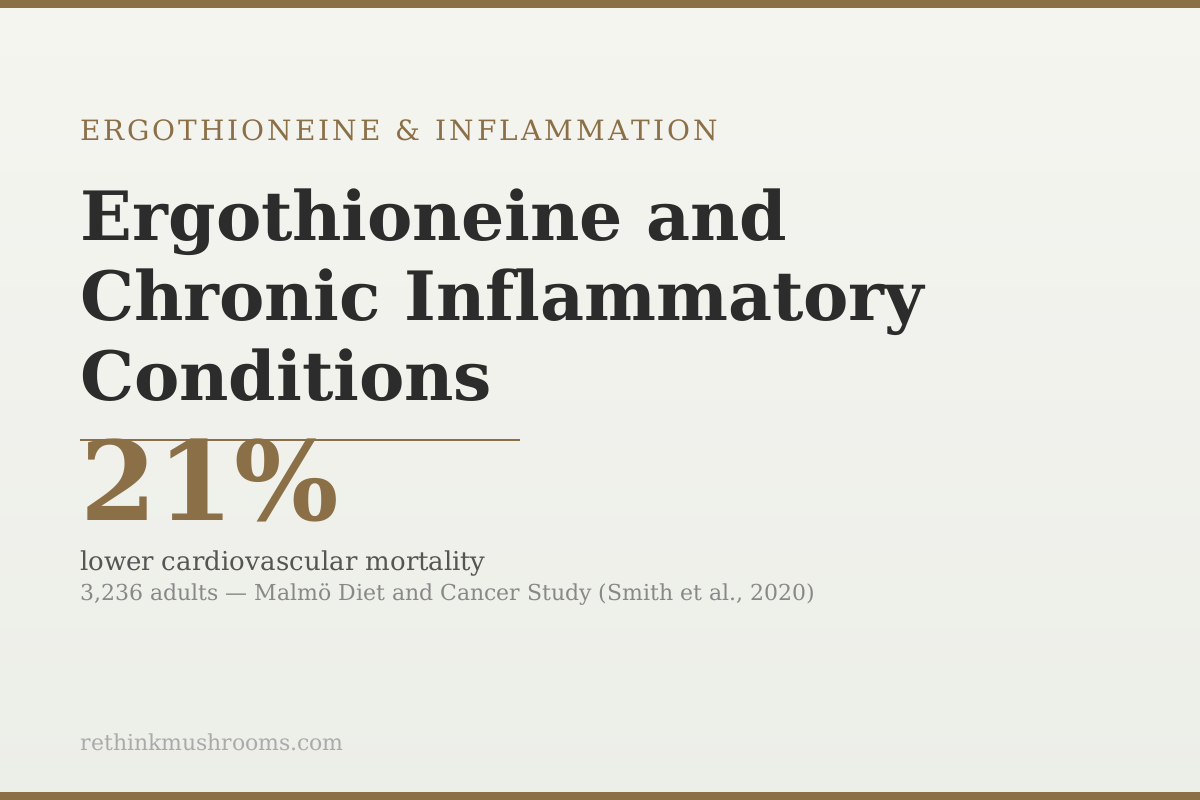
21% lower cardiovascular mortality
In 3,236 adults followed over a decade, higher plasma ergothioneine predicted 21% lower cardiovascular mortality. This is the strongest population-level evidence to date for a dietary compound concentrated in mushrooms.
Smith et al., Heart, 2020
15%
lower coronary disease risk (HR=0.85) in the same cohort
5 conditions
chronic diseases consistently linked to low ergothioneine
30 mg/day
recommended adult dose per 2025 comprehensive review
Smith et al., Heart, 2020
 View as image ↗
In 3,236 people followed for over a decade, those with the highest plasma ergothioneine levels were 21% less likely to die from cardiovascular disease and 14% less likely to die from any cause.[1] That is not the number you expect from a compound most people have never heard of. Ergothioneine is an amino acid humans cannot synthesize. It comes almost entirely from mushrooms and certain bacteria, accumulates in immune cells through a dedicated transport system, and turns up at consistently low levels in patients with a striking range of chronic inflammatory conditions.
The pattern across rheumatoid arthritis, psoriasis, inflammatory bowel disease, and cardiovascular disease is consistent: chronic inflammation draws ergothioneine out of the bloodstream because inflamed tissue actively pulls it in. When the supply runs short, the inflammatory signals it would otherwise dampen run longer. For background on how this transport system works and why ergothioneine accumulates in immune cells to begin with, see what ergothioneine is and why your body hoards it. This article covers what the research shows across five chronic inflammatory conditions, and what the evidence cannot yet say.
Key Takeaways
- In the 3,236-person Malmö Diet and Cancer cohort, higher plasma ergothioneine predicted 21% lower cardiovascular mortality (HR=0.79), 15% lower coronary disease risk (HR=0.85), and 14% lower all-cause mortality (HR=0.86) (Smith et al., Heart, 2020)
- Rheumatoid arthritis patients have significantly lower ergothioneine in red blood cells; OCTN1, the transporter that moves ergothioneine into immune cells, is upregulated in RA joint tissue by TNF-α, suggesting the inflamed joint is actively calling for it (Taubert et al., 2006)
- In a 2025 psoriasis mouse model, ergothioneine reversed the M1-to-M2 macrophage imbalance driving chronic skin inflammation and suppressed NF-κB and JAK/STAT3 phosphorylation (Li et al., Frontiers in Pharmacology, 2025)
- Mice lacking functional OCTN1 develop more severe experimental colitis than normal mice, showing that ergothioneine transport is necessary to limit gut inflammatory disease severity (Del et al., Inflammatory Bowel Diseases, 2024)
- In an accelerated-aging brain model, ergothioneine reduced TNF-α, IL-1β, and IL-6 and restored cognitive function, linking chronic neuroinflammation directly to ergothioneine depletion (Chen et al., 2024)
- A 2025 comprehensive review confirmed dose-dependent cytokine suppression via NF-κB, MAPK, and PI3K/AKT pathways, with 30 mg/day as the recommended adult dose (Syahputra et al., 2025)
Why Ergothioneine Deficiency and Chronic Disease Track Together
Bruce Ames, the UC Berkeley biochemist behind the Ames mutagenicity test, reviewed the ergothioneine evidence in 2018 and placed it in a category he called "longevity vitamins."[2] His argument was that some micronutrients are not strictly essential for short-term survival but are required to prevent the slow accumulation of cellular damage that accelerates chronic disease and aging. Ergothioneine, in that framing, is not a vitamin in the classical sense. It is a compound the body cannot afford to be without over the long run, even though short-term deficiency produces no obvious acute symptoms.
The mechanism underpinning this hypothesis starts with the OCTN1 transporter, which concentrates ergothioneine in the cells that face the highest oxidative and inflammatory burden. Monocytes, macrophages, and neutrophils accumulate it at concentrations up to 1,000 times higher than plasma. When those cells are chronically activated, they consume ergothioneine faster than dietary intake replenishes it. Blood levels fall. The immune system's capacity to regulate its own response diminishes.
The specific inflammatory targets were first mapped in 2010, when Cheah and colleagues demonstrated in monocyte cultures that ergothioneine blocked H2O2- and TNF-α-driven NF-κB activation and suppressed caspase-1, the enzyme that activates the pro-inflammatory cytokine IL-1β.[3] NF-κB is the master transcription factor that switches on hundreds of pro-inflammatory genes, so blocking its activation early produces cascading downstream effects.
A 2025 comprehensive review confirmed that ergothioneine regulates three distinct signaling pathways: NF-κB (the master inflammatory switch), PI3K/AKT (a survival and proliferation pathway that sustains chronic inflammation when overactive), and JAK/STAT3 (the pathway by which cytokines amplify the immune response from cell to cell).[4] The review documented dose-dependent suppression of TNF-α, IL-1β, and IL-6 across multiple tissue types. Acting upstream of the inflammatory signal, rather than just scavenging reactive oxygen species downstream, explains why ergothioneine produces measurable effects in tissues as different as skin, gut, heart, and brain.
Ergothioneine is one of several mushroom-derived compounds with anti-inflammatory properties. For context on how its mechanism compares to triterpene and polysaccharide pathways, see triterpenes vs. polysaccharides: different anti-inflammatory pathways.
Rheumatoid Arthritis: Joints That Actively Recruit Ergothioneine
In a case-control study, Taubert and colleagues measured ergothioneine in the red blood cells of rheumatoid arthritis patients and healthy controls.[5] Patients with RA had significantly lower levels. At the same time, OCTN1 expression was upregulated in inflamed synovial joints, the tissue lining the joint cavity where RA causes most of its damage. TNF-α, one of the dominant pro-inflammatory cytokines in RA, was driving that upregulation.
The picture this creates is a demand-supply mismatch. The inflamed joint is calling for ergothioneine by increasing the transporter that pulls it in. But overall blood levels are lower, meaning the system is trying to compensate for an inadequate supply. Whether low dietary intake precedes disease onset or disease itself depletes the supply faster than intake can replenish it remains unresolved by this study. What it establishes is the mechanism: inflamed tissue upregulates OCTN1 in response to cytokines, actively pulling ergothioneine away from general circulation.
The genetic evidence adds another layer. The gene encoding OCTN1 is SLC22A4, and functional polymorphisms in this gene are associated at the population level with higher susceptibility to rheumatoid arthritis, Crohn's disease, ulcerative colitis, and Type 1 diabetes. People born with less functional OCTN1 may not effectively concentrate ergothioneine in immune cells. The disease associations in epidemiological data suggest this has downstream consequences. This is among the strongest evidence that ergothioneine transport is not optional for immune health. It is a genetic risk factor for chronic inflammatory disease susceptibility.
Psoriasis in 2025: The Most Mechanistically Detailed Picture Yet
Psoriasis is driven by a macrophage polarization imbalance. M1 macrophages are pro-inflammatory, producing TNF-α, IL-1β, and IL-6. M2 macrophages are anti-inflammatory, involved in tissue repair and resolution of the inflammatory response. In healthy skin, these populations balance each other. In psoriatic lesions, M1 activity dominates, sustaining the chronic inflammatory state that produces characteristic plaques.
Li and colleagues published a 2025 study using an imiquimod-induced psoriasis mouse model to test whether ergothioneine could correct this imbalance.[6] It did. Ergothioneine reversed the M1/M2 polarization imbalance, reprogramming pro-inflammatory macrophages toward an anti-inflammatory phenotype. It simultaneously suppressed phosphorylation of NF-κB and JAK/STAT3, the two pathways responsible for amplifying the inflammatory signal and maintaining the M1 state. The authors identified this as the most mechanistically detailed demonstration of ergothioneine's anti-inflammatory action in a chronic skin inflammatory disease published to date.
The significance lies in how ergothioneine worked. It did not simply scavenge reactive oxygen species. It reprogrammed the immune cells generating the inflammatory response. This M1-to-M2 shift is the same mechanism described in ergothioneine and anti-inflammatory research, suggesting macrophage repolarization is a central rather than incidental feature of ergothioneine's action across tissue types. This is animal model data. No clinical trials in psoriasis have tested ergothioneine supplementation.
Inflammatory Bowel Disease: When OCTN1 Breaks Down, Disease Gets Worse
Two animal studies approach IBD from opposite angles. Together, they make the mechanistic case more clearly than either does alone.
Shimizu and colleagues used a DSS-induced colitis mouse model to track what happens to ergothioneine during active intestinal inflammation.[7] During colitis, OCTN1 expression increased in intestinal macrophages and ergothioneine levels rose inside those cells. Blood ergothioneine dropped simultaneously. This directly demonstrated that ergothioneine is being redistributed from circulation to the inflammation site. The body is not running low on ergothioneine because of poor absorption. It is being actively deployed to where inflammation is occurring.
Del and colleagues took the complementary approach in 2024: they removed OCTN1 entirely in an experimental colitis model.[8] Mice without functional OCTN1 developed more severe colitis, showed worse gut bacterial dysbiosis, and had more disrupted immune responses than normal mice. The anti-TNF drug infliximab restored bacterial richness in both strains, but the OCTN1 knockout mice had a significantly worse inflammatory baseline. The conclusion is direct: OCTN1 plays a protective role in IBD that extends beyond antioxidant activity. It modulates immune cell function and, through that, gut microbial composition.
For the detailed biology of the OCTN1 transporter and the inflammation-specific redistribution mechanism, see OCTN1 and ergothioneine accumulation at inflammation sites. The IBD finding is straightforward: losing OCTN1 function makes inflammatory bowel disease measurably worse in animal models.
Cardiovascular Disease: Population Numbers With Real Hazard Ratios
The Smith 2020 study tracked 3,236 participants from the Malmö Diet and Cancer study over long-term follow-up.[1] Higher plasma ergothioneine was independently associated with three endpoints:
- 15% lower coronary disease risk (HR=0.85, p=0.01)
- 21% lower cardiovascular mortality (HR=0.79, p=0.002)
- 14% lower all-cause mortality (HR=0.86, p=4×10⁻⁵)
These are measured plasma biomarker levels, not self-reported dietary recall. The hazard ratios are modest but statistically robust across three separate endpoints in the same cohort. For a detailed analysis of what the biomarker data means and how it extends to other disease endpoints, see ergothioneine as an inflammatory biomarker.
At the tissue level, Duan and colleagues demonstrated in 2023 that ergothioneine improved cardiac function after acute myocardial infarction in a mouse model by suppressing NF-κB-driven inflammatory remodeling in heart muscle.[9] The mechanism involved S-glutathionylation, a specific chemical modification that prevents NF-κB from switching on the genes driving fibrotic remodeling after ischemic injury. The downstream pathway identified was Wnt5a-sFlt-1. This is animal data, not human clinical data. But it proposes a specific mechanistic explanation consistent with the population biomarker findings: less ergothioneine in cardiac tissue means less regulation of the NF-κB inflammatory cascade that drives post-injury remodeling.
The Aging Brain Under Chronic Inflammatory Stress
Neuroinflammation follows the same pattern seen in peripheral tissues. Chen and colleagues used a D-galactose-induced accelerated-aging mouse model to test whether ergothioneine could reverse aging-related cognitive decline.[10] After ergothioneine treatment, the animals showed reduced levels of TNF-α, IL-1β, and IL-6 in brain tissue, preserved mitochondrial membrane potential, and restored performance on cognitive tests. The cognitive recovery appeared to be a direct consequence of the anti-inflammatory effect: reducing neuroinflammation was sufficient to restore measurable function.
This connects to a consistent finding across aging research: ergothioneine levels decline with age. A 2023 review in the British Journal of Nutrition examined the evidence for ergothioneine as a conditionally essential nutrient in aging populations.[11] Across observational data, low blood ergothioneine was consistently associated with cognitive impairment, Parkinson's disease, cardiovascular disease, frailty, and all-cause mortality. The review's argument was that older adults lose ergothioneine faster than they replenish it through declining food intake, and that chronic low-grade inflammation, the process sometimes called inflammaging, accelerates the depletion.
The connection between ergothioneine's anti-inflammatory action and mitochondrial preservation is covered in ergothioneine and mitochondrial protection. For the broader longevity angle on what sustained ergothioneine depletion means over a lifetime, see ergothioneine and longevity.
How Much Ergothioneine, and From Which Mushrooms
No clinical trial has tested ergothioneine as a treatment for any chronic inflammatory condition described in this article. The evidence here is observational, animal model, and mechanistic. That context matters for every finding.
The 2025 review by Syahputra and colleagues concluded that 30 mg/day is the recommended adult dose based on the existing evidence base.[4] For comparison, an earlier clinical pilot in healthy adults found declining trends in CRP and lipid peroxidation markers after ergothioneine supplementation. That study is the only human biomarker data available and is covered in detail in ergothioneine as an inflammatory biomarker.
Mushrooms are the primary dietary source. Porcini mushrooms contain the highest concentrations, followed by shiitake, oyster, and king trumpet varieties. Ergothioneine is unusually stable to heat: it survives standard cooking temperatures and remains bioavailable from cooked mushrooms, unlike many phytochemicals that degrade under heat. For people with low mushroom intake, ergothioneine is increasingly available as a standalone supplement. Bioavailability from food-form ergothioneine appears superior to synthetic in some models, though this has not been tested clinically in inflammatory conditions.
For the specific case of COVID-19-related acute respiratory inflammation, where ergothioneine's mechanisms have been separately examined, see ergothioneine and COVID-19: inflammation research.
The Bottom Line
Across rheumatoid arthritis, psoriasis, inflammatory bowel disease, cardiovascular disease, and neurodegeneration, the research consistently shows lower ergothioneine in patients and measurable benefit from its presence. The evidence spans population biomarker data in over 3,000 people, animal models where removing OCTN1 function worsens disease severity, and mechanistic studies identifying NF-κB, JAK/STAT3, and PI3K/AKT suppression as the key pathways. No clinical trial has tested ergothioneine as a therapeutic intervention for any of these conditions. What exists is a mechanistically coherent body of evidence linking this dietary compound to chronic inflammatory pathology through a specific, well-described transport and signaling system.
Frequently Asked Questions
Sources & References
- 1. Source details for this reference are not yet available.
- 2. Source details for this reference are not yet available.
- 3. Source details for this reference are not yet available.
- 4. Source details for this reference are not yet available.
- 5. Source details for this reference are not yet available.
- 6. Source details for this reference are not yet available.
- 7. Source details for this reference are not yet available.
- 8. Source details for this reference are not yet available.
- 9. Source details for this reference are not yet available.
- 10. Source details for this reference are not yet available.
- 11. Source details for this reference are not yet available.