Ergothioneine & Inflammation
SLC22A4 — the OCTN1 gene
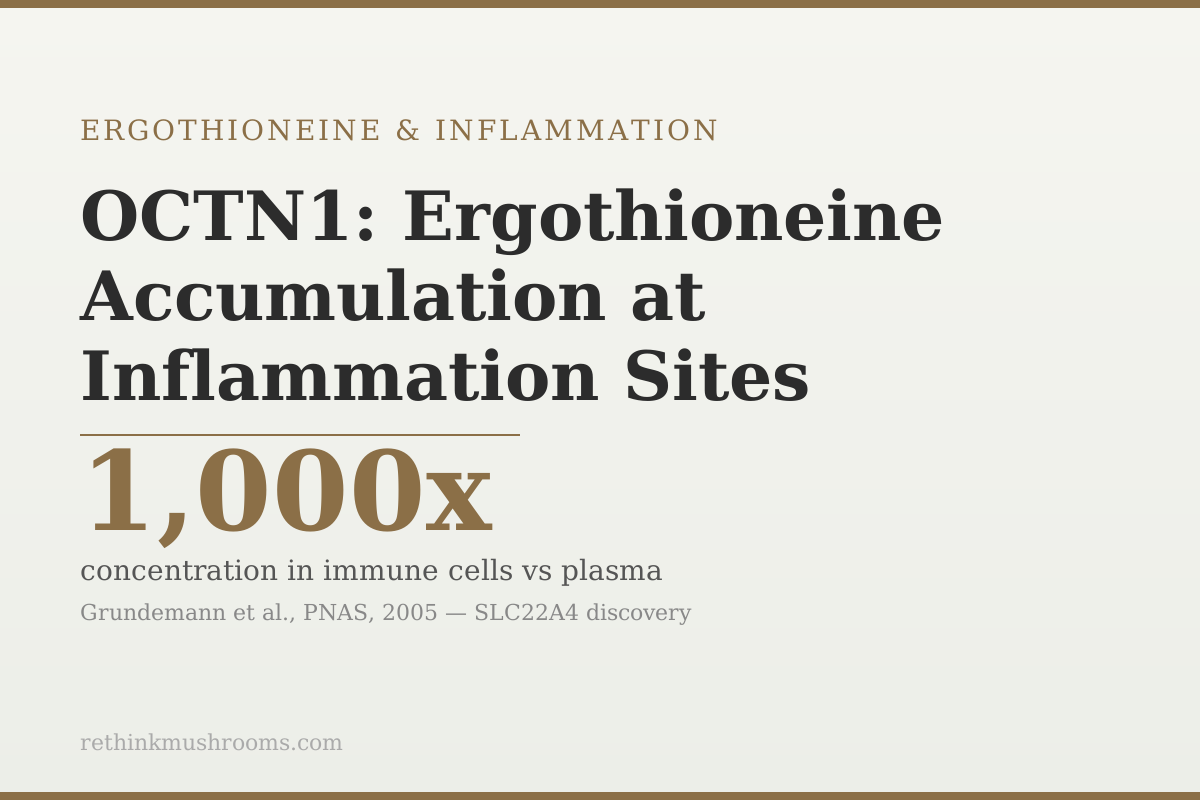
In 2005, Gründemann and colleagues identified SLC22A4 as the gene encoding a high-affinity, ergothioneine-specific transporter expressed at its highest levels in monocytes, macrophages, and neutrophils — the cells that run the inflammatory response.
Gründemann et al., PNAS, 2005
1,000x
intracellular ergothioneine concentration vs plasma in immune cells
RA, IBD
chronic diseases linked to SLC22A4 genetic polymorphisms
2024
year OCTN1 knockout mice were shown to get worse colitis
Gründemann et al., PNAS, 2005
 View as image ↗
Before 2005, ergothioneine was understood as a dietary antioxidant that happened to be found in mushrooms. An interesting compound, but not fundamentally different from other antioxidants — something that neutralized free radicals and moved on. Then Gründemann and colleagues published a discovery in PNAS that reframed the biology entirely.[1] They identified the gene SLC22A4 as encoding a transporter with one primary substrate: ergothioneine. Not a broad-spectrum antioxidant carrier. Not a general organic cation transporter. A dedicated, high-affinity pump built specifically to move ergothioneine into cells.
The transporter is called OCTN1, and it is expressed at its highest levels in monocytes, macrophages, and neutrophils — the immune cells that generate, amplify, and regulate the inflammatory response. This single fact changed the biological interpretation of ergothioneine from "useful antioxidant" to "targeted immune tool." The body does not passively accumulate ergothioneine wherever it happens to end up. It actively concentrates it in immune cells, at concentrations up to 1,000 times plasma levels, and during active inflammation, it draws more of it out of the bloodstream and into the inflamed tissue. This article covers the discovery, the mechanism, the genetics, and the functional proof. For an introduction to ergothioneine itself, see what ergothioneine is and why your body hoards it.
Key Takeaways
- OCTN1 (gene: SLC22A4) is the body's dedicated, high-affinity transporter for ergothioneine, expressed most highly in monocytes, macrophages, and neutrophils, enabling intracellular concentrations 1,000 times higher than plasma (Gründemann et al., PNAS, 2005)
- OCTN1 is extraordinarily substrate-selective: it transports ergothioneine with high affinity but does not efficiently transport structurally similar compounds, suggesting evolutionary specialization for this specific molecule (Gründemann et al., 2019)
- During intestinal inflammation in mice, OCTN1 expression increases in tissue macrophages and ergothioneine redistributes from blood into inflamed tissue — blood levels drop as inflamed tissue levels rise (Shimizu et al., 2015)
- In rheumatoid arthritis patients, OCTN1 is upregulated in inflamed synovial tissue by TNF-α, showing that inflammatory cytokines actively trigger ergothioneine recruitment to damaged joints (Taubert et al., 2006)
- Polymorphisms in SLC22A4 are associated with susceptibility to rheumatoid arthritis, Crohn's disease, ulcerative colitis, and Type 1 diabetes — genetic evidence that this transport system is functionally required for immune health
- OCTN1 knockout mice develop more severe experimental colitis and worse gut dysbiosis than normal mice, directly proving that OCTN1 function is necessary to limit IBD severity (Del et al., Inflammatory Bowel Diseases, 2024)
The 2005 Discovery That Made Ergothioneine a Targeted Immune Tool
The Gründemann PNAS paper was a straightforward piece of molecular biology with large implications.[1] Using expression cloning, the researchers identified the protein encoded by SLC22A4 — known to be in the organic cation transporter family — and tested what it actually transported. The answer was ergothioneine, with a high affinity that had no close competitor in the compounds they tested.
The cell types expressing OCTN1 at the highest levels were the critical finding. Monocytes and macrophages are the primary cells that patrol for pathogens and orchestrate inflammation. Neutrophils are the first responders to infection and injury. Erythrocytes, which also express OCTN1, carry ergothioneine through the bloodstream to wherever it is needed. That the body's dedicated ergothioneine transporter is concentrated in these specific cell types is not coincidental. It is the anatomical fingerprint of a system that evolved to get this compound to precisely the cells that need it.
The intracellular concentrations OCTN1 achieves are 1,000 times higher than plasma. To understand the significance: plasma ergothioneine in healthy adults with adequate mushroom intake is typically in the low micromolar range. Inside monocytes and macrophages, it reaches millimolar concentrations. No passive diffusion explains this magnitude of concentration gradient. Only an active, energy-driven transporter accounts for it.
Before this discovery, ergothioneine's anti-inflammatory activity was studied in cell culture with externally added compound. The Gründemann finding explained why those concentrations were biologically plausible in vivo: the cells naturally maintain high internal ergothioneine levels specifically because they have OCTN1.
How OCTN1 Works: Selectivity That Points to Evolutionary Purpose
A second Gründemann paper in 2019 addressed the mechanistic question of why OCTN1 is so specific.[2] Using HeLa cells with natively expressed OCTN1, the researchers tested a panel of structurally similar compounds against ergothioneine. The transporter showed striking selectivity: it transported ergothioneine efficiently and failed to transport compounds with closely related structures at comparable rates. This specificity is unusual. Many transporters handle families of structurally related molecules. OCTN1 handles essentially one.
The kinetic characterization was provided by Nakamura and colleagues in 2008 using rat Octn1.[3] The transport was sodium-independent, carrier-mediated, and saturable, with kinetic parameters consistent with high-affinity, active transport. Sodium independence distinguishes OCTN1 from many other secondary active transporters that use the sodium gradient as their energy source. Ergothioneine transport via OCTN1 operates through a different mechanism, still actively concentrating the molecule against its gradient but not depending on co-transported sodium ions.
The evolutionary argument that emerges from the selectivity data is straightforward: if a transporter exists that is specifically tuned to move one compound, and that compound is found almost exclusively in fungi and bacteria that humans can encounter through food, then humans evolved over deep evolutionary time to maintain high concentrations of that specific compound in their immune cells. The transporter is the evidence that this accumulation is not accidental. It is selected for.
What Happens to Ergothioneine During Active OCTN1-Driven Inflammation
The discovery of OCTN1 explained how ergothioneine accumulates in immune cells under baseline conditions. A 2015 study by Shimizu and colleagues explained what happens during active inflammation, and the result is more dynamic than simply "immune cells have high ergothioneine."[4]
Working with a DSS-induced colitis mouse model, Shimizu tracked ergothioneine levels in both blood and intestinal tissue during active inflammatory disease. The finding was directionally striking: during colitis, OCTN1 expression increased in intestinal macrophages at the site of inflammation, ergothioneine levels rose inside those macrophages, and blood ergothioneine levels fell simultaneously. The ergothioneine was not disappearing. It was being redirected.
This redistribution pattern establishes that OCTN1 does not operate at a fixed baseline. Inflammatory stimuli increase OCTN1 expression in tissue macrophages, which increases their capacity to take up ergothioneine from the surrounding environment and from the bloodstream. The immune system, in response to active inflammation, actively recruits more ergothioneine to the site that needs it. Blood levels drop not because the body is depleted but because the compound is being deployed.
This mechanism appears in human inflammatory disease as well. Taubert and colleagues showed in 2006 that rheumatoid arthritis patients have significantly lower ergothioneine in red blood cells than healthy controls, and that OCTN1 expression in inflamed synovial joint tissue is elevated — driven upward by TNF-α, the central cytokine of RA pathology.[5] The inflamed joint is calling for ergothioneine by increasing the very transporter that draws it in. The blood level is low because the tissue level is elevated.
The same redistribution logic appears across the other articles in this cluster. In ergothioneine as an inflammatory biomarker, this is why low blood ergothioneine is both a dietary marker and a signal of active immune activity. In ergothioneine and chronic inflammatory conditions, it explains why patients with multiple chronic diseases consistently show lower blood ergothioneine.
SLC22A4 Polymorphisms: The Genetic Proof That This Transporter Is Non-Optional
The strongest evidence that OCTN1 function is required for immune health comes not from experimental models but from human genetics. Functional polymorphisms in SLC22A4, the gene encoding OCTN1, are associated at the population level with susceptibility to several immune-mediated diseases:
- Rheumatoid arthritis: SLC22A4 polymorphisms that reduce transporter function appear more frequently in RA patients than in healthy controls
- Crohn's disease: the same variant-disease association pattern documented for CD, an IBD with strong immunogenetic components
- Ulcerative colitis: associated with SLC22A4 variants in some population studies
- Type 1 diabetes: an autoimmune disease where SLC22A4 polymorphism data has been reported
The implication is direct: people born with less functional OCTN1 are less able to concentrate ergothioneine in immune cells, and this functional deficit appears at the population level as higher rates of immune-mediated chronic disease. This is not observational correlation between dietary intake and disease risk. This is genetic evidence that the transporter itself, independent of dietary supply, is required for proper immune regulation.
OCTN1 in the Cardiovascular System: Monocytes and Endothelial Protection
A 2017 review by Servillo and colleagues examined ergothioneine's cardiovascular protective properties and specifically highlighted OCTN1's expression in monocytes and macrophages as the mechanistic foundation for this protection.[7]
Monocytes circulate in the bloodstream and are the precursors to tissue macrophages. During atherosclerosis and other cardiovascular inflammatory processes, monocytes infiltrate vascular tissue and can drive inflammatory damage to the endothelium — the inner lining of blood vessels. OCTN1's high expression in circulating monocytes means these cells carry concentrated ergothioneine with them as they enter and modify vascular tissue. The review documented ergothioneine's direct protective effects on vascular endothelial cells under oxidative stress and NF-κB suppression in cardiovascular contexts.
This cardiovascular connection is not incidental. The Smith 2020 population cohort data showing 21% lower cardiovascular mortality at higher ergothioneine levels — examined in detail in ergothioneine as an inflammatory biomarker — aligns precisely with a mechanism where monocyte-carried ergothioneine limits inflammatory damage to the vascular endothelium over time.
When OCTN1 Is Absent, Inflammation Becomes Worse
The most direct functional proof that OCTN1 activity is necessary to limit inflammatory disease severity comes from a 2024 study by Del and colleagues.[6] Using OCTN1 knockout mice in an experimental colitis model, the researchers compared disease progression in animals with and without functional OCTN1.
The OCTN1 knockout mice developed more severe colitis than normal mice. They showed worse gut bacterial dysbiosis, more disrupted immune cell populations, and a greater inflammatory burden overall. The anti-TNF drug infliximab restored bacterial richness in both strains, confirming the drug worked regardless of OCTN1 status. But the knockout mice had a significantly worse inflammatory baseline that infliximab partially addressed but did not fully normalize.
The conclusion is direct: removing OCTN1 makes inflammatory bowel disease worse. This is not correlational data. It is an experimental removal of the transport function with a measured worsening of outcome. The protective role OCTN1 plays in IBD goes beyond its transport of ergothioneine as an antioxidant. The study found that OCTN1 modulates immune cell function and, through that, gut microbial composition. The transporter appears to be involved in broader immune signaling beyond simple ergothioneine accumulation.
For the related article covering the ergothioneine anti-inflammatory mechanisms that this transport system delivers to inflamed tissue, see ergothioneine and anti-inflammatory research. For the COVID-19 context where OCTN1 expression in immune cells has been proposed as relevant to respiratory inflammation, see ergothioneine and COVID-19.
The Bottom Line
OCTN1 transforms ergothioneine from a passive dietary antioxidant into a specifically targeted immune tool. The transporter is expressed at its highest levels in the cells that run the inflammatory response, achieves intracellular concentrations 1,000 times higher than plasma, and is selectively tuned to ergothioneine to a degree that implies evolutionary specialization. During active inflammation, OCTN1 expression increases, actively drawing ergothioneine out of the bloodstream into inflamed tissue. Genetic evidence from SLC22A4 polymorphisms links loss of this transport function to susceptibility to rheumatoid arthritis, Crohn's disease, and ulcerative colitis. And direct experimental removal of OCTN1 in colitis mice makes disease measurably worse. The transporter is not a passive channel. It is an active component of inflammatory regulation.
Frequently Asked Questions
Sources & References
- 1. Source details for this reference are not yet available.
- 2. Source details for this reference are not yet available.
- 3. Source details for this reference are not yet available.
- 4. Source details for this reference are not yet available.
- 5. Source details for this reference are not yet available.
- 6. Source details for this reference are not yet available.
- 7. Source details for this reference are not yet available.