Ergothioneine & Inflammation
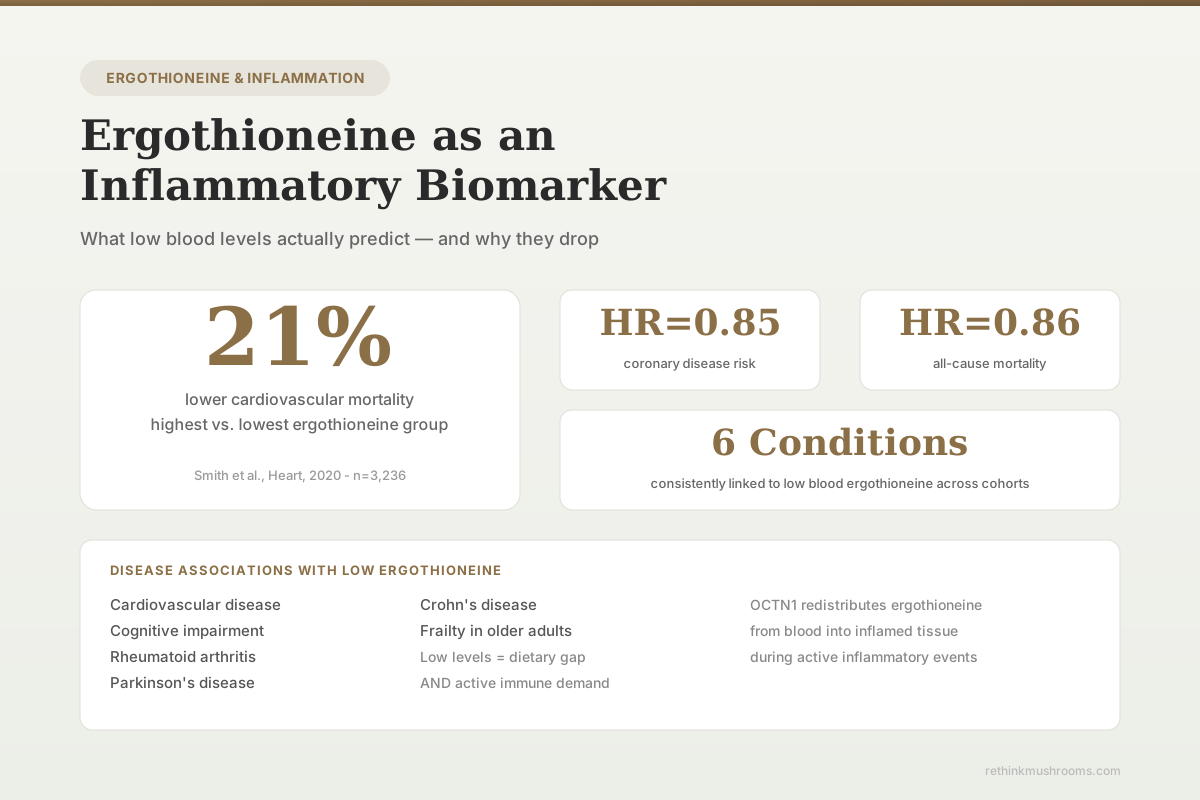
21% lower cardiovascular mortality
In 3,236 adults from the Malmö Diet and Cancer study, the highest plasma ergothioneine group had 21% lower cardiovascular mortality — and the effect held across coronary disease and all-cause mortality.
Smith et al., Heart, 2020
HR=0.85
coronary disease risk, highest vs. lowest quintile
HR=0.86
all-cause mortality, p=4×10⁻⁵
n=3,236
largest ergothioneine biomarker cohort to date
Smith et al., Heart, 2020
 View as image ↗
Ergothioneine as an inflammatory biomarker is an unusual case in nutrition research. Most dietary compounds are tracked by what people report eating. Ergothioneine is studied differently — researchers measure the actual amount in the blood, and that measured level predicts future disease with unusual consistency across independent cohorts.
The most striking number comes from a 2020 study of 3,236 Swedish adults: higher plasma ergothioneine predicted 21% lower cardiovascular mortality, 15% lower coronary disease risk, and 14% lower all-cause mortality, all with statistically robust p-values.[1] A measured plasma biomarker is stronger evidence than a food frequency questionnaire because it reflects what the body actually absorbed, metabolized, and retained — not what someone recalled eating.
But the more interesting part of the ergothioneine biomarker story is why blood levels fall in the first place. Low plasma ergothioneine is not just a sign of eating few mushrooms. It is also a sign that the immune system is working — actively pulling ergothioneine out of circulation and into inflamed tissue. For background on what ergothioneine is and how it enters the body, see what ergothioneine is and why your body hoards it.
Key Takeaways
- In 3,236 adults, higher plasma ergothioneine predicted 21% lower cardiovascular mortality (HR=0.79, p=0.002), 15% lower coronary disease risk (HR=0.85, p=0.01), and 14% lower all-cause mortality (HR=0.86, p=4×10⁻⁵) (Smith et al., Heart, 2020)
- Blood ergothioneine drops during active inflammation because OCTN1 redistributes it from circulation into inflamed tissue macrophages — so low levels signal both dietary insufficiency and active immune response (Shimizu et al., 2015)
- RA patients have significantly lower ergothioneine in red blood cells than healthy controls, and OCTN1 is upregulated in their inflamed joint tissue by TNF-α — diseased tissue is calling for more ergothioneine (Taubert et al., 2006)
- Ergothioneine levels decline with age and cognitive decline; elderly people with mild cognitive impairment have lower levels than healthy elderly controls (Cheah et al., 2016)
- In a human pilot study, ergothioneine supplementation produced declining trends in CRP, 8-iso-PGF2α, and 8-OHdG — the only direct human data linking ergothioneine to measurable biomarker changes (Cheah et al., 2017)
- The 2025 state-of-evidence review found observational data consistently associating low ergothioneine with cognitive impairment, cardiovascular disease, Parkinson's disease, and frailty across multiple independent cohorts (May-Zhang et al., Proceedings of the Nutrition Society, 2025)
The 3,236-Person Study That Put Ergothioneine on the Biomarker Map
Most biomarker claims in nutrition start with cell studies and work forward to humans. The ergothioneine biomarker case starts unusually well — with a large, long-running human population study.
Smith and colleagues analyzed plasma ergothioneine levels in 3,236 participants from the Malmö Diet and Cancer cohort, a Swedish prospective study with two decades of cardiovascular and mortality follow-up.[1] The Malmö cohort is one of the most rigorously characterized datasets in nutritional epidemiology, which gives these ergothioneine findings more interpretive weight than a typical observational sample.
The results across three separate hard endpoints:
- Coronary heart disease: HR=0.85, 95% CI [0.74–0.96], p=0.01 (15% lower risk)
- Cardiovascular mortality: HR=0.79, 95% CI [0.67–0.92], p=0.002 (21% lower risk)
- All-cause mortality: HR=0.86, 95% CI [0.80–0.92], p=4×10⁻⁵ (14% lower risk)
Those p-values are not marginal. The all-cause mortality association at p=4×10⁻⁵ means the probability of seeing this result by chance, if there were no real relationship, is about 1 in 25,000. This level of statistical strength is unusual in nutritional epidemiology.
The effect magnitude is also notable. A hazard ratio of 0.79 for cardiovascular mortality — a 21% lower risk — from a compound concentrated almost exclusively in mushrooms, accumulating via a dedicated transporter, showing up in a large unselected population: this is the kind of finding that warrants follow-up at scale.
The study cannot establish causality. Ergothioneine could be a marker of overall dietary quality, with mushroom consumption tracking other healthy patterns. The researchers adjusted for standard confounders, but observational data cannot rule out all residual confounding. What the data firmly establishes is a statistically robust association across multiple hard endpoints in a large prospective cohort. For the cardiovascular disease angle specifically, see ergothioneine and atherosclerosis prevention.
Why Low Blood Ergothioneine Signals More Than Just Diet
Standard biomarker reasoning runs: low blood level means deficiency, deficiency causes disease. The ergothioneine story is more layered.
Low plasma ergothioneine can mean two different things simultaneously, and the distinction changes how the biomarker should be interpreted in disease populations.
The first meaning is dietary: insufficient intake from ergothioneine-rich foods, primarily mushrooms, with no compensating biosynthesis since humans cannot make ergothioneine themselves.
The second meaning is physiological: active immune response. During inflammation, the OCTN1 transporter — which sits on monocytes, macrophages, and neutrophils — is upregulated, and ergothioneine is actively pulled out of circulation and concentrated inside immune cells at the inflammation site. A 2015 study by Shimizu and colleagues demonstrated this directly in a mouse model of intestinal inflammation: when colitis was induced, OCTN1 expression increased in intestinal macrophages, ergothioneine rose inside those cells, and blood ergothioneine dropped simultaneously.[2] The body was not losing ergothioneine. It was relocating it.
This redistribution dynamic is also visible in human disease. Taubert and colleagues found that rheumatoid arthritis patients had significantly lower ergothioneine in their red blood cells than healthy controls.[3] At the same time, OCTN1 expression was upregulated in inflamed RA synovial joint tissue, driven by the very TNF-alpha causing the inflammation. The inflamed joint was calling for more ergothioneine. The body was responding by raising the transporter's capacity at that site, drawing it away from circulation.
The practical implication: a blood test showing low ergothioneine in someone with chronic disease could reflect two things happening at once. Dietary reserves are inadequate. And the immune system is burning through what little remains faster than food can replenish it. Both explanations support the association with poor outcomes, and they frequently occur together. For the full story on how OCTN1 drives this redistribution during active inflammatory events, see OCTN1 transporter and ergothioneine accumulation at sites of inflammation. For how ergothioneine suppresses the inflammatory pathways at work in those tissues, see ergothioneine and inflammation: anti-inflammatory research.
The Disease Pattern: What Low Ergothioneine Consistently Predicts
The biomarker signal is not limited to cardiovascular disease. Across independent study populations, methods, and designs, low blood ergothioneine shows up alongside a consistent set of conditions.
The 2023 British Journal of Nutrition review examined accumulated evidence for ergothioneine as an underrecognized dietary micronutrient and found low blood levels consistently associated with:[6]
- Cardiovascular disease: 21% higher cardiovascular mortality, 15% higher coronary disease risk (Smith et al., 2020)
- Cognitive impairment and neurodegeneration: significantly lower in elderly adults with mild cognitive impairment versus healthy elderly peers
- Parkinson's disease: lower levels in PD patients across multiple independent cohorts
- Rheumatoid arthritis: lower RBC ergothioneine versus healthy controls, with OCTN1 upregulation in inflamed joint tissue
- Crohn's disease: SLC22A4 gene polymorphisms that impair OCTN1 function are associated with Crohn's susceptibility; lower circulating ergothioneine is consistent with redistribution to inflamed intestinal tissue
- Frailty: lower ergothioneine associated with the frailty phenotype in aging populations independent of other nutritional status markers
The 2025 review by May-Zhang and colleagues in the Proceedings of the Nutrition Society updated this picture with the most comprehensive synthesis to date.[7] The pattern across observational data was described as "consistent" across cognitive impairment, neurodegeneration, cardiovascular disorders, frailty, and mortality. Interventional trials in older adults showed supplementation improved cognition, memory, and sleep quality. Safety data supports doses up to 25 mg per day.
Bruce Ames framed this disease pattern in a 2018 PNAS paper as evidence for ergothioneine's status as a "longevity vitamin": a conditionally essential compound where chronic deficiency does not cause an acute deficiency disease but accelerates the cellular damage that drives chronic aging-related conditions — most of which involve persistent low-grade inflammation.[8]
The breadth of these disease associations is unusual for a single compound. The common thread across cardiovascular disease, neurodegeneration, Parkinson's, and autoimmune conditions is chronic, unresolved inflammation in the tissues that ergothioneine is specifically recruited to protect. For the chronic disease evidence in detail, see ergothioneine and chronic inflammatory conditions. For the COVID-19 inflammation angle — where the same redistribution dynamics apply during acute viral illness — see ergothioneine and COVID-19: inflammation research.
The Aging Problem: Levels Fall Precisely When Disease Risk Rises
The biomarker signal gets sharper when age is added to the picture.
Cheah and colleagues measured ergothioneine in elderly adults across a spectrum of cognitive health and found that levels were not just lower in people with mild cognitive impairment — they declined progressively with both age and the severity of cognitive decline.[4] The pattern is consistent with what you would expect from a compound the body depletes in response to inflammation: as the cumulative inflammatory burden of decades of aging accumulates, and as mushroom consumption tends to decrease in older adults, blood ergothioneine falls at precisely the life stage when the diseases it tracks become most prevalent.
May-Zhang et al. described this as a convergence problem in their 2025 review.[7] Dietary ergothioneine intake declines with age because food intake narrows. At the same time, the immune system's demand for ergothioneine increases as it manages oxidative stress and inflammatory signaling in aging tissues. The result is a widening gap between supply and demand exactly when the gap matters most.
The 2023 British Journal of Nutrition review described this as a potential reinforcing cycle.[6] Lower ergothioneine impairs the ability of immune cells to resolve inflammation. Persistent unresolved inflammation increases oxidative stress. That oxidative stress further depletes circulating ergothioneine as the body redirects it to sites of damage. The cycle continues with each iteration.
Whether this cycle is causally important in aging humans, or primarily a correlational pattern, remains an open research question. But the pattern holds across enough independent cohorts that the 2023 review identified ergothioneine as a priority compound in aging nutrition research.
Can Supplementation Move the Biomarker?
The disease associations above are observational. The critical follow-up question for any biomarker is: can you shift it, and does shifting it change outcomes?
The first half has a partial answer. Cheah and colleagues administered pure ergothioneine to healthy human volunteers and measured a panel of inflammation and oxidative stress markers before and after supplementation.[5] After supplementation, declining trends were observed in five markers:
- CRP — the standard clinical marker of systemic inflammation
- 8-iso-PGF2α — a marker of lipid peroxidation (fat oxidative damage)
- 8-OHdG — a marker of DNA oxidative damage
- Allantoin — a marker of urate oxidation
- Protein carbonylation — a marker of protein oxidative damage
These are the only direct human data linking ergothioneine supplementation to measurable changes in inflammation and oxidative stress biomarkers. They have not been replicated in a larger trial.
The limitations matter here. This was a small pilot in healthy adults with normal baseline inflammation. Healthy people have less room for measured improvement in CRP than someone with chronic inflammatory disease would. Statistical significance was not formally achieved for all markers. This is not evidence that ergothioneine supplementation treats inflammation — it is a pilot that confirms the biology works as expected and justifies larger trials.
What the study does establish: ergothioneine gets into the body in measurable quantities, reaches plasma and tissue, and is associated with directional movement in multiple inflammation markers simultaneously. That is a necessary precondition for larger trials to be interpretable. The ergothioneine and inflammation: anti-inflammatory research article covers the mechanistic pathways in more detail — including what NF-κB suppression and macrophage polarization research shows about how ergothioneine acts on inflammatory signaling once it reaches immune cells.
The second half of the biomarker question — does shifting ergothioneine levels reduce hard outcomes like cardiovascular events or cognitive decline? — has no answer yet. That is the clinical trial gap. The Malmö cohort shows high natural ergothioneine associates with better outcomes, but observational data cannot confirm that supplementing to raise low levels would replicate the same benefit.
The Bottom Line
Ergothioneine functions as a disease biomarker through two mechanisms: it reflects dietary adequacy of a compound that immune cells require to regulate inflammation, and it tracks the degree to which the body is actively depleting its reserves in response to ongoing inflammatory processes. The Smith 2020 cohort data in 3,236 adults provides the strongest quantified evidence, with HR=0.79 for cardiovascular mortality. The redistribution mechanism — OCTN1 pulling ergothioneine from blood into inflamed tissue — explains why the biomarker signal is meaningful beyond diet alone. A human pilot study shows supplementation produces declining trends in CRP and oxidative stress markers. The full clinical utility of ergothioneine as a routine biomarker remains to be established, but the mechanistic and epidemiological evidence for its relevance is substantial.
Frequently Asked Questions
Sources & References
- 1. Source details for this reference are not yet available.
- 2. Source details for this reference are not yet available.
- 3. Source details for this reference are not yet available.
- 4. Source details for this reference are not yet available.
- 5. Source details for this reference are not yet available.
- 6. Source details for this reference are not yet available.
- 7. Source details for this reference are not yet available.
- 8. Source details for this reference are not yet available.