Meshima (Phellinus linteus) & Inflammation
68% TNF-alpha reduction
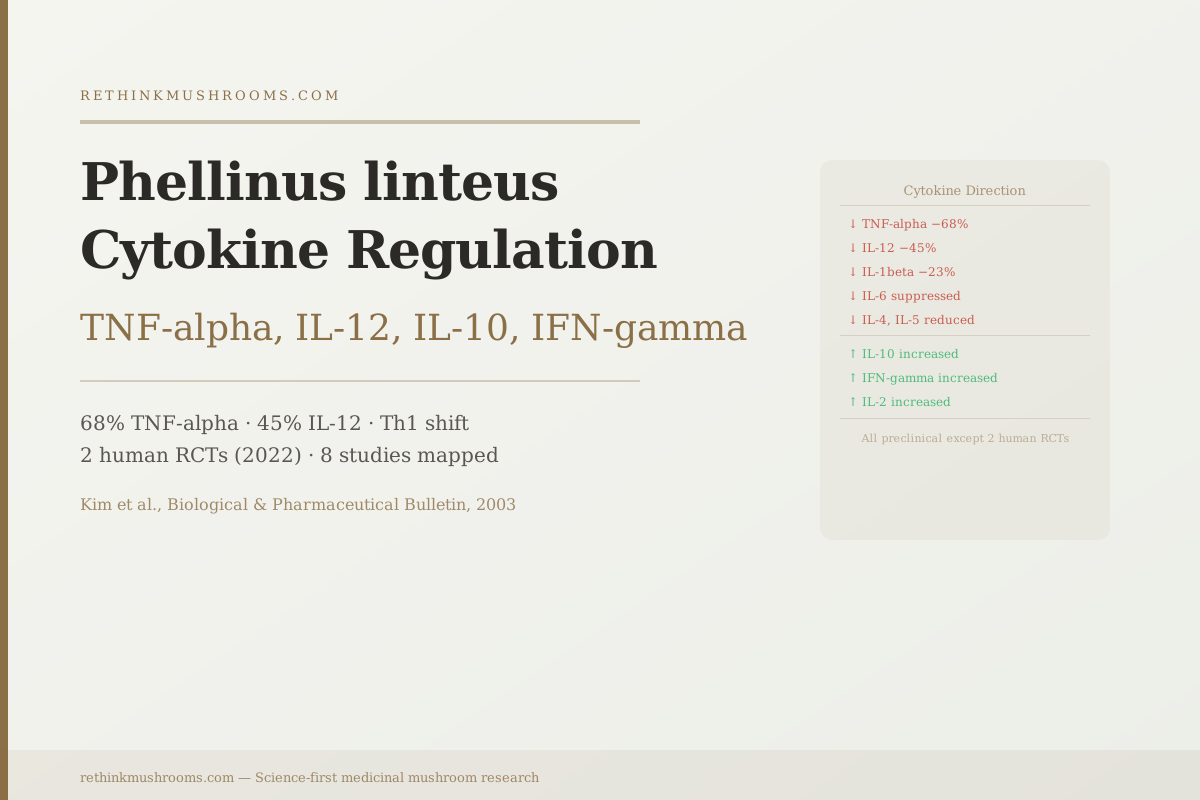
A single acidic polysaccharide fraction from Phellinus linteus inhibited circulating TNF-alpha by 68%, IL-12 by 45%, and IL-1beta by 23% in an LPS-induced septic shock mouse model — among the most specific cytokine data for any medicinal mushroom.
Kim et al., Biological & Pharmaceutical Bulletin, 2003
2 human RCTs
2022 double-blind CONSORT trials (Ku & Kang 2022; Ku et al. 2022) confirming immune marker improvement in human participants vs. placebo
Th1 shift
oral Phellinus linteus shifts immune balance toward cellular immunity (Th1) and away from allergy-associated responses (Th2)
IL-6 down, IL-10 up
polysaccharide fractions shift macrophage cytokine balance from pro-inflammatory IL-6 toward anti-inflammatory IL-10
Kim et al., Biological & Pharmaceutical Bulletin, 2003
 View as image ↗
Cytokines are signaling proteins that immune cells use to communicate and coordinate their responses. When the immune system detects a threat, it releases pro-inflammatory cytokines — proteins like TNF-alpha (tumor necrosis factor alpha) and IL-6 (interleukin-6) — to amplify the response. When the threat is resolved, anti-inflammatory cytokines like IL-10 (interleukin-10) counterbalance the pro-inflammatory signals and return the system to baseline.
Phellinus linteus (meshima mushroom) has been studied for its ability to modulate this balance, reducing pro-inflammatory cytokines and increasing anti-inflammatory ones through several compound-specific mechanisms.
The most specific numbers in this literature come from a 2003 study in a septic shock mouse model: a single acidic polysaccharide fraction from Phellinus linteus inhibited circulating TNF-alpha by 68%, IL-12 by 45%, and IL-1beta by 23%.[1] These are not vague claims about "anti-inflammatory properties." They are specific numbers tied to specific compounds in a quantifiable experimental model.
This article maps the cytokine regulation evidence by study, compound, and direction. For the upstream signaling mechanisms that produce these cytokine effects, see meshima and inflammation: NF-kB pathway research. For the hispolon-specific iNOS and NO inhibition pathway, see meshima hispolon and iNOS inhibition: a targeted anti-inflammatory mechanism. For a full introduction to meshima, see the meshima mushroom guide.
Key Takeaways
- Kim et al. (2003) found that an acidic polysaccharide from Phellinus linteus inhibited circulating TNF-alpha by 68%, IL-12 by 45%, and IL-1beta by 23% in a septic shock mouse model, significantly improving survival — the most specific cytokine inhibition data in the Phellinus linteus literature[1]
- Qin et al. (2015) showed Phellinus linteus polysaccharides induced a strong IL-10 response while suppressing IL-6 in macrophages — a cytokine shift from pro-inflammatory to anti-inflammatory relevant to chronic conditions including obesity, type 2 diabetes, and depression[4]
- Oh et al. (2006) found that oral administration of Phellinus linteus in mice significantly increased Th1-associated cytokines (IFN-gamma, IL-2) while reducing Th2-associated cytokines (IL-4, IL-5) — an immunomodulatory Th1 shift relevant to allergic conditions[2]
- Shin et al. (2021) confirmed that Phellinus linteus mycelium elevates the IFN-gamma/IL-4 ratio and reduces inflammatory markers — a Th1-shifting effect distinct from but complementary to fruiting body polysaccharide effects[3]
- Two double-blind CONSORT RCTs from 2022 (Ku & Kang; Ku et al.) confirmed that Phellinus linteus extract improved immune parameters in human participants vs. placebo — the only human trial data available for this species[7],[8]
- Qin et al. (2023) systematic review found that anti-inflammatory potency varies by polysaccharide structure, molecular weight, and branching pattern — explaining why studies using different extracts report different results[6]
What Cytokine Regulation Means — and Why the Direction Matters
The immune system does not simply "turn on" or "turn off." It calibrates its response through a complex mix of signaling proteins. Pro-inflammatory cytokines amplify immune activity: TNF-alpha triggers fever and tissue damage at the infection site; IL-1beta recruits immune cells and promotes inflammation; IL-6 drives acute phase responses in the liver. These are necessary responses, but when sustained beyond the initial threat, they become damaging.
Anti-inflammatory cytokines like IL-10 suppress pro-inflammatory signaling, protect tissues from collateral damage, and restore homeostasis. The balance between pro-inflammatory and anti-inflammatory cytokines determines whether an immune response resolves cleanly or persists as chronic inflammation.
Two immune cell subtypes — Th1 and Th2 helper cells — have opposing cytokine profiles. Th1 cells produce IFN-gamma (interferon-gamma) and IL-2, promoting cellular immunity against bacteria, viruses, and cancer cells. Th2 cells produce IL-4, IL-5, and IL-13, driving antibody production and allergic responses. An excess of Th2 activity contributes to allergies, asthma, and some autoimmune patterns. Phellinus linteus research consistently shows a shift toward Th1 dominance, which is relevant to both of these conditions.
Kim 2003: The Specific Numbers From a Septic Shock Model
Kim and colleagues (2003) administered an acidic polysaccharide fraction isolated from Phellinus linteus to mice that had received a lethal dose of LPS (lipopolysaccharide, a bacterial cell wall component that triggers an overwhelming immune response resembling septic shock).[1]
In septic shock, pro-inflammatory cytokines spike catastrophically, damaging organs and reducing survival. The study measured whether the Phellinus linteus polysaccharide could attenuate this cytokine storm.
The findings were specific:
- TNF-alpha: reduced by approximately 68% compared to untreated septic controls
- IL-12: reduced by approximately 45%
- IL-1beta: reduced by approximately 23%
- Survival: significantly improved in treated animals
These numbers represent the clearest cytokine inhibition data in the Phellinus linteus literature because the model produces extreme, measurable cytokine elevations that are easy to quantify. The polysaccharide fraction tested was pretreatment rather than treatment after onset — which is a limitation when considering clinical applications in acute inflammation. But the magnitude of cytokine inhibition documents the compound's capacity to interfere with pro-inflammatory signaling at levels that translate to survival benefit.
Septic shock is not the primary context in which people think about Phellinus linteus. But the same polysaccharide fraction that suppressed 68% of TNF-alpha in an acute inflammatory crisis is the same compound class studied for chronic inflammation — the numbers just reflect the model's sensitivity to the effect.
The Cytokine Map: Direction and Magnitude by Cytokine
The table below maps the cytokine regulation effects documented across the studies in this cluster, with the direction of change, approximate magnitude where reported, the compound responsible, and the study source.
| Cytokine | Direction | Approximate Change | Compound | Study |
|---|---|---|---|---|
| TNF-alpha | Down | 68% (septic model) | Acidic polysaccharide | Kim 2003 |
| IL-12 | Down | 45% (septic model) | Acidic polysaccharide | Kim 2003 |
| IL-1beta | Down | 23% (septic model) | Acidic polysaccharide | Kim 2003 |
| IL-6 | Down | Suppressed (macrophages) | Polysaccharides | Qin 2015 |
| IL-10 | Up | Strong increase | Polysaccharides | Qin 2015 |
| IFN-gamma | Up | Significant increase | Oral extract | Oh 2006 |
| IL-2 | Up | Significant increase | Oral extract | Oh 2006 |
| IL-4 | Down | Reduced | Oral extract / mycelium | Oh 2006, Shin 2021 |
| IL-5 | Down | Reduced | Oral extract | Oh 2006 |
This table captures the consistent pattern: Phellinus linteus polysaccharides and extracts reduce pro-inflammatory signaling proteins (TNF-alpha, IL-12, IL-1beta, IL-6) while increasing anti-inflammatory and cellular immunity signals (IL-10, IFN-gamma, IL-2).
Polysaccharides and the IL-6/IL-10 Balance: Qin 2015
Qin and colleagues (2015) characterized the structural features of Phellinus linteus polysaccharides and tested their immunomodulatory effects on the IL-6/IL-10 balance in macrophages.[4]
The finding: polysaccharides from Phellinus linteus induced a strong IL-10 response while suppressing IL-6 transcription in macrophages under stimulated conditions.
The IL-6/IL-10 ratio matters beyond acute inflammation. Chronically elevated IL-6 with low IL-10 is associated with metabolic syndrome, type 2 diabetes, cardiovascular disease, and depression — conditions driven partly by persistent low-grade inflammation. IL-10 is a broad anti-inflammatory moderator that counteracts many of IL-6's downstream effects. The shift Qin 2015 documented — more IL-10, less IL-6 — is the direction associated with resolution of chronic inflammatory states.
This study also found that the immunomodulatory effect depended on the structural characteristics of the polysaccharides tested, which connects to the broader finding in the 2023 systematic review: not all Phellinus linteus polysaccharides produce equivalent cytokine effects, because polysaccharide structure determines bioactivity.
Oral Administration and the Th1 Shift: Oh 2006 and Shin 2021
One limitation of most mushroom cytokine studies is that they test extracts in isolated cells, not through oral consumption. Oh and colleagues (2006) addressed this by studying the cytokine effects of oral Phellinus linteus administration in mice — a route of administration that is directly relevant to dietary or supplement use.[2]
After oral administration, mice showed significantly increased levels of Th1-associated cytokines (IFN-gamma and IL-2) and significantly decreased levels of Th2-associated cytokines (IL-4 and IL-5). This Th1 shift was observed in the absence of immune challenge — it represents a baseline immunomodulatory effect from consumed Phellinus linteus.
The clinical relevance of a Th1 shift depends on context. In Th2-dominated conditions like allergic asthma, atopic dermatitis, and food allergies, a Th1-promoting intervention could theoretically reduce the Th2-driven immune reactivity. This is the rationale behind the allergy and asthma research on Phellinus linteus covered in the meshima for chronic inflammatory conditions article.
Shin and colleagues (2021) confirmed that Phellinus linteus mycelium (as distinct from the fruiting body used in most studies) also produces a Th1 shift, measured by an elevated IFN-gamma/IL-4 ratio.[3] The Shin study found that mycelium-derived compounds produce anti-inflammatory effects that are distinct from, but complementary to, the effects of fruiting body polysaccharides. This matters for consumers evaluating supplement sources: mycelium and fruiting body extracts may not be interchangeable for cytokine effects, because their active compound profiles differ.
For the Th1/Th2 balance data in more detail, including the immune rebalancing context for allergic conditions, see meshima and Th1/Th2 balance: precision immune tuning research.
Lin 2014: The Upstream Signaling Chain — MyD88, TRAF-6, and TNF-alpha
Lin and colleagues (2014) examined the upstream signaling events by which Phellinus linteus fermented broth reduces TNF-alpha and NF-kB activity in macrophages.[5]
The study tracked the signaling chain from LPS to cytokine production. LPS activates macrophages through a surface receptor, which signals through adapter proteins MyD88 and then TRAF-6 (tumor necrosis factor receptor-associated factor 6), eventually activating NF-kB (the master transcription factor for inflammatory cytokine genes). Phellinus linteus fermented broth blocked the expression of MyD88, TRAF-6, VCAM-1, and NF-kB itself, while also inhibiting ROS (reactive oxygen species) formation.
The significance of blocking MyD88 and TRAF-6 specifically is that these are early steps in the signaling cascade. Blocking them interrupts multiple downstream cytokines simultaneously — TNF-alpha, IL-6, IL-1beta, and others all run through the same signaling chain. This explains how a single mushroom compound fraction can reduce multiple pro-inflammatory cytokines at once: they all trace back to the same upstream activation event.
For the full NF-kB pathway story, see meshima and inflammation: NF-kB pathway research. For the bridge between innate and adaptive immune regulation that these cytokines affect, see how meshima bridges innate and adaptive immunity.
Qin 2023: Why Studies Report Different Cytokine Effects
A recurring problem in the Phellinus linteus literature is that different studies using different extracts report different magnitudes of cytokine effects, sometimes in different directions. Qin and colleagues (2023) published a systematic review explaining why.[6]
Anti-inflammatory activity in Phellinus linteus polysaccharides depends on:
- Molecular weight of the polysaccharide
- Branching pattern (the geometry of how sugar units connect)
- Extraction conditions (temperature, solvent, processing method)
Higher molecular weight polysaccharides with specific beta-1,3/1,6-glucan branching patterns show stronger anti-inflammatory activity. Extraction with hot water at different temperatures, or with alkali solvents, yields polysaccharides with different structural profiles — and therefore different potencies.
This structural variability explains why a study using hot water extract might show moderate TNF-alpha reduction while a study using an acidic polysaccharide fraction (as in Kim 2003) shows 68% inhibition. The compounds are structurally distinct even if they come from the same mushroom.
For consumers evaluating Phellinus linteus supplements, this means that extract type and processing method matter — a supplement listing "Phellinus linteus extract" without specifying the extraction method or polysaccharide content cannot be reliably compared to any of the study compounds.
For the compound-level breakdown including polysaccharide structures, hispolon, and inotilone, see Phellinus linteus bioactive compounds: polysaccharides and phenols.
The Human Data: Two 2022 RCTs
All the cytokine data above comes from cell cultures and animal models. The human evidence consists of two double-blind, placebo-controlled CONSORT trials published in 2022 by Ku and colleagues.
Ku and Kang (2022) and Ku and colleagues (2022) ran separate CONSORT-compliant RCTs testing Phellinus linteus extract against placebo in human participants.[7],[8] Both found that the extract improved immune parameters compared to placebo.
These are pilot-scale studies, and their scope is general immune function rather than specific inflammatory conditions or individual cytokine measurements. They do not replicate the cytokine-specific findings of the cell and animal studies. But they provide the only human clinical confirmation that Phellinus linteus extract produces measurable immune effects in people — not just in LPS-stimulated macrophages or septic mice.
Having two independent CONSORT-compliant RCTs from 2022, both showing similar findings, provides meaningful human-evidence support even at pilot scale. The next step — measuring specific pro- and anti-inflammatory cytokine levels in humans taking Phellinus linteus extract — has not been done.
The Bottom Line
Phellinus linteus regulates inflammatory cytokines in a consistent pattern across multiple study designs: pro-inflammatory cytokines (TNF-alpha, IL-12, IL-1beta, IL-6) are reduced while anti-inflammatory signals (IL-10, IFN-gamma) are increased. The most specific quantitative data comes from a 2003 septic shock model: 68% TNF-alpha, 45% IL-12, and 23% IL-1beta inhibition from a single polysaccharide fraction. Oral administration in mice consistently produces a Th1 shift. Two 2022 human RCTs confirm immune parameter improvement vs. placebo. The variability across studies reflects structural differences in polysaccharide extracts — not inconsistency in the underlying biology.
Frequently Asked Questions
Sources & References
- 1RTHM-00111·Kim, Gi-Young et al. (2003). “Alleviation of experimental septic shock in mice by acidic polysaccharide isolated from the medicinal mushroom Phellinus linteus..” Biological & pharmaceutical bulletin.Study breakdown →PubMed →↩
- 2RTHM-00198·Oh, Gi-Su et al. (2006). “Effects of oral administration of Phellinus linteus on the production of Th1- and Th2-type cytokines in mice..” Immunopharmacology and immunotoxicology.Study breakdown →PubMed →↩
- 3RTHM-01435·Shin, Mi-Rae et al. (2021). “Immunomodulatory and anti-inflammatory effects of Phellinus linteus mycelium..” BMC complementary medicine and therapies.Study breakdown →PubMed →↩
- 4. Source details for this reference are not yet available.
- 5RTHM-00618·Lin, Chun-Jung et al. (2014). “Biological evaluation of Phellinus linteus-fermented broths as anti-inflammatory agents..” Journal of bioscience and bioengineering.Study breakdown →PubMed →↩
- 6RTHM-01770·Qin, Dandan et al. (2023). “Polysaccharides from Phellinus linteus: A systematic review of their extractions, purifications, structures and functions..” International journal of biological macromolecules.Study breakdown →PubMed →↩
- 7RTHM-01555·Ku, Yong Ho et al. (2022). “Efficacy of Phellinus linteus extract on immunity enhancement: A CONSORT-randomized, double-blind, placebo-controlled pilot trial..” Medicine.Study breakdown →PubMed →↩
- 8RTHM-01556·Ku, Yong Ho et al. (2022). “Effects of Phellinus linteus extract on immunity improvement: A CONSORT-randomized, double-blinded, placebo-controlled trial..” Medicine.Study breakdown →PubMed →↩