Meshima Research
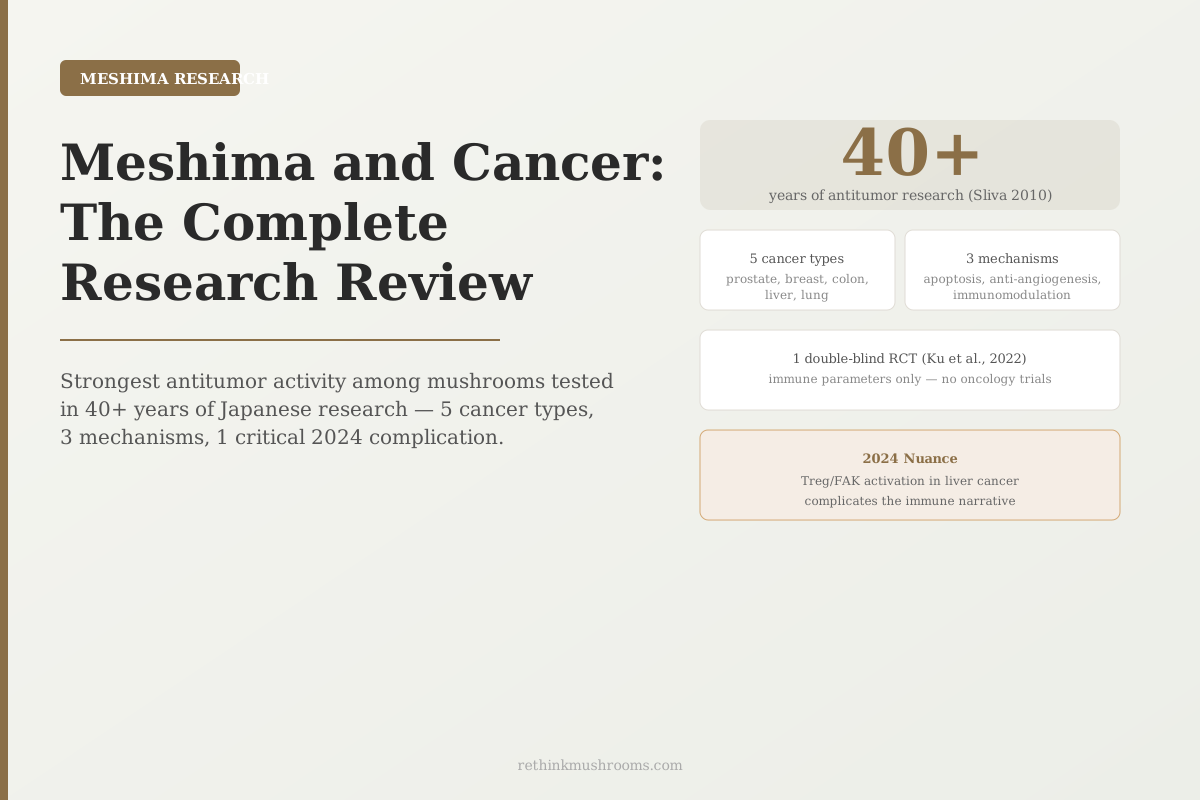
40+ years of antitumor research
Phellinus linteus has the strongest antitumor activity among mushrooms tested in four decades of Japanese research, acting through apoptosis, anti-angiogenesis, and immune modulation.
Sliva, Experimental and Therapeutic Medicine, 2010
5 cancers
types with preclinical evidence: prostate, breast, colon, liver, lung
1 RCT
double-blind human trial on immunity parameters (Ku et al., 2022)
0
human oncology clinical trials published for Meshima
Sliva, Experimental and Therapeutic Medicine, 2010
 View as image ↗
Among the medicinal mushrooms studied for anti-cancer properties, Meshima (Phellinus linteus) has one of the deepest and most consistent preclinical records. A 2010 review of four decades of Japanese research concluded that it showed the strongest antitumor activity among the mushrooms evaluated.[1] Published studies have tested it against prostate, breast, colon, liver, and lung cancer cells, and identified at least three distinct anti-cancer mechanisms: triggering programmed cell death (apoptosis), blocking tumor blood vessel formation (anti-angiogenesis), and modulating immune activity. This is meshima cancer research in complete form, including the 2024 finding that, in liver cancer specifically, Meshima's immune interactions are more complicated than the headline suggests.
For a full introduction to what Meshima is, where it grows, and why it has been called Korea's anti-cancer mushroom for centuries, see what is Meshima mushroom. This article focuses on the cancer-specific evidence, organized by mechanism and cancer type, with honest attention to what the research does and doesn't show.
Key Takeaways
- A 2010 comprehensive review spanning 40+ years of Japanese research identified Phellinus linteus as having the strongest antitumor activity among mushrooms tested, acting across prostate, breast, colon, and other cancer types (Sliva, Experimental and Therapeutic Medicine, 2010)
- Three distinct anti-cancer mechanisms have been identified in research: apoptosis induction, inhibition of tumor blood vessel formation (anti-angiogenesis), and immune modulation
- Colon cancer evidence includes simultaneous inhibition of tumor growth, invasion, and angiogenesis in the same cell model, operating through Wnt/beta-catenin pathway disruption (Song et al., BMC Cancer, 2011)
- In 2024, a study found that Phellinus linteus activates regulatory T cells (Treg) via FAK signaling in hepatocellular carcinoma, promoting a pro-tumorigenic immune shift, a finding that complicates the simple anti-cancer narrative (Chen et al., Cancer Immunology Immunotherapy, 2024)
- The most rigorous human data comes from a 2022 double-blind RCT on immune parameters (Ku et al., Medicine), not cancer outcomes; no published oncology clinical trials exist for Meshima
- Both a 2023 and a 2024 systematic review of Phellinus linteus polysaccharides confirmed broad biological activity, including structure-activity data supporting drug delivery research (Qin et al., 2023; Kou et al., 2024)
The 40-Year Research Record: Meshima's Standing Among Medicinal Mushrooms
The systematic scientific study of Phellinus linteus for cancer began in Japan in the late 1960s and accelerated through the 1980s and 1990s as Japanese researchers systematically screened medicinal mushroom polysaccharides for antitumor activity. The program that produced approved mushroom-based cancer therapies, most notably lentinan from shiitake and PSK from turkey tail, also generated substantial data on P. linteus.
In a 2010 review article in Experimental and Therapeutic Medicine, Sliva synthesized this accumulated record and concluded that P. linteus demonstrated the strongest antitumor activity among the mushrooms evaluated across that research period.[1] The review identified mechanisms spanning apoptosis induction, suppression of angiogenesis, inhibition of cancer cell invasion and migration, and immunomodulatory activity. Multiple cancer types were covered: prostate, breast, colon, and lung.
A brief note on taxonomy: the mushroom sold and studied as "Meshima" in Japan and Korea has had its scientific name revised. Phellinus linteus, the name used in the majority of published research, now encompasses what some taxonomists classify as Sanghuangporus sanghuang or related species within the Phellinus/Sanghuangporus genus complex. A 2023 lung cancer study used Sanghuangporus sanghuang specifically and found consistent anti-cancer activity.[9] When reading any Meshima research, the species label reflects both the naming convention of its era and the taxonomic ambiguity that still characterizes this genus.
Two recent systematic reviews have updated the evidence base. Qin and colleagues' 2023 review in the International Journal of Biological Macromolecules comprehensively covered polysaccharide structures, extraction methods, and biological functions documented in P. linteus research.[10] Kou and colleagues' 2024 review in the same journal covered polysaccharide preparation, structure-activity relationships, and emerging drug delivery approaches including nanoparticle systems.[11] Both confirmed the breadth and current relevance of the evidence base.
Not One Mechanism But Three: Why Meshima Acts on Multiple Fronts
What distinguishes Meshima from many other candidate compounds in cancer biology is the breadth of its documented mechanisms. Most pharmaceutical candidates target a single pathway. P. linteus research has identified at least three distinct anti-cancer processes operating simultaneously.
The first is apoptosis, which is programmed cell death. Cancer cells resist the normal signals that tell damaged or abnormal cells to self-destruct. Meshima's polysaccharides and its key polyphenol compound, hispolon, appear to override that resistance through multiple independent pathways. This mechanism is covered in depth at Meshima and cancer cell apoptosis.
The second is anti-angiogenesis. Tumors cannot grow beyond a few millimeters without developing their own blood supply. They do this by secreting signals that cause nearby blood vessels to sprout new branches toward the tumor. Blocking this process starves tumors of the oxygen and nutrients they need to expand. AKT signaling is central to the pro-angiogenic programs that tumors rely on, and Sliva 2008 identified AKT/PI3K pathway inhibition in breast cancer cells as part of Meshima's mechanism.[2] The dedicated article on Meshima and anti-angiogenesis covers this mechanism.
The third is immune modulation. The immune system is the body's existing anti-cancer defense, and many tumors survive partly by suppressing or evading immune detection. Mushroom polysaccharides generally enhance immune cell activity. In Meshima's case, there is also a complicating 2024 finding about how that immune interaction plays out in one specific cancer type, covered in detail in a later section.
Understanding that Meshima may be working through all three mechanisms simultaneously is important context for interpreting individual study results. A study showing apoptosis induction in a cell line doesn't capture the full picture. A study showing anti-angiogenic effects doesn't show apoptosis effects. The complete evidence base is more than the sum of its parts.
Getting Cancer Cells to Die: How Meshima Triggers Programmed Death
Cancer cells have evolved multiple strategies to avoid apoptosis, the cellular self-destruction process that normally eliminates damaged or abnormal cells. Different cancers disable apoptosis through different mechanisms: some neutralize the p53 tumor suppressor protein; others overactivate survival signals; others disable the internal machinery of cell death entirely.
Meshima's apoptosis evidence covers both the intrinsic pathway (triggered by internal damage, operating through the mitochondria) and the extrinsic pathway (triggered by external signals via death receptor proteins on the cell surface).
Zhu and colleagues, publishing in the British Journal of Cancer in 2007, tested P. linteus against two prostate cancer cell lines with different androgen receptor profiles.[3] LNCaP cells are androgen receptor-positive (hormone-driven); PC3 cells are androgen receptor-negative (castration-resistant). P. linteus activated caspase-8 and BID cleavage and triggered endoplasmic reticulum stress in LNCaP cells, but followed a different apoptotic pathway in PC3 cells, with less complete activation. The androgen receptor status influenced how the cells responded, a mechanistic detail with clinical relevance, since hormone-sensitive and castration-resistant prostate cancers are treated differently.
Hispolon, Meshima's main polyphenol compound, adds a second layer of apoptosis activity. Lu and colleagues (2009) showed that hispolon inhibited breast and bladder cancer cell proliferation through MDM2-recruited ERK1/2 activation.[4] MDM2 is a protein that normally suppresses p53, the tumor suppressor that triggers apoptosis. By acting through MDM2, hispolon can induce apoptosis even in cancer cells where p53 has been partially disabled, a meaningful finding since p53 dysfunction is common in many cancers. The full hispolon TRAIL-sensitization mechanism, including upregulation of death receptors DR4 and DR5, is covered in the dedicated article on Meshima and cancer cell apoptosis.
Prostate, Breast, Colon, Liver, Lung: The Cancer Types Researchers Have Tested
The Meshima cancer evidence base is unusual in its breadth. Most natural product research concentrates on one or two cancer types; Meshima has been systematically tested across five.
Prostate cancer has the deepest individual study record. Zhu 2007's cell line work in the British Journal of Cancer showed that P. linteus activates different apoptotic pathways depending on androgen receptor status.[3] Additional prostate cancer evidence reviewed by Sliva (2010) includes in vivo tumor suppression and chemosensitization to doxorubicin.[1] The prostate cancer evidence in full, including androgen receptor status and the chemosensitization finding, is at Meshima and prostate cancer.
Breast cancer work has centered on Sliva and colleagues' 2008 British Journal of Cancer study, which tested P. linteus against MDA-MB-231 cells, a highly invasive triple-negative breast cancer line considered one of the more aggressive models used in preclinical research.[2] P. linteus inhibited not only cell proliferation but also colony formation and invasive behavior, operating through AKT/PI3K pathway inhibition and cell cycle arrest at S phase via p27Kip1 upregulation. The breast cancer-specific evidence, including the hormone receptor angle for ER-positive cancers, is at Meshima and breast cancer.
Colon cancer evidence comes from Song and colleagues' 2011 BMC Cancer study, which showed that a protein-bound polysaccharide from P. linteus simultaneously inhibited tumor growth, invasion, and angiogenesis in SW480 colon cancer cells, operating through Wnt/beta-catenin pathway disruption.[5] The Wnt/beta-catenin pathway is dysregulated in approximately 90% of colorectal cancers, making it a highly relevant mechanistic target. The compound acted on three separate cancer hallmarks at once in the same cell model.
Liver cancer evidence comes from two directions: Huang and colleagues (2011) showed that oral administration of P. linteus mycelial culture reduced tumor growth in hepatoma-bearing mice, which is the most relevant delivery model since humans consume mushrooms orally rather than by injection;[6] and Chen and colleagues (2024) provided the complicating finding about Treg activation in hepatocellular carcinoma, discussed in full in the next section.
Lung cancer evidence is the most recent. Wang and colleagues' 2023 study in Nutrition Research and Practice tested a Sanghuangporus sanghuang extract against lung cancer cells in both cell culture and animal models, finding inhibition of both proliferation and invasion.[9]
All five cancer types show preclinical data. None have human clinical trial evidence.
The 2024 Finding That Complicates the Narrative: Treg Activation in Liver Cancer
The conventional summary of Meshima for cancer reads as follows: broad-spectrum antitumor activity through apoptosis, anti-angiogenesis, and immune stimulation. That summary is largely accurate for the evidence accumulated before 2024. Then Chen and colleagues published a study in Cancer Immunology Immunotherapy that added an important complication.
In hepatocellular carcinoma (liver cancer), Chen's group found that Phellinus linteus activates regulatory T cells (Tregs) through FAK (focal adhesion kinase) signaling.[7] This promotes a shift in macrophage polarization from M1 to M2 phenotype.
Context on these immune cell populations helps to understand why this matters. Regulatory T cells are immune cells that suppress immune responses. In healthy tissue, they prevent the immune system from attacking the body's own cells. In tumors, however, they are often co-opted to suppress the immune cells that should be attacking the tumor. M1 macrophages are inflammatory and tumor-fighting; M2 macrophages are generally anti-inflammatory and can support tumor progression and immune evasion.
A finding that Meshima promotes Treg activation and M2 macrophage polarization in hepatocellular carcinoma is in tension with the general immune-stimulating narrative. It does not mean Meshima causes cancer or worsens liver cancer outcomes in humans. The study is in vitro and the clinical significance is unknown. But it does indicate that Meshima's immune interactions are context-dependent: the same compound that stimulates anti-tumor immunity in some models may enhance immune evasion pathways in the liver cancer context specifically.
This is the kind of nuance that differentiates careful evidence review from promotional summaries. The Chen 2024 finding is genuinely important. It suggests the field should investigate whether pro-tumor or anti-tumor immune effects dominate in liver cancer specifically before any clinical application is considered.
One Human Trial, No Oncology Data: The State of Clinical Evidence
The most rigorous human data for Phellinus linteus comes from Ku and colleagues' 2022 randomized, double-blind, placebo-controlled pilot trial, published in the journal Medicine.[8] The trial assessed P. linteus extract's effect on immune parameters in healthy adults, not cancer patients. It found that PL extract improved immune parameters relative to placebo.
That is the most rigorously controlled human evidence available for this mushroom, and it measured immune function, not cancer outcomes.
This gap between preclinical and clinical evidence is the defining limitation of the entire Meshima cancer literature. Decades of compelling cell culture and animal data have not advanced to human oncology trials. This is not unusual for natural compounds. The path from promising preclinical results to funded clinical trials is long, expensive, and rarely traveled. Turkey tail's PSK reached clinical trials partly because it became the focus of a major Japanese pharmaceutical program and received government support. Meshima's research, while substantial, has not followed that path.
How does this compare to Turkey Tail for cancer evidence? Turkey tail (Trametes versicolor) has clinical trial evidence in human cancer patients, including RCTs assessing immune recovery in breast cancer patients undergoing chemotherapy. Meshima's preclinical evidence base is arguably broader and deeper than Turkey Tail's cell culture evidence, but Turkey Tail's clinical evidence is more advanced. For readers weighing these two mushrooms, see how Turkey Tail enhances the immune system's anti-cancer response.
For the broader context of mushroom consumption and cancer risk, the cross-pillar overview at daily mushroom consumption and cancer risk reduction covers population-level evidence. The specific role of mushroom polysaccharides in activating immune cells is explored in how mushroom sugars activate cancer-fighting immune cells.
What the Polysaccharide Chemistry Shows
Two systematic reviews of P. linteus polysaccharides bring the chemistry perspective that helps interpret the bioactivity data. Qin and colleagues (2023) covered the structural diversity of PL polysaccharides, their extraction methods, and how structural features like molecular weight and monosaccharide composition relate to biological activity.[10] The review confirmed that multiple structurally distinct polysaccharide fractions have each demonstrated biological activity in isolation, which strengthens confidence that the effects are a genuine property of the mushroom rather than a single artifact compound.
Kou and colleagues (2024) extended this to drug delivery: PL polysaccharides have been studied as components of nanoparticle delivery systems designed to improve targeting and bioavailability in cancer therapy applications.[11] This represents a step beyond simply testing raw extracts; researchers are attempting to engineer the bioactive components for clinical use. No clinical delivery systems exist today, but the research marks a progression in how seriously some investigators are treating PL polysaccharides as drug candidates.
For the mechanisms of tumor growth inhibition specifically (Wnt/beta-catenin, AKT/PI3K, and MDM2/ERK1/2 pathway details), see Phellinus linteus and tumor growth inhibition mechanisms. For the complete picture of how Meshima's effects extend to blocking cancer spread, see Meshima and cancer metastasis.
The Bottom Line
Phellinus linteus has the strongest preclinical antitumor profile among medicinal mushrooms reviewed in 40+ years of Japanese research, with mechanistic evidence across apoptosis induction, anti-angiogenesis, and immune modulation, tested against prostate, breast, colon, liver, and lung cancer types. A 2024 finding that PL activates Treg cells in hepatocellular carcinoma adds important nuance: its immune effects are not uniformly anti-tumor across cancer types. Human clinical evidence is limited to one RCT on immune parameters with no published oncology trials.
Frequently Asked Questions
Sources & References
- 1RTHM-00364·Sliva, Daniel (2010). “Medicinal mushroom Phellinus linteus as an alternative cancer therapy..” Experimental and therapeutic medicine.Study breakdown →PubMed →↩
- 2RTHM-00271·Sliva, D et al. (2008). “Phellinus linteus Extract in Breast-Cancer Cell Models: What This 2008 Study Actually Found.” British journal of cancer.Study breakdown →PubMed →↩
- 3RTHM-00240·Zhu, T et al. (2007). “Phellinus linteus activates different pathways to induce apoptosis in prostate cancer cells..” British journal of cancer.Study breakdown →PubMed →↩
- 4RTHM-00306·Lu, Te-Ling et al. (2009). “Hispolon from Phellinus linteus has antiproliferative effects via MDM2-recruited ERK1/2 activity in breast and bladder cancer cells..” Food and chemical toxicology : an international journal published for the British Industrial Biological Research Association.Study breakdown →PubMed →↩
- 5RTHM-00437·Song, Kyoung-Sub et al. (2011). “Protein-bound polysaccharide from Phellinus linteus inhibits tumor growth, invasion, and angiogenesis and alters Wnt/β-catenin in SW480 human colon cancer cells..” BMC cancer.Study breakdown →PubMed →↩
- 6RTHM-00403·Huang, Hui-Yu et al. (2011). “Orally administered mycelial culture of Phellinus linteus exhibits antitumor effects in hepatoma cell-bearing mice..” Journal of ethnopharmacology.Study breakdown →PubMed →↩
- 7RTHM-01867·Chen, Feihua et al. (2024). “Phellinus linteus activates Treg cells via FAK to promote M2 macrophage polarization in hepatocellular carcinoma..” Cancer immunology.Study breakdown →PubMed →↩
- 8RTHM-01555·Ku, Yong Ho et al. (2022). “Efficacy of Phellinus linteus extract on immunity enhancement: A CONSORT-randomized, double-blind, placebo-controlled pilot trial..” Medicine.Study breakdown →PubMed →↩
- 9RTHM-01817·Wang, Weike et al. (2023). “Sanghuangporus sanghuang extract inhibits the proliferation and invasion of lung cancer cells in vitro and in vivo..” Nutrition research and practice.Study breakdown →PubMed →↩
- 10RTHM-01770·Qin, Dandan et al. (2023). “Polysaccharides from Phellinus linteus: A systematic review of their extractions, purifications, structures and functions..” International journal of biological macromolecules.Study breakdown →PubMed →↩
- 11RTHM-01920·Kou, Fang et al. (2024). “Phellinus linteus polysaccharides: A review on their preparation, structure-activity relationships, and drug delivery systems..” International journal of biological macromolecules.Study breakdown →PubMed →↩