Meshima & Cancer
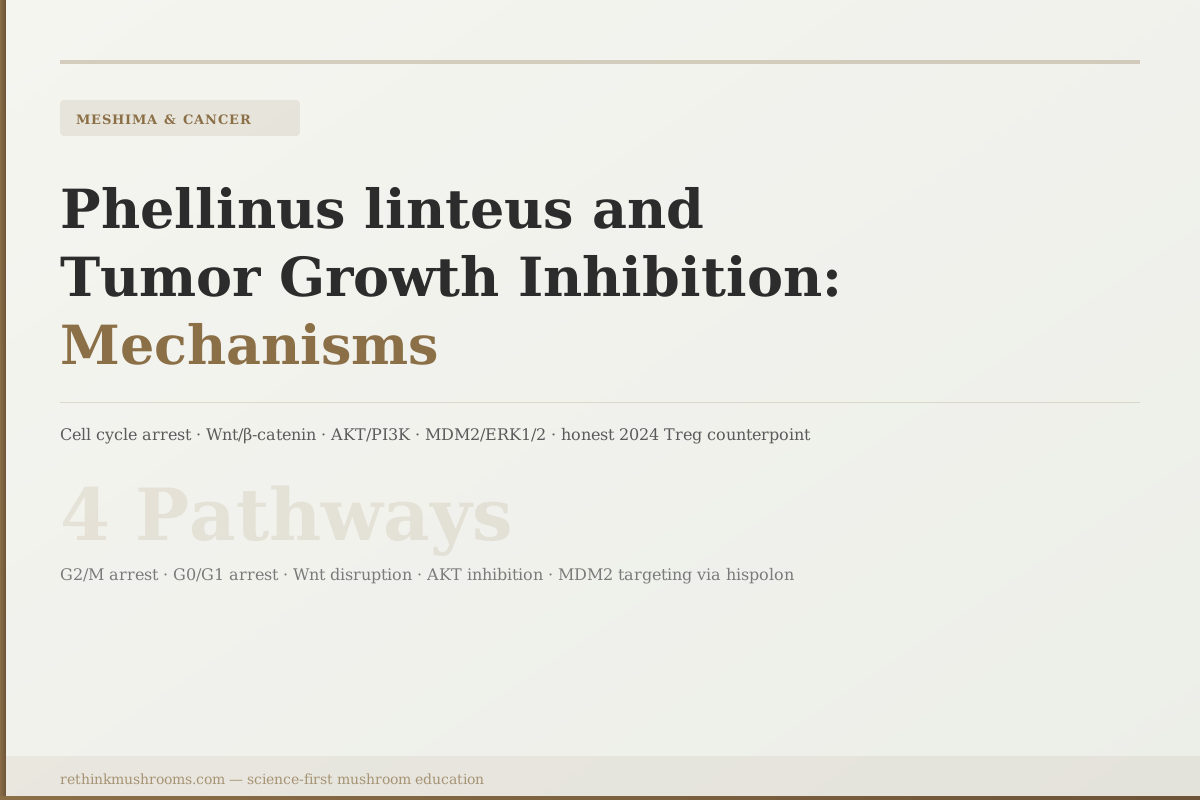
4 tumor inhibition pathways
Phellinus linteus inhibits tumor growth through four documented pathways, across colon, breast, and leukemia cell models, using two distinct compound classes with different mechanisms.
Sliva, Experimental and Therapeutic Medicine, 2010
Wnt/β-catenin
pathway disrupted in colon cancer cells dysregulated in ~90% of colorectal cancers (Song et al., BMC Cancer, 2011)
G2/M + G0/G1
two different cell cycle arrest patterns from two different PL compound classes in the same cancer type
2024
the year a new study found PL activates Treg cells in liver cancer via FAK, a pro-tumorigenic immune effect no consumer site has covered
Sliva, Experimental and Therapeutic Medicine, 2010
 View as image ↗
Four separate molecular mechanisms. Two distinct compound classes. Research published in journals including the British Journal of Cancer and BMC Cancer. Most of it from the last two decades, and almost none of it covered in consumer health content.
This article maps how Phellinus linteus (Meshima) inhibits tumor growth at the pathway level. It is the most technically detailed article in the Meshima cancer cluster. The intent is not to suggest Meshima is a cancer treatment (the evidence is entirely preclinical) but to explain precisely what the laboratory data shows about how the compounds in this mushroom interact with cancer cell biology.
For the overview of Meshima cancer research across all mechanisms, see Meshima and Cancer: The Complete Research Review. For the pillar overview of Meshima itself, see What Is Meshima Mushroom? Korea's Anti-Cancer Mushroom.
Key Takeaways
- Two different Phellinus linteus compounds arrest the cell cycle at different checkpoints: protein-bound polysaccharide halts colon cancer cells at G2/M phase; hispolon (the key polyphenol) halts leukemia cells at G0/G1 phase (Li et al., 2004; Chen et al., 2013)
- Song and colleagues (2011) found that PL protein-bound polysaccharide simultaneously inhibited tumor growth, invasion, and angiogenesis in colon cancer cells by disrupting Wnt/beta-catenin signaling, a pathway dysregulated in approximately 90% of colorectal cancers
- Sliva and colleagues (2008) showed that PL suppressed growth, colony formation, and invasive behavior in triple-negative MDA-MB-231 breast cancer cells through AKT/PI3K pathway inhibition and S-phase cell cycle arrest via p27Kip1 upregulation
- Hispolon works through the MDM2/ERK1/2 pathway, an approach active even in cancer cells with mutated, non-functional p53, because MDM2 is a p53 regulator that hispolon recruits via ERK1/2 (Lu et al., Food and Chemical Toxicology, 2009)
- A 2024 study in Cancer Immunology Immunotherapy found that PL activates regulatory T cells (Treg) via FAK signaling, promoting M2 macrophage polarization in hepatocellular carcinoma, a context in which PL's immune effects appear pro-tumorigenic rather than anti-tumorigenic (Chen et al., 2024)
- All evidence is from cell culture and animal models; no human clinical trial has tested PL for anti-tumor effects in cancer patients
What Tumor Growth Inhibition Means at the Cell Level
Tumors grow because cells divide faster than they die, evade immune surveillance, build their own blood supply, and invade surrounding tissue. A compound that can interfere with any of these processes has anti-tumor activity in the laboratory. Phellinus linteus has documented activity against several.
The four categories of tumor growth inhibition in PL research are:
Cell cycle arrest. Normal cells progress through the cell cycle (G1, S, G2, M phases) on a controlled schedule. Cancer cells cycle rapidly. Compounds that halt cells at a specific checkpoint stop division. If the arrested cells then undergo apoptosis (programmed cell death), the tumor shrinks.
Wnt/beta-catenin disruption. Wnt signaling is a molecular pathway that regulates cell growth, survival, and identity. In colorectal cancer, this pathway is often stuck in the "on" position, driving continuous growth. Compounds that interrupt Wnt/beta-catenin signaling can slow or reverse this.
AKT/PI3K inhibition. The AKT pathway is a key survival signal in many cancer types, particularly breast cancer. When AKT is active, cancer cells resist death and continue growing. Blocking AKT reduces proliferation and increases cancer cell sensitivity to cell death signals.
MDM2/ERK1/2 targeting. MDM2 is a protein that regulates p53, the tumor suppressor. Many cancers disable p53 through MDM2 overexpression. Hispolon recruits MDM2 via ERK1/2 signaling in a way that can reactivate cell death pathways even when p53 itself is mutated.
The snippet-target answer: Phellinus linteus inhibits tumor growth through cell cycle arrest (two different checkpoints from two compound classes), Wnt/beta-catenin pathway disruption, AKT/PI3K inhibition, and MDM2/ERK1/2 targeting via hispolon. Each mechanism has been documented in cell culture models.
Cell Cycle Arrest: G2/M from Polysaccharides, G0/G1 from Hispolon
Cell cycle arrest means a compound forces cancer cells to stop dividing. But where in the cycle the arrest happens depends on which compound does it and which cell type it targets.
Li and colleagues (2004) tested a protein-bound polysaccharide extracted from Phellinus linteus against SW480 human colon cancer cells. The polysaccharide induced arrest at G2/M phase, meaning cells were stopped just before or during the division step. This was followed by apoptosis: the arrested cells died rather than resuming their cycle.[1]
The G2/M checkpoint is where the cell checks whether DNA replication was successful. Arresting cells here means forcing them to pause before dividing, giving them the option to repair or die.
Chen and colleagues (2013) tested hispolon, the key polyphenol in Phellinus linteus, against NB4 human leukemia cells and found arrest at G0/G1 phase. G0/G1 is earlier in the cycle: the cell is told to stop before DNA replication even begins. The hispolon-treated leukemia cells then underwent apoptosis via caspase-3 and caspase-9 activation (mitochondrial pathway).[2] Hispolon was more toxic to the leukemia cells than to normal cells in the same experimental setup.
The same mushroom contains two compound classes that arrest cancer cells at different cell cycle phases through different mechanisms. This mechanistic diversity may explain part of PL's reported activity across multiple cancer types.
Wnt/Beta-Catenin Disruption: The Colon Cancer Pathway
In 2011, Song and colleagues published a study in BMC Cancer examining the effect of PL protein-bound polysaccharide on SW480 colon cancer cells. They found the polysaccharide did not just arrest cell division. It simultaneously inhibited tumor growth, invasion of surrounding tissue, and angiogenesis (the formation of new blood vessels that feed the tumor).[3]
The molecular mechanism was disruption of Wnt/beta-catenin signaling. In the Wnt pathway, beta-catenin is a protein that migrates to the cell nucleus and turns on growth-promoting genes. In colorectal cancers, this pathway is frequently constitutively active: the growth signal is stuck on. The PL polysaccharide interrupted this pathway, reducing nuclear beta-catenin.
This finding is notable for several reasons. First, Wnt/beta-catenin dysregulation occurs in approximately 90% of colorectal cancers, making it a primary target in colon cancer research. Second, the study demonstrated three simultaneous effects from one compound on one cell type: growth inhibition, invasion suppression, and angiogenesis blockade. Multi-target effects are uncommon in natural product research. For the angiogenesis aspect specifically, see Meshima and Anti-Angiogenesis: Cutting Off Tumor Blood Supply.
AKT/PI3K Inhibition: Breast Cancer Invasion and the S-Phase Story
Sliva and colleagues published a 2008 study in the British Journal of Cancer testing PL extract against MDA-MB-231 breast cancer cells. MDA-MB-231 is triple-negative breast cancer: it lacks hormone receptors and HER2, making it the most aggressive and treatment-resistant breast cancer subtype.
PL inhibited proliferation, reduced the ability of cells to form colonies, and suppressed the invasive behavior of cancer cells through matrigel (a laboratory proxy for tissue invasion). The central mechanism was inhibition of the AKT/PI3K signaling pathway, which is one of the most commonly overactivated survival pathways in breast cancer. Cell cycle arrest occurred at S phase via upregulation of p27Kip1, a protein that puts the brakes on cell division.[4]
PL also suppressed urokinase-plasminogen activator secretion. Urokinase-plasminogen activator is an enzyme that cancer cells use to degrade the protein matrix around them, enabling invasion into neighboring tissue. Blocking it reduces invasive capacity.
For the full breast cancer evidence review including the hormone-sensitive tumor angle, see Meshima and Breast Cancer: Research on Hormone-Sensitive Tumors.
MDM2 and Hispolon: Active Even When p53 Is Mutated
An estimated 50% of human cancers carry mutations in the p53 gene, the primary tumor suppressor. Many cancer drugs work through p53, and they fail when p53 is non-functional.
Lu and colleagues (2009) tested hispolon against breast and bladder cancer cells and found it inhibited proliferation via the MDM2/ERK1/2 pathway.[5] MDM2 is a protein that normally acts as a negative regulator of p53: when MDM2 is active, it marks p53 for degradation. Some cancers overexpress MDM2 specifically to disable p53 and avoid cell death.
The finding that hispolon works through MDM2 via ERK1/2 recruitment is mechanistically significant because it suggests a pathway to apoptosis that does not require functional p53. The ERK1/2 signaling chain is separate from p53, and hispolon's recruitment of MDM2 through this pathway appears to reactivate cell death mechanisms even when the p53 route is blocked.
This is a cell culture finding from two cancer types. Whether this mechanism operates in living tumor tissue at achievable hispolon concentrations is not established.
The 2024 Counterpoint: When PL's Immune Effects Work Against Tumor Control
Most consumer coverage of Meshima presents it as having uniformly anti-cancer immune effects. The 2024 research complicates this picture.
Chen and colleagues (2024) published a study in Cancer Immunology Immunotherapy examining how Phellinus linteus interacts with the immune microenvironment in hepatocellular carcinoma (liver cancer). They found that PL activates regulatory T cells, called Tregs, via a signaling protein called FAK (focal adhesion kinase). Active Treg cells suppress other immune cells, including cytotoxic T cells that would otherwise attack the tumor. The FAK-driven Treg activation also promoted M2 macrophage polarization, a shift in macrophage behavior from inflammatory/anti-tumor to anti-inflammatory/pro-tumor.[6]
In the context of liver cancer specifically, this means PL's immune interaction may suppress the immune response against the tumor rather than enhance it. This is the opposite of the mechanism most people assume when they hear "immune-modulating mushroom."
This finding does not invalidate the cell cycle arrest and Wnt/AKT/MDM2 mechanisms documented in other cancer types. But it demonstrates that PL's effects are context-dependent: the cancer type, the immune microenvironment, and the signaling state of the tumor all influence whether a given compound is acting against tumor growth or inadvertently supporting it. For more on Meshima and immune effects, see Meshima and the Immune System: Immunomodulatory Research. For how mushroom polysaccharides generally activate cancer-fighting immune cells, see How Mushroom Sugars Activate Cancer-Fighting Immune Cells.
What the 2023-2024 Reviews Show and What Remains to Be Proven
Two major review papers updated the Phellinus linteus polysaccharide evidence base in 2023 and 2024.
Qin and colleagues (2023) published a systematic review of PL polysaccharides in the International Journal of Biological Macromolecules, covering extraction methods, structural characterization, and documented biological activities. The review confirmed that PL polysaccharides retain anti-cancer and immunomodulatory activity across multiple study types and synthesis their structure-activity relationships.[7]
Kou and colleagues (2024) extended this to drug delivery applications: the same journal published a review covering nanoparticle-based delivery systems for PL polysaccharides, noting enhanced bioavailability and anti-tumor efficacy in delivery-enhanced models compared to conventional administration.[8] The drug delivery angle matters because one limitation of natural polysaccharides as therapeutic agents is their poor oral bioavailability, and drug delivery research is an attempt to address this.
A related 2023 study by Wang and colleagues tested Sanghuangporus sanghuang, a close taxonomic relative of Phellinus linteus, against lung cancer cells in both cell culture and a mouse model, finding inhibition of both proliferation and invasion in the animal setting.[10] This extends the Pleurotus genus evidence to lung cancer in an in vivo model, from the species most closely related to Meshima.
The 2010 comprehensive review by Sliva summarized four decades of PL antitumor research and positioned PL as having the strongest antitumor activity among mushrooms tested in Japanese studies over that period, across prostate, breast, colon, lung, and melanoma cell types.[9]
What remains to be proven: no human clinical trial has tested Phellinus linteus for anti-tumor effects in cancer patients. The Ku 2022 double-blind RCT measured immune parameters, not cancer outcomes. The cell cycle arrest, Wnt disruption, AKT inhibition, and MDM2 targeting mechanisms are all cell culture findings. The Huang 2011 oral hepatoma study and the Tsuji 2010 prostate xenograft study provide in vivo validation but remain animal models. The path from these preclinical data points to clinical cancer therapy has not been mapped. For the apoptosis mechanism specifically, see Meshima and Cancer Cell Apoptosis: How It Triggers Cell Death. For the prostate evidence, see Meshima and Prostate Cancer: Preclinical Evidence.
The Bottom Line
Phellinus linteus inhibits tumor growth in preclinical models through four documented pathways: cell cycle arrest (G2/M via polysaccharide, G0/G1 via hispolon), Wnt/beta-catenin disruption (colon cancer), AKT/PI3K inhibition (breast cancer), and MDM2/ERK1/2 targeting via hispolon. A 2024 study found a pro-tumorigenic immune effect in liver cancer via Treg/FAK activation. All evidence is preclinical; no human cancer trials exist for PL.
Frequently Asked Questions
Sources & References
- 1RTHM-00140·Li, Ge et al. (2004). “Protein-bound polysaccharide from Phellinus linteus induces G2/M phase arrest and apoptosis in SW480 human colon cancer cells..” Cancer letters.Study breakdown →PubMed →↩
- 2RTHM-00514·Chen, Yi-Chuan et al. (2013). “Hispolon from Phellinus linteus induces G0/G1 cell cycle arrest and apoptosis in NB4 human leukaemia cells..” The American journal of Chinese medicine.Study breakdown →PubMed →↩
- 3RTHM-00437·Song, Kyoung-Sub et al. (2011). “Protein-bound polysaccharide from Phellinus linteus inhibits tumor growth, invasion, and angiogenesis and alters Wnt/β-catenin in SW480 human colon cancer cells..” BMC cancer.Study breakdown →PubMed →↩
- 4RTHM-00271·Sliva, D et al. (2008). “Phellinus linteus Extract in Breast-Cancer Cell Models: What This 2008 Study Actually Found.” British journal of cancer.Study breakdown →PubMed →↩
- 5RTHM-00306·Lu, Te-Ling et al. (2009). “Hispolon from Phellinus linteus has antiproliferative effects via MDM2-recruited ERK1/2 activity in breast and bladder cancer cells..” Food and chemical toxicology : an international journal published for the British Industrial Biological Research Association.Study breakdown →PubMed →↩
- 6RTHM-01867·Chen, Feihua et al. (2024). “Phellinus linteus activates Treg cells via FAK to promote M2 macrophage polarization in hepatocellular carcinoma..” Cancer immunology.Study breakdown →PubMed →↩
- 7RTHM-01770·Qin, Dandan et al. (2023). “Polysaccharides from Phellinus linteus: A systematic review of their extractions, purifications, structures and functions..” International journal of biological macromolecules.Study breakdown →PubMed →↩
- 8RTHM-01920·Kou, Fang et al. (2024). “Phellinus linteus polysaccharides: A review on their preparation, structure-activity relationships, and drug delivery systems..” International journal of biological macromolecules.Study breakdown →PubMed →↩
- 9RTHM-00364·Sliva, Daniel (2010). “Medicinal mushroom Phellinus linteus as an alternative cancer therapy..” Experimental and therapeutic medicine.Study breakdown →PubMed →↩
- 10RTHM-01817·Wang, Weike et al. (2023). “Sanghuangporus sanghuang extract inhibits the proliferation and invasion of lung cancer cells in vitro and in vivo..” Nutrition research and practice.Study breakdown →PubMed →↩