Psilocybin Species and Mycology
180+ Psilocybe species
Psilocybe cubensis is the most widely distributed psilocybin-containing mushroom in the world, found on cattle dung in tropical regions across six continents and placed among roughly 180 species in its genus by a 2024 PNAS phylogenomic study.
Bradshaw et al., PNAS, 2024; Nichols, Journal of Antibiotics, 2020
1.6–8cm
cap diameter at maturity
Purple-black
spore print color (key diagnostic)
4 enzymes
in the psilocybin biosynthetic pathway (Fricke 2017)
Bradshaw et al., PNAS, 2024; Nichols, Journal of Antibiotics, 2020
 View as image ↗
Understanding the biology and identification of Psilocybe cubensis begins with a simple observation: touch this mushroom and it turns blue within seconds. That color change is not cosmetic. It is a chemical reaction: psilocin, the active metabolite of psilocybin present in the tissue, oxidizes on contact with oxygen at the site of damage. No other common dung-growing mushroom behaves this way.
Psilocybe cubensis is a Schedule I controlled substance in the United States and is illegal in most jurisdictions worldwide. This article covers its natural history, morphology, and biology as scientific and educational content only. It does not contain cultivation instructions or acquisition guidance.
P. cubensis is a coprophilic species (one that grows on the dung of large herbivores), native to tropical and subtropical regions worldwide. It is the most widely distributed and most-studied psilocybin-containing mushroom species on Earth. For a comprehensive overview of the species and its role in psilocybin research, see Psilocybe cubensis: The World's Most Cultivated Magic Mushroom.
Key Takeaways
- Psilocybe cubensis is a dung-colonizing fungus native to tropical and subtropical environments, found in the Americas, Southeast Asia, Africa, and Australia
- The species belongs to family Hymenogastraceae within roughly 180 species in genus Psilocybe; older literature sometimes refers to it as Stropharia cubensis (now taxonomically incorrect)
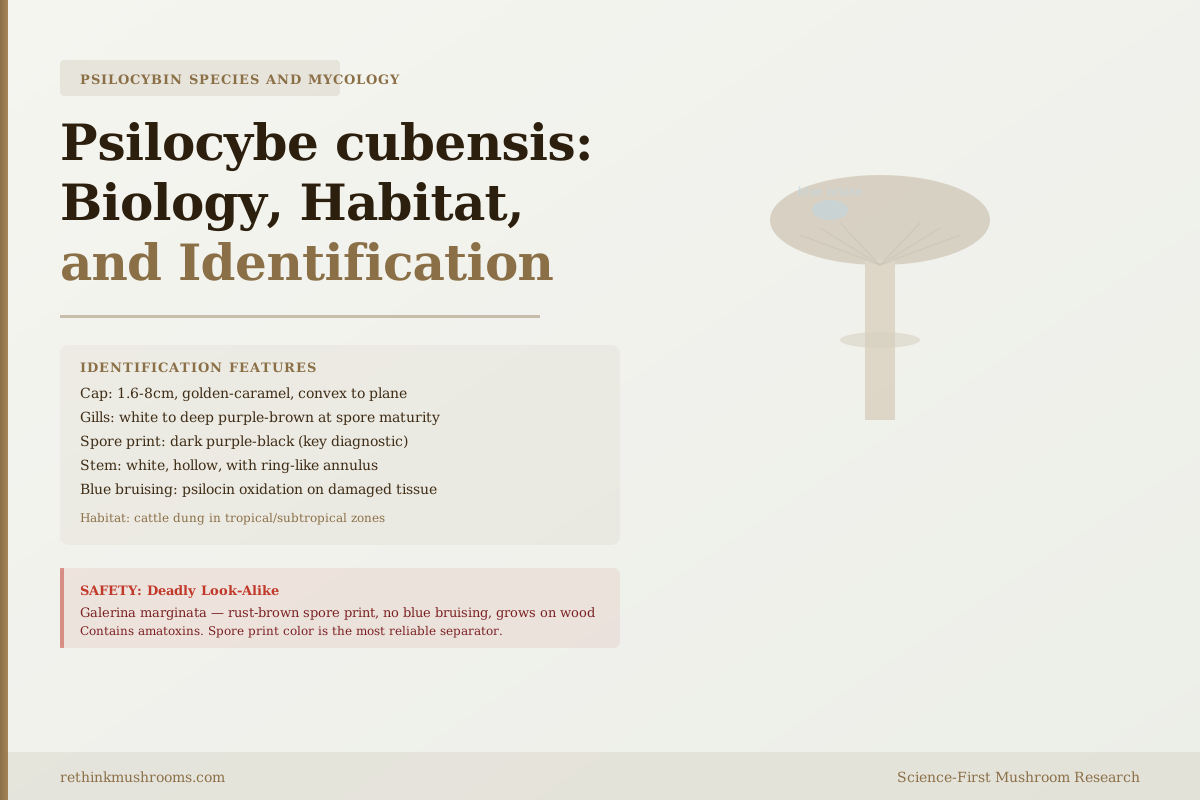
- Five identification features: golden-caramel cap (1.6-8cm), gills darkening from white to purple-brown at spore maturity, dark purple-black spore print, white stem with ring, blue-green bruising reaction on any damaged tissue
- The blue bruising reaction is caused by psilocin (the active form of psilocybin) oxidizing when tissue is damaged; Fricke et al.'s 2017 research identified the four-enzyme psilocybin biosynthetic pathway that explains this
- The most dangerous look-alike is Galerina marginata, which contains liver-destroying amatoxins, distinguished by its rust-brown (not purple-black) spore print and absence of blue bruising
- The 2024 PNAS phylogenomic study by Bradshaw and colleagues found that psilocybin biosynthesis evolved at least twice independently across the fungal lineage, confirming its origin through horizontal gene transfer
Where P. cubensis Grows: Dung-Specialist of the Tropical World
Psilocybe cubensis is a coprophilic fungus: it grows on and decomposes the dung of large herbivorous mammals, primarily cattle, horses, and water buffalo. Its natural range follows tropical and subtropical climate zones around the globe. The species is documented in the southern United States (Florida, Texas, Louisiana, Georgia), throughout Central and South America, across Southeast Asia (Thailand, Vietnam, the Philippines, Malaysia), parts of sub-Saharan Africa, and in northern Australia.
A 2020 review by David Nichols, covering the pharmacological and ethnological history of psilocybin, notes that the geographic spread of P. cubensis closely tracks the spread of cattle ranching from the 16th century onward. As European colonization introduced large domesticated cattle to tropical and subtropical regions, the conditions for P. cubensis followed: a reliable substrate in warm, humid climates with high rainfall.[1]
The fruiting conditions for P. cubensis are specific. Optimal temperatures for sporulation and fruiting range from approximately 23 to 28°C (73 to 82°F). Relative humidity must stay consistently high, above approximately 85%, for fruiting bodies to form and develop. In practice, this means mushrooms appear in cattle pastures shortly after heavy rain during warm seasons. The mycelium colonizes fresh or recently weathered dung; fruiting bodies emerge when moisture and temperature conditions align.
A 2025 review by Kurzbaum and colleagues on P. cubensis strains and biology notes that the species shows considerable morphological plasticity across these environments.[2] Fruiting body size, cap color intensity, and cap shape vary meaningfully with substrate quality, ambient temperature, and humidity at fruiting. This environmental responsiveness is part of why specimens from different regions and different growing conditions can look quite different while being the same species.
P. cubensis grows singly or in small scattered groups on or near dung piles. It is not a wood-decomposer and does not grow from living wood or intact tree roots. Habitat is one of the most reliable first-stage identification criteria.
Five Identification Features of Psilocybe cubensis
Identifying any wild mushroom requires evaluating multiple features simultaneously. No single feature is sufficient for a definitive identification. The five features below are the consistent characteristics that together identify P. cubensis; they should be evaluated as a set.
The cap. Caps are 1.6 to 8 cm in diameter, depending on the specimen's age and growing conditions. Young caps are convex and golden to caramel-brown, often darker at the center. A slight raised point at the center (called an umbo) is common but not always present. As the cap matures and flattens, the color fades from the center outward, becoming paler cream or off-white in old specimens. The surface is smooth to slightly sticky when moist. Young specimens sometimes show white patches on the cap surface from the universal veil, a thin membrane that covers the entire young mushroom.
The gills. Gills are closely spaced and attached to the stem. In very young mushrooms, they are whitish to pale grey. As the mushroom matures and spores develop, the gills darken progressively through grey-purple to deep purple-brown. Older specimens show almost black gills at full spore maturity. The color transition is consistent across specimens, though the timing varies with growth rate.
The spore print. This is one of the most diagnostically reliable features. Placing a cap gill-side down on white paper for several hours produces a visible deposit of spores. P. cubensis produces a dark purple-brown to nearly black spore print. This color distinguishes it from many look-alike species with rust, brown, or ochre spore prints.
The stem. The stem is 4 to 15 cm tall and 0.5 to 1.5 cm wide. It is white to whitish, and hollow when the mushroom is mature. A thin, skirt-like membrane called the annulus (the remnant of the partial veil that originally covered the gills) encircles the stem roughly in its upper third. The annulus is fragile and sometimes absent in older specimens.
The blue bruising reaction. Any damaged part of the mushroom, including cap, stem, or gills, develops a blue-green coloration within seconds to minutes of damage. This bruising is caused by the oxidation of psilocin (explained in detail below). Blue bruising is consistent in P. cubensis and serves as a supporting identification feature. It is not uniquely diagnostic, because other psilocybin-containing Psilocybe species also bruise blue, and blue bruising alone is insufficient for a safe identification.
The Fatal Mistake: Galerina marginata and Why It Matters
Any identification guide for P. cubensis must address its most dangerous look-alike directly. Galerina marginata is a wood-decomposing fungus found in temperate forests worldwide. It can be confused with P. cubensis by inexperienced observers, and the consequence of that error is potentially fatal.
Galerina marginata contains amatoxins, the same family of toxins found in the death cap mushroom. Amatoxins cause liver and kidney failure through a delayed mechanism: symptoms typically appear 6 to 24 hours after ingestion, by which point significant organ damage has already occurred. There is no reliable antidote. A single cap of G. marginata can be lethal.
The similarities that create confusion: G. marginata is a small to medium brown mushroom with a stem ring and gills that darken with age. In poor lighting or when specimens are damaged or dried, the visual overlap with a young P. cubensis is real enough that experienced foragers have made this mistake.
The differences that resolve it:
Habitat. G. marginata grows on decaying wood, often in clusters. P. cubensis grows on herbivore dung or dung-enriched soil, not on wood. Habitat observation is the first and most important separator.
Spore print color. G. marginata produces a rust-brown to rust-orange spore print. P. cubensis produces a dark purple-brown to black spore print. This is the clearest distinguishing feature and should be confirmed before any other conclusion.
Blue bruising. G. marginata does not bruise blue. The absence of blue bruising is a useful negative indicator. However, relying on blue bruising as the primary positive indicator is insufficient, because the reaction may be weak or absent in dried specimens, and the test must be performed on fresh tissue.
The practical implication: identifying P. cubensis with enough confidence to be meaningful requires confirming habitat (dung, not wood), observing the characteristic color progression from cap center to edges, and most critically, making a spore print and confirming the dark purple-black color. Any uncertainty, any missing feature, any atypical characteristic should be treated as inconclusive.
Why P. cubensis Turns Blue: The Oxidation Chemistry Behind the Bruise
The blue bruising reaction is the most visually distinctive feature of P. cubensis and the most commonly misunderstood. It is not a psilocybin concentration indicator. It is an oxidation reaction involving psilocin.
The chemistry was clarified by Fricke, Blei, and Hoffmeister in 2017, when they identified the complete four-enzyme pathway by which P. cubensis synthesizes psilocybin from the amino acid tryptophan.[3] The four enzymes work in sequence: PsiD converts tryptophan to tryptamine (removing a carboxyl group), PsiK adds a phosphate group, PsiM adds two methyl groups, and PsiH adds a hydroxyl group. The final product is psilocybin.
Psilocybin itself is colorless and stable. The blue color comes from what happens to it under certain conditions. A small portion of the psilocybin in mushroom tissue exists as psilocin, the dephosphorylated form (lacking the phosphate group). Psilocin is considerably less stable than psilocybin. When mushroom tissue is damaged and exposed to oxygen, psilocin at the site oxidizes rapidly, forming a blue-green compound. The bruise is the visible product of this reaction.
What this tells you about a specimen: the presence of blue bruising confirms that psilocin (and therefore psilocybin) is present in the tissue. The intensity and speed of bruising do not reliably predict how much psilocybin is present. A mushroom that bruises quickly and deeply is not necessarily higher-potency than one that bruises slowly. The reaction depends on how much tissue damage occurred, how much psilocin was at the damage site, and oxygen exposure.
The same chemistry explains why dried P. cubensis specimens may bruise less readily or not at all: drying converts much of the unstable psilocin back toward stable compounds, or reduces the tissue moisture needed for the oxidation reaction to be visible.
For a full analysis of what blue bruising does and does not indicate about a mushroom's identity, see Is Blue Bruising a Reliable Indicator of Psilocybin? Identification Guide.
180 Species and Where P. cubensis Fits Among Them
In 2024, Bradshaw and colleagues published a landmark phylogenomic analysis of the genus Psilocybe in the Proceedings of the National Academy of Sciences, using whole-genome sequencing data from approximately 180 Psilocybe species.[4]
The study placed P. cubensis within the family Hymenogastraceae in the order Agaricales. Earlier literature classified the genus under Strophariaceae, and some pre-2010 sources refer to P. cubensis by its former name Stropharia cubensis. The Hymenogastraceae classification is now supported by phylogenomic data.
The Bradshaw 2024 study's most significant finding was about the psilocybin biosynthetic gene cluster itself. The four genes encoding the psilocybin-making enzymes (psiD, psiK, psiM, psiH) appear to have been acquired by multiple fungal lineages independently through horizontal gene transfer. The same genes jumped between distantly related species rather than passing down through a single ancestral lineage. Psilocybin synthesis appears to have evolved at least twice in the fungal kingdom, and possibly more often.
This has implications for understanding P. cubensis's biology. The species' ability to produce psilocybin is not the result of a slow, gradual evolutionary elaboration unique to its lineage. It is a relatively recently acquired capacity, possibly driven by the same selective pressure (whatever that was) that drove horizontal transfer in other lineages. What that selective pressure was remains an open scientific question.
Within the Psilocybe genus, P. cubensis is positioned among the tropical and subtropical coprophilic species, phylogenetically separate from the more potent temperate species like P. azurescens (found in Oregon dunes) and P. semilanceata (found in European grasslands). The coprophilic lifestyle is not universal in Psilocybe; most species in the genus decompose wood debris or grow in disturbed soil.
For the detailed evolutionary biology of psilocybin gene transfer across fungi, see Horizontal Gene Transfer: How Psilocybin Genes Jump Between Species.
From Cattle Pastures to Research Labs: P. cubensis in Scientific History
The Mazatec people of Oaxaca, Mexico, had ceremonial uses for psilocybin-containing mushrooms long before Western science encountered them. Ethnomycologist R. Gordon Wasson documented a Mazatec mushroom ceremony in a 1957 Life magazine article that introduced the concept to a broad Western audience. Swiss chemist Albert Hofmann isolated and synthesized psilocybin from a related species, Psilocybe mexicana, in 1958. The pharmacology of psilocybin, specifically its role as an agonist of serotonin receptors (particularly the 5-HT2A receptor), was established in subsequent decades. Nichols's 2020 review provides the most comprehensive and authoritative single-source account of this history.[1]
P. cubensis became dominant in subsequent research and cultivation culture for biological reasons. Compared to other psilocybin-containing species, it is more tolerant of variable growing conditions, colonizes substrate reliably, and produces multiple successive crops of fruiting bodies from a single colonized base. A 2025 review by Kurzbaum and colleagues documents how these characteristics drove the development of hundreds of named cultivar varieties from the 1970s onward, as amateur mycologists developed strains selected for morphological traits, yield, or potency.[2]
Today, P. cubensis appears throughout psilocybin research as the species whose compound (psilocybin) is being studied therapeutically. The clinical trials themselves, however, use pharmaceutical-grade synthetic psilocybin rather than the mushroom. The distinction matters: when researchers publish findings on psilocybin-assisted therapy, they are studying the isolated molecule, not P. cubensis. The mushroom's place in current science is as the natural source and historical context for a compound now synthesized in pharmaceutical facilities.
For the data on exactly how much psilocybin P. cubensis contains across different samples and named varieties, see Psilocybin Content in P. cubensis: How Much Is Actually There?.
The Bottom Line
Psilocybe cubensis is a dung-colonizing fungus native to tropical and subtropical regions worldwide, identified by its golden-caramel cap, dark purple-black spore print, and characteristic blue bruising reaction caused by psilocin oxidation. The species belongs to a genus of approximately 180 species in family Hymenogastraceae, positioned within that genus as a tropical coprophile phylogenetically distinct from more potent temperate species. The most dangerous identification error involves confusion with Galerina marginata, which contains liver-destroying amatoxins and is distinguished by rust-brown spore print and absent blue bruising. A 2024 PNAS phylogenomic study confirmed that the ability to synthesize psilocybin was acquired through horizontal gene transfer, not continuous ancestral inheritance.
Frequently Asked Questions
Sources & References
- 1RTHM-00646·Nichols, David E (2020). “Psilocybin: from ancient magic to modern medicine..” The Journal of antibiotics.Study breakdown →PubMed →↩
- 2RTHM-00932·Kurzbaum, Eyal et al. (2025). “Exploring Psilocybe cubensis Strains: Cultivation Techniques, Psychoactive Compounds, Genetics and Research Gaps..” Journal of fungi (Basel.Study breakdown →PubMed →↩
- 3RTHM-00471·Fricke, Janis et al. (2017). “Enzymatic Synthesis of Psilocybin..” Angewandte Chemie (International ed. in English).Study breakdown →PubMed →↩
- 4RTHM-00865·Bradshaw, Alexander J et al. (2024). “Phylogenomics of the psychoactive mushroom genus Psilocybe and evolution of the psilocybin biosynthetic gene cluster..” Proceedings of the National Academy of Sciences of the United States of America.Study breakdown →PubMed →↩