Tremella Mushrooms
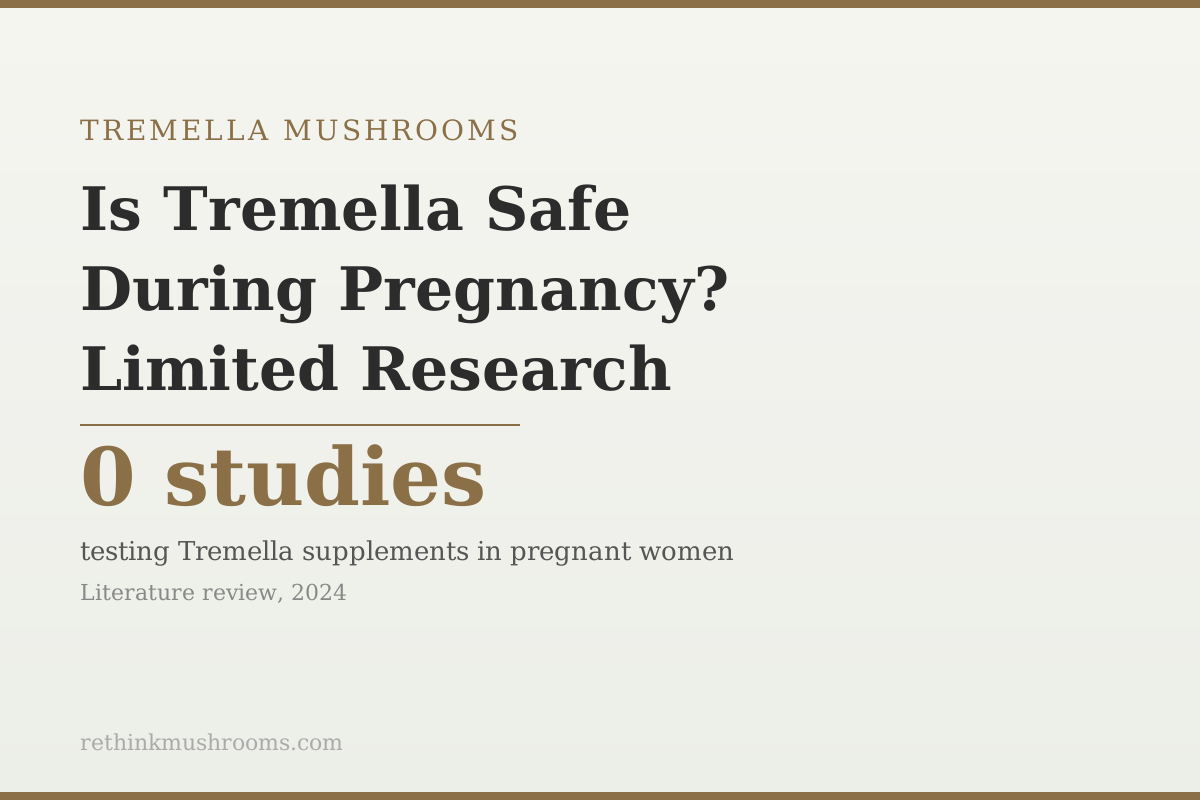
0 clinical studies of Tremella supplements during pregnancy
No clinical safety study has tested Tremella fuciformis supplements in pregnant women. The only existing clinical data involves non-pregnant adults. The absence of evidence is itself important information for anyone weighing this decision.
Literature review; Ban et al., 2018 (non-pregnant adults only)
1,000+ years
of Tremella fuciformis as a food ingredient in China, including traditional use during pregnancy as snow mushroom soup
Food vs. supplement
a critical distinction: traditional whole-food use has a different safety profile than concentrated extract capsules at 1200mg+
Topical
Tremella in skincare has lower systemic exposure than oral supplements and is considered a low-concern ingredient by EWG for most users
Literature review; Ban et al., 2018 (non-pregnant adults only)
 View as image ↗
The direct answer to whether Tremella supplements are safe during pregnancy is: no one knows. No clinical trial has tested Tremella in pregnant women. No animal study has specifically examined its effects during pregnancy. The evidence base that exists covers non-pregnant adults in one randomized trial and preclinical data showing low general toxicity. These findings cannot answer the pregnancy safety question.
This does not mean Tremella is unsafe during pregnancy. It means the question is unanswered by clinical evidence. The distinction matters because the most important thing a person searching this question can learn is the actual state of the research, not a reassuring claim that lacks evidence behind it. For broader context on what Tremella is and what research shows in other populations, see what is Tremella mushroom: the beauty mushroom explained.
Key Takeaways
- There are no clinical safety studies of Tremella supplements in pregnant women; all existing clinical safety data comes from studies of non-pregnant adults
- Ban et al. (2018) conducted the most rigorous clinical safety assessment of Tremella: an RCT in adults with cognitive impairment found no significant safety concerns, but this population is not generalizable to pregnancy
- Yang et al. (2019) reviewed preclinical data on Tremella polysaccharides and found a favorable general safety profile in animal models, but the review did not specifically include pregnancy or developmental toxicity studies
- Tremella fuciformis has been consumed as snow mushroom soup in Chinese cuisine for over 1,000 years, including traditional use during pregnancy; this long food-use record is relevant context but does not constitute clinical safety evidence
- The food-supplement distinction is critical: eating tremella mushroom in soup involves very different compound concentrations and preparation than taking a concentrated extract capsule at 1200mg or more per day
- Topical use of Tremella-containing skincare products during pregnancy presents lower systemic exposure risk than oral supplementation and is a separate consideration
What the Research Actually Shows
Tremella fuciformis (snow mushroom) has been studied for various health properties, but the pregnancy safety question has not been the focus of any clinical research.
The most rigorous clinical data comes from Ban and colleagues, who published a randomized controlled trial on Tremella in 2018.[1] The study examined efficacy and safety in adults with subjective cognitive impairment, testing both effectiveness and tolerability over time. The safety findings were favorable in this population: participants reported no significant adverse effects. But the study population was older adults with cognitive concerns, not pregnant women. The physiological changes of pregnancy, the different metabolic considerations, and the additional safety threshold that applies to any substance that might affect fetal development are not addressed by data from this population.
Yang and colleagues reviewed the molecular mechanisms and drug action of Tremella polysaccharides in 2019, including preclinical toxicity data.[2] Animal studies of Tremella polysaccharides showed a generally favorable safety profile at doses relevant to typical supplement use, with no significant toxicity signals in the standard acute and subacute toxicity models tested. However, the review did not include developmental toxicity studies (which test for teratogenicity or embryotoxicity) or reproductive toxicity studies. The absence of these specific safety assessments means the preclinical data does not provide developmental safety information.
The combined picture: Tremella shows low toxicity in non-pregnant adults and in general animal models, but no study has specifically examined its safety during pregnancy or in developing fetuses.
Traditional Use as Context
Tremella fuciformis has been a food ingredient in Chinese cuisine for more than a thousand years. In traditional Chinese medicine, it is classified as a yin-nourishing ingredient often recommended specifically during pregnancy and postpartum recovery. Snow mushroom soup (銀耳蓮子羹) is a traditional preparation consumed by pregnant women in parts of China.
This traditional use history is relevant context. A substance consumed as food by millions of people across generations without documented adverse pregnancy outcomes has a different practical risk profile than a novel laboratory compound. The absence of historical harm signals from traditional food consumption is meaningful information.
However, traditional food use is not the same as clinical safety evidence, and food-form consumption at culinary levels is not the same as supplemental consumption at concentrated doses. Both of these distinctions matter.
The Critical Distinction: Food vs. Supplement
The gap between eating snow mushroom in soup and taking a concentrated Tremella extract capsule is significant enough to warrant explicit discussion.
As food: Snow mushroom in soup involves whole fungal material at culinary quantities (a few grams of dried mushroom per serving, primarily water and polysaccharides, prepared by boiling). This is the form consumed in traditional Chinese practice during pregnancy.
As a supplement: Commercial Tremella supplements are typically sold as capsules containing 500mg-1200mg or more of extract per dose, standardized to polysaccharide content. This represents a concentrated form of the mushroom's bioactive compounds at doses substantially higher than typical food consumption.
The safety logic of traditional food use does not automatically transfer to high-dose concentrated supplements. Many substances that are safe in food quantities cause harm at supplement doses. A pregnant woman eating snow mushroom in soup as an occasional culinary ingredient is making a different decision than one taking daily high-dose Tremella extract capsules. The former has centuries of practical safety context; the latter does not.
Topical Use: A Different Risk Profile
Tremella polysaccharides are commonly used in skincare products for their water-binding and skin-conditioning properties. This topical use is a separate consideration from oral supplementation.
The primary concern with any substance during pregnancy is systemic exposure (absorption into the bloodstream) and potential transfer across the placenta. Topical application of a high-molecular-weight polysaccharide like Tremella fuciformis extract presents substantially lower systemic absorption risk than oral supplementation. Large polysaccharide molecules do not readily penetrate intact skin.
The Environmental Working Group (EWG) rates Tremella fuciformis extract as a low-concern ingredient for most skin-related applications. This assessment is not specific to pregnancy, but the low systemic exposure from topical use means the risk profile is meaningfully lower than for oral supplements.
Pregnant women who want to use skincare products containing Tremella extract are making a different risk decision than those considering oral supplements. The topical application concern, while not zero, is substantially lower given the limited systemic exposure pathway.
When to Be Most Cautious
Pregnancy involves several distinct periods with different vulnerability profiles. The first trimester is generally the highest-risk period for any substance because organ formation (organogenesis) occurs primarily during weeks 3-8. Substances with any potential developmental effects are most consequential during this window.
For mushroom supplements generally, the most cautious approach is to avoid all non-essential supplements during the first trimester and to consult a healthcare provider before using any supplement at any point during pregnancy. This applies to Tremella supplements and to functional mushroom supplements generally.
For dietary (food) consumption of Tremella in traditional culinary preparations, the risk profile is different and lower. The centuries of traditional use during pregnancy across a large population without documented adverse outcomes is meaningful, though not equivalent to clinical evidence.
What This Article Cannot Tell You
This article has explained what the research shows (limited general safety data in non-pregnant adults) and what it does not show (no pregnancy-specific data). It has provided traditional use context and the food-supplement distinction.
It cannot tell you whether Tremella is safe for you during your specific pregnancy. That determination involves your specific health history, your healthcare provider's assessment, the specific product and dose you're considering, and the stage of your pregnancy. No article can substitute for that conversation.
The practical guidance this research supports: avoid high-dose concentrated Tremella supplements during pregnancy until clinical safety data exists; culinary consumption of snow mushroom at typical food quantities is a different and lower-risk situation; topical use in skincare is lower risk than oral supplementation; consult your healthcare provider for guidance specific to your situation.
The Bottom Line
No clinical safety studies of Tremella supplements during pregnancy exist. The available evidence consists of a 2018 RCT in non-pregnant adults with cognitive impairment showing favorable safety (Ban et al., 2018) and preclinical data showing low general toxicity without pregnancy-specific developmental testing (Yang et al., 2019). Traditional food consumption of snow mushroom in Chinese cuisine during pregnancy has a centuries-long safety record at culinary doses, but this is not equivalent to clinical evidence and does not automatically extend to concentrated supplement extracts. The food-versus-supplement distinction, the topical-versus-oral distinction, and the absence of any pregnancy-specific safety data are the key factors for anyone evaluating this question.
Frequently Asked Questions
Sources & References
- 1RTHM-00941·Ban, Soonhyun et al. (2018). “Efficacy and Safety of Tremella fuciformis in Individuals with Subjective Cognitive Impairment: A Randomized Controlled Trial..” Journal of medicinal food.Study breakdown →PubMed →↩
- 2RTHM-01145·Yang, Dandan et al. (2019). “Tremella polysaccharide: The molecular mechanisms of its drug action..” Progress in molecular biology and translational science.Study breakdown →PubMed →↩