Mushroom Cultivation
7-10 Days
A 2019 study published in PLOS ONE developed the Cabin-Sequestering method for removing bacterial contamination from fungal cultures. Clean fungal hyphae grew out from under a sterile coverslip in 7-10 days, while bacteria remained trapped inside.
Shi et al., PLOS ONE, 2019
PDA vs MEA
two most common agar media
21-24 C
optimal incubation range
3 Methods
spore, tissue, and transfer
Shi et al., PLOS ONE, 2019
 View as image ↗
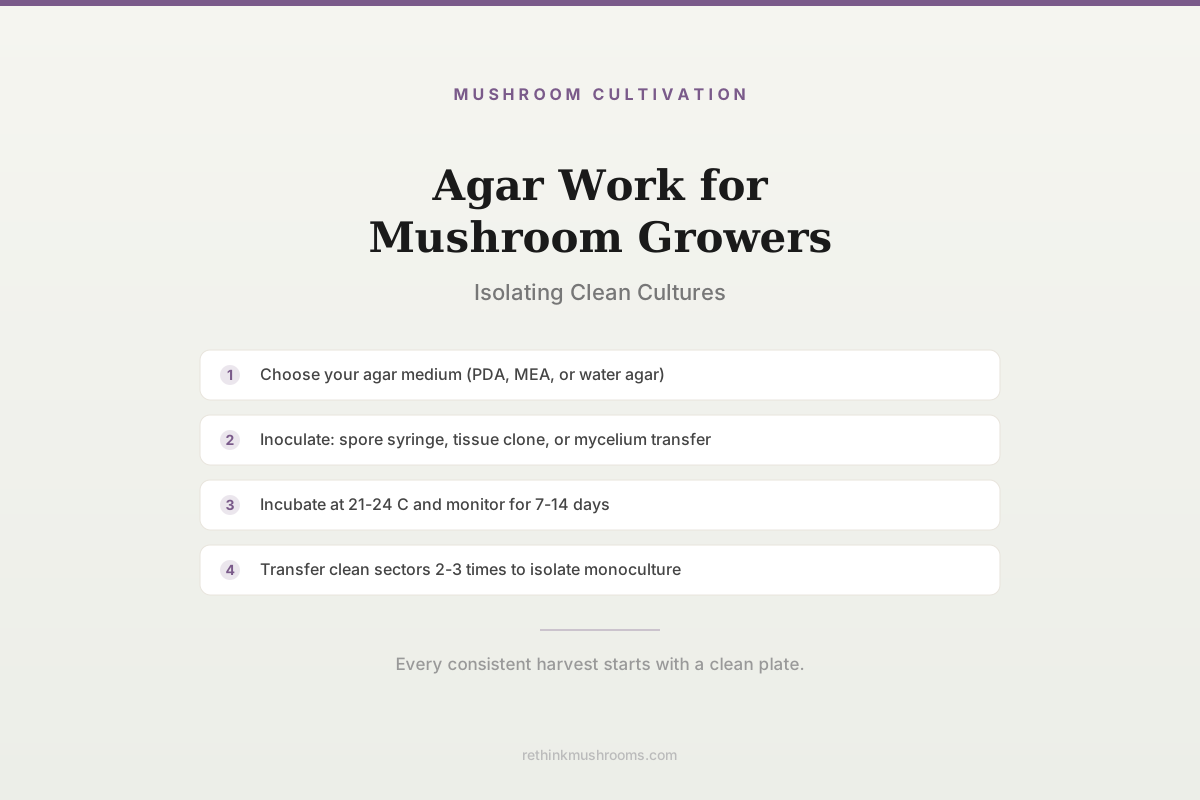
Agar work is the foundation of controlled mushroom cultivation. Every clean grain spawn jar, every reliable fruiting block, and every consistent harvest traces back to a culture isolated on an agar plate. The plate gives you a controlled, visible environment to grow mycelium, check for contamination, isolate strong genetics, and maintain cultures over time. Without agar skills, you rely on whatever is in the spore syringe or liquid culture, contamination and all. For the workspace needed to do this cleanly, the still air box guide covers construction and technique. For identifying what went wrong when plates go bad, the contamination identification guide has visual references.
Key Takeaways
- PDA (Potato Dextrose Agar) was the most suitable medium for mycelial growth of P. eryngii, while P. ostreatus grew better on YMA and MEA media (Nguyen et al., PJBS, 2020)
- The Cabin-Sequestering (CS) method removes bacterial contamination from fungal cultures without antibiotics, producing clean colonies in 7-10 days (Shi et al., PLOS ONE, 2019)
- Substrate chemistry, strain, and developmental stage cause wide metabolite variation in fungal tissue, making culture origin and maintenance critical for consistent results (Berger et al., Microorganisms, 2022)
- Best grain for spawn production was species-dependent: barley and rye for P. eryngii, oat for P. ostreatus (Nguyen et al., 2020)
- Beta-glucan content varied roughly threefold across 21 edible species by the Megazyme assay (10.50-34.97 g per 100 g dry mass), and assay choice can reshuffle the species ranking (Mironczuk-Chodakowska and Witkowska, IJERPH, 2020)
What Agar Work Is and Why It Matters
Agar is a gelling agent derived from red algae. When mixed with water and nutrients, then sterilized in a pressure cooker, it creates a transparent or semi-transparent solid medium in a petri dish. Mushroom mycelium grows across this surface in a visible, controllable way.
The agar plate serves three primary functions:
Isolation. When you inoculate a plate from a multispore syringe, tissue sample, or liquid culture, you can see what grows. Healthy mycelium appears as white, fuzzy, rhizomorphic (rope-like) or tomentose (cottony) growth radiating from the inoculation point. Contaminants, whether bacterial (slimy, discolored) or mold (green, black, gray), appear distinctly different and can be identified early.
Selection. Not all mycelium from a multispore inoculation is the same. Different spore germinations produce different genetic combinations. By transferring the fastest-growing, healthiest-looking sector to a new plate, you select for the genetics you want. After several rounds of transfer (typically 2-3), you isolate a monoculture: genetically uniform mycelium from a single germination.
Maintenance. Clean cultures stored on agar at refrigerator temperatures (2-4 degrees C) remain viable for months to years depending on species. This gives you a library of verified genetics to draw from whenever you need to make grain spawn.
Choosing Your Agar Medium: PDA, MEA, and Alternatives
The two most widely used media in mushroom cultivation are PDA (Potato Dextrose Agar) and MEA (Malt Extract Agar). Both work for most species, but research shows they are not equivalent.
Nguyen and colleagues compared culture media for Pleurotus eryngii (king oyster) and Pleurotus ostreatus (oyster mushroom) in 2020.[1] PDA was the most suitable medium for P. eryngii mycelial growth, while P. ostreatus grew better on YMA (Yeast Malt Agar) and MEA. They also tested grain sources for spawn production and found that the best grain depended on species: barley and rye were most favorable for P. eryngii, while oat grains gave the best mycelial extension and density for P. ostreatus.
PDA (Potato Dextrose Agar) contains potato extract (or dehydrated potato flakes) and dextrose (glucose) as the primary carbon source. It is the most cost-effective option, widely available as pre-mixed powder, and works well for most gourmet and medicinal species. PDA is an especially good choice for isolation work because contaminants grow visibly on it, making them easy to spot.
MEA (Malt Extract Agar) uses malt extract as its primary nutrient source. It promotes faster mycelial growth for many species, produces denser growth, and is preferred for species like oyster mushrooms that respond better to the complex sugars in malt extract. MEA is more expensive per plate than PDA.
Water Agar contains only agar and water, with no nutrients. This is a specialized tool for contamination management: healthy mycelium can grow on water agar using its own stored energy, but most bacteria and molds cannot proliferate without nutrients. Transferring mycelium to water agar and then back to nutrient agar can help clean up marginally contaminated cultures.
Dog Food Agar (DFA) is a budget alternative used by some home growers. Dry dog food blended and added to agar provides a surprisingly complete nutrient profile. It works, but introduces more variables and is harder to standardize.
How to Inoculate Agar Plates
Three primary methods exist for getting mushroom genetics onto agar.
Spore Inoculation
A multispore syringe is the most common starting point for new growers. Draw a small amount (0.1-0.2 mL) and streak it lightly across the agar surface. The key word is lightly. Excess liquid pools on the surface and promotes bacterial growth. A single light streak across the plate is better than flooding it.
After 3-7 days at 21-24 degrees C, you will see germination points where spores have begun growing. Multiple spore germinations will appear as separate mycelial colonies. Each one is genetically distinct. Some will grow faster, some more rhizomorphic, some more tomentose. This is where selection begins.
Tissue Culture (Cloning)
Tissue culture produces a genetic clone of the mushroom you start with. Split a fresh, healthy fruiting body in half with clean hands. Using sterilized fine-tip tweezers, pluck a small piece of internal tissue (about 2-3 mm) from the center of the flesh where it has not been exposed to open air. Place this tissue in the center of an agar plate. The internal tissue is less likely to carry surface contaminants than the outer cap or gills.
Berger and colleagues demonstrated in their 2022 review that substrate chemistry, strain, and developmental stage all cause wide variation in metabolite concentrations in both mycelium and fruiting bodies.[2] This means the mushroom you clone from determines the baseline chemistry of everything you grow from that culture. Cloning from a vigorous, well-formed fruiting body selects for those traits.
Mycelium Transfer
Once you have a growing plate, transfers are how you clean up, isolate, and maintain cultures. Using a flame-sterilized scalpel, cut a small wedge (3-5 mm) from the leading edge of healthy mycelium growth. Transfer it to the center of a fresh plate. The leading edge is the newest, most actively growing tissue and the least likely to carry contamination from the inoculation point.
Each transfer round reduces contamination risk and narrows genetic variation. By the third transfer, you typically have a clean monoculture suitable for grain spawn production.
Dealing with Contamination
Contamination happens. The question is whether you can recover the culture.
Shi and colleagues developed the Cabin-Sequestering (CS) method, published in PLOS ONE in 2019, as an antibiotic-free approach to removing bacterial contamination from fungal cultures.[3] The method works by exploiting the physical growth difference between fungi and bacteria. A 3-5 mm hole is cut in a solid agar plate. The contaminated fungal culture is placed in the hole and covered with a sterilized glass coverslip. Fungal hyphae grow out along the edge of the coverslip over 7-10 days, while bacteria cannot pass through the thin gap between the coverslip and the medium surface. The clean hyphae emerging around the coverslip are then transferred to fresh plates, producing bacteria-free colonies.
This method has advantages over antibiotic treatment: no risk of incomplete removal, no effects on the fungal strain, no contribution to antibiotic resistance, and rare recontamination. For home growers, it is a practical rescue technique when a valuable culture picks up bacterial contamination.
For more straightforward contamination, standard sectoring works: use a flame-sterilized scalpel to transfer a clean mycelium wedge from the opposite side of the plate from the contaminant to a fresh plate. If contamination appears in multiple locations on the plate or covers more than a third of the surface, the plate should be discarded.
Identifying Healthy Growth vs. Contamination
Healthy mushroom mycelium has predictable visual characteristics:
- Rhizomorphic growth: rope-like strands radiating from the center, often a sign of vigorous genetics
- Tomentose growth: cottony, fluffy white growth that is more uniform, typical of some species and earlier growth stages
- Color: white for most gourmet species; some species produce pigmented mycelium naturally
- Pattern: radial, even growth from the inoculation point
Common contaminants have distinct appearances:
- Trichoderma: starts white and fluffy (easy to confuse with mycelium), then develops green spores within 3-5 days
- Penicillium/Aspergillus: blue-green or green-black spots, often with a powdery texture
- Bacteria: slimy, wet-looking colonies, often yellow, orange, or white; may produce a sour smell
- Cobweb mold: extremely fine, gray, wispy growth that spreads faster than mushroom mycelium
The contamination identification guide covers each type with visual details.
From Plate to Grain Spawn
A clean agar culture is the starting point for grain spawn production. The standard workflow:
- Grow clean culture on agar (2-3 transfers until monoculture)
- Cut wedges from the clean plate
- Drop wedges into sterilized grain jars (oats, rye, wheat berries)
- Incubate at 21-24 degrees C until grain is fully colonized
- Use colonized grain to inoculate bulk substrate
Nguyen et al. found that the best grain for spawn production was species-dependent: barley and rye for P. eryngii, oat for P. ostreatus.[1] Rye is the other widely used choice, valued for its high nutrient content and consistent hydration properties. The grain source affects colonization speed and vigor, which in turn affects how quickly your bulk substrate colonizes and how competitive the mycelium is against contaminants. The full sterile technique guide covers the complete process from agar to harvest.
Species-Specific Considerations
Not all mushrooms behave the same on agar. Mirończuk-Chodakowska and Witkowska measured beta-glucan content across 21 edible species and found a roughly threefold range by the Megazyme assay (lowest 10.50 g/100 g dry mass in Macrolepiota procera, highest 34.97 g/100 g in Tricholoma portentosum).[4] This species-level variation in fruiting-body chemistry has parallels in growth rates, temperature preferences, and media preferences on agar.
Some practical species differences:
- Oyster mushrooms (P. ostreatus): fast growers, prefer MEA, tolerate a wide temperature range, aggressive colonizers that compete well with contaminants
- King oyster (P. eryngii): slower than common oyster, prefers PDA, more sensitive to temperature fluctuations
- Shiitake (Lentinula edodes): moderate growth rate, forms brown pigmented zones on agar, benefits from a period of cold storage before fruiting
- Lion's mane (Hericium erinaceus): distinctive tomentose growth, can produce tiny fruiting primordia on agar plates, prefers slightly warmer temperatures (24-26 degrees C)
- Reishi (Ganoderma lucidum): often produces a lacquered appearance on agar, grows on both PDA and MEA, forms a distinctive dark-edged growth front
The Bottom Line
Agar work gives mushroom growers visual control over genetics, contamination, and culture quality. Published research shows that media choice (PDA versus MEA) affects growth rate differently depending on species. The Cabin-Sequestering method provides an antibiotic-free rescue technique for contaminated cultures. Standard practice involves 2-3 transfers to establish a clean monoculture, followed by grain spawn inoculation. Species differ in growth rate, media preference, and temperature optimum on agar, making it worth testing multiple conditions when working with a new species.
Frequently Asked Questions
Sources & References
- 1RTHM-00645·Nguyen, Thanh M et al. (2020). “Effect of Different Culture Media, Grain Sources and Alternate Substrates on the Mycelial Growth of Pleurotus eryngii and Pleurotus ostreatus..” Pakistan journal of biological sciences : PJBS.Study breakdown →PubMed →↩
- 2RTHM-00743·Berger, Ralf G et al. (2022). “Mycelium vs. Fruiting Bodies of Edible Fungi-A Comparison of Metabolites..” Microorganisms.Study breakdown →PubMed →↩
- 3RTHM-00587·Shi, Xiao-Xiao et al. (2019). “A handy method to remove bacterial contamination from fungal cultures..” PloS one.Study breakdown →PubMed →↩
- 4RTHM-00637·Mirończuk-Chodakowska, Iwona et al. (2020). “Evaluation of Polish wild Mushrooms as Beta-Glucan Sources..” International journal of environmental research and public health.Study breakdown →PubMed →↩