Agarikon
70-75% Decline
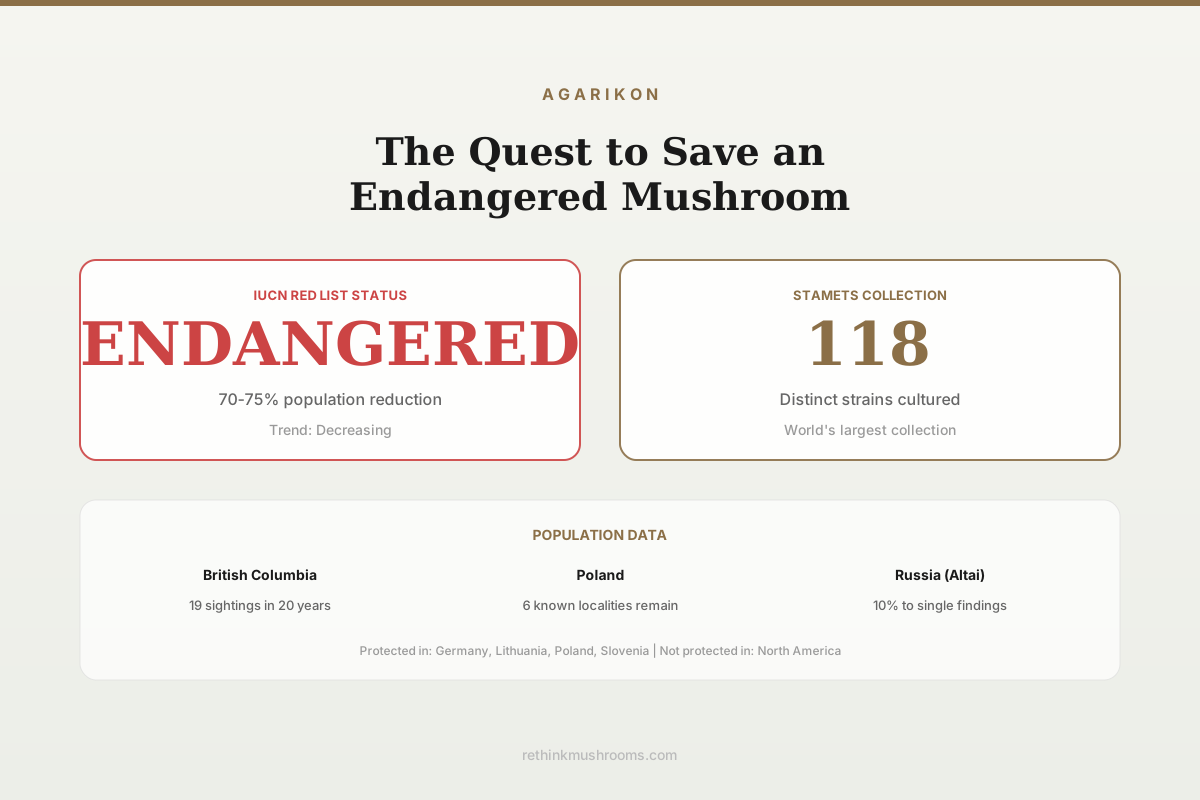
Agarikon (Fomitopsis officinalis) is classified as Endangered on the IUCN Red List after an estimated 70-75% population reduction driven by old-growth habitat loss and historical over-harvesting.
IUCN Red List Assessment
100+ Strains
cultured by Fungi Perfecti, world's largest collection
75 Years
maximum lifespan of a single fruiting body
4 Countries
legally protected: Germany, Lithuania, Poland, Slovenia
IUCN Red List Assessment
 View as image ↗
In 2024, mycologist Paul Stamets announced that his team at Fungi Perfecti had cultured 100 strains of agarikon (Fomitopsis officinalis), "by far the largest culture collection in the world." By the time of the announcement, the number had grown to 118 distinct strains, each undergoing full genome sequencing. The collection represents decades of field work across the old-growth forests of the Pacific Northwest, often in terrain so remote that specimens could only be reached by boat or helicopter.
The urgency behind this work is straightforward. Agarikon is classified as Endangered on the IUCN Red List, with an estimated 70-75% population reduction driven by two forces: the destruction of old-growth forests and centuries of harvesting the mushroom for medicine.[1] Every strain that goes extinct before it can be studied is a potential loss to both ecology and medicine. The antiviral research that makes agarikon scientifically interesting also makes its conservation biologically urgent: different strains show different bioactivity profiles, and the strain that produces the most potent antiviral compounds may be growing on a tree that will be logged next year.
Key Takeaways
- Agarikon is listed as Endangered (EN) on the IUCN Red List under criterion A2ad, with a 70-75% population reduction and a decreasing trend (IUCN Red List Assessment)
- Paul Stamets' Fungi Perfecti has cultured 118 distinct strains, the world's largest collection, with full genome sequencing underway on each strain (Stamets, 2024)
- The species requires old-growth conifers aged 150+ years, primarily larch (Larix spp.) and Douglas fir, making it entirely dependent on ancient forest ecosystems (Muszynska et al., Chemistry and Biodiversity, 2020)
- British Columbia recorded only 19 sightings in 20 years despite systematic surveys; Poland's range contracted from common occurrence to six known localities (IUCN Red List Assessment)
- Agarikon is legally protected in four European countries: Germany, Lithuania, Poland, and Slovenia; no legal protection exists in North America (IUCN Red List Assessment)
- Of seven agarikon strains submitted to the U.S. BioShield BioDefense Program, three showed antiviral activity, but strain-specific responses varied, demonstrating that genetic diversity in the species has direct medicinal relevance (Girometta, Mycology, 2019)
Biology of an Ancient Fungus
Agarikon produces the largest and longest-lived fruiting bodies of any polypore mushroom. A single specimen can persist on its host tree for up to 75 years, adding a new layer of pore tissue each growing season. The resulting structure is hoof-shaped or elongated, sometimes exceeding 40 cm in diameter, with a chalky white exterior and a bitter taste that early pharmacists used as a substitute for quinine.[1]
The species is a white-rot saprotroph, meaning it decomposes lignin in dead or dying wood. It colonizes living-snags (dead sections of living trees) and standing dead trunks of old-growth conifers. Its primary hosts are larch trees (Larix spp.) across its Eurasian range and Douglas fir (Pseudotsuga menziesii) in North America. The common element is tree age: agarikon typically establishes on trees aged 150 years or older. Young plantation forests, even those with the correct tree species, do not support agarikon because they lack the structural complexity (dead branches, heartwood exposure, bark fissures) that the fungus requires for initial colonization.
The geographic range spans the Northern Hemisphere's boreal and montane forests. In North America, populations concentrate in the Pacific Northwest from southern British Columbia through Washington and Oregon. In Europe, remnant populations survive in mountain forests of the Alps, Carpathians, and Scandinavian highlands. The species also occurs in Siberia, the Russian Far East, Mongolia, China, Japan, Korea, India's Himalayan forests, and Morocco's Atlas Mountains.[1]
The 2,000-Year Medicinal History
The Greek physician Dioscorides described agarikon in the first century CE as a treatment for "phthisis" (consumption/tuberculosis), establishing it as one of the oldest documented medicinal fungi in Western medicine. For the next 1,800 years, agarikon appeared consistently in European pharmacopeias. It earned the Latin epithet "elixirium ad longam vitam" (elixir of long life).[2]
In 18th and 19th century European pharmacy, agarikon was used primarily for two conditions: tuberculosis and night sweats (hyperhidrosis). The anti-tuberculosis application has a modern correlate. Hwang and colleagues, working with Stamets, isolated chlorinated coumarins from agarikon mycelium that showed activity against Mycobacterium tuberculosis, including extensively drug-resistant strains (XDR-TB).[3] The night sweat application may reflect antipyretic or immunomodulatory properties rather than direct antimicrobial action. The full medical history of agarikon covers this timeline in depth.
This centuries-long medicinal demand contributed directly to agarikon's decline. The IUCN assessment lists "intensive harvesting of fruiting bodies for traditional medicine" as one of two primary threats alongside logging.[1] In Russia's Altai Mountains, where Teplyakova and colleagues collected specimens for antiviral research, the infection rate on larch trees dropped from 10% in the early 20th century to isolated single findings by 2001.
The Population Collapse
The IUCN Red List assessment documents agarikon's decline across its range with specific numbers:
- British Columbia: Only 19 confirmed sightings in 20 years of systematic surveys, versus 109 total records since 1940. The species is increasingly restricted to remote coastal old-growth stands accessible only by water.
- Poland: Range contracted from "common occurrence" to six known localities. The species is now legally protected.
- Russia (Altai): Early 20th century surveys found agarikon on 10% of larch trees in some forests. By 2001, only single specimens could be located.
- Europe broadly: The species is described as "on the brink of extinction" across the continent, with viable populations persisting primarily in Scandinavian and Carpathian mountain forests.
The decline tracks directly with old-growth forest loss. Agarikon cannot colonize young trees. When a 300-year-old larch bearing agarikon is logged, the fungus is destroyed, and no replacement host will be suitable for another 150+ years. The generation time of the fungus exceeds the rotation age of commercial timber plantations by an order of magnitude. Even "sustainable" forestry that replaces harvested old growth with replanted stands eliminates agarikon habitat for centuries.
Stamets' Collection: Why Strain Diversity Matters
Paul Stamets began collecting agarikon strains in the 1990s as part of broader mycological fieldwork in the Pacific Northwest. The collection accelerated after the BioShield antiviral screening revealed that different strains had markedly different bioactivity profiles. Of seven strains submitted to USAMRIID, three showed "remarkable" antiviral activity against poxviruses, herpes, and influenza. The other four showed weak or no activity.[4]
This strain specificity has profound implications. It means that agarikon's antiviral potential is not a species-level property but a strain-level property. A population that appears visually identical to another may have entirely different chemistry. Losing a genetically distinct population to logging or harvesting could mean losing a specific antiviral profile that exists nowhere else.
The Fungi Perfecti collection now contains 118 distinct strains. Each strain is being subjected to full genome sequencing, enabling comparative genetic analysis that can correlate specific genomic features with antiviral or antimicrobial activity. This is the mycological equivalent of a germplasm bank: preserving genetic diversity for future research even if wild populations continue to decline.
Stamets described the collection as "a national treasure" and argued that "when we cut down the old-growth forests, we are potentially losing genomic libraries that could have a strain of fungi that could have enormous implications for human biosecurity, and moreover, habitat health."
Legal Protection: Where It Exists and Where It Does Not
The legal status of agarikon varies dramatically by jurisdiction, and the gaps in protection are as significant as the protections themselves.
Agarikon is legally protected in four European countries: Germany, Lithuania, Poland, and Slovenia. These protections prohibit harvesting of fruiting bodies and, in some cases, mandate habitat conservation for known localities. In Poland, where the species declined from widespread to six known localities, the protection includes both the organism and its habitat. In Germany, harvesting is prohibited under federal nature conservation law. Lithuania and Slovenia have similar protections, though enforcement in remote mountain forests remains challenging.
No legal protection exists for agarikon in North America, despite the Pacific Northwest holding some of the species' last viable populations. The species is not listed under the U.S. Endangered Species Act or Canada's Species at Risk Act. This reflects a broader gap in fungal conservation: most endangered species legislation was written for plants and animals, and fungi are frequently excluded from legal frameworks entirely. The IUCN assessment explicitly recommends "establishment and appropriate management of areas protected by law covering the places of its occurrence, active protection promoting the presence of larch and its regeneration, the prohibition of logging and removing of single old larch trees, the prohibition of unrestricted collection of basidiomata, and strict control of the fungus trade."[1]
Stamets has publicly advocated for old-growth forest protection specifically citing agarikon. In letters to U.S. and Canadian officials, he argued that old-growth forests are "genomic libraries" whose medicinal value cannot be replicated in plantations. His argument connects biodiversity conservation directly to biodefense: if a future pandemic requires an antiviral compound that exists only in a wild agarikon strain, and that strain's habitat has been logged, the compound is gone.
The Cultivation Question
If agarikon can be grown in laboratory culture (which it can, as Stamets' 118-strain collection demonstrates), why does wild conservation matter?
The answer is genetic diversity. Laboratory cultures preserve specific strains, but they do not generate new genetic variation. Wild populations produce new genotypes through sexual reproduction (spore fusion between genetically distinct individuals) and through adaptation to local environmental pressures. A population growing in a hurricane-exposed coastal forest in British Columbia faces different selective pressures than one in a sheltered Carpathian valley. Those pressures drive the evolution of different secondary metabolites, which are the very compounds that produce biomedical interest.
The 2025 review by Gafforov and colleagues confirmed that the distribution of bioactive compounds in F. officinalis varies by "tissue type, extraction solvent, and geographic origin."[5] Geographic origin is a proxy for genetic background. A culture bank preserves the past; wild populations generate the future. Both are necessary. For details on the specific compounds that make geographic variation medically relevant, see the article on Stamets' antiviral hypothesis.
Where Things Stand
Agarikon's status is a case study in the intersection of conservation biology and drug discovery. The species produces compounds with demonstrated in vitro antiviral activity. Its genetic diversity, which determines which compounds each population produces, is declining along with old-growth forests. The largest culture collection in the world contains 118 strains, a significant but necessarily incomplete snapshot of a species whose range once spanned the entire Northern Hemisphere's boreal zone.
The conservation challenges are structural. Agarikon cannot be saved by propagation programs alone because it requires host trees that take 150 years to mature. Habitat protection is the only viable conservation strategy, and that requires policy changes in countries where fungi are not included in endangered species legislation. The medicinal research that makes agarikon valuable also makes it harvested, creating a feedback loop between demand and decline.
The growing supplement market for agarikon adds complexity. As consumer awareness of the species increases, so does harvesting pressure on wild populations. Stamets has stated that he does not harvest fruiting bodies unless they are in forests scheduled for logging or otherwise threatened, but not all collectors follow this practice. The IUCN assessment specifically calls for "strict control of the fungus trade" as a conservation measure. Whether the supplement industry can be supplied entirely from cultivated mycelium without relying on wild-harvested fruiting bodies is an open question that will shape the species' future.
The Bottom Line
Agarikon is IUCN Endangered with a 70-75% population decline driven by old-growth logging and medicinal harvesting. Paul Stamets' Fungi Perfecti has assembled the world's largest culture collection at 118 strains, each undergoing genome sequencing. Strain-level variation in antiviral activity means genetic diversity has direct medicinal relevance. Legal protection exists in four European countries but not in North America. Wild population conservation cannot be replaced by laboratory cultivation alone because genetic diversity and ongoing adaptation require intact old-growth forest habitat.
Frequently Asked Questions
Sources & References
- 1RTHM-00641·Muszyńska, Bożena et al. (2020). “Fomitopsis officinalis: a Species of Arboreal Mushroom with Promising Biological and Medicinal Properties..” Chemistry & biodiversity.Study breakdown →PubMed →↩
- 2RTHM-00641·Muszyńska, Bożena et al. (2020). “Fomitopsis officinalis: a Species of Arboreal Mushroom with Promising Biological and Medicinal Properties..” Chemistry & biodiversity.Study breakdown →PubMed →↩
- 3RTHM-00290·Hwang, Chang Hwa et al. (2013). “Chlorinated coumarins from the polypore mushroom Fomitopsis officinalis and their activity against Mycobacterium tuberculosis..” Journal of natural products.Study breakdown →PubMed →↩
- 4RTHM-00556·Girometta, Carolina (2019). “Antimicrobial properties of Fomitopsis officinalis in the light of its bioactive metabolites: a review..” Mycology.Study breakdown →PubMed →↩
- 5RTHM-00924·Gafforov, Yusufjon et al. (2025). “Mycochemistry, Traditional Uses, and Nutraceutical Potential of Laricifomes officinalis: A Biotechnological and Pharmacological Perspective..” Plant foods for human nutrition (Dordrecht.Study breakdown →PubMed →↩