Agarikon
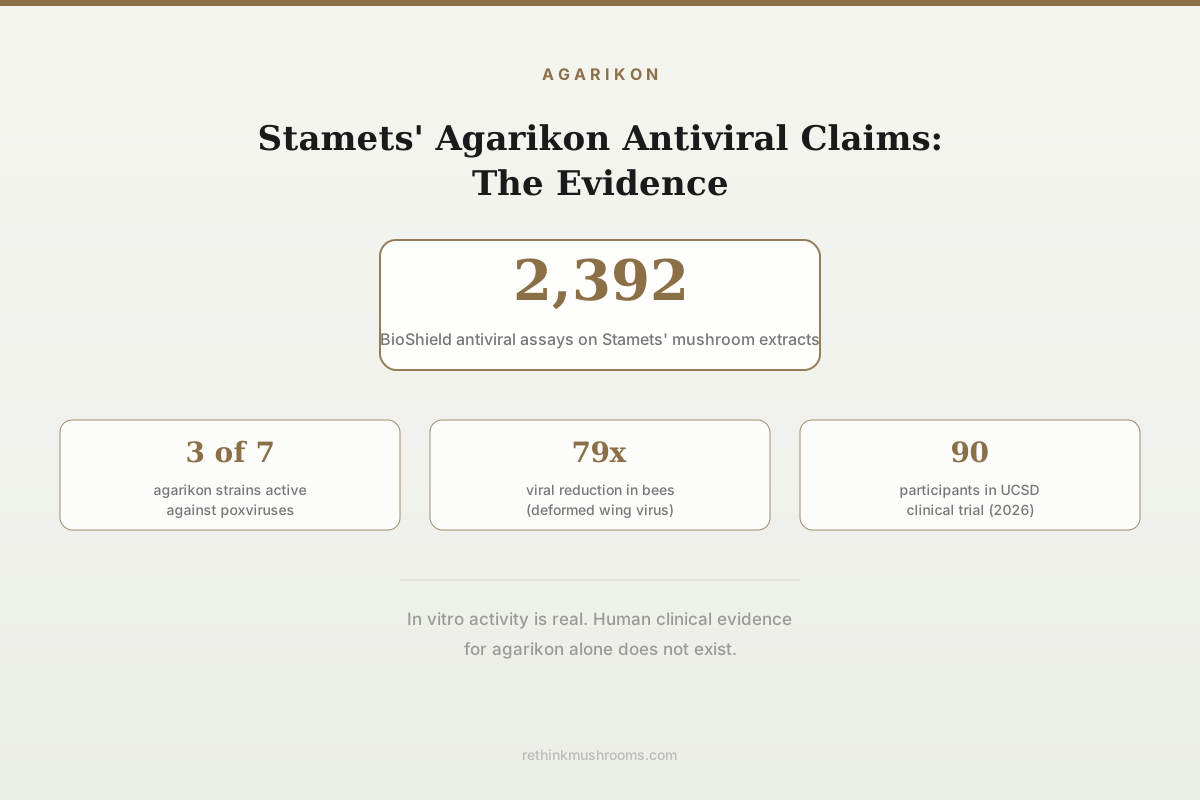
2,392 antiviral assays
The U.S. BioShield program ran 2,392 assays on mushroom extracts submitted by Paul Stamets. Three of seven agarikon strains showed activity against poxviruses and herpes viruses.
Stamets, International Journal of Medicinal Mushrooms, 2005
3 of 7 strains active
against cowpox and vaccinia in BioShield screening
Chlorinated coumarins
isolated from mycelium, active against TB
90-person RCT
UCSD trial: agarikon + turkey tail vs placebo
Stamets, International Journal of Medicinal Mushrooms, 2005
 View as image ↗
Paul Stamets has spent over two decades arguing that agarikon (Fomitopsis officinalis) is a potent broad-spectrum antiviral, citing government screening data, patent filings, and in vitro assays. Some of these claims are supported by published research. Others rest on conference presentations, patent applications, and interviews rather than peer-reviewed studies. This article separates what has been measured and published from what remains hypothesis. For a broader introduction to what agarikon is and its 2,000-year medical history, see our dedicated articles.
The distinction matters because Stamets' public statements often conflate different levels of evidence. A government screening result is not a clinical trial. An in vitro EC50 value is not a human dosing study. A patent claim is not a peer-reviewed finding. The research on agarikon's antiviral properties is genuinely interesting, but it is thinner than public enthusiasm suggests.
Key Takeaways
- Three of seven agarikon strains submitted by Stamets to the U.S. BioShield program showed activity against cowpox and vaccinia viruses in cell culture (Stamets, 2005)
- Chlorinated coumarins isolated from F. officinalis mycelium showed activity against Mycobacterium tuberculosis with MIC values of 2.5 to 4 micrograms per milliliter (Hwang et al., 2013)
- F. officinalis mycelium extract showed antiviral activity against influenza A (H1N1) and herpes simplex virus type 2 in cell culture, with neutralization index values of 3.0 and 2.5 respectively (Krupodorova et al., 2014)
- Polypore mushroom mycelium extracts (including agarikon) reduced deformed wing virus and Lake Sinai virus titers in honey bee colonies by up to 79-fold and 45,000-fold respectively (Stamets et al., 2018)
- A 90-person randomized, double-blind, placebo-controlled trial at UCSD found that agarikon plus turkey tail mycelium was well tolerated and associated with sustained antibody levels at six months post-vaccination (Saxe et al., 2026)
- No human clinical trial has tested agarikon extract alone against any viral infection
The Hypothesis: Agarikon as a Broad-Spectrum Antiviral
Stamets' central claim is that agarikon mycelium contains compounds active against multiple virus families, including poxviruses, herpesviruses, and influenza viruses. He has described crude extract diluted to 1:1,000,000 as still effective against influenza A, influenza B, and herpes in cell culture assays. This claim appears in patent filings (US8765138B2, filed 2006) and media interviews but not in the format of a traditional peer-reviewed publication with full methods and data tables.
The BioShield screening that launched this hypothesis was a U.S. Department of Defense program designed to identify potential countermeasures against biological weapons. Stamets submitted extracts from multiple mushroom species and strains. Of 2,392 assays run on these samples, three of seven agarikon (F. officinalis) strains showed what Stamets described as "remarkable" antiviral activity against cowpox and vaccinia viruses. He published these findings in the International Journal of Medicinal Mushrooms in 2005.[1]
The limitation of this work: the International Journal of Medicinal Mushrooms is an industry-adjacent publication, and the BioShield screening data has not been independently replicated in a separate peer-reviewed study. The activity was real within the assay system, but "activity in a government screening program" occupies a very early position on the evidence hierarchy.
Published Antiviral Data: What Peer-Reviewed Studies Measured
Chlorinated Coumarins Against Tuberculosis
The strongest peer-reviewed chemistry from Stamets' collaboration comes from Hwang et al. (2013), published in the Journal of Natural Products. The team isolated two new chlorinated coumarins from an ethanol extract of F. officinalis mycelium. These compounds showed activity against Mycobacterium tuberculosis with minimum inhibitory concentration (MIC) values of 2.5 to 4 micrograms per milliliter. The structures were confirmed by chemical synthesis.[2]
This is antimycobacterial rather than antiviral activity, but it establishes that F. officinalis mycelium produces bioactive chlorinated compounds not found in the fruiting body. The mycelium versus fruiting body distinction is critical: Girometta et al. (2019) documented that the two growth stages produce different metabolite profiles, with chlorinated coumarins concentrated in mycelium and lanostane triterpenoids in the fruiting body.[1]
Influenza and Herpes Virus Activity
Krupodorova et al. (2014) tested mycelia from 11 basidiomycete species, including F. officinalis, against influenza A (H1N1) and herpes simplex virus type 2 (HSV-2) in cell culture. F. officinalis mycelium extract produced neutralization index values of 3.0 against H1N1 and 2.5 against HSV-2. For context, values above 2.0 indicate antiviral activity in this assay, but the results were not the highest in the panel: some other species, including Inonotus obliquus (chaga), scored higher on certain assays.[3]
Muszynska et al. (2020) reviewed the full range of F. officinalis bioactivities and noted antiviral properties against orthopox viruses (cowpox, vaccinia), H5N1 avian influenza, and H3N2 human influenza, citing neutralization index values of 3.0 and 1.5 respectively for the latter two. All of this data comes from in vitro cell culture systems.[4]
Broad Antiviral Mechanisms in Mushrooms
Seo and Jeong (2021) reviewed antiviral compounds across mushroom species and categorized the mechanisms into three groups: direct virucidal activity (disrupting viral particles), inhibition of viral replication enzymes, and immunomodulation (enhancing host antiviral defenses). For F. officinalis specifically, the evidence points toward the first and third categories, with chlorinated coumarins potentially acting as direct antimicrobials and polysaccharides modulating immune responses.[5]
The Bee Study: Stamets' Strongest Published Evidence
Stamets et al. (2018) published a study in Scientific Reports (a Nature portfolio journal) showing that extracts from polypore mushroom mycelia, including F. officinalis and Ganoderma resinaceum (reishi), reduced viral loads in honey bee colonies naturally infected with deformed wing virus (DWV) and Lake Sinai virus (LSV).[6]
The results were striking: colonies fed mycelium extract showed a 79-fold reduction in DWV and a 45,000-fold reduction in LSV compared to controls. The study used field colonies (not laboratory bees) and included proper controls, making it the most robust published evidence for antiviral activity from Stamets' work.
The study is also notable because it was published in a high-impact journal with rigorous peer review, unlike some of Stamets' earlier agarikon work. The experimental design included multiple colonies per treatment group and measured viral titers using quantitative RT-PCR rather than relying on visual symptom assessment alone.
The caveat: bee viruses are not human viruses. DWV is a positive-sense RNA virus in the family Iflaviridae, unrelated to influenza or herpesviruses. The mechanism by which mycelium extract reduced viral titers in bees is unknown. The authors proposed both direct antiviral effects and immune-boosting effects but did not determine which was operative. Extrapolating from bee antiviral activity to human antiviral activity requires ignoring fundamental differences in immune systems, viral biology, and pharmacokinetics.
The UCSD COVID-19 Clinical Trial
The most clinically relevant data comes from a Phase I/II randomized, double-blind, placebo-controlled trial conducted at the University of California, San Diego (NCT04667247). Saxe, Stamets, and colleagues enrolled 90 healthy adults who received a combination of F. officinalis (agarikon) and Trametes versicolor (turkey tail) mushroom mycelium for four consecutive days at the time of COVID-19 vaccination, then continued for six months.
Published in BMC Immunology in March 2026, the trial reported that the mushroom combination was well tolerated. Participant-reported outcomes showed fewer transient side effects in the treatment group compared to placebo, including reduced injection site pain and systemic symptoms like fatigue and headache. Among participants without prior SARS-CoV-2 exposure, antibody levels were sustained and in some cases increased at six months, while placebo group levels declined as expected.
This is the first placebo-controlled human clinical trial evaluating an agarikon-containing product. The limitations are substantial: the product combined two mushroom species, so the individual contribution of agarikon cannot be isolated. The trial measured antibody levels as a surrogate endpoint, not actual infection rates or clinical outcomes. The sample size of 90 is small for detecting meaningful differences in immune endpoints. The study was not designed to show that agarikon prevents viral infection.
What the Evidence Does Not Support
Stamets' public claims exceed what the published data demonstrates in several specific ways:
No human antiviral trials for agarikon alone. The UCSD trial tested a combination product. No study has measured what happens when humans take agarikon extract and are then exposed to a virus. The in vitro data is interesting but cannot predict clinical efficacy without human pharmacokinetic and efficacy data. This gap between laboratory and clinical evidence is common across medicinal mushroom research, including Agaricus blazei's cancer research from Brazil and Japan.
Patent claims are not peer-reviewed findings. The 1:1,000,000 dilution claim appears in patent filings but not in a peer-reviewed publication with full dose-response curves, cell viability data, and statistical analysis. Patents require "utility" (the invention works for its stated purpose) but not the level of evidence required for scientific publication.
The BioShield data lacks independent replication. Government screening programs identify candidates for further study, not finished therapeutics. The fact that 3 of 7 strains showed activity is a starting point, not an endpoint. Independent labs have tested F. officinalis against some of the same viruses (Krupodorova et al., 2014) and found activity, but at different magnitudes and with different strains.
Mycelium and fruiting body are not interchangeable. Stamets' work primarily uses mycelium extracts, which contain chlorinated coumarins not found in the fruiting body. Most commercial agarikon supplements sold to consumers are fruiting body products. Fijalkowska et al. (2021) demonstrated that fortified F. officinalis mycelium contains specific bioactive compounds effective in preclinical models, but these may differ from what consumers actually purchase.[7]
The Bioactive Compound Picture
Altannavch et al. (2022) demonstrated that F. officinalis extracts inhibit hepatocellular carcinoma cell growth in vitro through the NF-kB pathway, showing anticancer rather than antiviral effects. This illustrates a broader pattern: F. officinalis produces multiple bioactive compound classes with different biological activities, and "antiviral" is one of several documented properties, not the only one.[8]
The known bioactive chemistry includes:
- Chlorinated coumarins (mycelium): antimycobacterial, potentially antiviral
- Lanostane triterpenoids (fruiting body): trypanocidal, anti-inflammatory
- Polysaccharides (both): immunomodulatory
- Agaric acid (fruiting body): historically used as an antiperspirant and antitubercular agent
Which of these compounds drives the observed antiviral activity in cell culture is not established. The extraction method, growth substrate, and whether the source is mycelium or fruiting body all affect the chemical profile of the final product. This makes "agarikon extract" an imprecise term: two products labeled agarikon can contain entirely different compound profiles depending on how they were produced. The antiviral research on agarikon specifically targeting influenza and herpes covers the virology in more detail. For how Stamets' conservation work intersects with his research program, see the quest to save this endangered mushroom.
The Bottom Line
Paul Stamets' hypothesis that agarikon is a broad-spectrum antiviral rests on government screening data (3 of 7 strains active against poxviruses), in vitro cell culture results showing activity against influenza A and herpes, a bee study demonstrating viral load reductions in honey bee colonies, and a 90-person clinical trial testing a combination product alongside COVID-19 vaccination. Chlorinated coumarins from the mycelium have been isolated and characterized with antimycobacterial activity. No human trial has tested agarikon alone against any viral infection. The published evidence supports genuine bioactivity in laboratory systems but does not yet support the clinical antiviral claims made in patents and media appearances.
Frequently Asked Questions
Sources & References
- 1RTHM-00556·Girometta, Carolina (2019). “Antimicrobial properties of Fomitopsis officinalis in the light of its bioactive metabolites: a review..” Mycology.Study breakdown →PubMed →↩
- 2RTHM-00290·Hwang, Chang Hwa et al. (2013). “Chlorinated coumarins from the polypore mushroom Fomitopsis officinalis and their activity against Mycobacterium tuberculosis..” Journal of natural products.Study breakdown →PubMed →↩
- 3RTHM-00331·Krupodorova, Tetiana et al. (2014). “Antiviral activity of Basidiomycete mycelia against influenza type A (serotype H1N1) and herpes simplex virus type 2 in cell culture..” Virologica Sinica.Study breakdown →PubMed →↩
- 4RTHM-00640·Muszyńska, Bożena et al. (2020). “Fomitopsis officinalis: a Species of Arboreal Mushroom with Promising Biological and Medicinal Properties..” Chemistry & biodiversity.Study breakdown →PubMed →↩
- 5RTHM-00717·Seo, Dong Joo et al. (2021). “Antiviral Bioactive Compounds of Mushrooms and Their Antiviral Mechanisms: A Review..” Viruses.Study breakdown →PubMed →↩
- 6RTHM-00532·Stamets, Paul E et al. (2018). “Extracts of Polypore Mushroom Mycelia Reduce Viruses in Honey Bees..” Scientific reports.Study breakdown →PubMed →↩
- 7RTHM-00684·Fijałkowska, Agata et al. (2021). “Fortified Mycelium of Fomitopsis officinalis (Agaricomycetes) as a Source of Biologically Active Substances Effective in the Prevention of Civilization Diseases..” International journal of medicinal mushrooms.Study breakdown →PubMed →↩
- 8RTHM-00740·Altannavch, Nyamsambuu et al. (2022). “Anti-oxidant and Anticancerous Effect of Fomitopsis officinalis (Vill. ex Fr. Bond. et Sing) Mushroom on Hepatocellular Carcinoma Cells In Vitro through NF-kB Pathway..” Anti-cancer agents in medicinal chemistry.Study breakdown →PubMed →↩