Agarikon
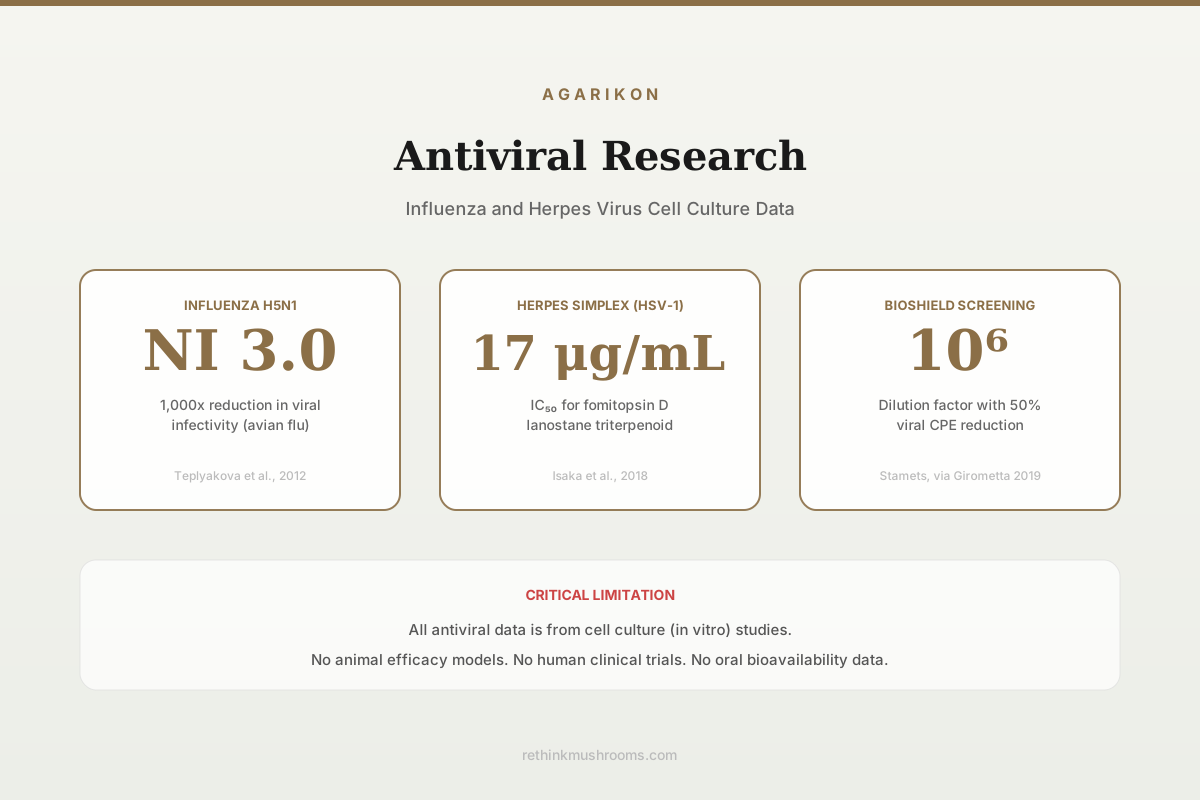
10⁶x Dilution
Crude extracts of Fomitopsis officinalis were reported to remain active against influenza A, influenza B, and herpes simplex virus even when diluted one million-fold in cell culture — a striking figure that has never been published as a peer-reviewed experiment.
Girometta, Mycology, 2019
NI 3.0
neutralization index against avian influenza H5N1 in cell culture
0 Compounds
isolated agarikon compounds with a published anti-flu or anti-herpes potency value
1 Human Trial
but it tested a two-species blend against SARS-CoV-2, not agarikon against flu
Girometta, Mycology, 2019
 View as image ↗
Agarikon (Fomitopsis officinalis, syn. Laricifomes officinalis) is a polypore fungus that grows on old-growth conifers, primarily larch trees, across temperate forests of North America, Europe, and Asia. It produces large, hoof-shaped fruiting bodies that can persist on living trees for decades. The species has one of the longest documented records of medicinal use of any fungus, appearing in European and Greek medical writing as a treatment for pulmonary disease — including "consumption," or tuberculosis — since antiquity.[1]
Modern antiviral interest in agarikon emerged after 2004, when mycologist Paul Stamets submitted mushroom extracts to U.S. government biodefense screening programs for testing against poxviruses, influenza, and herpes. That screening launched a small body of in vitro research and a very large body of marketing. This article separates the two. For context on the person behind this research and the conservation implications, see the articles on Paul Stamets' antiviral hypothesis and the quest to save an endangered mushroom.
Key Takeaways
- Aqueous extracts of F. officinalis mycelium from the Altai Mountains neutralized avian influenza H5N1 (neutralization index 3.0) and human H3N2 (NI 1.5) in cell culture — the best-documented quantitative influenza result for this species (Teplyakova et al., International Journal of Medicinal Mushrooms, 2012)
- The widely repeated "active at one-in-a-million dilution" figure against influenza A, influenza B, and herpes comes from Stamets' patent filings, not from a peer-reviewed experiment; a review reports it as a patent claim (Girometta, Mycology, 2019)
- No isolated, chemically defined compound from F. officinalis has a published anti-influenza or anti-herpes potency value. The frequently cited "fomitopsin D, IC₅₀ 17 μg/mL against HSV-1" result is from Fomitopsis feei, a different mushroom species (Isaka et al., Tetrahedron Letters, 2017, via Girometta 2019)
- The lanostane triterpenoids actually isolated from F. officinalis were tested against a parasite, not a virus, showing trypanocidal activity with IC₅₀ values of 7.0–27.1 μM (Naranmandakh et al., Journal of Natural Medicines, 2018)
- Chlorinated coumarins isolated from F. officinalis mycelium showed a narrow antimicrobial spectrum with the lowest MICs against Mycobacterium tuberculosis — an antibacterial finding, not an antiviral one (Hwang et al., Journal of Natural Products, 2013)
- One randomized controlled human trial now exists: 90 adults received an F. officinalis + Trametes versicolor mycelium blend as an adjunct to COVID-19 vaccination. It found no adverse events and fewer vaccine side-effects in previously unexposed participants — but it did not test agarikon alone, and it did not test influenza or herpes (Saxe et al., BMC Immunology, 2026)
The BioShield Screening: Where the Antiviral Claims Originate
After the Project BioShield Act of 2004 created funding for biodefense research, Fungi Perfecti LLC (Stamets' company) submitted mushroom extracts for antiviral screening in collaboration with U.S. government infectious disease programs. The extracts were tested in standard cytopathic effect (CPE) assays, where viruses are added to cell cultures and researchers measure how much the extract reduces virus-induced cell death.
The key figure, cited across the agarikon literature, comes from these screens. A 2019 review summarizing the patent record reports that a 1–2% F. officinalis extract inhibited virus-induced cellular damage by 50%, and that crude extract diluted one million-fold was still reported as effective against influenza A, influenza B, and herpes.[2] The same review notes separately that F. officinalis showed direct antiviral activity in human foreskin fibroblast cells against cowpox and vaccinia virus.[2]
These numbers need a second layer of context, and it is the more important one. The primary experimental data behind the dilution figure has never been published as a standalone peer-reviewed study with full methodology. It appears in Stamets' patent applications and has been summarized second-hand by reviewers.[2] Two further claims that circulate constantly — that three of seven agarikon strains showed "remarkable" activity, and that ethanol extracts outperformed the antiviral drug ribavirin by a factor of ten or more — trace to Stamets' patent filings and public presentations rather than to any refereed publication. They may well be accurate. They have simply never been through peer review, independent replication, or publication of the underlying methods, and no reader can check them.
Fact Check
The one-in-a-million dilution figure
The claim
“Agarikon extract kills flu and herpes viruses even when diluted one million times, making it one of the most potent antivirals ever found.”
Patent filings and popular retellings of the BioShield-era screening results
What research shows
OverstatedA peer-reviewed review does report the 1:10⁶ dilution result — but explicitly as a claim originating in Stamets' patent applications, not as a replicated experimental finding.
The underlying methods, strain identities, controls, and raw data have never been published. Independent groups have not reproduced the result. A CPE screening endpoint also cannot separate antiviral action from cytoprotection.
Girometta (2019), Mycology 10(1):32–39
The Altai Mountains Study: The Best Published Influenza Data
The most detailed peer-reviewed antiviral data for agarikon against influenza comes from Russian researchers at the State Research Center of Virology and Biotechnology Vector. Teplyakova and colleagues tested aqueous extracts from the mycelium of 11 polypore species collected in the Altai Mountains against two influenza strains.[3]
Teplyakova et al. (2012) · International Journal of Medicinal Mushrooms
- Population
- Cell culture — no animals or humans
- Intervention
- Aqueous extracts of mycelium from 11 polypore species, including Laricifomes (Fomitopsis) officinalis
- Comparator
- Untreated virus controls
- Finding
- F. officinalis extract produced a neutralization index of 3.0 against avian influenza H5N1 (A/chicken/Kurgan/05/2005) and 1.5 against human H3N2 (A/Aichi/2/68) — roughly 1,000-fold and 30-fold reductions in viral infectivity.
preliminary Single-concentration crude extract; no dose-response curves, EC₅₀ values, or selectivity indices reported.
Teplyakova et al. (2012), Int J Med Mushrooms 14(1):37–45; values as reported in Girometta (2019)
A neutralization index of 3.0 on a logarithmic scale means the extract reduced viral infectivity by a factor of 1,000. An NI of 1.5 means a roughly 30-fold reduction. These are meaningful numbers in virology, and they are the strongest published quantitative antiviral result the species has.[2]
They also come with real limits. The assay used a single concentration of a crude extract. Dose-response curves, which would establish EC₅₀ values and selectivity indices, were not reported. And one detail is consistently misreported in secondary coverage: the paper did not single out agarikon as the standout species. It named seven of the eleven tested species — including Daedaleopsis confragosa, Trametes versicolor, and Lenzites betulina alongside L. officinalis — as the most promising candidates for developing antiviral preparations.[3] Agarikon was one of a group, not the winner.
Active Compounds: The Attribution Problem
Crude extracts are chemically undefined mixtures. The obvious next step is to isolate individual compounds and test them. This is where agarikon coverage goes most badly wrong.
Compound Audit
Which isolated compounds are actually agarikon’s — and what was actually measured
Named compounds get transferred between Fomitopsis species and between assay types as claims travel. Each row pins the compound to its source organism and to the endpoint the original experiment measured.
Chlorinated coumarins
AgarikonF. officinalis (mycelium)
Antibacterial — M. tuberculosis complex
Lowest MICs of the panel
Fomitopsin D
Not agarikonFomitopsis feei (fruiting body)
Antiviral — herpes simplex virus type 1
IC₅₀ 17 μg/mL
Fomitopsins E and F
Not agarikonFomitopsis feei (fruiting body)
Antibacterial — Bacillus cereus
MIC 6.25 μg/mL
Lanostane triterpenoids
AgarikonF. officinalis
Antiparasitic — Trypanosoma congolense
IC₅₀ 7.0–27.1 μM
FOBP50-1 polysaccharide
AgarikonF. officinalis
Immune activation / antiangiogenic (zebrafish)
Binds TLR-4, PD-1, VEGF
Net result: no isolated, chemically defined compound from F. officinalis has a published anti-influenza or anti-herpes potency value. The one quantified anti-herpes figure in this literature (fomitopsin D, IC₅₀ 17 μg/mL) belongs to a different mushroom species. Agarikon’s antiviral signal exists only in crude, chemically undefined extracts.
Sources: Hwang et al. (2013), Journal of Natural Products 76(10):1916–22; Isaka et al. (2017), Tetrahedron Letters 58(18):1758–61, as reported in Girometta (2019), Mycology 10(1):32–39; Naranmandakh et al. (2018), Journal of Natural Medicines 72(2):523–29; Shen et al. (2024), International Journal of Biological Macromolecules 267(Pt 2):131320.
The fomitopsin D error
Almost every popular article about agarikon and herpes cites the same figure: fomitopsin D, a lanostane triterpenoid, inhibits herpes simplex virus type 1 with an IC₅₀ of 17 μg/mL. The number is real and traceable — a 2019 review reports it, and reports alongside it that fomitopsins E and F inhibit Bacillus cereus at MIC values of 6.25 μg/mL.[2]
The problem is the organism. The review attributes those results to Isaka and colleagues (2017), whose paper describes lanostane triterpenoids isolated from the fruiting bodies of Fomitopsis feei — a tropical bracket fungus, not Fomitopsis officinalis. The compounds were never isolated from agarikon. Presenting fomitopsin D as an agarikon antiviral compound transfers a result across a species boundary without evidence that the compound is even present in agarikon, let alone active there.
What agarikon's own triterpenoids actually did
Lanostane triterpenoids have been isolated from genuine F. officinalis. Naranmandakh and colleagues purified eight of them — four previously unknown — from material collected in Mongolia, where the fungus is used traditionally for asthma and rheumatism.[5]
They tested those compounds against Trypanosoma congolense, a parasite that causes fatal disease in livestock. Five compounds showed moderate inhibition, with IC₅₀ values from 7.0 to 27.1 μM. That is an antiparasitic result. The compounds were not tested against influenza or herpes at all. The 2019 review states the division plainly: chlorinated coumarins from the mycelium account for antiviral and antibacterial activity, while lanostane triterpenoids from the fruiting bodies account for trypanocidal activity.[2]
Chlorinated coumarins
Hwang and colleagues, working with Stamets, isolated two naturally occurring chlorinated coumarins from an ethanol extract of F. officinalis: 6-chloro-4-phenyl-2H-chromen-2-one and an ethyl ester derivative.[4] Chlorinated coumarins are unusual in nature and represent a distinctive chemical signature of this species. Their antimicrobial profile was narrow, with the lowest MICs against the Mycobacterium tuberculosis complex — which is intriguing given agarikon's historical use against consumption, but is an antibacterial finding. Their antiviral activity was not evaluated in that study.
Polysaccharides
Shen and colleagues isolated a heteropolysaccharide (FOBP50-1) from F. officinalis with a molecular weight of 2.21 × 10⁴ g/mol, composed of 3-O-methylfucose, fucose, mannose, glucose, and galactose.[6] Surface plasmon resonance showed it binding TLR-4, PD-1, and VEGF, and it activated immunity and inhibited angiogenesis in transgenic zebrafish tumor assays. This was a cancer study, not an infection study, and zebrafish are a screening model rather than a mammalian one. The TLR-4 link is still relevant to antiviral immunity, because TLR-4 signaling triggers innate responses including type I interferon production — which suggests agarikon polysaccharides could contribute to antiviral defense indirectly through immune activation rather than by attacking viruses directly. That remains a hypothesis. For how other mushroom species use beta-glucans to activate immune cells, see that dedicated article.
The First Human Trial — And What It Did Not Test
For two decades, every honest summary of agarikon's antiviral research ended the same way: no human data. That changed in 2026.
Saxe and colleagues published a randomized, double-blind, placebo-controlled trial of FoTv — a mycelium product combining Fomitopsis officinalis and Trametes versicolor — as an adjunct to COVID-19 vaccination.[9] Ninety participants were randomized (52 to FoTv, 38 to placebo) and took eight 500-mg capsules three times daily for four days around vaccination.
The safety and feasibility results were clean: no adverse events, no meaningful difference between groups in renal or hepatic function, 100% study completion, and better than 95% treatment adherence. Among participants with no prior SARS-CoV-2 exposure, FoTv significantly reduced vaccine side-effects on days 3 and 5, and antibody responses were preserved across six months.
This is genuine human evidence, and the first controlled safety data for an agarikon-containing product. It is also not evidence for the claims this article is about.
Claim Reach
What the one human trial tested vs. what the antiviral claim needs
Agarikon-containing mycelium has now been through a randomized controlled trial in people. Only one of the five dimensions below lines up with the question “does agarikon work against flu or herpes?”
How to read this: the trial is real evidence, and it is the first controlled human safety data for an agarikon-containing product (no adverse events, 100% completion). It is not evidence that agarikon treats influenza or herpes, and it was never designed to be.
Source: Saxe et al. (2026), BMC Immunology 27(1); trial registration NCT04951336.
Where the Evidence Actually Stands
Agarikon's situation is not unusual for a medicinal mushroom. A review of antiviral activity across the Agaricomycetes documented effects against herpes, West Nile, influenza, HIV, hepatitis viruses, and orthopoxviruses, spanning polysaccharides, proteins, glycoproteins, terpenoids, melanins, and nucleosides.[7] Nearly all of it was demonstrated in vitro. Mushrooms are a genuinely rich chemical library for antiviral screening; almost none of that library has been carried through to clinical proof.
- Cell culture studiescompleted
Crude mycelium extracts reduce influenza and herpes virus effects in vitro; independently reported by Russian and U.S. groups.
- Animal infection modelsmissing
No published study has tested whether agarikon extracts reduce viral load or symptoms in an infected animal.
- Small human trialscurrent
One RCT (n=90) exists, but it tested a two-species blend as a vaccine adjunct against SARS-CoV-2 — not agarikon alone against influenza or herpes.
- Large randomized trialsmissing
None registered or published for agarikon against influenza or herpes.
- Meta-analysismissing
No body of trials exists to pool.
Agarikon has reproducible in vitro antiviral signal, one off-target human safety trial, and a complete absence of animal or human efficacy data against the viruses it is marketed for. The middle rung of the ladder — does it work in a living infected organism — has never been attempted.
Girometta (2019); Teplyakova et al. (2012); Saxe et al. (2026)
What the data shows:
- Crude mycelium extracts reduce influenza virus infectivity in cell culture, in a peer-reviewed experiment with quantified neutralization indices[3], and crude extracts have separately been reported active against influenza and herpes in patent-stage screening[2]
- Agarikon contains a distinctive and unusual chemistry — chlorinated coumarins, lanostane triterpenoids, immunologically active polysaccharides — that is worth investigating[4][8]
- An agarikon-containing mycelium blend was well tolerated in 90 human subjects over four days of dosing[9]
What the data does not show:
- That any isolated agarikon compound has measurable anti-influenza or anti-herpes potency
- Whether agarikon extracts reduce viral load or symptoms in any animal model of influenza or herpes infection
- Whether oral consumption produces antiviral concentrations of any active compound in blood or tissue
- Bioavailability of triterpenoids, coumarins, or polysaccharides after oral administration
- Dose-response relationships for most of the reported activities
- Any antiviral efficacy outcome in human subjects
The gap between cell culture activity and clinical efficacy is wide in antiviral drug development. Compounds that inhibit viruses in a dish routinely fail in animal models because of poor absorption, rapid metabolism, or insufficient tissue concentrations. Agarikon's antiviral research has not crossed from the first stage (in vitro screening) to the second (animal efficacy), let alone to efficacy trials in people. The screening data that generated the excitement is now roughly two decades old, and no group has published animal-model efficacy data for agarikon against influenza or herpes in the intervening years.
The Extraction and Product Problem
The distance between what was tested in research and what is sold commercially is the most practically important issue in this literature.
The compounds are not evenly distributed. The chlorinated coumarins were recovered from an ethanol extract of mycelium;[4] the lanostane triterpenoids came from fruiting bodies.[5] The 2019 review makes the consequence explicit — the different range of metabolites in fruiting body versus mycelium is a major concern in assessing antimicrobial potential, and most bioactive fungal metabolites carry oxygenated groups that are recovered by ethanol rather than water.[2]
The same review is blunt about the crude-extract literature as a whole: efficacy in vitro is "far from being standardised as extraction and treatment methodology are highly variable."[2] A 2025 review reached a similar conclusion, confirming that F. officinalis contains coumarin derivatives, indole compounds, phenolic compounds, polysaccharides, terpenoids, and sterols, with distribution varying by tissue type, extraction solvent, and geographic origin.[1]
For a buyer, this means a product's tissue source (mycelium or fruiting body) and extraction solvent (water or ethanol) determine which compound classes it can contain — and no commercial product has been shown to match the preparations used in the antiviral screening work.
Practical Guidance
ModerateAgarikon is not a treatment for influenza or herpes
Concern
Agarikon is widely marketed with antiviral language derived from cell-culture screening and unpublished patent claims. Someone could reasonably read that marketing as a reason to use agarikon instead of vaccination, antivirals such as oseltamivir or acyclovir, or medical care for a serious respiratory or herpetic infection.
What the research says
No animal or human study has tested whether agarikon reduces viral load, symptoms, or transmission for influenza or herpes. In vitro activity is a reason to fund research, not a reason to treat an infection.
Particularly relevant for: Anyone with an active viral infection, and anyone immunocompromised, pregnant, or on antiviral or immunosuppressive medication
What to do
Treat agarikon as an unproven supplement, not an antiviral. Discuss any mushroom supplement with your clinician before use, particularly alongside prescription medication.
Girometta (2019); Saxe et al. (2026)
This article is research education, not medical advice. Nothing here should be used to diagnose, treat, or prevent any disease, or to delay or replace care from a qualified clinician.
The Bottom Line
Agarikon extracts show reproducible antiviral activity against influenza and herpes viruses in cell culture, with the best published result being a 1,000-fold reduction in H5N1 infectivity from Altai mycelium extracts. The famous "active at one-in-a-million dilution" figure comes from patent filings rather than peer-reviewed experiments. No isolated agarikon compound has a published anti-influenza or anti-herpes potency value — the frequently cited fomitopsin D anti-HSV-1 result belongs to a different mushroom species, Fomitopsis feei, while agarikon's own lanostane triterpenoids were tested against a parasite and showed trypanocidal activity. One human RCT now exists, but it tested an agarikon–turkey tail blend as a COVID-19 vaccine adjunct and found safety and reduced vaccine side-effects, not antiviral efficacy. Animal infection models have never been run. Tissue source and extraction solvent determine which compounds a product contains, and no commercial product has been shown to match the research preparations.
Frequently Asked Questions
Sources & References
- 1RTHM-00924·Gafforov, Yusufjon et al. (2025). “Mycochemistry, Traditional Uses, and Nutraceutical Potential of Laricifomes officinalis: A Biotechnological and Pharmacological Perspective..” Plant foods for human nutrition (Dordrecht.Study breakdown →PubMed →↩
- 2RTHM-00556·Girometta, Carolina (2019). “Antimicrobial properties of Fomitopsis officinalis in the light of its bioactive metabolites: a review..” Mycology.Study breakdown →PubMed →↩
- 3RTHM-00265·Teplyakova, Tamara V et al. (2012). “Antiviral activity of polyporoid mushrooms (higher Basidiomycetes) from Altai Mountains (Russia)..” International journal of medicinal mushrooms.Study breakdown →PubMed →↩
- 4RTHM-00290·Hwang, Chang Hwa et al. (2013). “Chlorinated coumarins from the polypore mushroom Fomitopsis officinalis and their activity against Mycobacterium tuberculosis..” Journal of natural products.Study breakdown →PubMed →↩
- 5RTHM-02365·Naranmandakh, Shinen et al. (2018). “Lanostane triterpenoids from Fomitopsis officinalis and their trypanocidal activity..” Journal of natural medicines.Study breakdown →PubMed →↩
- 6RTHM-00907·Shen, Yongye et al. (2024). “An antitumor fungal polysaccharide from Fomitopsis officinalis by activating immunity and inhibiting angiogenesis..” International journal of biological macromolecules.Study breakdown →PubMed →↩
- 7RTHM-00450·Teplyakova, Tamara V et al. (2016). “Antiviral Effect of Agaricomycetes Mushrooms (Review)..” International journal of medicinal mushrooms.Study breakdown →PubMed →↩
- 8RTHM-00640·Muszyńska, Bożena et al. (2020). “Fomitopsis officinalis: a Species of Arboreal Mushroom with Promising Biological and Medicinal Properties..” Chemistry & biodiversity.Study breakdown →PubMed →↩
- 9RTHM-02244·Saxe, Gordon et al. (2026). “Polypore mushroom mycelia as an adjunct to COVID-19 vaccination: a randomized clinical trial..” BMC immunology.Study breakdown →PubMed →↩