Mushroom Chemistry and Analysis
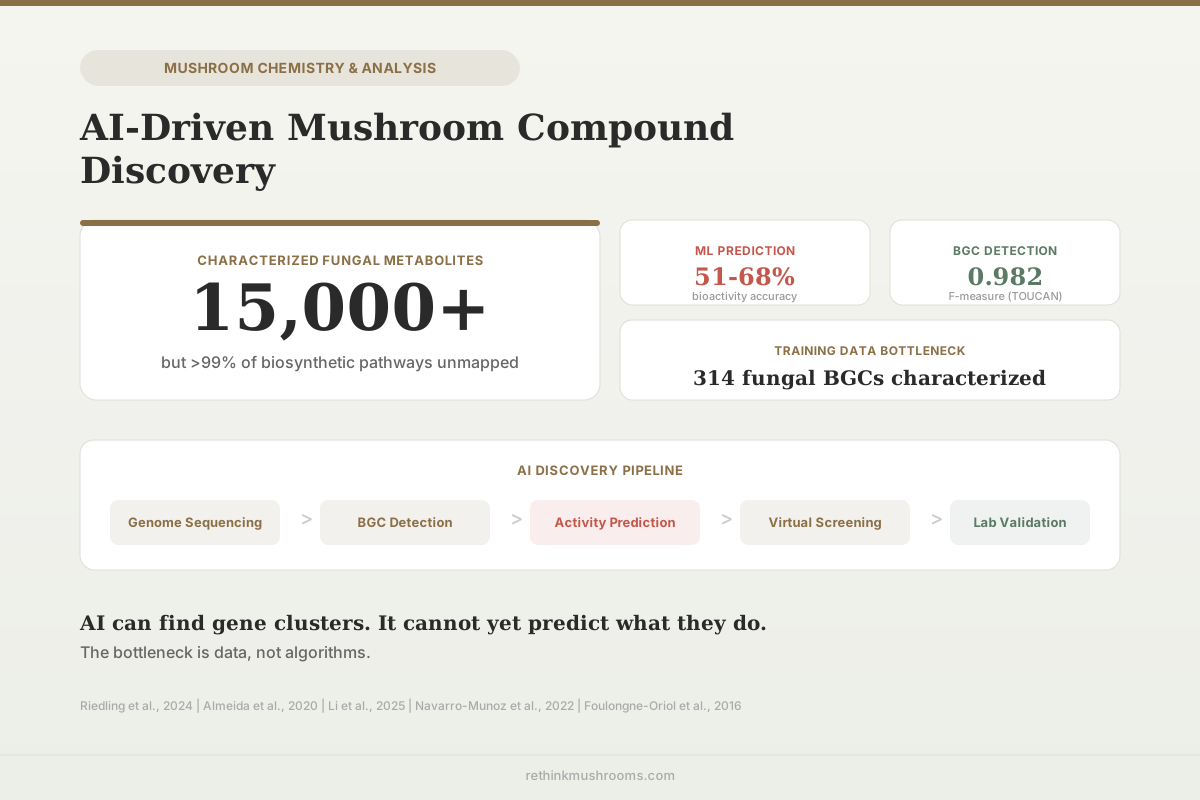
15,000+ characterized fungal SMs
Over 15,000 fungal secondary metabolites have been characterized, but millions of biosynthetic pathways remain unexplored. AI is beginning to map the gap.
Riedling et al., Microbiology Spectrum, 2024
51-68%
ML prediction accuracy
0.982
TOUCAN F-measure
Millions
of unmapped BGCs
Riedling et al., Microbiology Spectrum, 2024
 View as image ↗
Fungi produce over 15,000 characterized secondary metabolites, and DNA sequencing has revealed millions of putative biosynthetic pathways in fungal genomes whose products remain unknown.[1] More than 99% of the natural products encoded in those pathways have never been identified. Mushrooms sit at the center of this gap. Species like Agaricus blazei, Ganoderma lucidum, and Trametes versicolor have decades of pharmacological research behind them, but the compounds studied represent a fraction of what their genomes encode. Artificial intelligence and machine learning are now being applied to this problem, with mixed results. The tools work. The data does not yet exist at the scale needed to make them accurate. This article covers what computational approaches can do today, what they cannot, and why the next decade of mushroom metabolomics may look fundamentally different from the last.
Key Takeaways
- Machine learning models predicting fungal secondary metabolite bioactivity from biosynthetic gene cluster data achieved only 51-68% accuracy, limited by small training datasets (Riedling et al., 2024)
- The TOUCAN supervised learning framework achieved 0.982 F-measure for identifying fungal biosynthetic gene clusters in Aspergillus niger (Almeida et al., 2020)
- Over 15,000 fungal secondary metabolites are characterized, but millions of biosynthetic pathways remain unmapped (Riedling et al., 2024)
- AI-powered virtual screening can classify fungal compounds as "active" or "inactive" using deep neural networks and multi-layer perceptrons (Li et al., 2025)
- Similarity networking and phylogenetic analysis can prioritize candidate gene clusters likely to produce novel compounds (Navarro-Munoz et al., 2022)
- Genetic linkage maps between related species enable transfer of genomic knowledge, as demonstrated between A. subrufescens and A. bisporus (Foulongne-Oriol et al., 2016)
The Problem: Millions of Pathways, Almost No Data
The genes responsible for fungal secondary metabolite biosynthesis are typically clustered together in the genome in structures called biosynthetic gene clusters (BGCs). When researchers sequence a mushroom genome, bioinformatics tools like antiSMASH can identify these clusters and predict the general class of compound they produce (polyketide, nonribosomal peptide, terpene, etc.). The problem is that predicting the class tells you almost nothing about the specific compound, its structure, or its biological activity.
Riedling, Walker, and Rokas at Vanderbilt University quantified this gap precisely.[1] Of the millions of putative BGCs identified in fungal genomes, only 314 have been linked to a known secondary metabolite with characterized bioactivity. That is the entire training dataset available for machine learning models attempting to predict what fungal gene clusters actually do. For comparison, bacterial BGC databases contain over 1,000 characterized entries, which is still small by machine learning standards but three times larger than the fungal dataset.
This data scarcity is the central bottleneck. The algorithms are ready. The training data is not. Every discussion of AI in mushroom metabolomics must begin with this constraint.
Machine Learning Predictions: What Works and What Does Not
Predicting Bioactivity from Gene Cluster Data
Riedling and colleagues trained three classifiers (support vector machine, logistic regression, and random forest) to predict whether a fungal secondary metabolite would have antibacterial, antifungal, or cytotoxic/antitumor activity, based solely on attributes of genes in the biosynthetic gene cluster.[1] They used 10-fold cross-validation, training on 90% of the BGC data and testing on the remaining 10%.
The balanced accuracies ranged from 51% to 68% for models trained on fungal BGCs alone. When they combined fungal (314 BGCs) and bacterial (1,003 BGCs) training data, accuracies ranged from 56% to 68%. The bacterial data did not substantially improve predictions for fungal compounds, suggesting that fungal and bacterial biosynthetic logic differs enough that cross-kingdom transfer learning has limited value at current dataset sizes.
These numbers are sobering. A 51% accuracy is barely better than random guessing. A 68% accuracy means roughly one in three predictions is wrong. For drug discovery, where false positives waste millions in laboratory validation, these error rates are not yet practical for direct application. The researchers were transparent about this: the low accuracy "currently limits the application of machine learning approaches to fungal SM studies." The solution is not a better algorithm. It is a bigger, better-curated dataset linking fungal BGCs to their products and bioactivities.
Finding Gene Clusters: Where AI Already Excels
While predicting what a gene cluster does remains difficult, finding gene clusters in the first place is a solved problem. Almeida and colleagues developed TOUCAN, a supervised learning framework for fungal BGC discovery that achieved a 0.982 F-measure (near-perfect accuracy) on BGC regions in the Aspergillus niger genome.[2]
TOUCAN works on amino acid sequences rather than nucleotide sequences, which means it can process newly sequenced and uncurated data. It combines functional, evolutionary, and compositional features with high-performance classifiers and robust post-processing. The framework outperformed previous approaches and can be adapted to new species, including medicinal mushrooms. For mushroom researchers, TOUCAN-type tools mean that sequencing a new species immediately reveals the full inventory of potential BGCs in its genome, even if the specific compounds they produce remain unknown.
Navarro-Munoz and Collemare described a complementary bioinformatics workflow that uses similarity networking and phylogenetic analysis to prioritize which of those BGCs are most likely to produce novel compounds.[3] By comparing a new BGC against all known clusters, the workflow identifies those with no close matches in existing databases. These "orphan" clusters become top candidates for experimental characterization because they are most likely to produce something previously undiscovered. This approach to understanding secondary metabolites in mushrooms turns genomic data into a prioritized research agenda.
AI in Fungal Drug Development: The 2025 Landscape
Li and colleagues published a comprehensive review in 2025 evaluating the current state of AI in fungal drug development.[4] The review identifies several domains where AI is already contributing:
Virtual screening: Deep neural networks and multi-layer perceptrons perform ligand-based virtual screening to classify compounds as "active" or "inactive" against fungal targets. This replaces months of laboratory screening with computational predictions that can evaluate millions of candidate molecules in hours. For mushroom-derived compounds, virtual screening can identify which of the thousands of known fungal metabolites are most likely to bind specific disease-related protein targets.
Lead optimization: Generative adversarial networks (GANs) and reinforcement learning algorithms can propose chemical modifications to existing fungal compounds that improve their drug-like properties (solubility, stability, bioavailability) while preserving biological activity. This is directly relevant to how modern chemistry reveals new mushroom compounds, where the challenge often is not finding an active molecule but making it pharmaceutically viable.
Target identification: Natural language processing (NLP) tools mine the scientific literature at a scale no human researcher can match. For a field like mushroom pharmacology, where relevant studies span decades, multiple languages (particularly Japanese, Brazilian Portuguese, and Chinese), and diverse journals, NLP-based literature mining can surface connections and patterns that manual review misses.
Resistance prediction: Machine learning models trained on antifungal resistance data can predict which compounds are most likely to retain activity against resistant fungal strains. While this application focuses on pathogenic fungi rather than medicinal mushrooms, the underlying technology is transferable. The same approach could theoretically be applied to predict which mushroom-derived antimicrobial peptides or beta-glucan variants are most likely to retain immunomodulatory activity across genetic backgrounds.
The review also identifies persistent challenges. Data quality and standardization remain poor across fungal genomics databases; different laboratories use different protocols for extract preparation, different bioactivity assays, and different naming conventions for the same compounds. Regulatory frameworks for AI-discovered drugs are still developing, creating uncertainty about how computational predictions will be validated for clinical use. And the complexity of multi-component mushroom extracts, which contain hundreds of compounds acting in concert through additive, synergistic, or antagonistic interactions, is difficult for current single-target models to capture. Whole-extract pharmacology remains largely beyond the reach of existing AI approaches.
Genomic Resources That Enable AI Discovery
Computational approaches require high-quality genomic data as input. The availability of genetic maps and sequenced genomes varies dramatically across mushroom species. Agaricus bisporus (the button mushroom) has a fully sequenced, well-annotated genome because of its agricultural importance. Most medicinal mushrooms do not.
Foulongne-Oriol and colleagues demonstrated one strategy for bridging this gap by constructing the first genetic linkage map for A. subrufescens (= A. blazei) and comparing it to the A. bisporus genome.[5] With 202 markers across 16 linkage groups and high macrosynteny between species (13 of 16 groups mapping to A. bisporus chromosomes), the study showed that genomic knowledge can be transferred between related species. This is directly applicable to AI-driven discovery: machine learning models trained on the better-characterized A. bisporus genome could generate hypotheses about A. blazei BGCs using synteny data.
This approach has limitations. Gene order conservation (macrosynteny) does not guarantee conservation of gene expression or metabolite production. Two species can share the same biosynthetic genes but regulate them differently, producing different compound profiles. Still, for species where full genome sequencing and annotation is not yet available, comparative genomics provides a starting point for AI analysis. For the range of bioactive compounds already identified in Agaricus blazei, including beta-glucans and blazein, genomic data can now map these back to their biosynthetic origins.
What Changes in the Next Five Years
The trajectory of AI in mycochemistry is constrained by one variable more than any other: the size and quality of the training data linking fungal BGCs to characterized metabolites. At 314 entries, the current dataset is roughly 20 years behind bacterial datasets. Closing this gap requires systematic, high-throughput characterization of fungal metabolites linked to their genomic origins.
Several developments are converging to accelerate this:
Decreased sequencing costs make it feasible to sequence hundreds of mushroom genomes rather than a handful. Each new genome adds BGC data to the computational pool.
Improved mass spectrometry, particularly tandem MS and molecular networking approaches, can characterize metabolites in complex fungal extracts without requiring individual purification. This technology is the subject of mushroom metabolomics using mass spectrometry.
Federated databases linking BGC predictions (antiSMASH), metabolite structures (GNPS, MIBiG), and bioactivity data (ChEMBL) are beginning to provide the integrated datasets that machine learning requires.
AlphaFold and protein structure prediction can now model the three-dimensional structures of biosynthetic enzymes from sequence data alone. This enables virtual docking studies that predict which substrates an enzyme can process, effectively predicting metabolite structures from genomic data without ever synthesizing the compound.
The limiting factor is not computational power or algorithmic sophistication. It is the unglamorous, labor-intensive work of characterizing what fungal gene clusters actually produce. Every time a researcher isolates a new compound from a mushroom, identifies its structure, links it to a biosynthetic gene cluster, and tests its biological activity, they add one data point to the training set that machine learning models depend on. Until that database grows by at least an order of magnitude, from hundreds to thousands of characterized fungal BGC-metabolite pairs, AI will remain better at finding gene clusters than predicting what they do. The irony is that the very technology promising to accelerate discovery cannot reach its potential without the slow, careful experimental work it aims to replace.
The Bottom Line
AI and machine learning are beginning to transform mushroom compound discovery, but the field is constrained by a fundamental data gap: only 314 fungal biosynthetic gene clusters have been linked to characterized metabolites with known bioactivity. Machine learning can find gene clusters with near-perfect accuracy (0.982 F-measure) but predicts their bioactivity at only 51-68% accuracy. Virtual screening, lead optimization, and genomic mining tools are ready; the training data is not. The next breakthrough in mycochemistry will likely come not from a better algorithm but from systematically characterizing what mushroom genomes actually produce.
Frequently Asked Questions
Sources & References
- 1RTHM-00902·Riedling, Olivia et al. (2024). “Predicting fungal secondary metabolite activity from biosynthetic gene cluster data using machine learning..” Microbiology spectrum.Study breakdown →PubMed →↩
- 2RTHM-00604·Almeida, Hayda et al. (2020). “TOUCAN: a framework for fungal biosynthetic gene cluster discovery..” NAR genomics and bioinformatics.Study breakdown →PubMed →↩
- 3RTHM-00788·Navarro-Muñoz, Jorge C et al. (2022). “A Bioinformatics Workflow for Investigating Fungal Biosynthetic Gene Clusters..” Methods in molecular biology (Clifton.Study breakdown →PubMed →↩
- 4RTHM-00936·Li, Yanjian et al. (2025). “AI in fungal drug development: opportunities, challenges, and future outlook..” Frontiers in cellular and infection microbiology.Study breakdown →PubMed →↩
- 5RTHM-00425·Foulongne-Oriol, Marie et al. (2016). “The Genetic Linkage Map of the Medicinal Mushroom Agaricus subrufescens Reveals Highly Conserved Macrosynteny with the Congeneric Species Agaricus bisporus..” G3 (Bethesda.Study breakdown →PubMed →↩