Mushroom Science
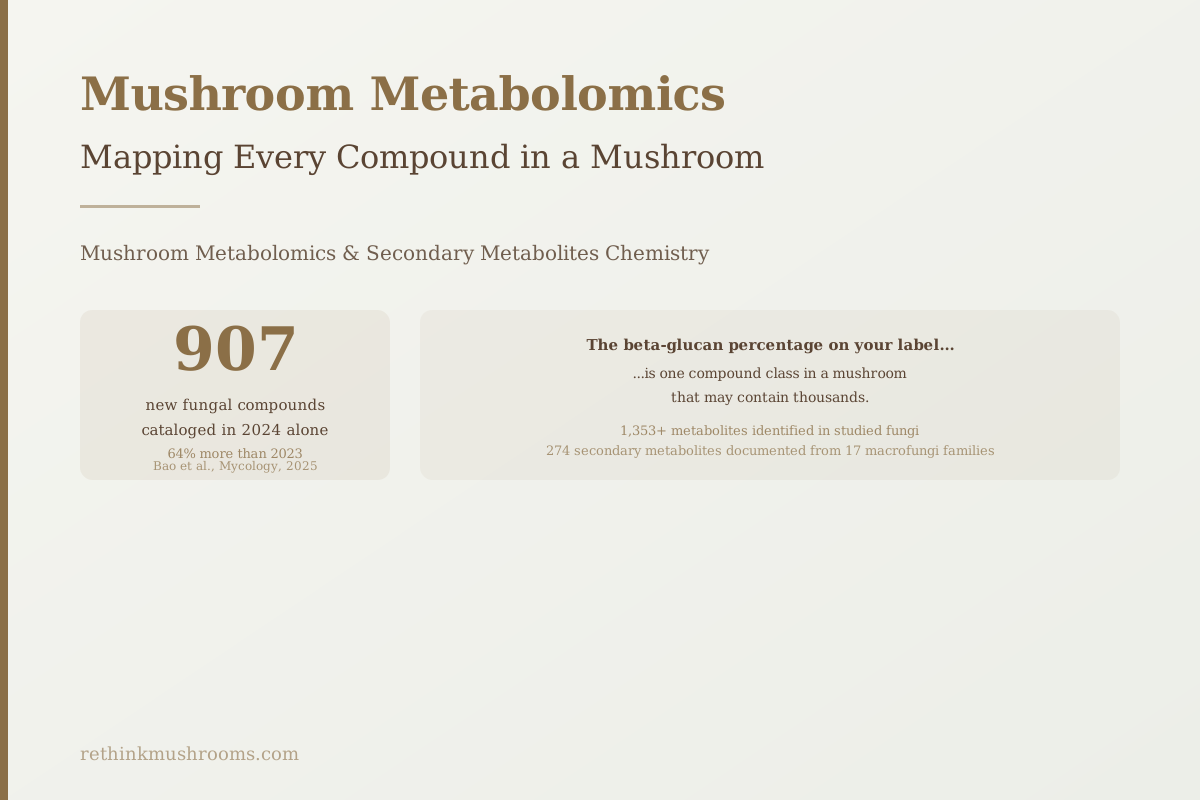
907 new compounds, 2024
Bao et al. (2025) cataloged 907 novel fungal-derived compounds from 2024 publications alone, including 362 terpenoids, a 153% terpenoid increase from 2023, driven by metabolomics-guided discovery platforms.
Bao et al., Mycology, 2025
1,353+
metabolite species mapped in studied fungi including 19 sugars, 42 glycosides, 22 phenols, 26 flavonoids, 11 terpenes (Li 2022)
4-fold
variation in triterpenoid composition between different wood substrates for the same Antrodia cinnamomea species (Lin 2011)
6 species
each with a unique metabolic fingerprint in the Hashimoto 2023 untargeted metabolomics study of common mushrooms
Bao et al., Mycology, 2025
 View as image ↗
The beta-glucan percentage on your mushroom supplement label is accurate. It is also a description of one compound class in a mushroom that may contain thousands.
Mushroom metabolomics is the comprehensive analysis of every small molecule a fungus produces, using instruments capable of detecting and identifying hundreds or thousands of compounds simultaneously from a single extract. When researchers apply these tools to familiar medicinal mushrooms, they find compound profiles far more complex than the standard "beta-glucans and triterpenes" framework suggests. In 2024 alone, researchers cataloged 907 entirely new fungal-derived compounds never previously described in the scientific literature, a 64% increase over 2023, according to the annual fungal metabolite review by Bao and colleagues.[1]
This article explains what mushroom metabolomics is, what it has revealed about the chemical complexity of familiar species, how environmental variables like substrate and age reshape the metabolome, and what the secondary metabolite landscape looks like beyond the compound classes that dominate supplement marketing. For how metabolomics connects to the fruiting body versus mycelium compound distribution question, see fruiting body vs. mycelium: the great mushroom supplement debate.
Key Takeaways
- Mushroom metabolomics maps all small molecules in a fungus simultaneously using mass spectrometers; studies have identified 1,353+ distinct metabolite species in analyzed fungi, including 19 sugars, 42 glycosides, 22 phenols, 26 flavonoids, and 11 terpenes (Li 2022)
- Untargeted metabolomics of 6 common mushroom species found each species has a chemically unique fingerprint, including terpenoids, fatty acids, glycerophospholipids, and sphingolipids as major enriched compound classes not captured by standard beta-glucan testing (Hashimoto 2023)
- The same Antrodia cinnamomea species produced metabolite profiles with up to 4-fold variation in triterpenoid composition between different wood substrates, demonstrating that the metabolome is not fixed but environmentally responsive (Lin 2011)
- A 2025 review in FEMS Microbiology Reviews frames metabolomics as having transformed fungal biology from descriptive to predictive: from cataloging what compounds exist to understanding when, why, and how they're produced (Adejor 2025)
- Sun et al. (2024) reviewed 274 secondary metabolites from 17 macrofungi families, including 116 terpenoids, 71 sterols, 22 phenols, 14 polyketides, and 9 alkaloids. None of these are polysaccharides, yet all have documented biological activity
- 907 novel fungal-derived compounds were cataloged in 2024 alone, including 362 terpenoids (a 153% increase from 2023), demonstrating that metabolomics-guided discovery is accelerating, not plateauing (Bao 2025)
What Metabolomics Actually Measures (and Why Standard Testing Misses Most of It)
Standard nutritional analysis of a mushroom might measure protein, fiber, beta-glucan content, and a handful of known vitamins and minerals. This information is accurate within its scope. Its scope is narrow.
Mushroom metabolomics takes a different approach. Rather than measuring pre-specified compounds, it uses mass spectrometry to detect every small molecule present in a sample by measuring the mass-to-charge ratio of molecules after they are ionized. In untargeted metabolomics, the instrument scans across all detected masses without preselecting targets, producing a chemical profile of everything present. Software then matches detected masses against known compound databases to identify as many as possible, while flagging novel masses for further characterization.
Li and colleagues summarized what this approach reveals in a 2022 review of metabolomics applied to fungal research. Studies using this approach have identified more than 1,353 distinct metabolite species in analyzed fungi, spanning 19 sugars, 42 glycosides, 12 amino acids, 22 phenols, 26 flavonoids, and 11 terpenes in a single representative data set.[2] These numbers refer to individual chemical structures, not compound classes.
The distinction between targeted and untargeted metabolomics matters for how results are interpreted. Targeted metabolomics measures specific pre-defined compounds with high precision and sensitivity, similar to how a laboratory tests for a specific vitamin. Untargeted metabolomics casts a broad net to detect the full spectrum of what's present, sacrificing some precision in exchange for comprehensiveness. Both have their applications; they answer different questions. A beta-glucan test is targeted. A full metabolomics scan is untargeted.
The practical implication: when you test a mushroom supplement for beta-glucan content, you learn the concentration of one compound class. When you run untargeted metabolomics on the same supplement, you find the chemical identity of potentially thousands of additional molecules that have never been measured, named in the product description, or considered in the efficacy evidence.
For how this compound diversity relates to the question of which mushroom part you're buying, see do fruiting bodies have more bioactive compounds than mycelium?.
The Scale Problem: Six Common Mushrooms, Hundreds of Hidden Compounds Each
Hashimoto and colleagues published an untargeted metabolomics study in 2023 covering six mushroom species that most readers will recognize: white button, crimini, portabella, lion's mane, maitake, and shiitake. These are grocery store and supplement store mushrooms, not rare medicinal species.
The study found that each species has a unique chemical fingerprint. The major enriched compound classes varied across species and included terpenoids, fatty acids, glycerophospholipids, and sphingolipids, alongside the more familiar polysaccharide and phenolic fractions.[3] Glycerophospholipids are the structural components of cell membranes, with biological activity in inflammation signaling and cellular communication. Sphingolipids are another cell membrane lipid class with documented roles in cell death signaling and immune function. Neither appears on a mushroom supplement label.
The significance of this fingerprint uniqueness is practical. If each species has a chemically distinct metabolome, then the assumption that any mushroom will do for a given health goal is not supported by the chemistry. Different species produce different compound landscapes. The species choice in supplementation is a chemical composition decision, whether the label reflects this or not.
Lion's mane provides a clear illustration. Friedman's comprehensive 2015 review of lion's mane chemistry cataloged hericenones (aromatic compounds found only in fruiting bodies), erinacines (diterpenoids found in mycelium), multiple sterol compounds, polysaccharides, and small bioactive peptides.[4] None of these compound classes are interchangeable with the others. Each requires different extraction methods to recover and produces different biological effects. The hericenone/erinacine content of a lion's mane product depends on whether it comes from fruiting bodies or mycelium, which the metabolomics fingerprint would immediately reveal.
For the cordycepin secondary metabolite story in Cordyceps, see cordycepin: the multi-target compound behind Cordyceps's effects.
From Descriptive to Predictive: The Paradigm Shift
Adejor and colleagues published a major 2025 review in FEMS Microbiology Reviews that frames the state of fungal metabolomics in terms of what it has changed about the science itself.
The older approach to fungal chemistry was descriptive: isolate a compound, determine its structure, test its biological activity, publish. This process took years per compound and produced a growing catalog of known molecules without a unifying explanatory framework.
Metabolomics changed the approach. By measuring all metabolites simultaneously, researchers can now ask: what shifts in the overall chemistry when the mushroom is stressed, when it enters a new growth phase, when it encounters a competing organism? These are process questions, not catalog questions. The metabolome becomes a dynamic readout of the fungus's biological state, not a static inventory of what it contains.[5]
Alves and colleagues extended this framing in a 2025 review, arguing that multi-omics integration, combining metabolomics with genomics and transcriptomics, is now the standard for comprehensive fungal compound characterization. When researchers know both what compounds are present (metabolomics) and which genes are being expressed (transcriptomics), they can connect compound production to the biological programs driving it.[6]
The practical result is that metabolomics is no longer just about characterizing what's in a given mushroom product. It's becoming a tool for understanding when and why mushrooms produce each compound, which creates the possibility of controlling compound production in cultivation, selecting strains with desired profiles, and predicting which compounds a yet-uncharacterized species might produce based on its genetic relatives.
For how this connects to AI-driven discovery, see AI-driven mushroom compound discovery: the future of mycochemistry.
Same Species, Completely Different Chemistry: Substrate and Age Change Everything
Two findings from species-specific metabolomics studies illustrate why "mushroom X" doesn't have a single fixed chemical profile.
Lin and colleagues published a 2011 metabolomics study of Antrodia cinnamomea fruiting bodies grown on different wood substrates and harvested at different culture ages. Their finding: triterpenoid composition varied by up to 4-fold between substrates in the same species.[7] The species name is identical. The wood substrate is the variable. The resulting chemistry is dramatically different.
This is not a minor perturbation. A 4-fold difference in a target compound class between substrate variants means that two products labeled with the same species name and grown by different producers on different wood types are literally not the same product from a chemistry standpoint. The metabolomics data captures this; the label does not.
The age effect is equally striking. Oh and colleagues' 2019 metabolomics study of Cordyceps militaris fruiting bodies found that cordycepin concentration rises dramatically as the fruiting bodies age through their senescence process.[8] Metabolomics tracked this in real time: as the mushroom aged toward spore release, the chemical profile shifted toward higher cordycepin. Harvest timing, therefore, determines cordycepin yield in a way that's only visible when you're measuring the full metabolome dynamically.
Nam and colleagues reached a parallel conclusion in a 2021 study comparing shiitake grown on traditional hardwood logs versus sawdust-based substrate. Untargeted metabolomics revealed that substrate choice affects dozens of secondary metabolite classes simultaneously, not only beta-glucan levels.[9] The substrate effect is not a single-variable change. It ripples through the entire metabolome.
For how these substrate effects connect to practical supplement decisions, see how growing substrate affects mushroom bioactive content.
What's in the Uncharted 90%: Secondary Metabolites Beyond Beta-Glucans
Sun and colleagues published a comprehensive 2024 review of secondary metabolites from edible-medicinal macrofungi, covering the scientific literature from 2017 to 2023. Across 17 macrofungi families, they documented 274 secondary metabolites with confirmed biological activity: 116 terpenoids, 71 sterols, 22 phenolics, 14 polyketides, 9 alkaloids, plus aromatic compounds and pyridine derivatives.[10]
None of these 274 compounds are polysaccharides. Every one of them falls outside the beta-glucan framework that dominates mushroom supplement marketing.
Niego and colleagues made a complementary observation in a 2021 review of macrofungi as nutraceutical sources: the commercially most successful mushroom-derived pharmaceutical compounds, including PSK from turkey tail and lovastatin from oyster mushroom, are not polysaccharides. They are terpenoids and polyketides.[11] The compound class most discussed in consumer supplement marketing is not the compound class most represented in pharmaceutical development from mushrooms.
Chanterelle metabolomics illustrates how much chemistry even common edible mushrooms contain that never appears in nutritional discussions. Režić Mužinić and colleagues analyzed chanterelle aqueous extracts in 2023 and found a complex mixture of phenolics, flavonoids, terpenoids, and organic acids, along with documented antioxidant and cytotoxic activity from these fractions.[12] Chanterelle is primarily discussed as a culinary mushroom. Its secondary metabolite chemistry has barely been explored.
For the extraction-method question that makes this practical, see double-extraction mushroom tinctures: why alcohol and water captures more compounds.
The Acceleration: 907 New Fungal Compounds in 2024 Alone
Bao and colleagues compiled the 2025 annual review of new bioactive secondary metabolites from fungi, covering publications from 2024. The count: 907 novel compounds, including 362 terpenoids, 284 polyketides, 108 alkaloids, and 75 peptides, all new to science in that single year.[1] This represents a 64% increase in total new compound discovery over the 2023 count of 553 compounds documented by Shi and colleagues.
The terpenoid surge is particularly notable: 153% more new terpenoids in 2024 than 2023. Terpenoids are the compound class that includes reishi's ganoderic acids, Antrodia's antcins, and many of the compounds most commonly cited in mechanistic cancer and inflammation research. The 153% acceleration reflects both improved analytical tools and a growing number of research groups applying metabolomics to previously undercharacterized species.
This acceleration is real and likely to continue. As more mushroom species are analyzed with untargeted metabolomics, more novel compounds will emerge. The fungal kingdom contains an estimated 2 to 4 million species; fewer than 150,000 have been formally described. Of those, a small fraction have undergone metabolomics analysis. The compound space in medicinal fungi is not close to mapped.
The Bottom Line
Mushroom metabolomics maps the complete chemical profile of a fungus using mass spectrometry, revealing hundreds to thousands of compounds per species that standard nutritional testing doesn't capture. Untargeted metabolomics of six common mushroom species found each has a unique chemical fingerprint including terpenoids, glycerophospholipids, and sphingolipids alongside the familiar beta-glucan fraction. The same species grown on different substrates or harvested at different ages shows dramatically different compound profiles: up to 4-fold triterpenoid variation between wood substrates in Antrodia, and cordycepin concentration rising with mushroom age in Cordyceps. A 2024 annual review cataloged 907 novel fungal-derived compounds, a 64% increase from 2023. The secondary metabolite chemistry of medicinal mushrooms is much larger and more diverse than the supplement market currently reflects.
Frequently Asked Questions
Sources & References
- 1. Source details for this reference are not yet available.
- 2. Source details for this reference are not yet available.
- 3. Source details for this reference are not yet available.
- 4. Source details for this reference are not yet available.
- 5. Source details for this reference are not yet available.
- 6. Source details for this reference are not yet available.
- 7. Source details for this reference are not yet available.
- 8. Source details for this reference are not yet available.
- 9. Source details for this reference are not yet available.
- 10. Source details for this reference are not yet available.
- 11. Source details for this reference are not yet available.
- 12. Source details for this reference are not yet available.