Antrodia and Antioxidant Defense
Nrf2 activation
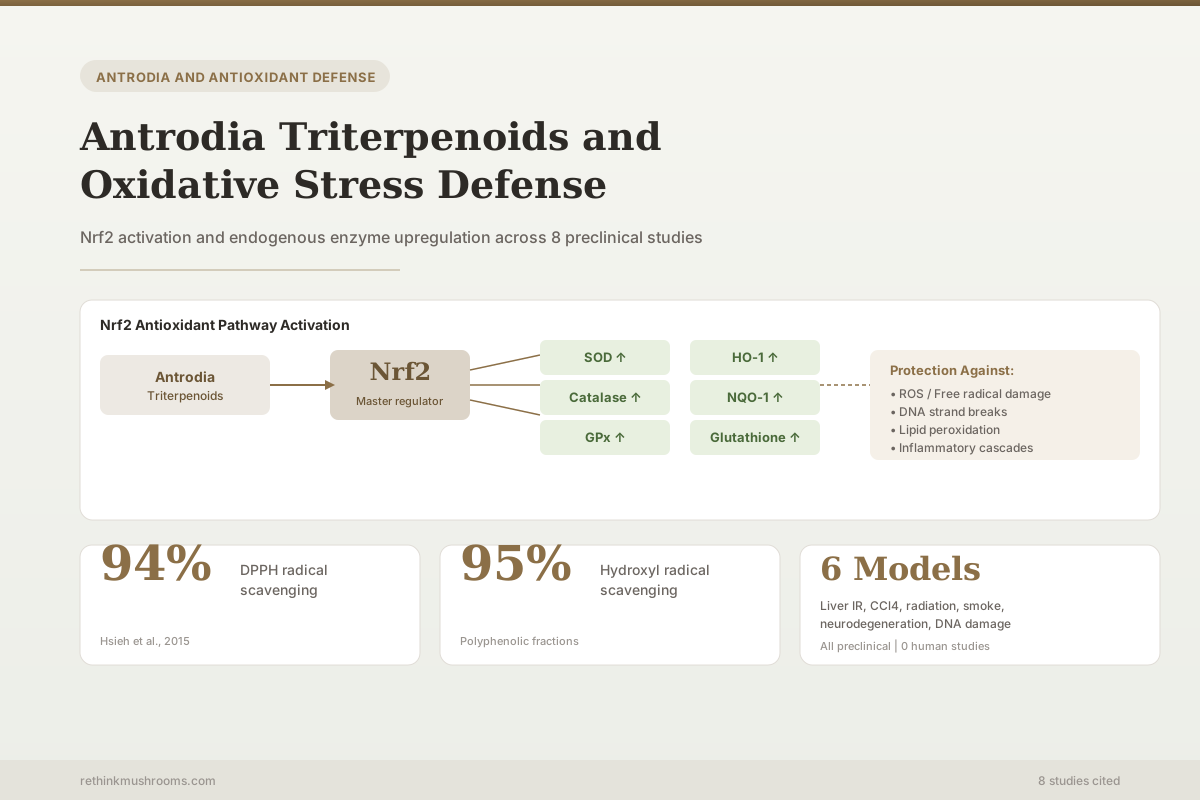
Multiple Antrodia triterpenoids activate the Nrf2 transcription factor, the master regulator of cellular antioxidant defense.
Lanza et al., International Journal of Molecular Sciences, 2023
SOD, CAT, GPx
antioxidant enzymes restored
94%
DPPH radical scavenging
3 Triterpenoids
with specific antioxidant data
Lanza et al., International Journal of Molecular Sciences, 2023
 View as image ↗
Oxidative stress occurs when reactive oxygen species (ROS) overwhelm the body's antioxidant defenses, damaging DNA, proteins, and lipid membranes. It sits at the intersection of aging, neurodegeneration, cardiovascular disease, and cancer. Antrodia camphorata triterpenoids do not simply scavenge free radicals the way vitamin C does. The preclinical evidence shows they activate Nrf2, the master transcription factor that upregulates the body's own antioxidant enzyme production: superoxide dismutase (SOD), catalase, glutathione peroxidase (GPx), and heme oxygenase-1 (HO-1).[1] That distinction matters because inducing endogenous antioxidant enzymes provides broader and more sustained protection than direct radical scavenging. For how Antrodia's antioxidant mechanisms relate to its free radical protection profile, see the dedicated overview.
Key Takeaways
- Antrodia camphorata extract activated Nrf2 and upregulated HO-1, NQO-1, and gamma-GCLC in a Parkinson's disease mouse model, reducing dopaminergic neuron loss (Lanza et al., 2023)
- Ergostatrien-3β-ol (EK100) reduced hepatic iNOS, COX-2, TNF-α, IL-6, and IL-1β in ischemia/reperfusion injury models (Chao et al., 2021)
- Antrodia extract restored CCl4-depleted SOD, catalase, GPx, and glutathione reductase activity while reducing lipid peroxidation products in mouse liver (Hsiao et al., 2003)
- Polyphenolic extracts scavenged 94% of DPPH radicals and 95% of hydroxyl radicals while protecting DNA from hydroxyl radical damage (Hsieh et al., 2015)
- In ApoE-deficient mice, Antrodia attenuated cigarette smoke-induced ROS production, DNA damage, and vascular inflammation (Yang et al., 2017)
- Over 78 bioactive compounds contribute to Antrodia's antioxidant profile, with triterpenoids, polyphenols, and polysaccharides each playing distinct roles (Geethangili et al., 2011)
Nrf2: The Master Antioxidant Switch
Nuclear factor erythroid 2-related factor 2 (Nrf2) is a transcription factor that, when activated, translocates to the nucleus and binds antioxidant response elements (ARE) in DNA. This binding triggers expression of a suite of protective genes: HO-1 (heme oxygenase-1), NQO-1 (NAD(P)H quinone dehydrogenase 1), SOD, catalase, GPx, and glutathione synthesis enzymes. Together, these enzymes constitute the cell's primary defense against oxidative damage.
Lanza et al. (2023) demonstrated that Antrodia camphorata extract activated the Nrf2 pathway in a MPTP-induced Parkinson's disease mouse model. Treated mice showed upregulation of HO-1, NQO-1, and gamma-GCLC (a glutathione synthesis enzyme). The downstream effect was protection of dopaminergic neurons in the substantia nigra, the brain region that degenerates in Parkinson's disease.[1]
The study confirmed that Nrf2 was the mediator, not just a bystander: when Nrf2 function was impaired, the protective effects diminished. This mechanistic validation is important because many antioxidant studies measure Nrf2 as a biomarker without proving it is causally required for the observed protection. The Lanza et al. study goes further by establishing necessity, placing Nrf2 as a validated target for Antrodia's antioxidant activity in neural tissue.
The neuroprotective context also illustrates a broader principle. The brain is disproportionately vulnerable to oxidative stress due to its high oxygen consumption, high polyunsaturated fatty acid content, and relatively low antioxidant enzyme levels compared to liver or kidney tissue. If Antrodia triterpenoids can reach brain tissue and activate Nrf2 there (which this study suggests), the antioxidant effects may be most impactful in tissues where endogenous defenses are weakest. For the broader implications of this finding for Antrodia's cellular antioxidant mechanisms, see the dedicated mechanistic review.
EK100: A Triterpenoid with Dual Antioxidant and Anti-Inflammatory Action
Ergostatrien-3β-ol (EK100) is one of the most studied Antrodia triterpenoids for oxidative stress protection. Chao et al. (2021) examined its effects in both cell models and a hepatic ischemia/reperfusion (IR) injury model in rats. IR injury occurs during liver surgery when tissue is damaged first by oxygen deprivation during ischemia, then by a cascade of oxidative and inflammatory insults when blood flow returns.
In rats, 5 mg/kg EK100 administered before IR injury decreased serum ALT and AST (liver damage markers) and reduced levels of inflammatory cytokines TNF-α, IL-6, and IL-1β. EK100 also reduced hepatic mRNA levels of iNOS and COX-2 and inhibited nitrite production in both HepG2 hepatocytes (exposed to hydrogen peroxide) and RAW 264.7 macrophages (exposed to lipopolysaccharide).[2]
The dual action is the key point: EK100 addresses both the oxidative damage and the inflammatory cascade that follows it. In IR injury, oxidative stress triggers inflammation, and inflammation generates more ROS, creating a destructive feedback loop. By intervening at both steps, EK100 may be more effective than a pure antioxidant or a pure anti-inflammatory compound alone.
Restoring the Endogenous Antioxidant System
Hsiao et al. (2003) conducted one of the earliest systematic studies of Antrodia's antioxidant effects, using carbon tetrachloride (CCl4)-induced liver injury as the oxidative stress model. CCl4 is metabolized by liver enzymes into trichloromethyl radicals that initiate lipid peroxidation and deplete endogenous antioxidant defenses.
Antrodia extract at 250-1,250 mg/kg dose-dependently produced multiple protective effects: restored SOD activity (the enzyme that converts superoxide radicals to hydrogen peroxide), restored catalase activity (which converts hydrogen peroxide to water), restored GPx and glutathione reductase activity (the glutathione recycling system), replenished hepatic glutathione content, and reduced lipid peroxidation products.[3]
The restoration of glutathione is particularly relevant. Glutathione is the most abundant intracellular antioxidant and a cofactor for multiple detoxification enzymes. Its depletion is a hallmark of severe oxidative stress. That Antrodia restored glutathione content, rather than just one or two enzymes, suggests a broad effect on the endogenous antioxidant system, consistent with upstream Nrf2 activation.
The extract also inhibited lipid peroxidation in rat brain homogenates with an IC50 of approximately 3.1 mg/mL and scavenged DPPH free radicals, with a dose of about 31 μg/mL producing measurable radical neutralization.[3]
DNA Protection and Anti-Mutagenesis
Hsieh et al. (2015) focused specifically on whether Antrodia could protect DNA from oxidative damage. The study tested Antrodia extracts for DPPH radical scavenging, hydroxyl radical scavenging, and direct DNA protection using a plasmid DNA damage assay.
Polyphenolic fractions achieved 94% DPPH radical scavenging efficiency and 95% hydroxyl radical scavenging. In the DNA protection assay, the extract prevented hydroxyl radical-mediated strand breaks in plasmid DNA. The study also demonstrated anti-mutagenic activity in the Ames test, reducing the rate of mutations induced by known mutagens.[4]
The DNA protection finding connects Antrodia's antioxidant activity directly to genotoxicity prevention. Oxidative DNA damage (8-OHdG formation, strand breaks) is a key mechanism linking chronic oxidative stress to cancer initiation. Every cell in the human body sustains an estimated 10,000-100,000 oxidative DNA lesions per day under normal conditions; antioxidant enzymes and DNA repair mechanisms handle most of these, but any increase in the oxidative burden or decrease in repair capacity shifts the balance toward accumulated mutations. Whether Antrodia's DNA protection translates from in vitro plasmid assays to chromosomal DNA in living organisms at achievable tissue concentrations has not been tested, but the anti-mutagenic activity in the Ames test provides at least partial cellular-level validation.
Cardiovascular Oxidative Stress
Yang et al. (2017) tested Antrodia in a model of cigarette smoke-induced oxidative stress, which is relevant to cardiovascular disease. In ApoE-deficient mice (a model for atherosclerosis), Antrodia attenuated cigarette smoke-induced ROS production, DNA damage, apoptosis, and inflammation in vascular smooth muscle cells. The extract also reduced atherosclerotic plaque development.[5]
This study is notable for testing a real-world oxidative stressor (cigarette smoke contains thousands of free radicals per puff) in a disease-relevant model (ApoE-deficient mice develop atherosclerosis similarly to humans with familial hypercholesterolemia). The combination of reduced ROS, reduced DNA damage, and reduced atherosclerosis suggests the antioxidant effects translate to measurable disease modification in this preclinical model.
The vascular smooth muscle cell findings are mechanistically important. Cigarette smoke-induced ROS in these cells triggers a chain reaction: oxidative damage leads to apoptosis of smooth muscle cells, which destabilizes atherosclerotic plaques and promotes inflammatory recruitment. By interrupting this chain at the ROS generation step, Antrodia prevented the downstream cascade of cellular damage and inflammation that drives plaque progression.
Radiation-Induced Oxidative Damage
Kuo et al. (2019) examined whether Antrodia could protect against irradiation-induced acute hepatitis, a model of extreme oxidative stress where ionizing radiation generates massive free radical bursts in liver tissue. Antrodia cinnamomea extract provided protective effects in this high-oxidative-stress environment.[6]
Radiation protection is a demanding test of antioxidant capacity. Unlike chemical stressors that generate specific radical species, ionizing radiation produces a broad spectrum of ROS simultaneously, including superoxide, hydroxyl radicals, hydrogen peroxide, and lipid peroxy radicals within milliseconds. That Antrodia provided protection in this context supports the conclusion that its antioxidant effects operate through systemic upregulation of defense enzymes rather than scavenging of any single radical species. A direct radical scavenger would need to be present at the exact site of radical generation in sufficient concentration, an implausible scenario for oral supplements. Enzyme induction, by contrast, produces protective proteins throughout the tissue before the oxidative insult occurs.
Multiple Compound Classes Contribute
Wu et al. (2011) isolated individual metabolites from Antrodia cinnamomea and tested their antioxidant activities independently. The results showed that multiple compound classes contribute to the overall antioxidant profile, with different metabolites showing varying potencies across different antioxidant assays (DPPH, ABTS, ferric reducing power).[7]
Geethangili and Tzeng (2011) catalogued over 78 bioactive compounds from Antrodia across six chemical classes and noted that antioxidant activity arises from triterpenoids, polyphenols, and polysaccharides working through different mechanisms.[8] Triterpenoids primarily activate Nrf2 and modulate enzyme expression. Polyphenols provide direct radical scavenging. Polysaccharides may contribute through immunomodulatory effects that reduce oxidative stress at the systemic level. For more on how the SOD induction pathway works specifically, see that focused review.
How Antrodia Compares to Other Antioxidant Mushrooms
Every medicinal mushroom marketed for health has some antioxidant activity. The question is whether Antrodia's profile is qualitatively or quantitatively different. The Nrf2 activation data and the breadth of endogenous enzyme restoration suggest a mechanism beyond simple radical scavenging, which is shared with some other medicinal mushrooms (Ganoderma lucidum also activates Nrf2, for instance) but is not universal.
The direct comparative data is limited. Wu et al. (2011) tested individual Antrodia metabolites against standard antioxidant reference compounds but not against extracts from other mushroom species.[7] For the available cross-species comparison data on this question, see Antrodia vs. Other Antioxidant Mushrooms.
Limitations
All preclinical. No human study has measured Antrodia's effects on oxidative stress biomarkers (8-OHdG, F2-isoprostanes, glutathione ratio, or plasma antioxidant capacity) in living people.
Bioavailability unknown. Triterpenoid absorption, distribution, and metabolism in humans have not been characterized. High in vitro antioxidant activity does not guarantee tissue-level antioxidant effects after oral consumption.
Assay limitations. DPPH and ABTS assays measure radical scavenging in a test tube. They correlate poorly with in vivo antioxidant effects. The enzyme restoration studies (Hsiao et al., 2003) are more biologically relevant but still limited to animal models.
Dose-response gaps. Most studies test a single dose or a narrow dose range. The minimum effective dose, the dose-response curve shape, and the ceiling of antioxidant enzyme induction are largely uncharacterized.
Specificity question. Nrf2 activation is not unique to Antrodia. Sulforaphane from broccoli, curcumin from turmeric, and extracts from Ganoderma lucidum all activate Nrf2. The question of whether Antrodia triterpenoids activate Nrf2 more potently, more selectively, or with fewer off-target effects than these well-characterized Nrf2 activators remains unanswered. Without comparative data, the practical advantage of Antrodia over cheaper, more widely available Nrf2 activators is unclear.
The Bottom Line
Antrodia camphorata triterpenoids protect against oxidative stress through two complementary mechanisms: direct free radical scavenging and Nrf2-mediated upregulation of endogenous antioxidant enzymes (SOD, catalase, GPx, HO-1). This dual action has been demonstrated across liver injury, neurodegeneration, cardiovascular, radiation, and DNA damage models. The Nrf2 pathway has been validated as a causal mechanism in at least one study. No human antioxidant studies have been published.
Frequently Asked Questions
Sources & References
- 1RTHM-00836·Lanza, Marika et al. (2023). “The Transcription Factor Nrf2 Mediates the Effects of Antrodia camphorata Extract on Neuropathological Changes in a Mouse Model of Parkinson's Disease..” International journal of molecular sciences.Study breakdown →PubMed →↩
- 2RTHM-00677·Chao, Ting-Yu et al. (2021). “Ergostatrien-3β-ol (EK100) from Antrodia camphorata Attenuates Oxidative Stress, Inflammation, and Liver Injury In Vitro and In Vivo..” Preventive nutrition and food science.Study breakdown →PubMed →↩
- 3RTHM-00055·Hsiao, George et al. (2003). “Antioxidative and hepatoprotective effects of Antrodia camphorata extract..” Journal of agricultural and food chemistry.Study breakdown →PubMed →↩
- 4RTHM-00376·Hsieh, Yu-Lin et al. (2015). “Effects of Antrodia camphorata extracts on anti-oxidation, anti-mutagenesis and protection of DNA against hydroxyl radical damage..” BMC complementary and alternative medicine.Study breakdown →PubMed →↩
- 5RTHM-00500·Yang, Hsin-Ling et al. (2017). “Antrodia camphorata attenuates cigarette smoke-induced ROS production, DNA damage, apoptosis, and inflammation in vascular smooth muscle cells, and atherosclerosis in ApoE-deficient mice..” Environmental toxicology.Study breakdown →PubMed →↩
- 6RTHM-00566·Kuo, Tsu-Hsiang et al. (2019). “Protective Effect of Antrodia cinnamomea Extract against Irradiation-Induced Acute Hepatitis..” International journal of molecular sciences.Study breakdown →PubMed →↩
- 7RTHM-00239·Wu, Ming-Der et al. (2011). “Antioxidant activities of extracts and metabolites isolated from the fungus Antrodia cinnamomea..” Natural product research.Study breakdown →PubMed →↩
- 8RTHM-00214·Geethangili, Madamanchi et al. (2011). “Review of Pharmacological Effects of Antrodia camphorata and Its Bioactive Compounds..” Evidence-based complementary and alternative medicine : eCAM.Study breakdown →PubMed →↩