Antrodia Antioxidant Activity
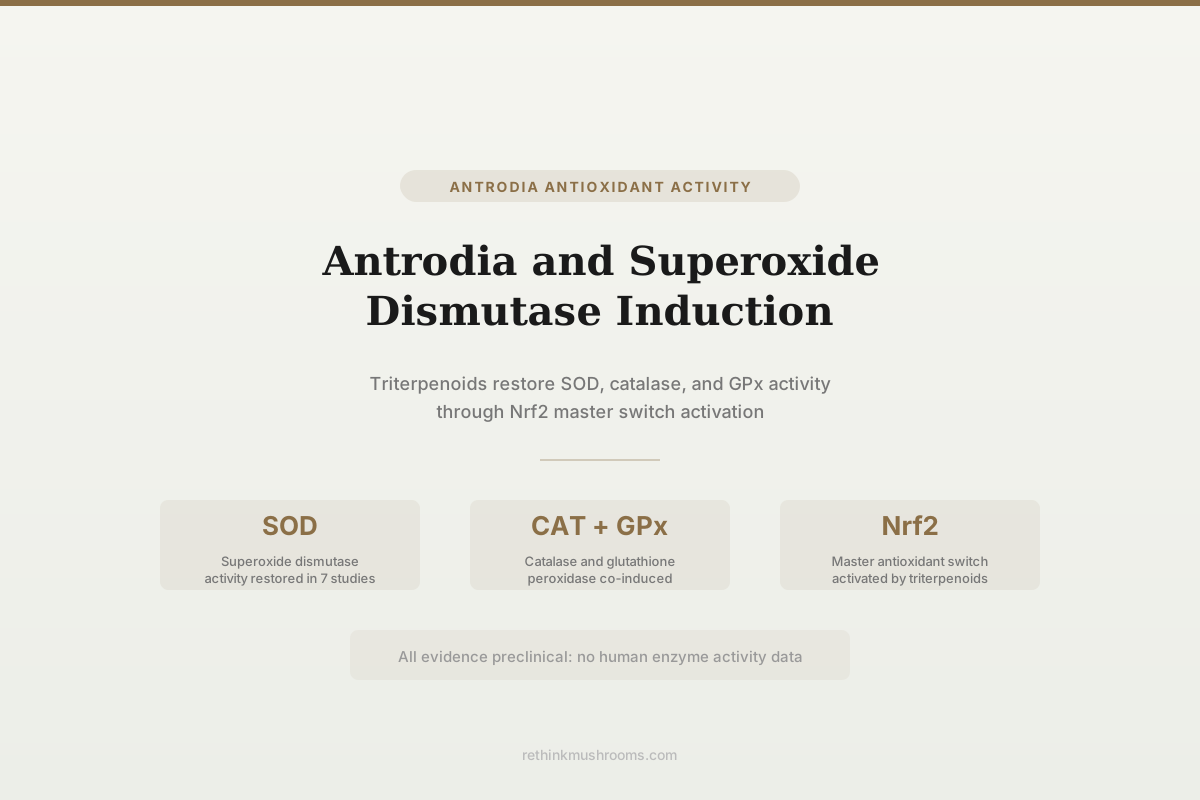
SOD + CAT + GPx
Multiple Antrodia triterpenoids restore the activity of three key antioxidant enzymes in inflamed and injured tissues across liver, brain, and vascular models.
Deng et al., J. Agric. Food Chem., 2013
3 Enzymes
SOD, catalase, GPx all upregulated
Nrf2
master antioxidant pathway activated
7 Studies
on Antrodia antioxidant enzyme effects
Deng et al., J. Agric. Food Chem., 2013
 View as image ↗
Every cell in the human body produces superoxide radicals as a byproduct of mitochondrial respiration and immune defense. Superoxide dismutase (SOD), catalase (CAT), and glutathione peroxidase (GPx) form the enzymatic frontline that converts these reactive oxygen species into harmless water and oxygen. When oxidative stress overwhelms this defense system, cellular damage accumulates, contributing to inflammation, tissue injury, and chronic disease. Antrodia camphorata, a rare Taiwanese medicinal mushroom, contains multiple triterpenoid compounds that restore or enhance the activity of all three antioxidant enzymes across different tissue types. For a broader overview of how Antrodia combats oxidative damage, see Antrodia and antioxidant activity.
The evidence reviewed here comes from seven preclinical studies spanning liver injury, inflammation, vascular damage, neurodegeneration, and DNA protection models. A consistent pattern emerges: Antrodia compounds do not simply scavenge free radicals directly (though some do that too). They restore the endogenous antioxidant enzyme system, effectively recharging the cell's own defense machinery. This distinction matters because enzyme induction provides sustained protection, while direct scavenging is consumed in a single reaction.
Key Takeaways
- Eburicoic acid and dehydroeburicoic acid from Antrodia increased SOD, catalase, and GPx activity in inflamed paw tissue while reducing malondialdehyde, a lipid peroxidation marker (Deng et al., 2013)
- Ergostatrien-3beta-ol from Antrodia submerged culture increased liver SOD, catalase, and GPx activity while decreasing malondialdehyde in a carrageenan inflammation model (Huang et al., 2010)
- Pretreatment with eburicoic acid and dehydroeburicoic acid prevented SOD, catalase, and GPx depletion in CCl4-induced acute liver injury, with effects comparable to silymarin (Huang et al., 2013)
- Antrodia fermented broth and mycelial extracts preserved SOD activity and protein levels in human endothelial cells under free radical attack (Hseu et al., 2008)
- Antrodia extract activated the Nrf2 transcription factor in a Parkinson's mouse model, upregulating the downstream antioxidant enzyme network including HO-1 (Lanza et al., 2023)
- Oral Antrodia administration upregulated SOD and catalase expression in vascular smooth muscle cells exposed to cigarette smoke extract (Yang et al., 2017)
The Antioxidant Enzyme Triad: SOD, Catalase, and GPx
Understanding why Antrodia's effects on these three enzymes matter requires knowing how they work together. The system operates as a relay:
- SOD converts superoxide radicals (O2-) into hydrogen peroxide (H2O2) and oxygen. There are three human SOD isoforms: Cu/Zn-SOD (cytoplasmic), Mn-SOD (mitochondrial), and EC-SOD (extracellular).
- Catalase converts H2O2 into water and oxygen, primarily in peroxisomes. It handles high concentrations of H2O2 efficiently.
- GPx also converts H2O2 into water, but uses glutathione as a co-substrate and operates in the cytoplasm and mitochondria. It handles lower H2O2 concentrations and also neutralizes lipid peroxides.
If SOD increases without corresponding increases in catalase and GPx, the result is more H2O2 accumulation, which can paradoxically increase oxidative damage. This is why compounds that simultaneously upregulate all three enzymes are mechanistically preferable to those that affect only one. Multiple Antrodia compounds appear to upregulate all three in parallel.
Convergence Map
One Response, Six Independent Roads — and a Gap
Different compounds, different tissues, different labs, different injury models — yet the readout is the same each time: the superoxide dismutase (SOD), catalase (CAT), and glutathione peroxidase (GPx) triad is restored or reinforced, most plausibly through the Nrf2 master switch. The chips show which enzymes were measured to move. That convergence is the strength of the case; the dashed row below is its honest limit.
Eburicoic acid + dehydroeburicoic acid
Deng 2013Inflamed paw tissue · carrageenan edema
Ergostatrien-3β-ol
Huang 2010Liver · carrageenan inflammation
Eburicoic acid + dehydroeburicoic acid
Huang 2013Liver · CCl₄ acute injury
Fermented broth + mycelial extract
Hseu 2008Human endothelial cells · AAPH radicals
Antrodia extract (oral)
Lanza 2023Brain · MPTP Parkinson’s model
Fermented culture broth (oral)
Yang 2017Vascular smooth muscle · cigarette smoke
Converges on: coordinated SOD + CAT + GPx induction, consistent with a single upstream regulator (Nrf2). Three structurally distinct triterpenoids producing the same triple-enzyme pattern points to a class effect, not a one-compound quirk.
Human tissue SOD measurement
gapEvery enzyme readout above is from mouse tissue or a human cell line. Whether oral Antrodia raises SOD activity in human blood, liver, or brain has not been measured.
How to read it: enzyme induction is not the same as radical scavenging. A scavenger is spent in one reaction; inducing SOD, CAT, and GPx rebuilds the cell’s own capacity to handle future oxidative load. Six independent lines converging on that same induction is a genuinely strong preclinical signal — but convergence in animals and cells is not a human outcome, which is why the dashed row is drawn as an equal member of the map, not a footnote.
Sources: Deng 2013 [1]; Huang 2010 [2]; Huang 2013 [3]; Hseu 2008 [4]; Lanza 2023 [5]; Yang 2017 [6]. Enzyme chips report the direction of measured change, not quantitative effect sizes; assays and units differ between studies and are not directly comparable.
Triterpenoids That Restore Antioxidant Enzymes in Inflammation
Deng et al. (2013) isolated eburicoic acid (TR1) and dehydroeburicoic acid (TR2) from Antrodia solid-state culture and tested them in a carrageenan-induced paw edema model in mice.[1] Both compounds decreased paw edema at the 4th and 5th hours after carrageenan injection and increased the activities of CAT, SOD, and GPx in the inflamed paw tissue. These enzyme increases occurred alongside decreased malondialdehyde (MDA, a lipid peroxidation marker) and suppressed levels of nitric oxide, TNF-alpha, and IL-1beta. The triterpenoids also inhibited iNOS and COX-2 protein expression.
The simultaneous anti-inflammatory and antioxidant enzyme-restoring effects are relevant because inflammation and oxidative stress form a positive feedback loop. Inflammatory cytokines increase ROS production, which depletes antioxidant enzymes, which allows more oxidative damage, which triggers more inflammation. By interrupting both arms of this cycle, eburicoic acid and dehydroeburicoic acid address the root cause rather than one symptom.
Huang et al. (2010) demonstrated the same pattern with a different Antrodia compound: ergostatrien-3beta-ol (ST1), isolated from submerged whole broth.[2] At 10 mg/kg, ST1 decreased carrageenan-induced paw edema and increased liver CAT, SOD, and GPx activities while decreasing liver MDA. ST1 also inhibited serum nitric oxide and TNF-alpha levels, and suppressed iNOS, COX-2, and NF-kappaB expression.
The fact that three structurally distinct Antrodia triterpenoids (eburicoic acid, dehydroeburicoic acid, and ergostatrien-3beta-ol) all produce the same triple enzyme induction pattern suggests this is a class effect of Antrodia triterpenoids rather than a property of any single compound. For more on the triterpenoid-specific antioxidant mechanisms, the dedicated cluster article explores the structural chemistry in greater depth.
SOD Preservation in Acute Liver Injury
Huang et al. (2013) tested eburicoic acid and dehydroeburicoic acid specifically in a CCl4-induced acute liver injury model, where oxidative stress is the primary damage mechanism.[3] Both compounds were administered intraperitoneally for 7 days before CCl4 challenge.
Pretreatment prevented the CCl4-induced elevation of AST and ALT (markers of hepatocyte death) and liver lipid peroxides. The activities of SOD, CAT, and GPx, which CCl4 depletes by overwhelming the antioxidant system, were preserved in the triterpenoid-treated groups. Nitric oxide levels and iNOS expression were also suppressed, and NF-kappaB activation was inhibited.
This hepatoprotective SOD-preserving effect connects directly to Antrodia's use for liver conditions in Taiwanese traditional medicine. The mechanistic explanation is that maintaining antioxidant enzyme capacity during an acute oxidative insult prevents the cascade of lipid peroxidation, membrane damage, and cell death that would otherwise follow. For more context on how Antrodia protects the liver through multiple hepatoprotective mechanisms, the sibling article covers the broader cellular defense landscape.
Endothelial SOD Protection Under Oxidative Attack
Hseu et al. (2008) shifted the tissue context to human endothelial cells, the cells lining blood vessels that are primary targets of cardiovascular oxidative stress.[4] Both fermented culture broth (FCBA, 25-100 microg/mL) and aqueous mycelial extract (AEMA, 50-200 microg/mL) protected human umbilical vein endothelial cells from damage by the free radical generator AAPH.
The AAPH-induced reduction in SOD activity and protein levels was prevented by both Antrodia preparations. Beyond SOD, the extracts inhibited DNA fragmentation, cytochrome c release, caspase-3 activation, and Bcl-2/Bax dysregulation, indicating protection against the full apoptotic cascade triggered by oxidative stress. Prostacyclin (PGI2) production, a marker of healthy endothelial function, was normalized.
This study is notable because it used human cells rather than mouse tissue, and it measured SOD protein levels in addition to enzyme activity. The preservation of SOD protein under oxidative attack suggests Antrodia compounds either prevent SOD degradation, maintain SOD gene expression, or both.
The Nrf2 Master Switch: Upstream Regulation of the Entire System
While the studies above measured individual enzyme activities, Lanza et al. (2023) identified the upstream regulator: the transcription factor Nrf2.[5] In an MPTP-induced Parkinson's disease mouse model, oral Antrodia extract (10-100 mg/kg) activated Nrf2, which upregulated its downstream targets including heme oxygenase-1 (HO-1), NQO1, and the glutathione system.
Nrf2 is called a "master switch" because it controls the transcription of over 200 genes involved in antioxidant defense, detoxification, and cytoprotection. Under normal conditions, Nrf2 is held in the cytoplasm by Keap1 and rapidly degraded. Under oxidative stress, or in the presence of certain electrophilic compounds, Nrf2 dissociates from Keap1, translocates to the nucleus, and activates antioxidant response element (ARE)-containing genes.
Many triterpenoids are electrophilic compounds that can activate Nrf2 through Keap1 modification. This provides a plausible mechanistic explanation for why multiple Antrodia triterpenoids all produce the same pattern of simultaneous SOD, CAT, and GPx upregulation: they may all activate Nrf2, which then coordinately induces the entire antioxidant enzyme battery.
Lanza et al. (2023) · International Journal of Molecular Sciences
- Population
- MPTP-induced Parkinson's disease mice
- Intervention
- Oral Antrodia camphorata extract, 10-100 mg/kg daily
- Comparator
- MPTP-lesioned, untreated controls
- Finding
- Antrodia activated the Nrf2 transcription factor and upregulated its downstream antioxidant targets (HO-1, NQO1, and the glutathione system), identifying the upstream regulator that can coordinate SOD, catalase, and GPx induction together.
preliminary Direct evidence of Nrf2 activation, but in an animal model; the earlier triple-enzyme studies did not measure Nrf2, so its role in those results is inferred.
Lanza et al., Int. J. Mol. Sci., 2023
Yang et al. (2017) demonstrated this system operating in vascular tissue.[6] In vascular smooth muscle cells exposed to cigarette smoke extract, Antrodia fermented culture broth upregulated SOD and catalase expression while suppressing ROS production and NF-kappaB activation. The in vivo component showed that 8 weeks of oral Antrodia prevented cigarette smoke-accelerated atherosclerosis in ApoE-deficient mice, with increased serum total antioxidant status.
Direct Radical Scavenging and DNA Protection
Beyond enzyme induction, Hsieh et al. (2015) demonstrated that Antrodia mycelial extract also possesses direct antioxidant activity.[7] The water extract showed DPPH radical scavenging ability, reducing power, and chelating activity on ferrous ions. It also protected DNA from hydroxyl radical-induced damage and exhibited antimutagenic activity against 2-aminoanthracene in the Ames test.
This dual mechanism (direct scavenging plus enzyme induction) means Antrodia provides both immediate and sustained antioxidant protection. Direct scavenging neutralizes radicals already present. Enzyme induction builds capacity to handle future oxidative challenges. The relative contribution of each mechanism likely depends on the dose, the specific compounds present, and the tissue context.
The DNA protection finding is particularly relevant to long-term health outcomes. Hydroxyl radicals attack DNA bases, causing strand breaks and mutations that can initiate carcinogenesis. The Ames test antimutagenic activity suggests Antrodia extracts reduce the mutation rate in cells exposed to known mutagens. Whether this translates to reduced cancer risk in living organisms requires chronic exposure studies that have not been conducted.
The metal chelation activity documented by Hsieh et al. provides a third antioxidant mechanism. Iron and copper ions catalyze the Fenton reaction, which converts relatively mild H2O2 into highly reactive hydroxyl radicals. By chelating these transition metals, Antrodia extracts reduce the catalytic generation of the most damaging radical species. This is complementary to both SOD-mediated H2O2 production and catalase/GPx-mediated H2O2 elimination. For comparisons of how Antrodia stacks up against other antioxidant mushrooms, that analysis requires standardized assays that most studies do not provide.
Clinical Relevance: Why Enzyme Induction Matters More Than ORAC Scores
Many antioxidant claims in the supplement industry rely on ORAC (Oxygen Radical Absorbance Capacity) scores or similar in vitro assays that measure direct radical scavenging in a test tube. These scores are poor predictors of biological activity because they ignore bioavailability, metabolism, and tissue distribution. The FDA withdrew its ORAC database in 2012 specifically because ORAC values were being misused in marketing claims.
Fact Check
Does a high antioxidant score mean a supplement works?
The claim
“A high ORAC or antioxidant-capacity score means a mushroom extract will protect your cells.”
Supplement marketing that ranks products by test-tube radical-scavenging numbers.
What research shows
MisleadingORAC measures how well a substance mops up radicals in a cuvette, not what happens inside a living body. It ignores whether the compound is absorbed, metabolized, or ever reaches tissue. The USDA/FDA removed its ORAC database in 2012 precisely because the values were being misused in marketing.
Antrodia's stronger evidence is a different kind of measurement: enzyme activity rising in living mouse liver, brain, and human endothelial cells (Deng et al., 2013; Hseu et al., 2008). Inducing the cell's own SOD, catalase, and GPx builds durable capacity, whereas a test-tube scavenger is consumed in a single reaction. That distinction, not the score, is what the biology supports.
U.S. FDA ORAC database withdrawal, 2012; Deng et al., 2013; Hseu et al., 2008
Antrodia's evidence base avoids this pitfall. The studies reviewed here measure enzyme activity in living tissues (mouse paw, liver, brain, and human endothelial cells), not just radical scavenging in a cuvette. Enzyme induction reflects a genuine biological response: the cell detected the Antrodia compounds, activated transcription factors (likely Nrf2), produced new enzyme protein, and achieved higher antioxidant capacity. This is fundamentally different from adding a free radical scavenger to a test tube.
The distinction matters for understanding how Antrodia might contribute to antioxidant defense if consumed orally. Even if the parent compounds are partially metabolized during digestion and first-pass liver metabolism, their ability to activate Nrf2 may be preserved in metabolites. Several Phase II metabolites of plant triterpenoids retain Nrf2-activating capacity. Whether this applies to Antrodia triterpenoid metabolites specifically has not been tested.
Limitations of the Evidence
No human SOD measurement data exists for Antrodia. All enzyme activity data comes from mouse tissues or human cell lines. Whether oral Antrodia consumption increases SOD activity in human blood, liver, or other tissues has not been measured.
Enzyme activity assays vary between studies. Different labs use different substrates, incubation conditions, and units for reporting SOD, CAT, and GPx activity. Direct numerical comparisons between studies are unreliable without standardization.
Dose-response relationships are incomplete. Most studies tested 2-3 doses. The minimum effective dose for antioxidant enzyme induction, which may differ by compound and tissue, has not been established.
The Nrf2 mechanism is inferred, not proven for all compounds. While Lanza et al. (2023) demonstrated Nrf2 activation directly, the earlier studies showing triple enzyme induction did not measure Nrf2. The assumption that Nrf2 mediates all Antrodia antioxidant enzyme effects is plausible but unconfirmed.
Antrodia contains SOD endogenously, but this is likely irrelevant. Some sources note that Antrodia itself contains SOD. However, dietary SOD is degraded in the gastrointestinal tract and does not contribute to tissue SOD activity after oral consumption. The relevant mechanism is induction of endogenous SOD synthesis, not delivery of exogenous SOD protein.
Context
LowPreclinical evidence is not a treatment claim
Concern
The antioxidant-enzyme findings here come entirely from mouse tissue and human cell lines. It is tempting to read 'restores SOD in the liver' or 'activates Nrf2 in a Parkinson's model' as evidence that an Antrodia supplement will protect a person's organs, but no human study has measured that.
What the research says
Treat these results as mechanism, not medical advice. If you are considering Antrodia for a liver, neurological, or cardiovascular condition, discuss it with a physician first, especially alongside prescription medication, rather than substituting it for established care.
Particularly relevant for: Anyone managing an existing liver, neurological, or cardiovascular condition, or taking prescription medication
What to do
Consult a qualified healthcare professional before using Antrodia for any health condition; do not delay or replace evidence-based treatment.
Evidence base is preclinical; no human tissue SOD trials exist (this article's cited studies)
The Bottom Line
Multiple Antrodia camphorata triterpenoids, including eburicoic acid, dehydroeburicoic acid, and ergostatrien-3beta-ol, consistently restore the activity of superoxide dismutase, catalase, and glutathione peroxidase across liver, inflammatory tissue, vascular, and neuronal models. The coordinated induction of all three enzymes is likely mediated through Nrf2 activation, a master transcription factor for cellular antioxidant defense. Antrodia also provides direct radical scavenging and DNA protection. All evidence is preclinical, and whether oral Antrodia consumption measurably increases human tissue SOD activity has not been tested.
Frequently Asked Questions
Sources & References
- 1RTHM-00284·Deng, Jeng-Shyan et al. (2013). “Analgesic and anti-inflammatory bioactivities of eburicoic acid and dehydroeburicoic acid isolated from Antrodia camphorata on the inflammatory mediator expression in mice..” Journal of agricultural and food chemistry.Study breakdown →PubMed →↩
- 2RTHM-00186·Huang, Guan-Jhong et al. (2010). “Analgesic effects and the mechanisms of anti-inflammation of ergostatrien-3beta-ol from Antrodia camphorata submerged whole broth in mice..” Journal of agricultural and food chemistry.Study breakdown →PubMed →↩
- 3RTHM-00289·Huang, Guan-Jhong et al. (2013). “Hepatoprotective effects of eburicoic acid and dehydroeburicoic acid from Antrodia camphorata in a mouse model of acute hepatic injury..” Food chemistry.Study breakdown →PubMed →↩
- 4RTHM-00135·Hseu, You-Cheng et al. (2008). “Antioxidant activity of Antrodia camphorata on free radical-induced endothelial cell damage..” Journal of ethnopharmacology.Study breakdown →PubMed →↩
- 5RTHM-00836·Lanza, Marika et al. (2023). “The Transcription Factor Nrf2 Mediates the Effects of Antrodia camphorata Extract on Neuropathological Changes in a Mouse Model of Parkinson's Disease..” International journal of molecular sciences.Study breakdown →PubMed →↩
- 6RTHM-00500·Yang, Hsin-Ling et al. (2017). “Antrodia camphorata attenuates cigarette smoke-induced ROS production, DNA damage, apoptosis, and inflammation in vascular smooth muscle cells, and atherosclerosis in ApoE-deficient mice..” Environmental toxicology.Study breakdown →PubMed →↩
- 7RTHM-00376·Hsieh, Yu-Lin et al. (2015). “Effects of Antrodia camphorata extracts on anti-oxidation, anti-mutagenesis and protection of DNA against hydroxyl radical damage..” BMC complementary and alternative medicine.Study breakdown →PubMed →↩