Antrodia Antioxidant Research
78+ compounds
The number of identified bioactive compounds in Antrodia camphorata, including triterpenoids, benzenoids, lignans, and polysaccharides with documented antioxidant properties.
Geethangili & Tzeng, eCAM, 2011
Nrf2 Activation
enzyme induction pathway
DPPH Scavenging
direct radical capture
DNA Protection
hydroxyl radical defense
Geethangili & Tzeng, eCAM, 2011
 View as image ↗
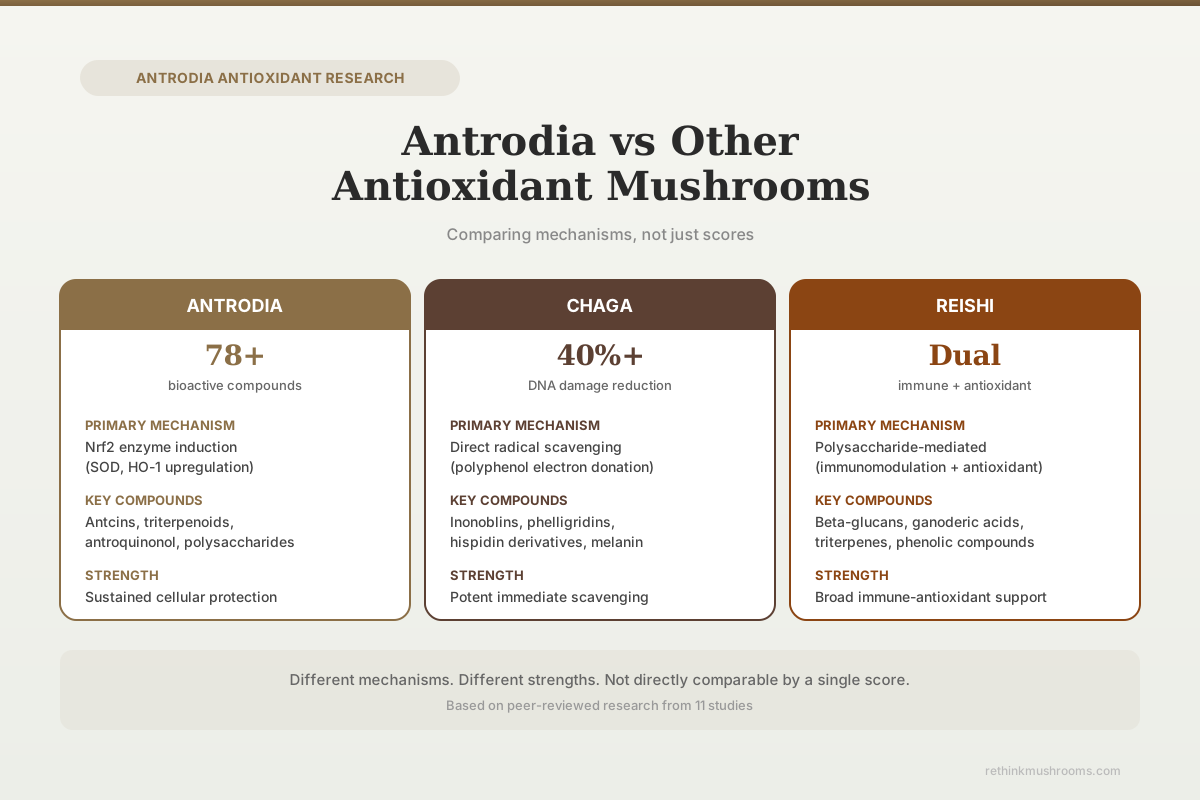
Comparing mushroom antioxidant activity is tempting but deceptive. A chaga extract that scores highest on a DPPH radical scavenging assay and an Antrodia extract that activates Nrf2-mediated enzyme production are doing fundamentally different things, and a single "antioxidant score" cannot capture both. Antrodia camphorata contains over 78 identified bioactive compounds spanning triterpenoids, polysaccharides, benzenoids, and ubiquinone derivatives.[10] Each mushroom species brings a distinct chemical toolkit to oxidative stress, and understanding those differences matters more than ranking them. For a deep look at Antrodia's own antioxidant mechanisms, see Antrodia and Antioxidant Activity: Free Radical Protection.
This article compares the antioxidant research evidence for Antrodia camphorata, chaga (Inonotus obliquus), and reishi (Ganoderma lucidum), focusing on what each species actually does at the molecular level rather than which one "wins."
Key Takeaways
- Antrodia camphorata extract showed dose-dependent DPPH radical scavenging with an IC50 of approximately 31 mcg/mL and protected DNA against hydroxyl radical damage (Hsieh et al., 2015)
- Chaga (Inonotus obliquus) extract reduced oxidative DNA damage in human lymphocytes by over 40% compared to controls, as measured by comet assay (Park et al., 2004)
- Antrodia activates the Nrf2 transcription factor pathway, upregulating endogenous antioxidant enzymes like superoxide dismutase (SOD) and heme oxygenase-1 (HO-1)
- Chaga's antioxidant activity derives primarily from polyphenolic compounds including inonoblins and phelligridins, which directly scavenge free radicals (Lee et al., 2007)
- Reishi (Ganoderma lucidum) polysaccharides show antioxidant activity through both direct radical scavenging and immune system modulation (Pan et al., 2013)
- Head-to-head antioxidant comparisons between mushroom species are rare, and the few that exist use wildly different extraction methods, making rankings unreliable
How Antioxidant Activity Is Measured in Mushroom Research
Before comparing species, the measurement problem deserves attention. Mushroom antioxidant studies use several assays, and each captures a different aspect of antioxidant behavior:
DPPH radical scavenging measures the ability of a compound to donate a hydrogen atom to the stable DPPH radical. This is the most commonly used assay in mushroom research and generates the most comparable data across studies. Witkowska et al. (2011) used DPPH among other methods to compare wild edible mushroom species and found substantial variation even within the same genus depending on harvest location and preparation method.[9]
ORAC (Oxygen Radical Absorbance Capacity) measures how well a substance protects a fluorescent probe from oxidation over time. ORAC values are frequently cited in marketing materials for chaga, but standardized ORAC comparisons across mushroom species are scarce in peer-reviewed literature. The USDA retired its ORAC database in 2012 because of widespread misuse by food and supplement companies, noting that ORAC values have no established relevance to health effects in humans. Despite this, ORAC scores remain a common marketing tool in the mushroom supplement industry.
ABTS radical cation scavenging is a complementary assay that measures both lipophilic and hydrophilic antioxidant capacity. Some compounds that perform well on DPPH perform poorly on ABTS and vice versa, which is why single-assay comparisons are misleading.
Cellular and enzymatic assays measure whether a compound activates the body's own antioxidant defense systems (such as SOD, catalase, and glutathione peroxidase) rather than directly scavenging radicals. These are more physiologically relevant but harder to standardize across laboratories. Enzymatic assays require living cells or tissue preparations, introduce more variables, and produce results that are less easily reduced to a single number for cross-species comparison.
The central problem: an extract can score poorly on DPPH but powerfully activate Nrf2-mediated enzyme induction, or vice versa. No single assay captures the full antioxidant potential of any mushroom species. For Antrodia's specific cellular mechanisms, see Antrodia and Cellular Antioxidant Mechanisms.
Antrodia camphorata: Enzyme Induction and Direct Scavenging
Antrodia's antioxidant activity operates through two parallel channels.
Direct Radical Scavenging
Hsieh et al. (2015) tested Antrodia camphorata extracts for DPPH radical scavenging, anti-mutagenic activity, and protection of DNA against hydroxyl radical damage. The extract showed dose-dependent radical scavenging with a concentration producing a 0.20 decrease in DPPH absorbance at approximately 31 mcg/mL. The extract also provided protective effects against hydroxyl radical-induced DNA strand breaks.[1]
Hsiao et al. (2003) demonstrated that Antrodia camphorata extract exhibited reducing power and scavenging activities against superoxide anion radicals, in addition to its hepatoprotective effects in CCl4-challenged mice at doses from 250 to 1,250 mg/kg.[2]
Endogenous Antioxidant Enzyme Activation
What distinguishes Antrodia from many other antioxidant mushrooms is its documented activation of the Nrf2 transcription factor pathway. Nrf2 is the master regulator of the cellular antioxidant response; when activated, it drives expression of protective enzymes including superoxide dismutase (SOD), heme oxygenase-1 (HO-1), and glutathione-related enzymes.
Yang et al. (2017) showed that Antrodia camphorata attenuated cigarette smoke-induced ROS production, DNA damage, apoptosis, and inflammation in vascular smooth muscle cells. The study demonstrated antioxidant protection in both cellular and animal (ApoE-deficient mice) models, linking the effect to reduced oxidative stress markers.[3]
Yang et al. (2022) found that Antrodia camphorata polysaccharide activated the Nrf2 signal pathway and increased SOD levels while suppressing ROS expression in a liver injury model. The polysaccharide fraction also modulated the ROS/TLR4/NF-kB signaling cascade, connecting antioxidant activity to anti-inflammatory outcomes.[4] This dual mechanism (direct scavenging plus enzyme induction) means Antrodia's antioxidant effects may persist beyond the immediate presence of the compound in the body, because the upregulated enzymes continue functioning independently. For the specific SOD induction pathway, see Antrodia camphorata and Superoxide Dismutase Induction.
Chaga (Inonotus obliquus): Polyphenol-Driven Radical Capture
Chaga's antioxidant reputation rests primarily on its exceptionally high polyphenolic content, particularly melanin-like compounds and unique small-molecule polyphenols.
DNA Protection in Human Cells
Park et al. (2004) demonstrated that chaga mushroom extract inhibited oxidative DNA damage in human lymphocytes as assessed by comet assay. When human lymphocytes were pre-treated with chaga extract before exposure to hydrogen peroxide, oxidative DNA damage was reduced by over 40% compared to untreated controls.[5]
This is one of the few mushroom antioxidant studies to use human cells rather than cell-free chemical assays, making it more physiologically informative than typical DPPH tests. The comet assay measures actual DNA strand breaks in living cells, which directly relates to the type of oxidative damage associated with aging and disease. Most mushroom antioxidant studies rely on chemical assays that measure radical scavenging in solution, which is a necessary first step but tells you nothing about whether the compound protects biological structures in a living system.
Unique Polyphenolic Compounds
Lee et al. (2007) isolated novel antioxidant polyphenols from Inonotus obliquus, including inonoblins A, B, and C, along with phelligridins D, E, and G. These compounds exhibited significant ABTS radical cation scavenging activity and DPPH radical scavenging activity, with moderate activity against the superoxide radical anion.[7]
Chaga's polyphenols function as direct radical scavengers, donating electrons to neutralize free radicals on contact. This is mechanistically different from Antrodia's enzyme induction approach. The structural diversity of chaga's polyphenolic compounds (inonoblins, phelligridins, hispidin derivatives) is unusual among medicinal mushrooms and likely explains why chaga consistently outperforms other species on in vitro radical scavenging assays. These compounds are concentrated in chaga's melanin-rich sclerotium, the hard black exterior that forms on birch trees, which is the part most commonly harvested and processed into extracts.
Comprehensive Review Evidence
Fordjour et al. (2023) reviewed chaga's pharmacological profile and noted that polyphenols are the principal compounds responsible for quenching free radicals, while polysaccharides and certain triterpenoid compounds contribute partially to DPPH and hydroxyl radical scavenging.[6] The review also noted that chaga had the strongest antioxidant activity among several fungi examined in terms of both superoxide and hydroxyl radical scavenging.
Reishi (Ganoderma lucidum): Polysaccharides and Triterpenes
Reishi occupies a middle ground between Antrodia and chaga in its antioxidant mechanisms, combining polysaccharide-mediated effects with triterpene activity.
Pan et al. (2013) optimized the extraction of Ganoderma lucidum polysaccharides and evaluated their antioxidant and immunity-enhancing activities. The polysaccharide fraction demonstrated both antioxidant capacity and immunomodulatory effects, suggesting that reishi's antioxidant activity is partly driven by immune system regulation of oxidative stress rather than purely direct chemical mechanisms.[11]
This immune-antioxidant connection is unique to reishi's profile. Activated immune cells produce reactive oxygen species as part of pathogen defense, and reishi's immunomodulatory polysaccharides may help regulate this process, preventing the oxidative collateral damage that accompanies chronic immune activation. This is a fundamentally different antioxidant strategy from either Antrodia's enzyme induction or chaga's direct radical scavenging.
Lysakowska et al. (2023) reviewed the bioactive components across multiple medicinal mushroom species including reishi, noting that triterpenes, beta-glucans, and phenolic compounds each contribute distinct antioxidant mechanisms. Reishi's triterpene profile differs from Antrodia's triterpenoid profile (which includes unique antcins), and these structural differences drive different biological activities.[8]
For related discussion of how reishi and other mushrooms function in stress response, see Adaptogenic Mushrooms for Stress: Reishi, Cordyceps, and the HPA Axis.
Head-to-Head Comparisons: Why Rankings Are Unreliable
Direct comparative studies of mushroom antioxidant activity are rare, and those that exist illustrate why simple rankings collapse under scrutiny.
Witkowska et al. (2011) compared wild edible mushrooms as sources of antioxidants using multiple assays (DPPH, reducing power, ferrous ion chelating activity). The study found that antioxidant activity varied substantially among species and that rankings changed depending on which assay was used. A species that ranked highest on DPPH scavenging did not necessarily rank highest on metal chelation or reducing power.[9]
Several factors make cross-species mushroom antioxidant comparisons unreliable:
Extraction method: Hot water extraction, ethanol extraction, and supercritical CO2 extraction pull different compound profiles from the same mushroom. A chaga hot water extract and a chaga ethanol extract will produce different antioxidant scores.
Concentration and standardization: "500 mg of chaga extract" and "500 mg of Antrodia extract" contain completely different concentrations of active compounds depending on extraction ratios, growing conditions, and processing.
Growth substrate and conditions: Wild-harvested chaga from birch trees contains different compound profiles than cultivated chaga. Wild Antrodia fruiting body from camphor trees has a different triterpenoid profile than solid-state cultivated mycelium.
Assay selection bias: Studies tend to use assays that show their target mushroom favorably. Chaga studies emphasize DPPH (where polyphenols excel). Antrodia studies emphasize cellular antioxidant enzyme induction (where triterpenoids excel).
Dose and bioavailability: Even if two mushroom extracts show identical DPPH scores in a test tube, their in vivo antioxidant effects depend on absorption, metabolism, and tissue distribution. Antrodia's triterpenoids and chaga's polyphenols have different pharmacokinetic profiles. A compound that excels in a cell-free assay may fail to reach target tissues in a living organism, and vice versa.
The bottom line: any claim that one mushroom is "X times more antioxidant" than another based on a single assay score should be treated with skepticism. The research supports species-specific mechanistic descriptions, not universal rankings. For Antrodia's specific bioactive compound classes, see Antrodia Bioactive Compounds: Antcins, Triterpenoids, and Polysaccharides.
Different Mechanisms, Different Applications
Rather than asking "which mushroom has the most antioxidant activity," a more productive question is "which antioxidant mechanism matters for a given context?"
| Mechanism | Antrodia | Chaga | Reishi |
|---|---|---|---|
| Direct radical scavenging (DPPH) | Moderate | High | Moderate |
| DNA protection | Demonstrated | Demonstrated in human cells | Limited direct data |
| Nrf2/enzyme induction (SOD, HO-1) | Strong evidence | Limited data | Some evidence |
| Polyphenol content | Lower | Very high | Moderate |
| Triterpenoid-mediated activity | High (unique antcins) | Limited | Moderate (ganoderic acids) |
| Polysaccharide-mediated activity | Moderate | Moderate | High (beta-glucans) |
Antrodia's strength lies in its triterpenoid-mediated Nrf2 activation and endogenous enzyme upregulation. This is a sustained, systemic antioxidant mechanism that operates through the body's own defense pathways. Chaga's strength lies in its exceptionally high polyphenol content, providing immediate, potent direct radical scavenging. Reishi offers a broader but less concentrated antioxidant profile complemented by strong immunomodulatory activity.
These are complementary, not competing, strategies. The research does not support ranking one species as universally "better" for antioxidant protection.
Evidence Quality Differences
The evidence base also differs by species. Antrodia camphorata has the most detailed mechanistic research on specific pathways (Nrf2, SOD induction) thanks to concentrated Taiwanese research investment. Chaga has the most in vitro radical scavenging data and some human cell studies. Reishi has the broadest research base overall but less focused antioxidant research because studies tend to emphasize its immunomodulatory and adaptogenic properties.
None of these species has large-scale human clinical trial data specifically measuring antioxidant outcomes (like plasma malondialdehyde, 8-OHdG, or isoprostane levels) as primary endpoints. The antioxidant evidence for all three remains predominantly preclinical. For the triterpenoid compounds that drive Antrodia's unique antioxidant profile, see Antrodia Triterpenoids and Oxidative Stress Defense.
The Bottom Line
Antrodia camphorata, chaga, and reishi each deliver antioxidant activity through fundamentally different mechanisms. Antrodia excels at Nrf2-mediated enzyme induction and triterpenoid-driven protection. Chaga provides the highest direct radical scavenging through polyphenols. Reishi combines polysaccharide and triterpene pathways with immune modulation. Single-assay rankings are unreliable because they capture only one dimension of antioxidant activity.
Frequently Asked Questions
Sources & References
- 1RTHM-00376·Hsieh, Yu-Lin et al. (2015). “Effects of Antrodia camphorata extracts on anti-oxidation, anti-mutagenesis and protection of DNA against hydroxyl radical damage..” BMC complementary and alternative medicine.Study breakdown →PubMed →↩
- 2RTHM-00055·Hsiao, George et al. (2003). “Antioxidative and hepatoprotective effects of Antrodia camphorata extract..” Journal of agricultural and food chemistry.Study breakdown →PubMed →↩
- 3RTHM-00500·Yang, Hsin-Ling et al. (2017). “Antrodia camphorata attenuates cigarette smoke-induced ROS production, DNA damage, apoptosis, and inflammation in vascular smooth muscle cells, and atherosclerosis in ApoE-deficient mice..” Environmental toxicology.Study breakdown →PubMed →↩
- 4RTHM-00804·Yang, Yi et al. (2022). “Antrodia camphorata polysaccharide improves inflammatory response in liver injury via the ROS/TLR4/NF-κB signal..” Journal of cellular and molecular medicine.Study breakdown →PubMed →↩
- 5RTHM-00076·Park, Yoo Kyoung et al. (2004). “Chaga mushroom extract inhibits oxidative DNA damage in human lymphocytes as assessed by comet assay..” BioFactors (Oxford.Study breakdown →PubMed →↩
- 6RTHM-01694·Fordjour, Eric et al. (2023). “Chaga mushroom: a super-fungus with countless facets and untapped potential..” Frontiers in pharmacology.Study breakdown →PubMed →↩
- 7RTHM-00118·Lee, In-Kyoung et al. (2007). “New antioxidant polyphenols from the medicinal mushroom Inonotus obliquus..” Bioorganic & medicinal chemistry letters.Study breakdown →PubMed →↩
- 8RTHM-00843·Łysakowska, Paulina et al. (2023). “Medicinal Mushrooms: Their Bioactive Components, Nutritional Value and Application in Functional Food Production-A Review..” Molecules (Basel.Study breakdown →PubMed →↩
- 9RTHM-00238·Witkowska, Anna M et al. (2011). “Comparative study of wild edible mushrooms as sources of antioxidants..” International journal of medicinal mushrooms.Study breakdown →PubMed →↩
- 10RTHM-00214·Geethangili, Madamanchi et al. (2011). “Review of Pharmacological Effects of Antrodia camphorata and Its Bioactive Compounds..” Evidence-based complementary and alternative medicine : eCAM.Study breakdown →PubMed →↩
- 11RTHM-00301·Pan, Ke et al. (2013). “Optimization extraction of Ganoderma lucidum polysaccharides and its immunity and antioxidant activities..” International journal of biological macromolecules.Study breakdown →PubMed →↩