Mushrooms vs. Pharmaceuticals
47% report weaker effects
Among people taking psilocybin mushrooms while on SSRIs, 47% reported weaker-than-expected psychedelic effects, and 55% of those on SNRIs reported the same.
Gukasyan et al., Journal of Psychopharmacology, 2023
4 weeks
of lion's mane intake reduced depression and anxiety scores vs. placebo in women
No difference
between psilocybin and escitalopram on primary depression outcome at 6 weeks
0 cases
of serotonin syndrome reported in controlled psilocybin + antidepressant studies
Gukasyan et al., Journal of Psychopharmacology, 2023
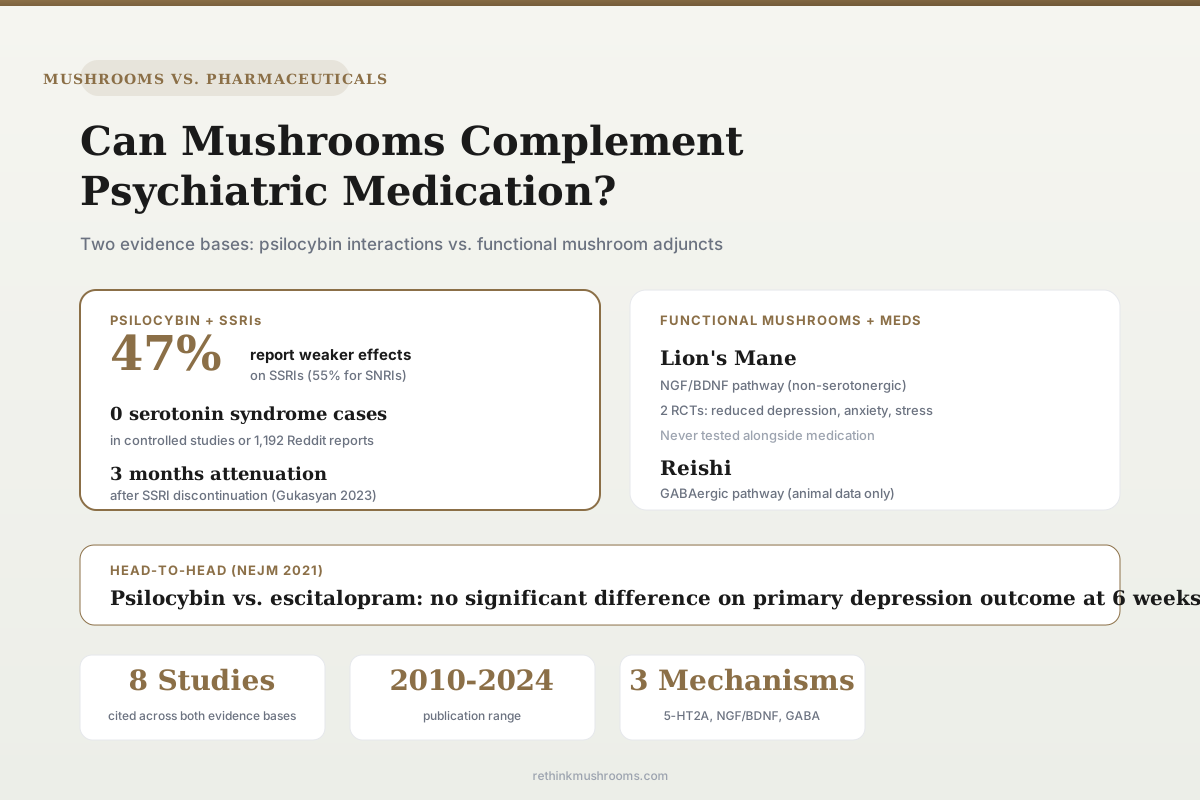 View as image ↗
The question of whether mushrooms can complement psychiatric medication requires separating two entirely different evidence bases. Functional mushrooms like lion's mane and reishi have preliminary evidence for mood and anxiety effects through mechanisms unrelated to serotonergic drugs. Psilocybin mushrooms interact directly with the same serotonin receptors targeted by SSRIs and SNRIs, creating genuine pharmacological questions about co-administration. Conflating these two categories, as popular media routinely does, obscures the actual state of evidence for each.
This article maps both evidence bases and their intersection with existing psychiatric medication. The functional mushroom data is early-stage but mechanistically distinct from standard antidepressants. The psilocybin data is more advanced but complicated by the fact that the leading antidepressants in clinical use directly interfere with psilocybin's mechanism. For a broader comparison of mushroom and pharmaceutical approaches, see mushrooms vs. SSRIs for mental health: can they compare?.
Key Takeaways
- A 2021 NEJM trial found no significant difference between psilocybin (25 mg, two doses) and escitalopram on the primary depression measure at 6 weeks, with secondary outcomes favoring psilocybin (Carhart-Harris et al., 2021)
- Single-dose psilocybin (25 mg) produced a significant reduction in depression scores at 3 weeks in treatment-resistant patients, but the 10 mg dose did not separate from the 1 mg control (Goodwin et al., 2022)
- Among people taking psilocybin while on SSRIs, 47% reported weaker-than-expected effects; this dampening persisted up to 3 months after SSRI discontinuation (Gukasyan et al., 2023)
- A content analysis of 1,192 Reddit posts found that users combining SSRIs and psilocybin most commonly reported reduced psychedelic effects, with no reports consistent with serotonin syndrome (Sakai et al., 2024)
- Four weeks of oral Hericium erinaceus reduced depression (CES-D) and anxiety scores compared to placebo in 30 women, through a mechanism unrelated to serotonin reuptake inhibition (Nagano et al., 2010)
- Lion's mane supplementation for 28 days reduced self-reported stress (DASS-21) and improved sleep quality compared to placebo in a double-blind trial of 41 healthy young adults (Docherty et al., 2023)
Psilocybin and SSRIs: The Pharmacological Conflict
Psilocybin's primary mechanism is agonism at 5-HT2A serotonin receptors. SSRIs increase synaptic serotonin by blocking reuptake at the serotonin transporter. When both are present, the chronic elevation of serotonin from SSRI use downregulates 5-HT2A receptors over time, reducing the receptor density that psilocybin needs for its effects. This is not a theoretical concern. It is the most consistently reported drug interaction in the psilocybin literature, documented in both clinical trials and observational data.
The interaction runs in one direction: SSRIs blunt psilocybin, not the reverse. A single psilocybin dose does not meaningfully alter SSRI efficacy because psilocybin's effects are acute (4 to 6 hours) while SSRIs require weeks of continuous dosing to achieve therapeutic levels. The asymmetry is important because it means the risk is reduced therapeutic benefit from psilocybin rather than destabilization of existing antidepressant therapy.
Gukasyan et al. (2023) surveyed people who had taken psilocybin mushrooms while using or recently discontinuing antidepressants. Among SSRI users, 47% reported weaker-than-expected psilocybin effects. Among SNRI users, 55% reported the same. The attenuation was not binary: some users still experienced full effects, particularly at higher psilocybin doses. The dampening effect persisted for up to 3 months after stopping the antidepressant, consistent with the time course required for 5-HT2A receptor density to recover after chronic SSRI exposure.[3]
Sakai et al. (2024) analyzed 1,192 Reddit posts describing SSRI-psilocybin co-administration. The most common reported outcome was reduced psychedelic effects, confirming the Gukasyan survey data in a larger, naturalistic sample. Critically, no posts described symptoms consistent with serotonin syndrome (hyperthermia, clonus, agitation, autonomic instability), a theoretical risk that has been a primary safety concern. The absence of serotonin syndrome in both controlled research and large self-report datasets suggests that psilocybin's receptor profile, primarily 5-HT2A agonism rather than broad serotonin release, may not generate the pharmacological conditions required for toxicity.[4]
Fact Check
Does combining psilocybin with an SSRI cause serotonin syndrome?
The claim
“Taking psilocybin while on an SSRI risks serotonin syndrome, a dangerous drug interaction.”
Generalized from known SSRI plus serotonergic-drug interactions
What research shows
OverstatedNo cases of serotonin syndrome have been reported in controlled psilocybin trials or in a content analysis of 1,192 Reddit posts describing SSRI-psilocybin co-administration.
Psilocybin is a 5-HT2A agonist that does not broadly increase serotonin release, so it appears not to create the conditions for toxicity. The documented problem is reduced psychedelic effect, not dangerous interaction.
Sakai et al., 2024; Gukasyan et al., 2023
Safety
ModerateStopping an SSRI to try psilocybin can destabilize you
Concern
Because SSRIs blunt psilocybin's effects (47% of SSRI users and 55% of SNRI users report weaker-than-expected responses), most clinical protocols require tapering off the antidepressant first, opening a gap in coverage for someone who has been stable.
What the research says
The attenuation can persist up to 3 months after stopping an SSRI, so any taper-and-washout window is prolonged and should be planned, not improvised.
Particularly relevant for: People currently stable on SSRIs or SNRIs considering psilocybin
What to do
This is not medical advice. Never stop or adjust a psychiatric medication to accommodate psilocybin without direct supervision from the prescribing clinician.
Gukasyan et al., Journal of Psychopharmacology, 2023
Psilocybin as a Standalone Alternative
Carhart-Harris et al. (2021) published the landmark head-to-head comparison in the New England Journal of Medicine. Fifty-nine patients with moderate-to-severe major depression received either two 25 mg psilocybin sessions (plus daily placebo pills) or two 1 mg psilocybin sessions (plus daily escitalopram). At 6 weeks, the primary outcome (QIDS-SR-16 depression score change) showed no significant difference between groups. Secondary measures, including response and remission rates, favored psilocybin, but these were not corrected for multiple comparisons.[1]
Carhart-Harris et al. (2021) · New England Journal of Medicine
- Population
- 59 adults with moderate-to-severe major depression
- Intervention
- Two 25 mg psilocybin sessions plus daily placebo
- Comparator
- Two 1 mg psilocybin sessions plus daily escitalopram
- Finding
- No significant difference on the primary depression measure (QIDS-SR-16) at 6 weeks; secondary outcomes such as remission and response favored psilocybin but were not corrected for multiple comparisons.
mixed A statistical tie on the primary endpoint in an underpowered trial: promising, not definitive.
Carhart-Harris et al., NEJM, 2021
One Tie, Then Divergence
Psilocybin vs. Escitalopram Across Every Outcome the Trial Measured
Primary endpoint — QIDS-SR-16 change
Pre-specified primary measure, 6 weeks
Remission rate
Secondary outcome, QIDS-SR ≤ 5
Response rate
Secondary outcome, ≥50% score reduction
6-month psychosocial trajectory
Erritzoe 2024Psilocybin
Advantage grew larger at 6 months than at 6 weeks
Escitalopram
Depression gains maintained; psychosocial gap widened
Emotional-face brain responsiveness (fMRI)
Wall 2025Psilocybin
No reduction; slight increase to neutral faces
Escitalopram
Reduced BOLD response to emotional faces across regions
The primary endpoint difference was real but statistically non-significant because the 59-person Phase 2 trial was not powered to detect a 2-point scale gap — not because the treatments were equivalent.
Sources: Carhart-Harris et al., NEJM, 2021 (primary & secondary outcomes); Erritzoe et al., EClinicalMedicine, 2024 (6-month follow-up); Wall et al., Am J Psychiatry, 2025 (fMRI substudy).
Goodwin et al. (2022) tested single-dose psilocybin in treatment-resistant depression, the population that has exhausted standard options. A single 25 mg dose produced a statistically significant and clinically meaningful reduction in MADRS depression scores at 3 weeks compared to a 1 mg control dose. The 10 mg dose did not separate from control. This trial established that psilocybin has dose-dependent antidepressant efficacy at therapeutic doses, but it was not designed to test whether psilocybin could work alongside existing medication.[2]
The clinical paradox: psilocybin shows antidepressant effects comparable to escitalopram, but taking both simultaneously weakens the psilocybin response. Current clinical trials generally require patients to taper off SSRIs before psilocybin sessions, creating a gap in antidepressant coverage that can be destabilizing for patients who have been stable on their current regimen.
The Carhart-Harris trial is particularly informative because of its design. Both groups received daily pills (escitalopram or placebo) and two psilocybin sessions (25 mg or 1 mg). The 1 mg "micro" sessions were intended as an active placebo. The fact that the full 25 mg psilocybin group did not clearly outperform the escitalopram group on the primary measure means either that escitalopram is more effective than critics suggest or that the psilocybin protocol (two sessions over six weeks) has a ceiling effect on sustained symptom reduction. Both interpretations are plausible. Whether a concurrent approach could work at modified doses remains untested in any controlled trial. For a direct comparison of side effect profiles, see mushrooms vs. SSRIs for mild depression: comparing evidence and side effect profiles.
Lion's Mane: A Mechanistically Different Approach
Hericium erinaceus (lion's mane) operates through entirely different pathways than both psilocybin and SSRIs. Its bioactive compounds, particularly hericenones from the fruiting body and erinacines from the mycelium, stimulate nerve growth factor (NGF) synthesis and brain-derived neurotrophic factor (BDNF) expression. This neurotrophic mechanism is not serotonergic and does not interact with monoamine reuptake or 5-HT receptors at known concentrations.
Nagano et al. (2010) conducted a randomized, double-blind, placebo-controlled trial in 30 women. Four weeks of oral H. erinaceus (in cookie form) significantly reduced scores on the Center for Epidemiologic Studies Depression Scale (CES-D) and a scale measuring indefinite complaints (fatigue, irritability, difficulty concentrating) compared to placebo. The authors attributed the effect to NGF-mediated neuronal support rather than direct neurotransmitter modulation.[5]
Docherty et al. (2023) extended this with a double-blind, parallel-group trial in 41 healthy young adults taking H. erinaceus supplementation for 28 days. The lion's mane group showed reduced self-reported stress on the DASS-21 and improved subjective sleep quality. Cognitive performance showed a trend toward improvement on a specific speed-of-performance task but did not reach significance across the full battery.[6]
Neither trial tested lion's mane as an adjunct to psychiatric medication specifically. The mechanistic separation from SSRIs suggests a low pharmacological interaction risk, but this has not been formally studied. No pharmacokinetic interaction study has tested whether lion's mane compounds affect the metabolism of common antidepressants through cytochrome P450 enzymes or other drug metabolism pathways. The evidence base is two small placebo-controlled trials and a handful of animal studies showing increased NGF expression and reduced depressive behavior in rodents. This is enough to generate a hypothesis that lion's mane could complement standard antidepressant therapy by supporting neurotrophic pathways that SSRIs do not directly target, but the hypothesis has not been tested in any medicated population. For how other functional mushrooms compare, see natural mushroom supplements vs. prescription anxiety meds.
Mechanism Map
Two Mushrooms Approach Depression From Opposite Directions
Lion's mane works from the neuron outward; reishi works from the immune and stress systems inward. Because depression is biologically heterogeneous, the two routes are partly independent — though no trial has yet tested them together.
Lion's Mane
Bottom-up · neurotrophic
Builds up from the neuron
- 1Hericenones and erinacines stimulate NGF and BDNF/TrkB signaling
- 2Drives hippocampal neurogenesis — the birth of new neurons
- 3Restores stress-lowered serotonin, dopamine, and norepinephrine
Best fit: Neuroplasticity-deficit depression
Vigna 2019 (human) · Chong 2021 · Chiu 2018 (animal)
Reishi
Top-down · immune-endocrine
Calms the system around the neuron
- 1Polysaccharides engage Dectin-1, lowering IL-1β and TNF-α
- 2Triterpenes modulate the HPA stress axis and cortisol load
- 3Reduced neuroinflammation lets prefrontal BDNF and serotonin recover
Best fit: Inflammatory / stress-driven depression
Mitra 2024 (human) · Li 2021 · Zhao 2021 (animal)
Both routes eventually raise BDNF and support mood-regulating circuits — they just enter the system at different points. That mechanistic complementarity is the rationale for pairing them, but it remains untested in any combination trial.
Source: Vigna et al. (2019); Chong et al. (2021); Chiu et al. (2018); Mitra et al. (2024); Li et al. (2021); Zhao et al. (2021)
Reishi: Preclinical Anxiolytic Data
Ganoderma lucidum (reishi) has an even earlier-stage evidence base for psychiatric effects. Socala et al. (2015) tested an aqueous extract of cultured reishi mycelia in mice and found dose-dependent anxiolytic effects in the elevated plus maze and antidepressant-like effects in the forced swim test, alongside anticonvulsant activity. The effective doses ranged from 75 to 300 mg/kg. The authors proposed GABAergic modulation as the mechanism, distinct from serotonergic pathways.[7]
This is animal-only data in forced behavioral paradigms, which is the weakest level of psychiatric evidence. The translation from mouse forced swim test to human depression treatment has an approximately 50% failure rate historically; compounds that show antidepressant-like effects in mice routinely fail in human trials. The elevated plus maze is somewhat more reliable for anxiolytic prediction, but the gap between preclinical promise and clinical reality remains wide.
No controlled human trial has tested reishi for anxiety or depression as either a standalone or adjunctive treatment. The only human study of reishi and psychological outcomes (a trial in female college students measuring stress) was not designed to evaluate psychiatric effects. The GABAergic mechanism, if confirmed in humans, would theoretically interact with benzodiazepines and other GABAergic medications rather than SSRIs, but this has not been tested in any pharmacokinetic study.
- Cell / mechanism studiescompleted
GABAergic activity proposed as the mechanism
- Animal behavioral modelscurrent
Dose-dependent anxiolytic and antidepressant-like effects in mice (75 to 300 mg/kg)
- Small human trialsmissing
No controlled trial for anxiety or depression, standalone or adjunctive
- Large RCTsmissing
Reishi's psychiatric evidence stops at the animal stage. Mouse forced-swim and elevated-plus-maze results translate poorly to human depression, so the promising preclinical signal remains unconfirmed in people.
Socala et al., 2015
The Complementary Use Question
The evidence landscape splits into three categories with very different levels of support:
Psilocybin replacing SSRIs: Supported by one phase 2 head-to-head trial (Carhart-Harris 2021) and one TRD trial (Goodwin 2022). Promising but not yet sufficient for clinical guideline recommendations. Two psilocybin sessions are not equivalent to daily medication management, and long-term durability data remains limited.
Psilocybin alongside SSRIs: Actively problematic. SSRIs attenuate psilocybin's subjective and potentially therapeutic effects through 5-HT2A downregulation. No controlled trial has tested concurrent use with dose adjustments to compensate. The serotonin syndrome risk appears lower than initially feared, but the efficacy concern is serious.
Functional mushrooms alongside psychiatric medication: No direct evidence for or against. Lion's mane and reishi operate through non-serotonergic mechanisms (NGF/BDNF and GABA, respectively), which theoretically reduces interaction risk with SSRIs. The mood and stress data from lion's mane trials is real but small-scale and has not been tested in medicated populations. This is the most common real-world scenario: people adding mushroom supplements to existing medication regimens. Surveys suggest that a substantial proportion of functional mushroom consumers also take prescription medications, yet this combination is the least represented in controlled research. The absence of reported adverse interactions in supplement surveillance databases is reassuring but is not the same as demonstrated safety from a pharmacovigilance perspective.
Polito and Liknaitzky (2024) noted that microdosing research, the form most likely used alongside ongoing medication, has been conducted almost exclusively in unmedicated, non-clinical populations. The cognitive and mood effects of microdosing in people actively taking psychiatric medication are essentially unstudied in controlled settings.[8] For how the broader case for mushrooms as support rather than replacement is framed in the evidence, see the case for mushrooms as mental health support, not replacement.
The Safety Evidence, Two Ways
Short-Term Safety Is Established. Long-Term Safety Is Not Studied.
These are two different evidence situations that deserve two different conclusions. The left panel is what the research supports; the right panel is what no one has measured.
Supported by data
Short-Term (Established)
Consistent across controlled trials, naturalistic cohorts, and systematic reviews.
31 studies systematically reviewed
Side effects dose-dependent, mild, transient (raised BP, anxiety, cognitive impairment)
Modzelewski 2025
0 serious adverse events
None reported in any controlled microdosing trial reviewed to date
Modzelewski 2025; Cavanna 2022; Szigeti 2021
Largest naturalistic cohort: n=953
953 microdosers vs 180 comparators tracked ~30 days — no serious adverse events
Rootman 2022
Most rigorous design: double-blind RCT
0.5 g dried Psilocybe cubensis vs placebo — acute anxiety up, no serious events
Cavanna 2022
No data exists
Long-Term (Unstudied)
The absence of reported harm reflects the absence of systematic monitoring.
Follow-up beyond ~30 days
No prospective cohort tracked longer; long-term safety unstudied since 2020
Ona & Bouso 2020; Savides & Outhoff 2024
Chronic cardiac (5-HT2B valvulopathy)
No confirmed cases, but no prospective cardiac monitoring in sustained microdosers
Nahlawi 2025
Tolerance & receptor desensitization
Whether repeated microdosing blunts response over months is untested in humans
Savides & Outhoff 2024
Drug interactions & developmental effects
SSRIs, MAOIs, lithium; pregnancy and adolescent brains — all uncharacterized
Savides & Outhoff 2024
Source: Modzelewski 2025, Cavanna 2022, Szigeti 2021, Rootman 2022 (short-term); Ona & Bouso 2020, Savides & Outhoff 2024, Nahlawi 2025 (long-term gaps)
Research Gaps
What would it take?
Can mushrooms safely complement psychiatric medication?
A controlled trial of psilocybin with dose adjustment in people who stay on their SSRI
Every trial to date requires tapering off the antidepressant first
Lion's mane or reishi tested as an add-on in a medicated population
Both lion's mane mood trials were in unmedicated participants
Pharmacokinetic (CYP450) interaction studies for functional mushrooms and common antidepressants
Microdosing studied in people actively taking psychiatric medication
Existing microdosing research is almost entirely in unmedicated, non-clinical samples
Gukasyan et al., 2023; Polito & Liknaitzky, 2024
None of this is medical advice. If you are taking psychiatric medication, decisions about adding, or substituting, any mushroom product belong with the clinician who manages your prescription.
The Bottom Line
Psilocybin shows antidepressant effects comparable to escitalopram in one head-to-head trial, but SSRIs attenuate psilocybin's effects by 47 to 55%, and no controlled trial has tested the two concurrently. Functional mushrooms like lion's mane operate through neurotrophic rather than serotonergic mechanisms, which reduces theoretical interaction risk with standard antidepressants, but no trial has tested lion's mane or reishi as adjuncts to psychiatric medication. The most common real-world scenario, adding mushroom supplements to existing prescriptions, is the least studied in the controlled literature.
Frequently Asked Questions
Sources & References
- 1RTHM-00675·Carhart-Harris, Robin et al. (2021). “Trial of Psilocybin versus Escitalopram for Depression..” The New England journal of medicine.Study breakdown →PubMed →↩
- 2RTHM-00761·Goodwin, Guy M et al. (2022). “Single-Dose Psilocybin for a Treatment-Resistant Episode of Major Depression..” The New England journal of medicine.Study breakdown →PubMed →↩
- 3RTHM-00827·Gukasyan, Natalie et al. (2023). “Attenuation of psilocybin mushroom effects during and after SSRI/SNRI antidepressant use..” Journal of psychopharmacology (Oxford.Study breakdown →PubMed →↩
- 4RTHM-00904·Sakai, Kimberly et al. (2024). “Content analysis of Reddit posts about coadministration of selective serotonin reuptake inhibitors and psilocybin mushrooms..” Psychopharmacology.Study breakdown →PubMed →↩
- 5RTHM-00194·Nagano, Mayumi et al. (2010). “Reduction of depression and anxiety by 4 weeks Hericium erinaceus intake..” Biomedical research (Tokyo.Study breakdown →PubMed →↩
- 6RTHM-00821·Docherty, Sarah et al. (2023). “The Acute and Chronic Effects of Lion's Mane Mushroom Supplementation on Cognitive Function, Stress and Mood in Young Adults: A Double-Blind, Parallel Groups, Pilot Study..” Nutrients.Study breakdown →PubMed →↩
- 7RTHM-00400·Socala, Katarzyna et al. (2015). “Evaluation of Anticonvulsant, Antidepressant-, and Anxiolytic-like Effects of an Aqueous Extract from Cultured Mycelia of the Lingzhi or Reishi Medicinal Mushroom Ganoderma lucidum (Higher Basidiomycetes) in Mice..” International journal of medicinal mushrooms.Study breakdown →PubMed →↩
- 8RTHM-00900·Polito, Vince et al. (2024). “Is microdosing a placebo? A rapid review of low-dose LSD and psilocybin research..” Journal of psychopharmacology (Oxford.Study breakdown →PubMed →↩