Bipolar Depression
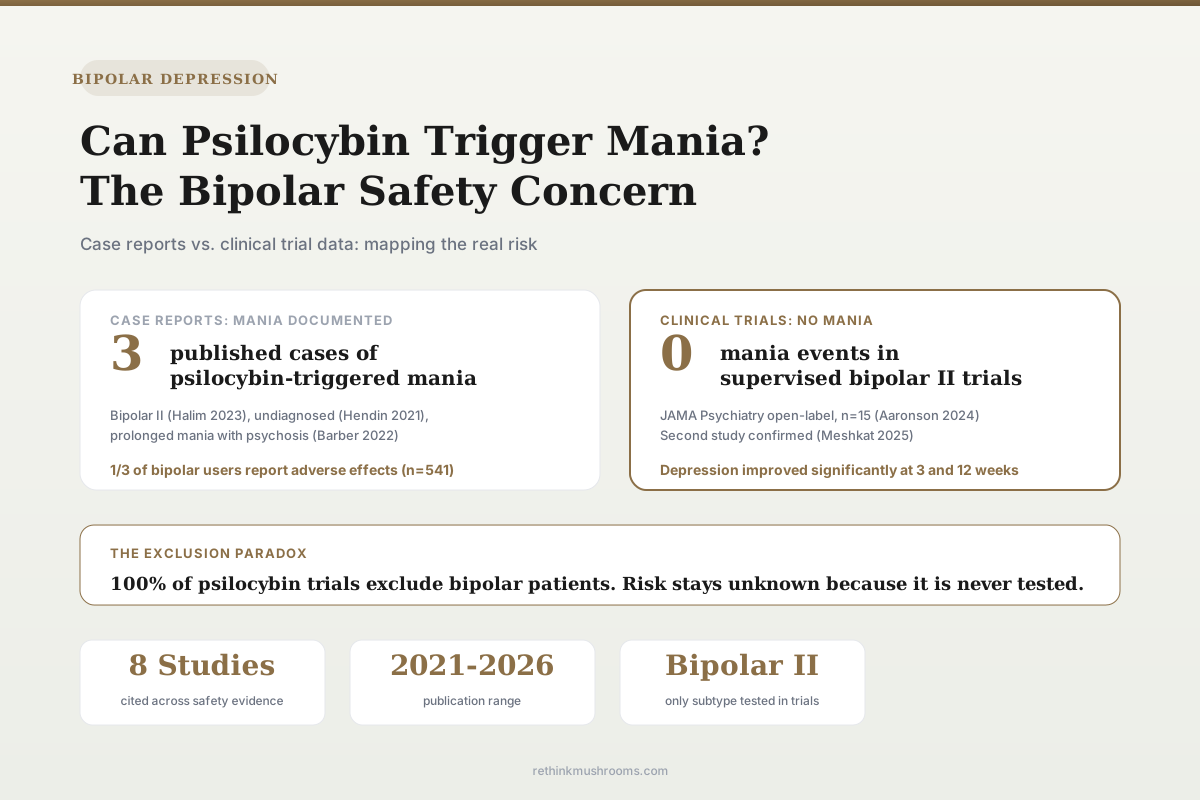
1/3 report adverse effects
In an international web-based survey of people with bipolar disorder who used psilocybin, approximately one-third reported adverse effects including new or worsening manic symptoms.
Morton et al., Journal of Psychopharmacology, 2023
0 mania
events in a JAMA open-label trial of psilocybin for bipolar II depression (n=15)
3 case reports
of psilocybin-triggered mania in the published medical literature
100%
of psilocybin clinical trials exclude bipolar disorder from enrollment
Morton et al., Journal of Psychopharmacology, 2023
 View as image ↗
Every psilocybin clinical trial to date has excluded people with bipolar disorder or a family history of bipolar disorder. This universal exclusion is based on a theoretical concern: psilocybin's 5-HT2A agonism could increase dopamine release in mesolimbic pathways, potentially triggering mania or hypomania in individuals vulnerable to mood switching. The concern is biologically plausible, supported by a handful of case reports, and now complicated by two small clinical trials that deliberately administered psilocybin to bipolar II patients and found no treatment-emergent mania.
This article maps the full evidence landscape: published case reports documenting psilocybin-associated mania, the naturalistic survey data showing mixed outcomes in self-medicating bipolar populations, the first clinical trials that challenge the blanket exclusion, and the mechanistic reasons the risk remains real even as the data grows more nuanced. For the broader question of how psilocybin research in bipolar depression is evolving, see psilocybin and bipolar disorder: potential and risks.
Key Takeaways
- A JAMA Psychiatry open-label trial administered 25 mg synthetic psilocybin to 15 patients with treatment-resistant bipolar II depression and reported no treatment-emergent mania or hypomania, with significant depression improvement at 3 and 12 weeks (Aaronson et al., 2024)
- An international survey of 541 bipolar disorder patients who used psilocybin found that approximately one-third reported adverse effects, including new or worsening manic symptoms, though the majority described the experience as beneficial (Morton et al., 2023)
- A 21-year-old man with bipolar II disorder developed a full manic episode requiring hospitalization after ingesting psilocybin mushrooms (Halim et al., 2023)
- A woman with no prior bipolar diagnosis developed a manic episode after psilocybin mushroom ingestion, subsequently diagnosed with bipolar disorder, suggesting psilocybin may unmask latent vulnerability (Hendin et al., 2021)
- A case of prolonged mania, psychosis, and severe depression following psilocybin use was documented in a patient without prior bipolar diagnosis, lasting several weeks (Barber et al., 2022)
- A 2026 comprehensive review concluded that current evidence is insufficient to determine whether psilocybin is safe or unsafe for bipolar populations, but that the blanket exclusion may be overly conservative for bipolar II specifically (Do et al., 2026)
The Case Reports
Three published case reports document psilocybin-associated manic episodes.
Halim et al. (2023) described a 21-year-old man with a recent bipolar II diagnosis who developed a manic episode after ingesting psilocybin mushrooms. He presented with grandiosity, decreased need for sleep, pressured speech, and impulsive behavior. The episode required psychiatric hospitalization and mood stabilizer initiation. He had been in a depressive phase when he used psilocybin, reportedly hoping for antidepressant effects based on media coverage of psilocybin therapy.[3]
Hendin et al. (2021) documented a woman with no prior psychiatric diagnosis who developed a manic episode following self-reported psilocybin mushroom ingestion. She was subsequently diagnosed with bipolar disorder. This case illustrates a particularly concerning scenario: psilocybin unmasking a latent bipolar vulnerability that might not have manifested for years or at all without the serotonergic provocation.[4]
Barber et al. (2022) published the most severe case in the American Journal of Psychiatry. A patient without prior bipolar diagnosis developed prolonged mania with psychotic features followed by severe depression after psilocybin use. The episode lasted several weeks and required intensive treatment. The authors argued that this case illustrates the risks created by increasing psychedelic drug availability without adequate screening for bipolar vulnerability.[5]
Three case reports do not establish a rate. They prove that psilocybin-associated mania occurs but cannot quantify how common it is. The denominator (how many people with bipolar disorder use psilocybin without incident) is unknown. Case reports are inherently biased toward dramatic outcomes: mild or positive experiences do not generate medical literature. The reporting rate for psilocybin-associated mania could be 1 in 50 bipolar users or 1 in 5,000. Without prospective monitoring data, neither estimate can be ruled out.
What the case reports collectively establish is that the mania risk is not limited to bipolar I: two of the three cases involved bipolar II or previously undiagnosed individuals. The Barber case, published in the American Journal of Psychiatry with an editorial comment, was treated as a signal event by the field because of the severity and duration of the manic episode, which included psychotic features and required weeks of treatment before resolution.
The Survey Data
Morton et al. (2023) conducted the largest study of psilocybin use in bipolar populations. An international web-based survey collected data from 541 people with self-reported bipolar disorder who had used psilocybin mushrooms. The findings were mixed in ways that resist simple interpretation.[2]
Approximately one-third reported adverse effects, including new or worsening manic symptoms. But the majority described the psilocybin experience as beneficial overall, including improvements in depressive symptoms. Some respondents reported both benefits and adverse effects from the same experience. The survey could not determine dose, frequency, setting, or concurrent medication use with precision. Self-selection bias is substantial: people who had catastrophic outcomes (hospitalization, psychosis) are less likely to complete an online survey than those whose experience was manageable.
The one-third adverse rate is higher than what the general psychedelic-using population reports, consistent with the hypothesis that bipolar disorder confers vulnerability. But the two-thirds who did not report adverse effects challenge the assumption that psilocybin is universally dangerous for bipolar populations. For deeper analysis of how bipolar depression specifically responds, see psilocybin for bipolar depression: early research.
The Clinical Trial That Challenged the Exclusion
Aaronson et al. (2024) published a landmark study in JAMA Psychiatry: the first clinical trial to intentionally administer psilocybin to bipolar patients. In this nonrandomized open-label trial, 15 patients with treatment-resistant bipolar II major depressive episodes received a single 25 mg dose of synthetic psilocybin with psychotherapy support.[1]
The primary safety outcome was the incidence of treatment-emergent mania or hypomania. None occurred. Zero of 15 patients developed manic or hypomanic symptoms during the 12-week follow-up period. Depression scores improved significantly at both 3 and 12 weeks. The study was explicitly designed to test the safety premise that has justified bipolar exclusion from all other psilocybin trials.
Critical context: the trial enrolled bipolar II patients specifically, not bipolar I. Bipolar II is characterized by hypomanic (less severe) rather than full manic episodes. The mania risk is theoretically lower in bipolar II than bipolar I, where full manic episodes are defining features. The study also used careful screening, mood stabilizer continuation, supervised administration, and 12 weeks of monitoring. These conditions do not replicate unsupervised recreational use.
The 0-of-15 mania rate has a wide confidence interval at this sample size: even if the true mania risk in supervised bipolar II psilocybin use were 10%, there would be a 20% probability of seeing zero events in 15 patients. The trial is sufficient to rule out catastrophic risk rates (for example, greater than 30%) but not sufficient to confirm that the risk is clinically negligible. The JAMA Psychiatry publication venue signals that the psychiatric establishment considers this question important enough for high-profile investigation, a shift from the previous consensus that the question was too dangerous to ask.
Meshkat et al. (2025) reported a second study of psilocybin-assisted psychotherapy for treatment-resistant depression in bipolar II disorder, similarly finding no treatment-emergent mania or hypomania. The convergence of two independent studies with zero mania events strengthens the safety signal for bipolar II under clinical conditions, though both were small and open-label.[6]
Why the Exclusion Persists
Downey et al. (2024) published a commentary titled "A Plea for Nuance" arguing that the blanket exclusion of all bipolar patients and their first-degree relatives from psilocybin trials is not adequately justified by the current evidence base. The exclusion was adopted by analogy to other serotonergic drugs and has persisted without being tested until the Aaronson trial. This creates a self-reinforcing evidence gap: bipolar patients are excluded because the risk is unknown, and the risk remains unknown because they are excluded.[7]
The authors argued that bipolar II disorder, where depressive episodes are the primary burden and manic episodes are by definition less severe, should be evaluated separately from bipolar I. They also questioned whether excluding first-degree relatives, who have elevated but not certain risk for bipolar disorder, is proportionate given the therapeutic potential.
The counterargument is straightforward: the three case reports demonstrate that psilocybin-associated mania is real, the Barber case was severe and prolonged, and the consequences of triggering a manic episode in a vulnerable person can include psychosis, hospitalization, job loss, and relationship destruction. The regulatory and ethical standard for psychiatric safety is conservative for good reason. For why clinical trials have maintained this exclusion despite evolving data, see why bipolar patients are excluded from psilocybin trials.
The Mechanism
Do et al. (2026) reviewed the proposed mechanism for psilocybin-induced mania in a comprehensive review of all available evidence. Psilocybin's primary action is 5-HT2A agonism. Activation of 5-HT2A receptors in the prefrontal cortex increases glutamate release and downstream dopamine release from mesolimbic and nigrostriatal pathways. In bipolar disorder, dopaminergic circuits are already dysregulated, with heightened sensitivity in the ventral tegmental area-nucleus accumbens pathway that mediates reward, motivation, and goal-directed behavior.[8]
The hypothesis is that psilocybin's serotonergic push, which in a healthy brain produces transient perceptual and emotional changes, can tip a bipolar brain past the threshold into sustained dopaminergic hyperactivity (mania). This would explain why mania is not reported in the general psilocybin-using population but appears in case reports from bipolar individuals. The vulnerability is structural, not pharmacological: the same drug produces different outcomes depending on the pre-existing circuit sensitivity.
The review concluded that current evidence is insufficient to determine whether psilocybin is categorically safe or unsafe for bipolar populations. The bipolar II clinical data is cautiously encouraging, but no bipolar I data exists, and the case reports serve as a persistent reminder that the risk is not theoretical.
The practical implication is that the safety profile for psilocybin in bipolar disorder will likely be subtype-specific rather than binary. Bipolar II patients in controlled clinical settings with mood stabilizer coverage and intensive monitoring may face a manageable risk level. Bipolar I patients, undiagnosed individuals with latent vulnerability, and anyone using psilocybin outside of clinical supervision face a risk level that cannot currently be quantified but includes the possibility of severe, prolonged manic episodes with psychotic features. The clinical priority is developing reliable screening tools that can identify vulnerability before administration rather than relying on the blunt instrument of blanket exclusion. For the broader assessment of potential and risks, see psilocybin and bipolar depression: risk of mania and emerging research.
The Bottom Line
Psilocybin can trigger mania in people with bipolar disorder, as documented in three published case reports. One-third of bipolar psilocybin users reported adverse effects including manic symptoms in a survey of 541 people. Two small open-label clinical trials in bipolar II patients found no treatment-emergent mania under supervised conditions, suggesting the risk may be manageable in controlled settings for the less severe bipolar subtype. No bipolar I patient has been tested. The blanket exclusion of all bipolar patients from psilocybin trials is being questioned but remains standard practice.
Frequently Asked Questions
Sources & References
- 1RTHM-00863·Aaronson, Scott T et al. (2024). “Single-Dose Synthetic Psilocybin With Psychotherapy for Treatment-Resistant Bipolar Type II Major Depressive Episodes: A Nonrandomized Open-Label Trial..” JAMA psychiatry.Study breakdown →PubMed →↩
- 2RTHM-00846·Morton, Emma et al. (2023). “Risks and benefits of psilocybin use in people with bipolar disorder: An international web-based survey on experiences of 'magic mushroom' consumption..” Journal of psychopharmacology (Oxford.Study breakdown →PubMed →↩
- 3RTHM-00828·Halim, Haniya J et al. (2023). “Manic episode following psilocybin use in a man with bipolar II disorder: a case report..” Frontiers in psychiatry.Study breakdown →PubMed →↩
- 4RTHM-00691·Hendin, Holly M et al. (2021). “An episode of mania following self-reported ingestion of psilocybin mushrooms in a woman previously not diagnosed with bipolar disorder: A case report..” Bipolar disorders.Study breakdown →PubMed →↩
- 5RTHM-00742·Barber, Gregory et al. (2022). “A Case of Prolonged Mania, Psychosis, and Severe Depression After Psilocybin Use: Implications of Increased Psychedelic Drug Availability..” The American journal of psychiatry.Study breakdown →PubMed →↩
- 6RTHM-00944·Meshkat, Shakila et al. (2025). “Psilocybin-Assisted Psychotherapy for Treatment-Resistant Depression in Bipolar II Disorder..” Psychedelic medicine (New Rochelle.Study breakdown →PubMed →↩
- 7RTHM-00875·Downey, Amanda E et al. (2024). “A Plea for Nuance: Should People with a Family History of Bipolar Disorder Be Excluded from Clinical Trials of Psilocybin Therapy?.” Psychedelic medicine (New Rochelle.Study breakdown →PubMed →↩
- 8RTHM-00957·Do, André et al. (2026). “Psilocybin use in bipolar disorder: A comprehensive review..” Journal of affective disorders.Study breakdown →PubMed →↩