Psilocybin & Bipolar Disorder
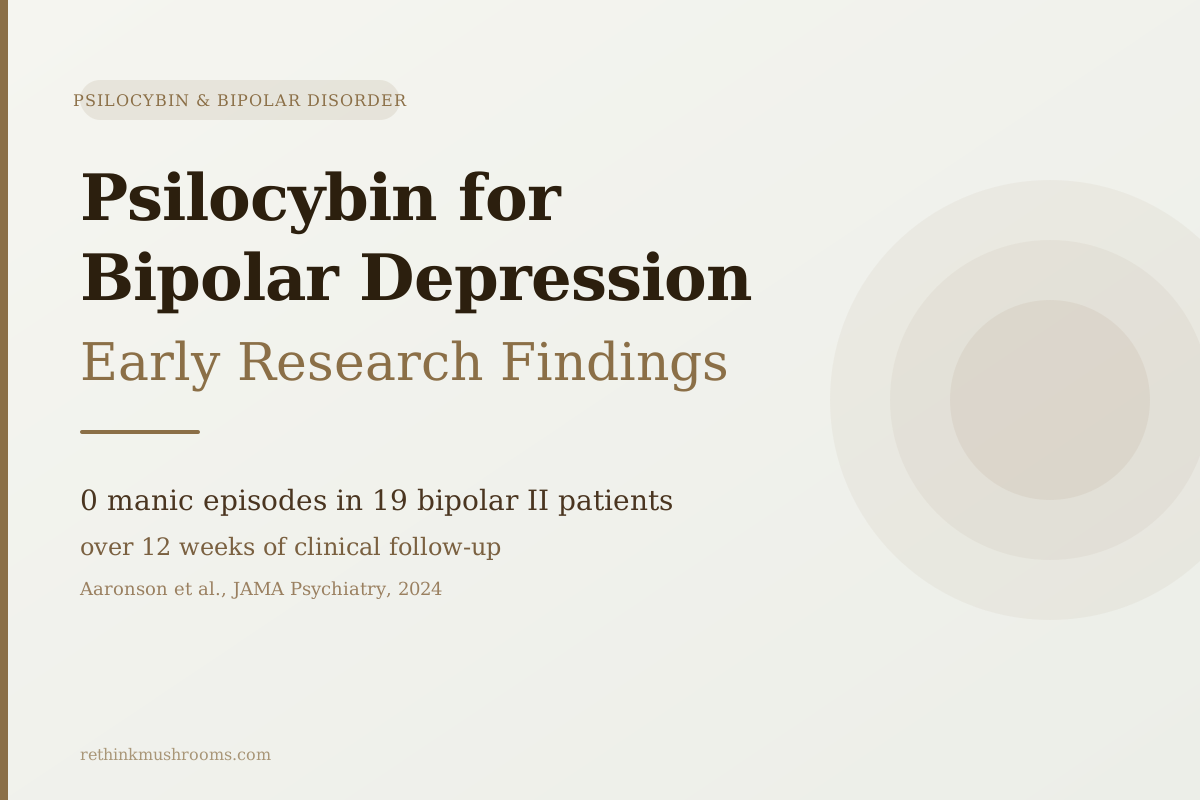
0 manic episodes
A 2024 JAMA Psychiatry trial gave 19 people with treatment-resistant bipolar II depression a single 25mg dose of psilocybin with psychotherapy. Most achieved remission within 3 weeks. None developed mania in 12 weeks of follow-up.
Aaronson et al., JAMA Psychiatry, 2024
25mg
single therapeutic dose given to all participants
3 weeks
to remission in most patients
12 weeks
follow-up with no mania, hypomania, or psychosis
Aaronson et al., JAMA Psychiatry, 2024
 View as image ↗
When Aaronson and colleagues published their psilocybin bipolar depression research in JAMA Psychiatry in early 2024, they reported something the field had never produced before: clinical trial data on psilocybin in bipolar patients.[1] Every major psilocybin depression trial before it had excluded people with bipolar disorder entirely. The reasoning was defensible: psilocybin affects the same brain chemistry that mood-stabilizing medications try to regulate, and triggering a manic episode in someone with bipolar disorder is a serious clinical concern.
The trial enrolled 19 adults with bipolar II disorder and treatment-resistant depression, meaning people who had tried multiple standard medications and were still severely depressed. Each received a single 25mg dose of synthetic psilocybin alongside structured psychotherapy. Most met remission criteria at 3 weeks. Most were still in remission at 12 weeks. Not one developed a manic episode during the trial.
This is early data. The sample is small, there was no comparison group, and this is not the evidence needed to draw strong conclusions about efficacy. But it is the first study of its kind, published in one of psychiatry's most respected journals, and it opened a research conversation the field had been avoiding. For a broader look at the clinical evidence for psilocybin in depression, see Psilocybin for Major Depression: The Clinical Evidence.
Key Takeaways
- The Aaronson 2024 JAMA Psychiatry trial is the first published clinical study to test psilocybin specifically in bipolar patients, enrolling 19 adults with bipolar II disorder and treatment-resistant depression.
- Most participants met remission criteria on a standard depression severity scale (MADRS) within 3 weeks of a single 25mg dose with psychotherapy, and most maintained remission at 12 weeks.
- Not one participant developed mania, hypomania, psychosis, or worsened suicidality during the 12-week trial, the finding that most directly addresses the field's primary safety concern.
- Researchers chose bipolar II rather than bipolar I because bipolar II patients experience hypomania (mild, brief mood elevation) rather than full manic episodes, a distinction that changes the clinical risk calculation.
- A 2025 follow-up by Meshkat and colleagues in Psychedelic Medicine extended this evidence base with additional clinical data on psilocybin-assisted psychotherapy for treatment-resistant bipolar II depression.
- A 2023 international survey of 541 bipolar patients who used psilocybin on their own, without clinical support, found 1 in 3 reported new or worsening manic symptoms, suggesting the controlled clinical environment may play a significant role.
The Historic Data Gap: Why No Trial Had Done This Before
Psilocybin clinical trials for depression began accumulating in earnest around 2016. Within a few years there were dozens, testing different doses, patient populations, and treatment formats. But one group was consistently left out: people with bipolar disorder.
The concern was not arbitrary. Psilocybin is a serotonin 2A receptor agonist. It works by activating a specific receptor in the brain that regulates mood, perception, and cognition. Standard antidepressants that also affect serotonin can sometimes destabilize mood in bipolar patients, pushing someone from a depressive episode toward a hypomanic or manic one, a process called affective switching. Researchers didn't know whether psilocybin might do the same.
There were also individual case reports in the clinical literature of psilocybin triggering manic episodes, in some instances in people with no prior bipolar diagnosis. These were isolated reports rather than systematic data, but they were enough to sustain a policy of exclusion across the field. When in doubt, trials excluded.
The exclusion created a clinical problem. Bipolar II patients in particular spend the large majority of their time depressed. Their hypomanic episodes are brief. Their depressive episodes are long, often severe, and frequently resistant to standard medications: antidepressants, mood stabilizers, atypical antipsychotics. An entire population with treatment-resistant depression was locked out of the psilocybin research that might have been most relevant to them, precisely because of a theoretical risk that had never been formally tested.
A 2026 comprehensive review by Do and colleagues in the Journal of Affective Disorders notes that this gap between theoretical concern and actual clinical evidence is now beginning to close, partly as a result of what the Aaronson 2024 trial produced.[3] For a detailed look at the reasons behind that exclusion policy, see Why Bipolar Patients Are Excluded from Psilocybin Trials.
Why They Started with Bipolar II, Not Bipolar I
The decision to study bipolar II rather than bipolar I was deliberate, and understanding it matters for interpreting the results.
Bipolar I disorder is defined by full manic episodes. Full mania can involve psychosis, where a person loses touch with reality. Manic episodes in bipolar I can be severe enough to require hospitalization, and the manic episode itself is what clinically defines the diagnosis. The mania induction risk in bipolar I patients is the scenario researchers were most concerned about.
Bipolar II is different. Bipolar II patients have hypomanic episodes: periods of elevated mood and energy that are milder than full mania, shorter in duration, and without psychotic features. The defining feature of bipolar II is not the hypomania. It is the depression. People with bipolar II spend most of their time cycling in and out of depressive episodes that look clinically similar to major depression, with occasional brief hypomanic periods between them.
For psilocybin research, this distinction changes the risk calculation. The theoretical risk of triggering a full manic episode was considered lower in bipolar II than in bipolar I. Researchers could construct a more defensible argument that a carefully screened bipolar II patient, supported with psychotherapy, faced a risk profile worth studying formally.[1]
This does not mean the concern vanished entirely. The assumption that bipolar II patients face universally low mania induction risk has been challenged in case reports in the clinical literature, specifically cases where bipolar II patients developed full manic episodes after psilocybin use, beyond the hypomania that defines their diagnosis. For a detailed look at what the mania risk research shows, see Psilocybin and Bipolar Depression: Risk of Mania and Emerging Research.
The Aaronson 2024 trial chose to start where the risk seemed lowest and the clinical rationale strongest. Bipolar II, treatment-resistant depression, 25mg dose with full psychotherapy support.
Psilocybin in Bipolar Depression: What the Aaronson 2024 Trial Found
The trial was a nonrandomized, open-label study. Every participant knew they were receiving psilocybin. There was no control group receiving a placebo. These are real limitations, and they matter for how the results should be interpreted. The study was designed as a first step: establish basic safety and get a preliminary signal on whether the treatment was even plausible to pursue further in this population.
The 19 participants were adults with bipolar II disorder and treatment-resistant depression. Treatment resistance was defined for this study as not responding adequately to at least two antidepressant medications. All participants received psychological preparation sessions before the psilocybin session, a single 25mg dose administered in a supervised clinical setting, and integration therapy sessions afterward.
The 25mg dose is at the high end of what psilocybin depression trials typically use. It is the same dose that produced the most robust antidepressant effects in the major unipolar depression trials that preceded this work. The choice to use this dose, rather than a lower exploratory dose, reflects the researchers' confidence in the preliminary safety rationale.
Depression severity was measured using the Montgomery-Åsberg Depression Rating Scale, a standard 10-item tool that clinicians use to rate how severe a person's depression is at a given point in time. A score of 10 or below is the conventional threshold for remission, meaning the depression has dropped to a level that no longer meets the clinical definition of a depressive episode.
At 3 weeks after the session, most participants had MADRS scores indicating remission. The 3-week timing is notable for a specific reason: it falls well after the acute effects of psilocybin have fully resolved, which typically happens within 6 to 8 hours. The improvement was not just an acute mood lift during the drug experience. It persisted after the drug itself was gone.
At 12 weeks, most participants were still in remission. At no point during the trial, including during the session and in the 12 weeks that followed, did any participant develop treatment-emergent hypomanic symptoms, a manic episode, a psychotic episode, or worsened suicidality.[1]
The honest reading of these results: they are promising but not conclusive. In an open-label trial without a placebo comparison, it is impossible to separate the drug's effects from the expectation of improvement, the therapeutic benefit of the psychotherapy, or the intensive clinical attention participants received throughout. What the Aaronson 2024 trial does establish is that it is possible to run this kind of study in bipolar II patients safely: the theoretical mania risk did not materialize in these 19 people, at this dose, under these conditions.
For context on how the Aaronson trial fits within the broader psilocybin depression evidence base, see Every Major Psilocybin Depression Trial: A Complete Guide.
Meshkat 2025: The Evidence Base Grows
Following the Aaronson 2024 publication, Meshkat and colleagues published additional clinical data in Psychedelic Medicine in 2025, further extending the evidence base for psilocybin-assisted psychotherapy in treatment-resistant bipolar II depression.[2]
The Meshkat 2025 study is part of the same research trajectory: accumulating clinical data in a population that had been entirely absent from psilocybin research just a few years earlier. Two years after bipolar II patients were effectively invisible in clinical psilocybin research, there were now multiple published data sources examining psilocybin in this specific population.
This is how evidence in early-stage research is supposed to build. A first trial with 19 participants establishes that the question is worth pursuing and that the safety concern did not materialize in initial testing. A follow-up study from a separate group adds data that either replicates or complicates the initial finding. Eventually, larger randomized controlled trials become the justified next step, not because the early data proves anything definitively, but because it clears the threshold for committing larger resources and more participants.
The Meshkat 2025 data does not resolve the open questions about efficacy or long-term safety in bipolar patients. But it confirms that the Aaronson 2024 trial was not an isolated outlier. Other researchers are working in the same direction.
Naturalistic Use Looks Different: What the Morton 2023 Survey Found
Not all the evidence on bipolar patients and psilocybin comes from clinical trials. Morton and colleagues published a different type of data in the Journal of Psychopharmacology in 2023: a large international survey of people with bipolar disorder who had used psilocybin mushrooms on their own, outside any clinical context.[4]
541 people with bipolar disorder responded. Many reported benefit for their depression. But approximately 1 in 3 reported adverse effects, specifically new or worsening manic or hypomanic symptoms after using psilocybin.
One in 3 is not a small number. Across a sample of 541 self-selected users, it represents a real adverse event signal, not a theoretical one. It complicates any simple narrative about psilocybin being well-tolerated in bipolar disorder.
But the Morton 2023 survey data and the Aaronson 2024 trial data are not measuring the same thing. The 541 survey respondents were using mushrooms of unknown purity and potency, with no psychotherapy before or after the experience, no clinical screening for current mood stability, and no monitoring during or following the session. The 19 trial participants were carefully screened for current stability, received structured psychotherapy preparation and integration support, and were monitored continuously throughout.
These are not comparable conditions. A better interpretation of the divergence between the two data sources is not that one is right and one is wrong. It is that the context of psilocybin use (the clinical structure, the psychotherapy, the patient selection) may be part of what determines whether the outcome is beneficial or destabilizing in this population.
That hypothesis cannot be confirmed from the existing data. But the contrast between the two datasets makes it the most important unanswered question in this research area. For a fuller look at both the potential and the risks, see Psilocybin and Bipolar Disorder: Potential and Risks.
The Do 2026 Review: Where the Psilocybin Bipolar Depression Research Field Stands
The most current synthesis of the entire psilocybin and bipolar disorder evidence base comes from Do and colleagues, who published a comprehensive review in the Journal of Affective Disorders in 2026.[3]
The Do 2026 review draws on naturalistic survey data, individual case reports, and clinical trials together, representing the full range of evidence types that have accumulated on this topic. The review identifies both the efficacy signals (depression improvement across multiple data sources) and the safety concerns, specifically the mania induction risk that the case reports and Morton survey illustrate, and the drug interaction risks that arise for the large proportion of bipolar patients who take lithium as a mood stabilizer.
The lithium concern is worth noting separately. Analysis of online psychedelic experience reports has found that combining classic psychedelics with lithium is associated with seizures in multiple documented cases, while combining psychedelics with lamotrigine (another mood stabilizer used in bipolar disorder) did not show the same risk. This is not from the clinical trial data; it is observational. But it represents a specific, concrete safety consideration for bipolar patients on lithium who are considering psilocybin, in any context.
The Do 2026 review does not resolve the central tensions in this field. The existing data is preliminary. But the review confirms that the field has moved from theoretical discussion to active clinical inquiry. Psilocybin in bipolar disorder is no longer a question researchers are simply declining to ask.
The path forward that the evidence points toward is randomized, controlled trials with larger samples. The existing data clears the threshold for pursuing that work. It does not yet support strong conclusions about whether psilocybin is effective for bipolar II depression, who responds, or what conditions are necessary for the treatment to be safe.
Readers interested in how psilocybin for treatment-resistant depression (the diagnosis the Aaronson 2024 bipolar II participants all met) compares across the broader evidence base can read Psilocybin for Treatment-Resistant Depression: When Nothing Else Works.
The Bottom Line
The Aaronson 2024 JAMA Psychiatry trial is the first published clinical study of psilocybin in bipolar patients. In 19 bipolar II adults with treatment-resistant depression, a single 25mg dose with psychotherapy produced remission in most participants at 3 weeks, with no mania over 12 weeks, a result that shifted the field from avoiding the question to beginning to answer it. A 2025 follow-up by Meshkat et al. added to the evidence base. A 2026 comprehensive review by Do et al. synthesizes the full picture, including the safety concerns that a 2023 survey of 541 naturalistic users raised (1 in 3 reported adverse mood effects). The evidence is promising enough to justify continued clinical research and too limited to draw conclusions about efficacy.
Frequently Asked Questions
Sources & References
- 1RTHM-00863·Aaronson, Scott T et al. (2024). “Single-Dose Synthetic Psilocybin With Psychotherapy for Treatment-Resistant Bipolar Type II Major Depressive Episodes: A Nonrandomized Open-Label Trial..” JAMA psychiatry.Study breakdown →PubMed →↩
- 2RTHM-00944·Meshkat, Shakila et al. (2025). “Psilocybin-Assisted Psychotherapy for Treatment-Resistant Depression in Bipolar II Disorder..” Psychedelic medicine (New Rochelle.Study breakdown →PubMed →↩
- 3RTHM-00957·Do, André et al. (2026). “Psilocybin use in bipolar disorder: A comprehensive review..” Journal of affective disorders.Study breakdown →PubMed →↩
- 4RTHM-00846·Morton, Emma et al. (2023). “Risks and benefits of psilocybin use in people with bipolar disorder: An international web-based survey on experiences of 'magic mushroom' consumption..” Journal of psychopharmacology (Oxford.Study breakdown →PubMed →↩