Psilocybin & Bipolar Disorder
1 in 3 bipolar patients
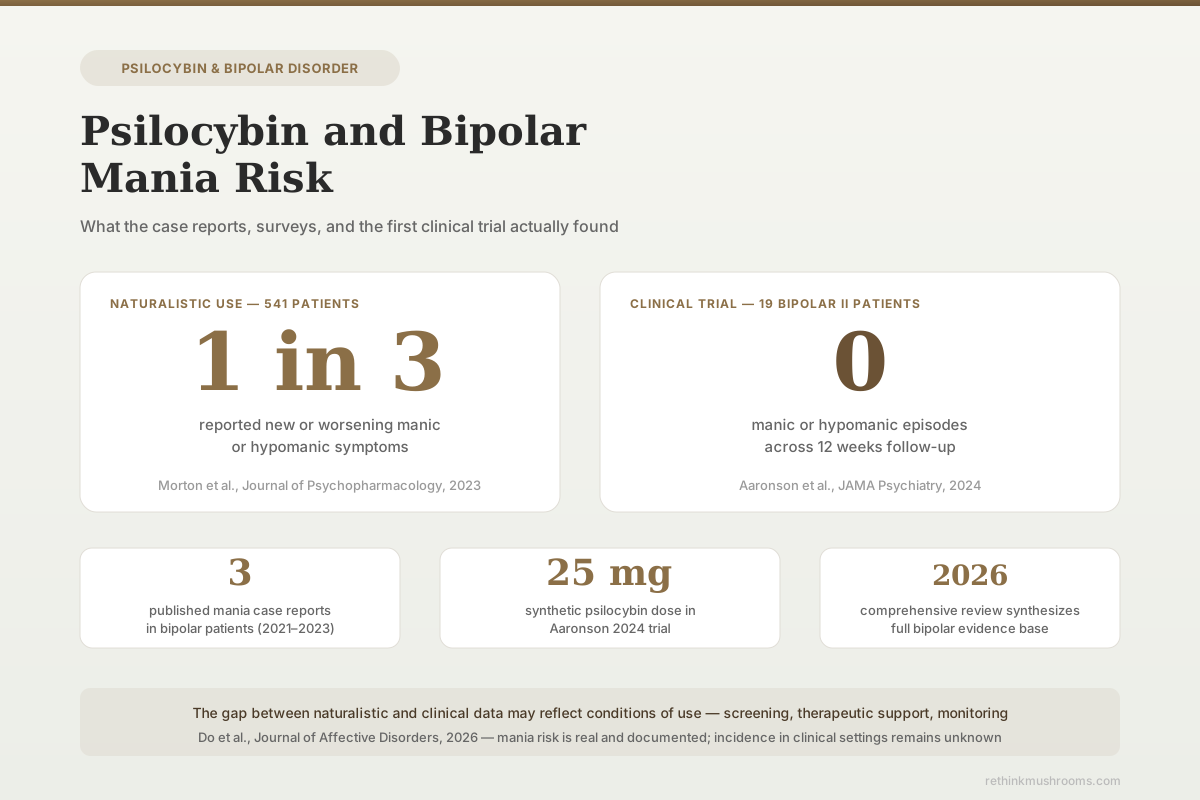
Morton and colleagues surveyed 541 people with bipolar disorder who used psilocybin on their own, outside any clinical setting. About a third reported new or worsening manic or hypomanic symptoms, compared to zero mania events in a supervised 2024 clinical trial.
Morton et al., Journal of Psychopharmacology, 2023
541
bipolar patients surveyed using naturalistic psilocybin
3 case reports
documenting mania after psilocybin (2021-2023)
0 mania events
in Aaronson's 2024 JAMA Psychiatry clinical trial (n=19)
Morton et al., Journal of Psychopharmacology, 2023
 View as image ↗
A drug being studied to lift depression has also been documented triggering the opposite: mania. That's the central problem in psilocybin bipolar mania risk research, and it's not a hypothetical. Case reports have documented it. A survey of 541 bipolar patients found roughly one third reporting new or worsening manic or hypomanic symptoms after naturalistic psilocybin use. At the same time, the first published clinical trial to test psilocybin directly in bipolar patients, published in JAMA Psychiatry in 2024, found zero mania events across 12 weeks. Both findings are real. The gap between them may be one of the most important questions in the emerging field of psychedelic psychiatry.
This article covers the full evidence: what the case reports documented, what the survey found, what the clinical trial showed, and what the difference between those results might mean. This article is part of the broader evidence base on psilocybin for major depression.
Key Takeaways
- Morton et al. (2023) surveyed 541 people with bipolar disorder who used psilocybin without clinical support: about 1 in 3 reported new or worsening manic or hypomanic symptoms[4]
- Three published case reports (2021-2023) document mania following psilocybin use in bipolar patients, including one in a confirmed bipolar II patient who had never previously had a full manic episode[1][2][3]
- Aaronson et al. (2024, JAMA Psychiatry) found zero manic or hypomanic episodes in 19 bipolar II patients given 25mg psilocybin with psychotherapy support over 12 weeks[5]
- The bipolar II diagnosis (which involves only hypomania, not full mania) was thought to mean lower mania risk; Halim et al. (2023) documented a bipolar II patient crossing into full mania after psilocybin, challenging that assumption[3]
- The gap between naturalistic survey results and the clinical trial may reflect what happens between unsupported use and carefully screened, therapist-supported use, but the trial was too small to establish incidence rates
- Do et al.'s 2026 comprehensive review identifies mania induction as a real documented risk while noting the evidence is too early to quantify how common it is in clinical versus naturalistic settings[6]
The Evidence Base, Weakest to Strongest
What Each Kind of Study Can and Cannot Tell You
Every tier here is real evidence, but they answer different questions. Reading them in order shows why the field can say mania risk is real while still not knowing how common it is.
Case reports
Hendin (2021), Barber (2022), Halim (2023)Establishes: That mania can follow psilocybin in bipolar patients — and did, including in a bipolar II patient with no prior full mania
Cannot: How often it happens, or whether psilocybin caused it
Naturalistic survey
Morton et al. (2023), n = 541Establishes: The real-world risk landscape: ~1 in 3 unsupervised users reported new or worsening manic / hypomanic symptoms
Cannot: How much unscreened, unsupported conditions drove that rate
Open-label clinical trial
Aaronson et al. (2024), n = 19Establishes: That under screening and full therapeutic support, no mania appeared across 12 weeks
Cannot: An incidence rate — too small, no control group, no blinding
Comprehensive review
Do et al. (2026)Establishes: The consensus read: mania induction is a real, documented risk that remains incompletely quantified
Cannot: A safety clearance or a prohibition — the evidence is too early for either
Sources: Hendin (2021); Barber (2022); Halim (2023); Morton (2023); Aaronson (2024); Do (2026)
Three Cases That Built the Concern About Bipolar and Psilocybin
Three published case reports between 2021 and 2023 documented mania following psilocybin use in people with bipolar disorder, or in people who discovered they had bipolar disorder only afterward. These cases, individually, tell limited stories. Together, they established that the adverse event was possible and that it had already happened.
Hendin and Hendin (2021) described a woman with no prior psychiatric diagnosis who developed a full manic episode after ingesting psilocybin mushrooms.[1] She had no history of manic or hypomanic episodes before this event. The case raised a specific question that has since shaped screening in clinical trials: can psilocybin reveal, or trigger, bipolar disorder in someone who had no idea they had it? A single case cannot answer that. But the question was real enough that many psilocybin trials now exclude anyone with a personal or family history of bipolar disorder, partly in response to cases like this one.
Barber and Bhatt (2022) published a more severe case in the American Journal of Psychiatry: a patient who developed a months-long cycle of mania, then psychosis, then severe depression after psilocybin use.[2] The authors published this case at a moment when psilocybin was becoming more widely available through decriminalization in several U.S. jurisdictions. They framed it as a clinical safety signal: as access to psilocybin expanded outside controlled research settings, adverse events like this were likely to become more common and clinicians needed to be aware.
Halim and colleagues (2023) added a wrinkle that complicated how researchers think about bipolar subtypes and psilocybin risk.[3] Their patient had a confirmed bipolar II diagnosis and no prior history of full mania. After using psilocybin, he developed a manic episode, the kind of episode that, by definition, bipolar II patients are not supposed to have. More on why this matters in the next section.
Three case reports. The lowest tier of clinical evidence: no control group, no incidence rate, no causal proof. But they established two things: mania can follow psilocybin use in bipolar patients, and the effect has been documented across people with different presentations. For the broader question of why these cases have led clinical trials to exclude bipolar patients systematically, see why bipolar patients are excluded from psilocybin trials.
The Bipolar II Surprise: Why the "Safer" Subtype Isn't a Safety Guarantee
Bipolar I and bipolar II are the two most common subtypes of bipolar disorder, and they differ in a specific clinical way. Bipolar I involves full manic episodes: extreme mood elevation, sharply reduced sleep, grandiosity, sometimes psychosis, severe enough to require hospitalization. Bipolar II involves only hypomania, which is mood elevation that is milder and shorter, doesn't reach the threshold for full mania, and typically doesn't require hospitalization.
This distinction mattered a great deal to psilocybin researchers. When Aaronson and colleagues at Sheppard Pratt designed the first clinical trial to test psilocybin in bipolar patients, they chose bipolar II specifically. Their reasoning: bipolar II patients had never experienced full mania. The concern about psilocybin switching someone from depression into mania seemed most relevant to patients who had already proven capable of reaching full mania, specifically bipolar I patients. Bipolar II patients, the thinking went, were the safer population to test.
Halim et al. (2023) complicated that reasoning directly.[3] Their case involved a man with a confirmed bipolar II diagnosis who had never had a manic episode in his life. After psilocybin, he had one. The crossing from hypomania to full mania is a threshold bipolar II patients, by definition, don't reach in the natural course of the illness. This patient reached it.
One case can't establish a rate. It doesn't mean bipolar II patients who use psilocybin commonly or even frequently develop mania. But it does mean the assumption that bipolar II represents categorically lower mania risk with psilocybin cannot be taken as guaranteed. Bipolar II was selected for the Aaronson trial partly because researchers expected lower risk. Halim 2023, published the year before that trial's results, showed the expectation was not a certainty.
A Survey of 541 Bipolar Patients: What Naturalistic Use Actually Looks Like
The largest naturalistic dataset comes from Morton and colleagues (2023), published in the Journal of Psychopharmacology.[4] They conducted an international web-based survey of 541 people with bipolar disorder who had used psilocybin outside of any clinical setting, purchased through recreational or decriminalized channels, without a therapist present, without preparatory sessions, without a structured follow-up protocol.
The results split in two directions. Many participants reported that psilocybin helped with their depression, the main reason most reported using it. But approximately one third reported experiencing new or worsening manic or hypomanic symptoms after psilocybin use. For a drug being tested as a depression treatment, triggering the manic pole of the bipolar spectrum is precisely the outcome researchers most want to avoid.
Morton 2023 is the largest body of naturalistic data available, which makes it important. It's also the hardest data to interpret cleanly, because of how different naturalistic use is from clinical use in every variable that might affect outcomes. Drug purity was unknown. Doses were self-reported and variable, not calibrated to body weight or session structure. No clinical screening for baseline mood stability or contraindicated medications like lithium. No therapist presence. No integration support. The setting was whatever setting the person chose.
These factors matter because so much of psychedelic safety research points to setting and support as critical variables. A chaotic or unsupported psilocybin experience, especially in someone whose mood regulation is already compromised by bipolar disorder, may carry meaningfully higher risk than a structured clinical session with trained guides. The Morton survey cannot separate these effects, because naturalistic use contains all of them tangled together.
What the survey establishes: about 1 in 3 bipolar patients who used psilocybin on their own reported manic or hypomanic symptoms afterward. That finding describes the naturalistic risk landscape. What it cannot tell us is how much the conditions of use drove that outcome.
The 2024 JAMA Psychiatry Trial: 19 Patients, 12 Weeks, Zero Mania
In 2024, Aaronson and colleagues published in JAMA Psychiatry, one of psychiatry's flagship journals, the first clinical trial to directly test psilocybin in people with bipolar disorder.[5] The choice of journal reflects how significant the research community considered the question: JAMA Psychiatry publishes landmark trials, not small exploratory case series.
The trial enrolled 19 adults with bipolar II disorder and treatment-resistant depression, of whom 15 completed the full protocol and were included in the outcome analysis. Treatment-resistant meant they had already tried antidepressant medications without adequate response. Each participant received a single 25mg synthetic psilocybin dose, a high therapeutic dose equivalent to what larger depression trials have used in non-bipolar populations. Every participant had multiple preparatory psychotherapy sessions before the psilocybin dose, a trained therapist present throughout the 6-to-8-hour session, and structured integration sessions in the weeks following.
Aaronson measured depression severity using the MADRS (Montgomery-Åsberg Depression Rating Scale), a clinician-administered tool that generates a numerical severity score. Most participants met MADRS remission criteria at three weeks after the session. Most maintained remission at 12 weeks. No treatment-emergent hypomanic or manic symptoms appeared. No psychotic episodes. No worsened suicidality.
Nineteen patients is a small sample. The trial had no control group; everyone received psilocybin, so there is no way to determine what fraction of improvement came from the drug versus the therapeutic attention, versus expectation, versus the natural course of a depressive episode. Open-label design means both researchers and participants knew the treatment being given, which can amplify expected effects. These are real limitations.
But the specific signal the trial was designed to detect, mania induction, was not found across 19 participants followed for 12 weeks with standardized clinical assessment at each follow-up point. That's a meaningful finding given how prominent the concern had been.
All 19 patients had treatment-resistant depression, the same population discussed in psilocybin for treatment-resistant depression: when nothing else works. The distinction is that Aaronson's cohort had bipolar II alongside the treatment resistance, a population that virtually every other psilocybin trial excluded.
For context on how bipolar patients were handled in the largest psilocybin depression trial to date: COMPASS Pathways explicitly excluded bipolar patients from their Phase IIb trial, which enrolled hundreds of participants. The exclusion was made before the Aaronson data existed, and represents the standard approach in the field.
Why the Trial Results Look So Different from the Survey
The gap between Morton 2023's approximately one-third adverse event rate and Aaronson 2024's zero mania events is large enough to demand an explanation. Several factors plausibly account for it, and they are not contradictory explanations. They point in the same direction.
Patient screening. Aaronson's trial screened participants carefully. Anyone with active psychiatric instability, a history of full manic episodes, or bipolar I disorder was excluded. Morton's survey included anyone with any bipolar diagnosis who had used psilocybin, regardless of their current mood stability, recent episode history, or concurrent medications.
Therapeutic structure. Aaronson's participants received multiple preparatory psychotherapy sessions before the dose, a trained therapist present throughout the entire session, and structured integration therapy afterward. This support is designed to reduce the likelihood of a destabilizing psychological experience. The naturalistic users in Morton's survey had none of this; they used psilocybin without preparation, guidance, or follow-up.
Monitoring and assessment. Aaronson's team assessed participants at standardized follow-up timepoints using validated clinical rating scales. Hypomanic symptoms, had they appeared, would have been detected and documented. The self-reported adverse events in Morton's survey relied on participants' own recognition and reporting of manic or hypomanic symptoms, a less precise instrument.
These three factors together create a hypothesis: clinical conditions (screening, support, and monitoring) may substantially reduce the mania risk that appears in naturalistic use. This hypothesis is consistent with the Aaronson findings. It cannot be confirmed by a trial of 19 patients, and it doesn't mean clinical conditions eliminate the risk entirely.
Same Drug, Two Numbers
Why Naturalistic Use Reports 1-in-3 Mania and the Clinical Trial Reported Zero
The two headline figures describe different worlds of use. Three conditions differ between them, and each plausibly pushes the mania rate down. Neither number is wrong; they measure different things.
Naturalistic survey
Morton et al., 2023 · n = 541
32.2%
reported new or worsening manic / hypomanic symptoms after unsupervised use (174 of 541)
Clinical trial
Aaronson et al., 2024 · n = 19 (15 completed)
0
treatment-emergent manic or hypomanic episodes across 12 weeks of supervised dosing
What differs between them
Screening
Any self-reported bipolar diagnosis, any mood state, any concurrent medication
Bipolar II only; active instability and bipolar I excluded
Therapeutic structure
No preparation, no therapist present, no integration
3 prep sessions, therapist through the 8-hour dose, 3 integration sessions
Monitoring
Self-recognition and self-report of symptoms, after the fact
YMRS and C-SSRS at every scheduled visit across 12 weeks
The trial’s 19 patients cannot establish an incidence rate, so this is a hypothesis the data is consistent with — not proof that clinical conditions remove the risk.
Sources: Morton et al., Journal of Psychopharmacology (2023); Aaronson et al., JAMA Psychiatry (2024)
People with bipolar disorder and a family history of psychosis face similar risk stratification questions; see family history of psychosis and psilocybin: risk assessment for how researchers approach that parallel exclusion debate.
Where the Evidence Stands in 2026: Real Risk, Not Zero Risk
Do and colleagues published the most current synthesis of the entire psilocybin and bipolar evidence base in the Journal of Affective Disorders in 2026.[6] Their comprehensive review pulled together naturalistic data, case reports, and the emerging clinical trial literature, the same body of evidence covered in this article, to assess both the efficacy signals and the safety concerns.
Their conclusion captures what the honest state of the evidence actually is: psilocybin shows signals of potential benefit for bipolar depression, and mania induction is a real, documented risk. The evidence base is too limited to establish the actual incidence rate of mania in supervised clinical settings versus unsupported naturalistic use. The available data points in conflicting directions precisely because the conditions of use vary so dramatically across studies.
The Do 2026 review does not provide a safety clearance. It does not provide a definitive prohibition. It describes a field early in the process of answering a hard question: whether mania risk in bipolar patients is categorically disqualifying for psilocybin therapy, or whether it is a risk that can be managed through careful clinical protocols in the same way that many psychiatric medications carry risks that are managed, not avoided, in clinical practice.
Mania is not the only bipolar-specific safety signal. A separate analysis of online psychedelic experience reports found that combining a classic psychedelic with lithium, the most common mood stabilizer for bipolar I, was associated with seizures, a pairing not seen with lamotrigine.[7] That interaction is separate from mania induction, and it is one more reason unsupervised psilocybin use in a medicated bipolar patient carries risks a clinical protocol is specifically designed to screen out.
Safety
ModerateDocumented mania risk and a lithium interaction in bipolar use
Concern
Two bipolar-specific harms are documented. Case reports describe mania after psilocybin, including a bipolar II patient with no prior full manic episode, and roughly one third of 541 people who used psilocybin without clinical support reported new or worsening manic or hypomanic symptoms. Separately, combining a classic psychedelic with lithium has been associated with seizures.
What the research says
In the one supervised clinical trial to date, careful screening, a bipolar II-only cohort, and full therapeutic support produced zero manic episodes across 12 weeks. Risk appears strongly condition-dependent, but with only 19 enrolled patients and no naturalistic incidence rate, the evidence cannot yet say how common mania is under clinical versus unsupervised conditions.
Particularly relevant for: People with bipolar disorder using psilocybin without clinical screening or supervision, and anyone taking lithium
What to do
This article is educational information, not medical advice. Anyone with bipolar disorder should consult their psychiatrist before considering psilocybin, and should never combine it with, or stop, a prescribed mood stabilizer on their own.
Morton et al., 2023; Halim et al., 2023; Nayak et al., 2021; Aaronson et al., 2024
That question is still open. The Aaronson 2024 trial was a meaningful step toward answering it: the first direct clinical test, the first published safety data from a supervised setting. What it was not was definitive. Nineteen patients is not enough to establish an incidence rate for a rare adverse event.
For anyone with bipolar disorder who is curious about this research, the clinical picture is this: the mania risk associated with psilocybin is documented and real, it may look different under clinical versus naturalistic conditions, and the research is still at a stage where confident safety statements in either direction would outrun the data. The question of what psilocybin means specifically for bipolar depression is covered in detail in psilocybin for bipolar depression: early research.
The Bottom Line
The evidence on psilocybin bipolar mania risk runs in two directions. Case reports document mania following psilocybin use in bipolar patients, and a 2023 survey of 541 naturalistic users found roughly one third reporting new or worsening manic symptoms. A 2024 JAMA Psychiatry clinical trial of 19 carefully screened bipolar II patients found zero mania events at 12 weeks with therapeutic support. The gap between these findings may reflect the difference between clinical and unsupported use, but the trial was too small to establish incidence rates, and the 2026 comprehensive review concludes that mania induction is a real documented risk that remains incompletely characterized.
Frequently Asked Questions
Sources & References
- 1RTHM-00691·Hendin, Holly M et al. (2021). “An episode of mania following self-reported ingestion of psilocybin mushrooms in a woman previously not diagnosed with bipolar disorder: A case report..” Bipolar disorders.Study breakdown →PubMed →↩
- 2RTHM-00742·Barber, Gregory et al. (2022). “A Case of Prolonged Mania, Psychosis, and Severe Depression After Psilocybin Use: Implications of Increased Psychedelic Drug Availability..” The American journal of psychiatry.Study breakdown →PubMed →↩
- 3RTHM-00828·Halim, Haniya J et al. (2023). “Manic episode following psilocybin use in a man with bipolar II disorder: a case report..” Frontiers in psychiatry.Study breakdown →PubMed →↩
- 4RTHM-00846·Morton, Emma et al. (2023). “Risks and benefits of psilocybin use in people with bipolar disorder: An international web-based survey on experiences of 'magic mushroom' consumption..” Journal of psychopharmacology (Oxford.Study breakdown →PubMed →↩
- 5RTHM-00863·Aaronson, Scott T et al. (2024). “Single-Dose Synthetic Psilocybin With Psychotherapy for Treatment-Resistant Bipolar Type II Major Depressive Episodes: A Nonrandomized Open-Label Trial..” JAMA psychiatry.Study breakdown →PubMed →↩
- 6RTHM-00957·Do, André et al. (2026). “Psilocybin use in bipolar disorder: A comprehensive review..” Journal of affective disorders.Study breakdown →PubMed →↩
- 7RTHM-01412·Nayak, Sandeep M et al. (2021). “Classic Psychedelic Coadministration with Lithium, but Not Lamotrigine, is Associated with Seizures: An Analysis of Online Psychedelic Experience Reports..” Pharmacopsychiatry.Study breakdown →PubMed →↩