Treatment-Resistant Depression and Psilocybin
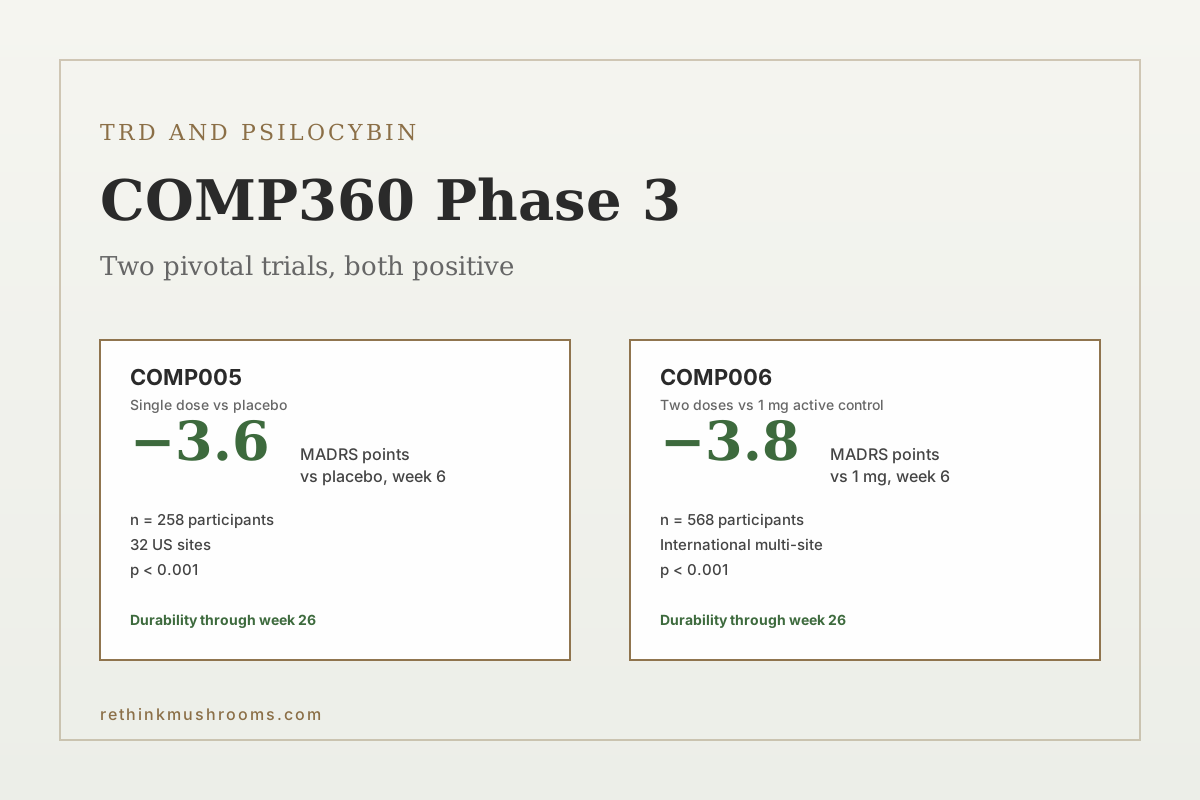
-3.6 to -3.8 MADRS points vs control
Both Phase 3 trials of COMP360 psilocybin in treatment-resistant depression hit their primary endpoint at week 6, with statistically significant MADRS improvements over placebo or active 1 mg control (p<0.001).
Compass Pathways COMP005 and COMP006 topline results, 2025-2026
258 and 568
participants in COMP005 and COMP006
Week 6
primary MADRS endpoint
26 weeks
durability follow-up
Compass Pathways COMP005 and COMP006 topline results, 2025-2026
 View as image ↗
COMP360 is the synthetic psilocybin formulation developed by Compass Pathways and the only psilocybin product that has completed two Phase 3 trials in treatment-resistant depression (TRD). The Phase 2b trial (Goodwin et al., 2022) established the dose-response signal; the two Phase 3 trials, COMP005 (single-dose) and COMP006 (two-dose), tested whether that signal would replicate in a larger, more rigorously controlled program. Both trials have now reported positive topline results on the primary endpoint. The implications are significant for the FDA regulatory path, the commercial psychedelic medicine thesis, and the framing of psilocybin as a pharmaceutical rather than a decriminalization or regulated-access substance.
This article reviews what the Phase 3 data show, what they do not show, how they fit with the Phase 2b and investigator-initiated trial literature, and what the implications are for the regulatory and clinical trajectory of psilocybin-assisted therapy. For the underlying clinical rationale, see psilocybin for treatment-resistant depression: when nothing else works. For the Phase 2b trial specifically, see psilocybin for treatment-resistant depression: COMPASS Pathways Phase IIb results. For the broader paradigm, see treatment-resistant depression and psilocybin: a new paradigm.
Key Takeaways
- COMP005 (single-dose design, n=258, 32 US sites) met its primary endpoint with a week-6 MADRS difference of -3.6 points favoring COMP360 25 mg over placebo, p<0.001
- COMP006 (two-dose design, n=568, international multi-site) met its primary endpoint with a week-6 MADRS difference of -3.8 points favoring 25 mg over 1 mg active control, p<0.001
- Goodwin et al. (2022) Phase 2b: a single 25 mg COMP360 dose produced a 12-point MADRS reduction at week 3 versus a 5.4-point reduction for 1 mg control in 233 TRD patients
- Durability through 26 weeks after one or two doses was demonstrated in both Phase 3 trials, supporting a pulse-dosing rather than daily-dosing treatment model
- Carhart-Harris et al. (2021) compared psilocybin to escitalopram in a non-TRD depression population; on the primary QIDS-SR-16 endpoint there was no statistically significant difference, though psilocybin outperformed numerically on most secondaries
- Investigator-initiated work in adjacent populations (Aaronson et al., 2024 in bipolar II TRD; Meshkat et al., 2025 in bipolar II; Ellis et al., 2025 in US military veterans) continues to report response and remission rates consistent with the Compass Phase 3 magnitude
- The -3.6 to -3.8 MADRS effect size is statistically clear but clinically modest, and the open question is whether that magnitude (combined with strong durability) justifies the complexity of supervised dosing infrastructure relative to standard antidepressants
The Phase 3 Design: COMP005 and COMP006
The Compass Phase 3 program in TRD is structured as two pivotal trials with complementary designs.
COMP005 is a randomized, double-blind, placebo-controlled trial testing a single 25 mg dose of COMP360 against placebo in 258 adults with TRD at 32 United States sites. The primary endpoint was the difference between arms in change from baseline MADRS score at week 6. Key secondary endpoints included response (≥50% reduction in MADRS), remission (MADRS ≤10), and sustained response through week 26.
COMP006 is a randomized, double-blind, active-control trial testing two fixed doses of COMP360 (25 mg and 10 mg) against a 1 mg active control in 568 adults with TRD at approximately 70 sites in the United States, Canada, and Europe. The two active doses were administered three weeks apart. The primary endpoint compared the 25 mg arm to 1 mg at week 6 on MADRS change from baseline. The 10 mg arm serves as a dose-response bridge.
Both trials used the same supervised-dosing session structure used in the Phase 2b: preparation sessions with a licensed therapist, an administration session with the study drug in a dedicated setting with two trained facilitators, and integration sessions in the days following dosing. This is the operational framework that Compass has proposed for post-approval commercial delivery.
What the Phase 3 Trials Showed
COMP005 (single dose, placebo-controlled)
Compass reported COMP005 topline results in 2025: the trial met its primary endpoint, with a week-6 MADRS change-from-baseline difference of -3.6 points favoring COMP360 25 mg over placebo, p<0.001. The company also reported that durability extended to at least week 26 in participants who had a clinically meaningful early response, with no new or unexpected safety findings and no meaningful imbalance in suicidality signals between arms.
The -3.6 MADRS difference is the arithmetic gap between the active and control arms at week 6. It is not the raw improvement in the active arm (which is larger, because the placebo arm also improves over six weeks of study participation). For context, the Phase 2b trial reported a 6.6-point within-arm MADRS reduction gap between 25 mg and 1 mg at week 3 (12 points in the 25 mg arm, 5.4 points in 1 mg).[1] The Phase 3 endpoint is at week 6 rather than week 3 and uses a true placebo rather than 1 mg active control, both of which reduce the numerical size of the between-arm gap.
COMP006 (two-dose, active-controlled)
Compass reported COMP006 topline results in 2026: the trial met its primary endpoint, with a week-6 MADRS change-from-baseline difference of -3.8 points favoring the 25 mg two-dose regimen over the 1 mg active control, p<0.001. This is directionally consistent with COMP005. The 10 mg arm (dose-response bridge) was not reported in the topline but will appear in the full publication.
The -3.8 COMP006 result against an active 1 mg control is, if anything, slightly larger than the -3.6 COMP005 result against placebo. This is mildly counterintuitive (an active control should provide a more conservative benchmark than placebo), but is plausible given that the two-dose design should accumulate a larger treatment effect than a single-dose design.
Safety and durability
Safety findings across both trials were consistent with prior psilocybin clinical trial data: transient headache, nausea, and blood pressure elevation during the dosing session, no new safety signals, and no clinically meaningful suicidality imbalance between arms. Durability through week 26 was demonstrated in both trials among participants with an early clinically meaningful response, supporting a pulse-dosing treatment model in which patients receive one or two supervised doses rather than daily medication.
How the Phase 3 Results Compare to the Phase 2b Trial
Goodwin et al. (2022) published the Phase 2b (P-TRD) trial: 233 participants with TRD randomized to 25 mg, 10 mg, or 1 mg (active control) COMP360. The primary endpoint was MADRS change at week 3. The 25 mg arm showed a 6.6-point MADRS advantage over 1 mg at week 3 (p<0.001). Response rates at week 3 were 37% for 25 mg versus 18% for 1 mg; remission rates were 29% versus 8%.[1]
Comparing across phases requires attention to methodological differences:
- Primary endpoint timing: Phase 2b measured at week 3, Phase 3 measured at week 6. Depression scores tend to drift upward from week 3 to week 6 in psilocybin trials as the acute post-dosing effect attenuates, which compresses the between-arm gap.
- Control arm: Phase 2b and COMP006 used a 1 mg active control that produces mild subjective effects without therapeutic efficacy; COMP005 used a true placebo. The choice affects blinding integrity and the measured effect size.
- Population: Both Phase 2b and Phase 3 enrolled TRD defined by failure of 2-4 prior antidepressant trials in the current episode. Populations are broadly comparable.
The Phase 3 -3.6 to -3.8 MADRS differences at week 6 are smaller in magnitude than the Phase 2b -6.6 difference at week 3 but are measured against different comparators and at a later timepoint. Both are statistically clean signals, and the Phase 3 durability data add a dimension the Phase 2b did not emphasize. Compass Pathways announced the COMP005 and COMP006 topline results via investor press releases in 2025 and 2026 respectively; peer-reviewed publication of the full Phase 3 datasets is pending.
The Adjacent Evidence Base
The Compass program is not the only Phase 2/3-grade work on psilocybin in TRD. Several investigator-initiated trials have reported in adjacent populations.
Aaronson et al. (2024) published a nonrandomized open-label trial of single-dose synthetic psilocybin with psychotherapy for treatment-resistant bipolar type II depressive episodes, with MADRS response in most participants and no hypomanic precipitation. This is significant because bipolar disorder is a standard exclusion criterion in TRD trials and the Phase 3 program did not include bipolar patients.[2]
Meshkat et al. (2025) reported psilocybin-assisted psychotherapy for treatment-resistant depression in bipolar II disorder, extending the Aaronson et al. (2024) signal in a controlled context.[3] Meikle et al. (2025) reported a pilot trial of psilocybin with psychotherapeutic support for TRD that showed MADRS reductions consistent with the Compass magnitude.[4] Ellis et al. (2025) extended the work to US military veterans with severe TRD in a first-in-kind open-label pilot.[5]
The non-TRD comparator of interest is Carhart-Harris et al. (2021), which compared two psilocybin doses to six weeks of escitalopram in moderate-to-severe depression. On the primary QIDS-SR-16 endpoint the between-arm difference was not statistically significant, though psilocybin showed numerically larger improvements on most secondary outcomes.[6] This is the closest the literature has come to a head-to-head trial of psilocybin against a standard-of-care antidepressant, and it is a population one rung less severe than the Compass Phase 3 TRD cohort.
Davis et al. (2021) randomized patients with MDD (not TRD specifically) to two psilocybin sessions with supportive psychotherapy versus waitlist control, with large response and remission rates at week 4.[7] This is a shorter, less rigorous trial than the Compass Phase 3s but reports effect sizes consistent with the overall picture.
For discussion of why psilocybin may work when standard antidepressants fail, see how psilocybin helps when antidepressants fail.
The Interpretation Question: Is 3.6 MADRS Points Clinically Meaningful?
The Phase 3 effect size (-3.6 to -3.8 MADRS points) is statistically clean but modest. For comparison, a typical SSRI versus placebo in MDD shows a between-arm MADRS difference of roughly 2-3 points; ketamine infusions show a difference closer to 6-8 points at 24 hours that wanes over days. The Compass result sits in between, with the important difference that the effect is produced by one or two supervised doses and appears to durably hold through 26 weeks.
The case for COMP360 as a clinically valuable product rests on the combination of:
- Effect size: Moderate between-arm difference, statistically robust, replicated across two Phase 3 trials.
- Durability: Single or double dosing with sustained effect through 26 weeks, unlike daily-dosed antidepressants that require continuous administration.
- Population: TRD patients who by definition have failed 2-4 prior antidepressant trials and have limited remaining pharmacological options.
- Delivery infrastructure: Supervised dosing with licensed facilitators, which introduces cost and access barriers but may also function as a therapeutic intensification rather than a simple medication administration.
The case against rests on:
- Modest numerical effect: A -3.6 MADRS difference is smaller than some alternatives like ECT or ketamine in acute response, though those come with their own durability and access tradeoffs.
- Blinding integrity: The psychedelic subjective effects are difficult to fully blind; the 1 mg active control in COMP006 partially addresses this but does not eliminate the concern.
- Delivery complexity: Supervised dosing is labor-intensive and has no direct analog in existing depression care infrastructure.
- Selection effects: Phase 3 TRD populations may differ from real-world TRD patients in ways that affect generalizability.
FDA review of the full New Drug Application will examine these tradeoffs with access to the complete data package, not just the topline summaries that have been publicly announced. A positive Phase 3 primary endpoint is necessary but not sufficient for approval, and the agency's focus on effect size clinical meaningfulness, durability, safety, and delivery feasibility will determine the approval and labeling outcome.
The Bottom Line
The two Phase 3 trials of COMP360 psilocybin in treatment-resistant depression, COMP005 (single-dose, placebo-controlled, n=258) and COMP006 (two-dose, active-controlled, n=568), both met their primary endpoints with week-6 MADRS between-arm differences of -3.6 and -3.8 points respectively (p<0.001) and sustained response through 26 weeks. The effect size is statistically robust and replicated across trials but clinically modest, and the question facing regulators and clinicians is whether that magnitude, combined with strong durability and TRD population need, justifies the complex supervised-dosing delivery infrastructure that pharmaceutical psilocybin would require. The adjacent literature, including Goodwin (2022), Carhart-Harris (2021), Davis (2021), Aaronson (2024), and Meshkat (2025), supports the overall signal even where individual trials differ in design and magnitude.
Frequently Asked Questions
Sources & References
- 1RTHM-00761·Goodwin, Guy M et al. (2022). “Single-Dose Psilocybin for a Treatment-Resistant Episode of Major Depression..” The New England journal of medicine.Study breakdown →PubMed →↩
- 2RTHM-00863·Aaronson, Scott T et al. (2024). “Single-Dose Synthetic Psilocybin With Psychotherapy for Treatment-Resistant Bipolar Type II Major Depressive Episodes: A Nonrandomized Open-Label Trial..” JAMA psychiatry.Study breakdown →PubMed →↩
- 3RTHM-00944·Meshkat, Shakila et al. (2025). “Psilocybin-Assisted Psychotherapy for Treatment-Resistant Depression in Bipolar II Disorder..” Psychedelic medicine (New Rochelle.Study breakdown →PubMed →↩
- 4RTHM-00942·Meikle, Sally et al. (2025). “Psilocybin with psychotherapeutic support for treatment-resistant depression: a pilot clinical trial..” Therapeutic advances in psychopharmacology.Study breakdown →PubMed →↩
- 5RTHM-00923·Ellis, Sara et al. (2025). “Single-dose psilocybin for U.S. military Veterans with severe treatment-resistant depression - A first-in-kind open-label pilot study..” Journal of affective disorders.Study breakdown →PubMed →↩
- 6RTHM-00675·Carhart-Harris, Robin et al. (2021). “Trial of Psilocybin versus Escitalopram for Depression..” The New England journal of medicine.Study breakdown →PubMed →↩
- 7RTHM-00682·Davis, Alan K et al. (2021). “Effects of Psilocybin-Assisted Therapy on Major Depressive Disorder: A Randomized Clinical Trial..” JAMA psychiatry.Study breakdown →PubMed →↩