Psilocybin Industry and Investment
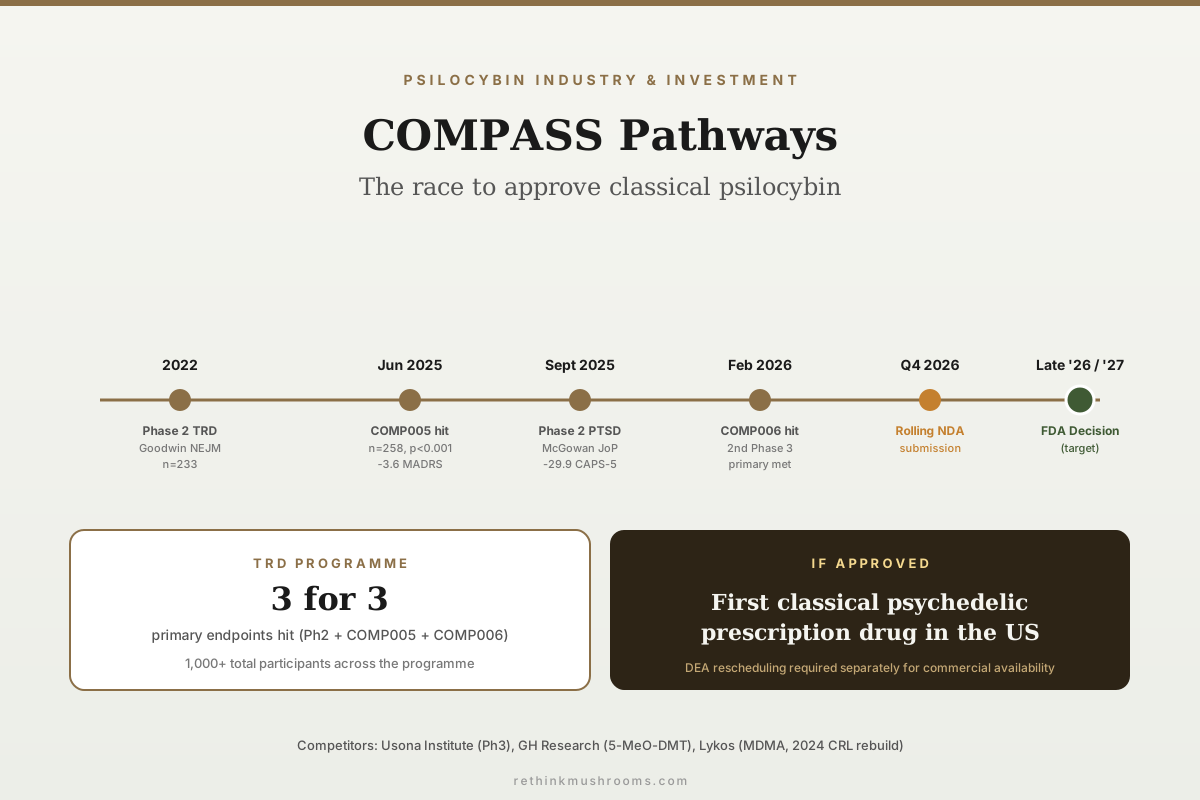
3 for 3 on Primary Endpoints
Compass Pathways has hit primary endpoints in two Phase 3 treatment-resistant depression trials (COMP005 in June 2025, COMP006 in February 2026) and one published Phase 2 PTSD trial. Over 1,000 participants enrolled. Rolling NDA submission targeted for Q4 2026, with potential FDA approval decision by late 2026 or early 2027. If approved, COMP360 becomes the first classical psychedelic cleared as a prescription drug in the US.
Compass Pathways press releases, 2025–2026; Goodwin et al., NEJM 2022
-3.6 MADRS
COMP005 Phase 3 primary endpoint: 25 mg COMP360 versus placebo, p<0.001, 258 participants across 32 US sites
26-week durability
COMP005 participants with meaningful response at week 6 maintained effect through week 26 after one or two doses
1,000+ participants
total across Compass's Phase 2 and Phase 3 TRD and PTSD programmes enrolled to date
Compass Pathways press releases, 2025–2026; Goodwin et al., NEJM 2022
 View as image ↗
Compass Pathways has spent a decade positioning itself to be the company that brings classical psilocybin to FDA approval as a prescription drug. Two successful Phase 3 treatment-resistant depression trials, a published Phase 2 PTSD trial, a rolling NDA submission targeted for Q4 2026, and a potential FDA decision by late 2026 or early 2027 now define the approval runway.[1] If it clears, COMP360 becomes the first classical psychedelic approved as a prescription medication in the US and, by most accounts, globally. For the specific PTSD Phase 2 data, see comp360 for ptsd: compass pathways trial results. For the broader industry picture, see the psilocybin industry: investment, companies, and future outlook.
Key Takeaways
- Compass's Phase 2 treatment-resistant depression trial (Goodwin et al., 2022, NEJM, n=233) established dose-response with 25 mg producing the largest and most durable MADRS reduction versus 10 mg and 1 mg comparator arms, anchoring the Phase 3 dose selection
- COMP005, the first Phase 3 trial (n=258, 32 US sites, reported June 2025), met its primary endpoint with a -3.6-point MADRS mean treatment difference versus placebo (95% CI -5.7 to -1.5, p<0.001) at week 6 for a single 25 mg COMP360 dose
- COMP006, the second Phase 3 trial, met its primary endpoint in February 2026, confirming the TRD efficacy signal
- 26-week durability data from COMP005 showed participants with clinically meaningful response at week 6 maintained response through week 26 after one or two doses, establishing the durability profile needed for commercial positioning
- A Phase 2 PTSD trial (McGowan et al., 2025, Journal of Psychopharmacology, n=22) produced a 29.9-point CAPS-5 reduction at week 4 from a severe-category baseline of 47.5, sustained at 29.5 points at week 12, with zero serious adverse events
- FDA acceptance of the Compass PTSD IND application was announced in 2026, clearing the path to Phase 3 PTSD trials; TRD remains the lead indication
- The FDA approval pathway is a rolling NDA submission targeted for Q4 2026 with a potential approval decision in late 2026 or early 2027, 9 to 12 months earlier than previously guided
Where Compass Sits in the Psychedelic Drug Development Landscape
Compass Pathways was founded in 2016 and went public on NASDAQ in 2020 (ticker CMPS). Its central asset is COMP360, a proprietary synthetic psilocybin formulation manufactured under pharmaceutical good manufacturing practice. The molecule is chemically identical to naturally produced psilocybin but is source-, purity-, and batch-controlled at drug-approval standards. Compass holds method-of-use patents around COMP360 administration protocols and has pursued a classical pharmaceutical drug development path (FDA-approvable indications, randomised controlled trials, manufacturing standardisation, regulatory submissions) rather than a botanical supplement or retreat-industry path.
The competitive context shifted in 2024 when FDA issued a Complete Response Letter to Lykos Therapeutics (MAPS-spinout) on its MDMA-assisted therapy for PTSD submission, requiring additional data. That decision reshaped the psychedelic drug development landscape: MDMA-assisted therapy, which had been ahead of psilocybin in the regulatory queue, fell back. Compass's psilocybin programme, with its Phase 3 TRD trials then in progress, became the likely first classical psychedelic to reach US approval. This regulatory repositioning is what the "race" framing captures.
The Phase 2 TRD Foundation
The Goodwin et al. (2022) trial published in the New England Journal of Medicine is the scientific anchor for everything Compass has built since.[2] The trial enrolled 233 treatment-resistant depression patients across 22 sites in 10 countries. Participants were randomised to receive a single dose of 1 mg, 10 mg, or 25 mg COMP360 alongside protocolised psychological support. MADRS (Montgomery-Åsberg Depression Rating Scale) change from baseline at week 3 was the primary endpoint.
The 25 mg arm produced the largest effect, with mean MADRS difference of -6.6 points versus the 1 mg comparator at week 3 (95% CI -10.2 to -2.9, p<0.001). The 10 mg arm did not separate statistically from the 1 mg arm. Approximately 29% of 25 mg participants met the sustained-response criterion through week 12. Serious adverse events were reported in 5 of 79 patients in the 25 mg arm and included suicidal ideation and intentional self-injury, which attracted public attention and shaped subsequent trial safety protocols.
Two features of this Phase 2 result are important for understanding Compass's overall trajectory:
-
The 1 mg arm was more than a placebo. In a pure placebo-controlled design, the expected effect in the placebo arm would be smaller than what was observed in the 1 mg arm. The 1 mg dose is below any pharmacological threshold for meaningful psilocybin effect but produced substantial MADRS improvement. This established that expectancy, therapeutic alliance, and the clinical support protocol collectively generate a large "active placebo" signal in Compass's trial infrastructure, which shaped Phase 3 design choices.
-
Dose-response established 25 mg as the Phase 3 dose. Phase 3 uses a single-arm 25 mg versus placebo design rather than dose-range escalation because Phase 2 already selected the dose.
The Phase 3 TRD Data
COMP005 (first Phase 3 trial) enrolled 258 TRD patients across 32 US sites. The trial design was randomised, double-blind, placebo-controlled, comparing a single dose of 25 mg COMP360 against placebo for primary endpoint of MADRS change at week 6. Results reported in June 2025 met the primary endpoint with a -3.6-point mean treatment difference (95% CI -5.7 to -1.5, p<0.001).[3]
The -3.6-point MADRS mean treatment difference is smaller in absolute magnitude than the Phase 2 mean difference, which is a pattern commonly observed when a Phase 2 dose-escalation signal converts to a Phase 3 placebo-controlled design. What matters regulatorily is that the difference is statistically significant at conventional thresholds and that the clinical response rate (defined as ≥25% MADRS reduction in COMP005) was observed in 25% of 25 mg arm participants.
COMP006 (second Phase 3 trial) met its primary endpoint in February 2026, reporting concordant results. The "3 for 3 on primary endpoints" framing Compass has used publicly refers to Phase 2 TRD + COMP005 + COMP006. Durability data from COMP005 through 26 weeks showed that participants with clinically meaningful response at week 6 maintained that response through week 26 after one or two doses, which is the durability profile Compass needs to position COMP360 commercially against existing TRD options (electroconvulsive therapy, ketamine/esketamine, transcranial magnetic stimulation).
The PTSD Programme
Compass's PTSD programme is one step behind the TRD programme. The Phase 2 open-label PTSD trial by McGowan et al. (2025) was discussed in depth in comp360 for ptsd: compass pathways trial results.[4] The short summary: 22 PTSD patients, single 25 mg dose, CAPS-5 reduction of 29.9 points at week 4 sustained to week 12, zero serious adverse events, zero withdrawals.
Compass announced FDA acceptance of its PTSD IND application in early 2026, which is the procedural step required to run US Phase 3 trials in that indication. The PTSD Phase 3 programme design is in finalisation with FDA consultation. The time lag between TRD approval (targeted late 2026 / early 2027) and any PTSD approval is likely several years because Phase 3 PTSD trials have not yet started enrolling.
The Rolling NDA and the Approval Timeline
Compass is targeting a rolling NDA submission in Q4 2026. A rolling submission is a regulatory mechanism available under priority-review and fast-track designations that lets a sponsor submit sections of the New Drug Application as they become ready rather than submitting all sections at once. FDA reviews sections as they arrive. This accelerates the review clock and is a meaningful indicator that the regulatory path is relatively clear: FDA generally reserves rolling submission for programmes with breakthrough designation or fast-track designation, both of which Compass holds for COMP360.
Compass has publicly guided to a potential FDA approval decision in late 2026 or early 2027, pulled forward 9 to 12 months from its previous guidance. The pull-forward reflects the Phase 3 data readout timing and the FDA's pace on Phase 3 data review. The commercial launch-ready timeline runs parallel, targeting end-of-2026 readiness to deploy quickly if approval arrives in that window.
What "Approval" Would and Would Not Mean
If COMP360 is approved by FDA, several things happen:
What approval would mean. COMP360 becomes a legally prescribable medication in the US for the approved indication (TRD) under a Risk Evaluation and Mitigation Strategy (REMS) that will define who can prescribe, where patients can be dosed, and what training and facility certification are required. Insurance coverage decisions follow approval; reimbursement for psychedelic-assisted therapy has no direct precedent in the US system, and coverage dynamics will be determined by payer-by-payer negotiation and cost-effectiveness analyses.
What approval would not mean. It would not automatically change the Schedule I status of psilocybin under the Controlled Substances Act. The DEA would need to reschedule psilocybin, a regulatory action that typically follows FDA approval but is not guaranteed. Rescheduling logistics could delay commercial availability by months. It would also not apply to generic psilocybin or psilocybin from natural sources; only COMP360 under Compass's manufacturing and distribution framework would be approved.
What approval would not resolve. The Phase 3 effect size (-3.6 MADRS points versus placebo) is statistically robust but modest compared to the Phase 2 open-label magnitude, and is in the same effect-size range as approved antidepressants. Whether COMP360 offers a durability advantage (one or two doses producing 26-week response) that justifies the cost and logistics of the administration protocol is a clinical and health economics question the post-approval evidence will have to resolve.
Competitors and the Post-Approval Landscape
Compass has a multi-year lead on classical psilocybin approval, but the post-approval landscape includes several competitors and adjacent approaches:
Usona Institute, the nonprofit psilocybin research organisation, has a parallel Phase 3 TRD trial with a different psilocybin formulation and non-commercial orientation. For more on Usona's distinctive positioning, see usona institute: the nonprofit driving psilocybin research.
atai Life Sciences, Compass's parent shareholder and partner, has multiple psychedelic assets in development beyond COMP360. The Compass-atai relationship has evolved over time and was restructured in 2024.
MAPS / Lykos Therapeutics has MDMA-assisted therapy in a regulatory rebuild after the 2024 CRL. MDMA is not a classical psychedelic and does not compete directly with Compass on mechanism, but it competes for the "psychedelic-assisted therapy" market category.
GH Research is developing 5-MeO-DMT for TRD, an alternative classical psychedelic with a shorter acute experience duration (roughly 30 minutes versus 4 to 6 hours for psilocybin) that could change administration economics significantly if approved.
For the broader funding environment, see psychedelic venture capital: where the money is going.
What Compass Still Has to Clear
The items between now and commercial availability include:
- Complete NDA submission. Sections still being prepared include nonclinical safety summaries, manufacturing and chemistry-manufacturing-controls (CMC) documentation, and integrated clinical safety analyses.
- FDA review. Priority review timelines are 6 months from acceptance; standard review is 10 months. Rolling submission may compress this further.
- Advisory committee meeting. FDA may convene a Psychopharmacologic Drugs Advisory Committee (PDAC) meeting to discuss the data, as occurred for the MDMA-assisted therapy review in 2024. The advisory committee vote is not binding on FDA but historically predicts the outcome.
- REMS design. The Risk Evaluation and Mitigation Strategy for COMP360 will need to define prescriber certification, site certification, patient enrollment, and post-session monitoring. REMS design is intensive for psychedelic-assisted therapy because the administration protocol is more complex than for ordinary prescription medications.
- DEA rescheduling. Commercial availability requires DEA action to reschedule psilocybin out of Schedule I.
- Commercial readiness. Provider training programmes, facility certification infrastructure, payer contracting, and supply chain scaling all need to be in place at launch.
The Bottom Line
Compass Pathways has positioned itself as the likely first company to bring classical psilocybin (COMP360, a synthetic psilocybin formulation) to FDA approval. The programme is built on two successful Phase 3 treatment-resistant depression trials (COMP005 in June 2025, COMP006 in February 2026), one published Phase 2 PTSD trial (McGowan et al., 2025), and the Phase 2 TRD foundation in NEJM (Goodwin et al., 2022). Over 1,000 participants have enrolled across the programme. Compass is targeting a rolling NDA submission in Q4 2026 with a potential FDA decision in late 2026 or early 2027. If approved, COMP360 becomes the first classical psychedelic prescription medication in the US and globally. Approval would not automatically reschedule psilocybin under DEA controlled-substance law, would apply only to the COMP360 formulation under Compass's manufacturing and distribution framework, and would not resolve open questions about real-world cost-effectiveness versus existing TRD options. Competitors include Usona Institute (nonprofit TRD psilocybin), GH Research (5-MeO-DMT), and Lykos Therapeutics (MDMA-assisted therapy, in regulatory rebuild after the 2024 FDA Complete Response Letter). The approval timing and commercial launch position Compass as the reference point for how classical psychedelic drug development clears the US regulatory system.
Frequently Asked Questions
Sources & References
- 2RTHM-00761·Goodwin, Guy M et al. (2022). “Single-Dose Psilocybin for a Treatment-Resistant Episode of Major Depression..” The New England journal of medicine.Study breakdown →PubMed →↩
- 4RTHM-00941·McGowan, Niall M et al. (2025). “Investigating the safety and tolerability of single-dose psilocybin for post-traumatic stress disorder: A nonrandomized open-label clinical trial..” Journal of psychopharmacology (Oxford.Study breakdown →PubMed →↩
Sources
- Compass Pathways investor announcements, 2025–2026, including COMP005 Phase 3 results (June 2025), COMP006 Phase 3 results (February 2026), Third Quarter 2025 business highlights, and FDA IND acceptance for PTSD.
- Goodwin et al., "Single-Dose Psilocybin for a Treatment-Resistant Episode of Major Depression," New England Journal of Medicine, 2022 (Phase 2, n=233).
- Compass Pathways press release, "Successfully Achieves Primary Endpoint in First Phase 3 Trial Evaluating COMP360 Psilocybin for Treatment-Resistant Depression," June 2025.
- McGowan et al., "Investigating the safety and tolerability of single-dose psilocybin for post-traumatic stress disorder: A nonrandomized open-label clinical trial," Journal of Psychopharmacology, 2025.
- BioPharma Dive, STAT News, Psychiatric Times, Clinical Trials Arena, and Psychedelic Alpha coverage of Phase 3 data releases and regulatory milestones.